Bankless Founder: By 2026, Tokens Will Finally Be Treated as 'Equity'

marsbitPubblicato 2026-02-03Pubblicato ultima volta 2026-02-03

Introduzione

Bankless co-founder David Hoffman argues that most tokens are treated poorly compared to equity, leading to low market valuations. However, 2026 marks a shift with innovative token distribution models. MegaETH locks 53% of its MEGA tokens in a KPI-based program, where tokens unlock only if specific growth targets—like TVL, decentralization progress, and performance metrics—are met. This aligns dilution with actual ecosystem growth and distributes new tokens to long-term stakers, reducing sell pressure. Meanwhile, Cap protocol replaces traditional airdrops with a "stabledrop," distributing stablecoins (cUSD) instead of governance tokens to users. Those seeking CAP tokens must participate in a public sale, ensuring holders are committed investors. These models move away from indiscriminate token distribution toward targeted, conditional mechanisms that reward genuine participation and long-term alignment, potentially improving token value and holder quality.

Author: David Hoffman

Compiled by: Deep Tide TechFlow

Deep Tide Introduction: Are most tokens garbage? Bankless co-founder David Hoffman points out that historically, teams have treated tokens far less seriously than equity, and the market has responded to this through token prices.

But 2026 saw a turning point:

MegaETH locked 53% of its tokens in a KPI plan, which only unlocks upon achieving growth targets;

The Cap protocol replaced governance token airdrops with stablecoin airdrops, allowing only real investors to obtain CAP through token sales.

These innovative strategies are ending the era of "spray-and-pray" token distribution, shifting towards precise, conditional allocation mechanisms.

Full text as follows:

The crypto industry has a "good coins problem".

Most tokens are garbage.

Most tokens are not treated with the same legal and strategic seriousness as equity by their teams. Because teams have historically not given tokens the same respect as equity in traditional companies, the market has reflected this in token prices.

Today I want to share two sets of data that make me optimistic about the state of tokens in 2026 and beyond:

  1. MegaETH's KPI Plan
  2. Cap's Stablecoin Airdrop (Stabledrop)

Conditional Token Supply

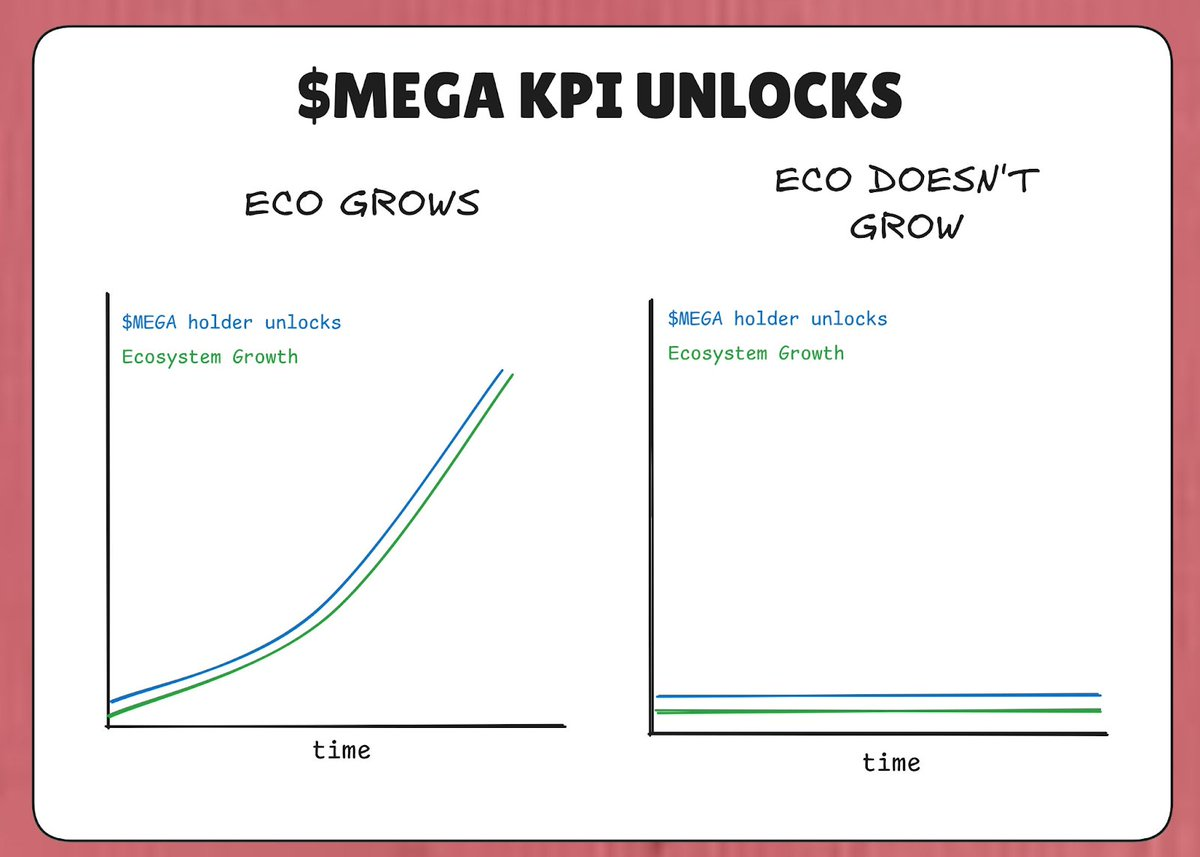
MegaETH has locked 53% of the total MEGA token supply in a "KPI Plan". The logic is: if MegaETH does not achieve its KPIs (Key Performance Indicators), these tokens will not unlock.

Therefore, in a pessimistic scenario where the ecosystem does not grow, at least no additional tokens flood the market to dilute holders. MEGA tokens only enter the market when the MegaETH ecosystem actually achieves growth (as defined by the KPIs).

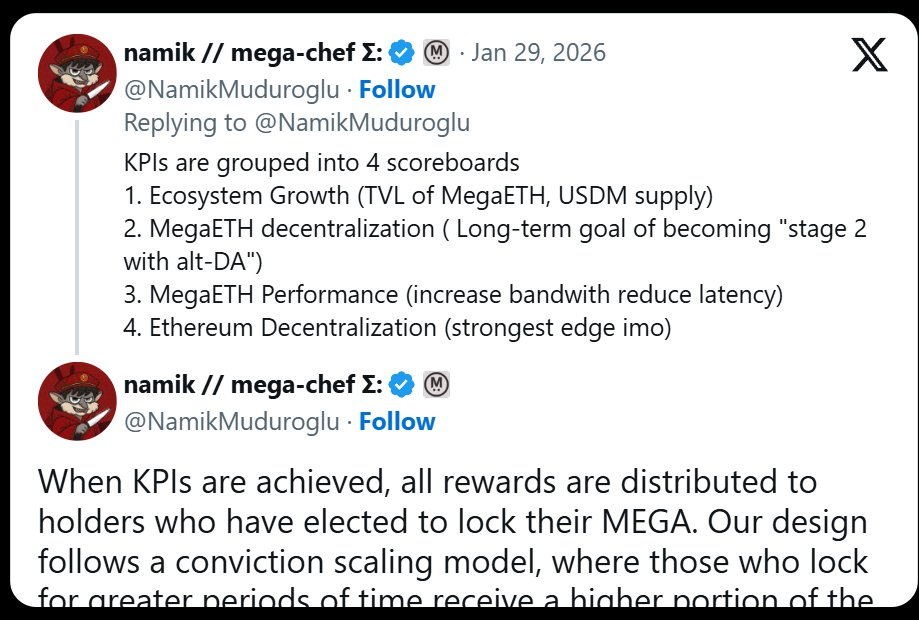
The KPIs for this plan are divided into 4 scoreboards:

  1. Ecosystem Growth (TVL, USDM supply)
  2. MegaETH Decentralization (L2Beat stage progress)
  3. MegaETH Performance (IBRL)
  4. Ethereum Decentralization

Thus, in theory, as MegaETH achieves its KPI targets, the value of MegaETH should grow correspondingly, mitigating the negative price impact of MEGA dilution on the market.
This strategy is very similar to Tesla's "pay for performance" compensation philosophy for Elon Musk. In 2018, Tesla granted Musk an equity compensation package that vested in tranches, only payable if Tesla simultaneously achieved increasing market capitalization targets and revenue targets. Elon Musk only gets paid if Tesla's revenue grows AND its market capitalization grows.

MegaETH is trying to transplant the same logic into its tokenomics. "More supply" is not a given—it's something the protocol must earn by scoring real points on meaningful scoreboards.

Unlike Musk's Tesla benchmarks, I don't see anything in Namik's KPI targets about MEGA market cap as a KPI target—perhaps for legal reasons. But as a public MEGA investor, this KPI is very interesting to me. 👀

Who Gets the Unlock Matters

Another interesting factor of this KPI plan is: who gets the MEGA when KPIs are met. According to Namik's tweet, the recipients of the unlocked MEGA are those who stake MEGA into the locking contract.

Those who lock more MEGA for longer periods receive a larger share of the 53% MEGA tokens entering the market.
The logic behind this is simple: allocate MEGA dilution to those who have already proven themselves as MEGA holders and are interested in holding more MEGA—those least likely to become MEGA sellers.

Alignment and Trade-offs

It's worth emphasizing that this also introduces risks. We have seen historical cases where similar structures went seriously wrong. Look at this excerpt from Cobie's article: "(content)"
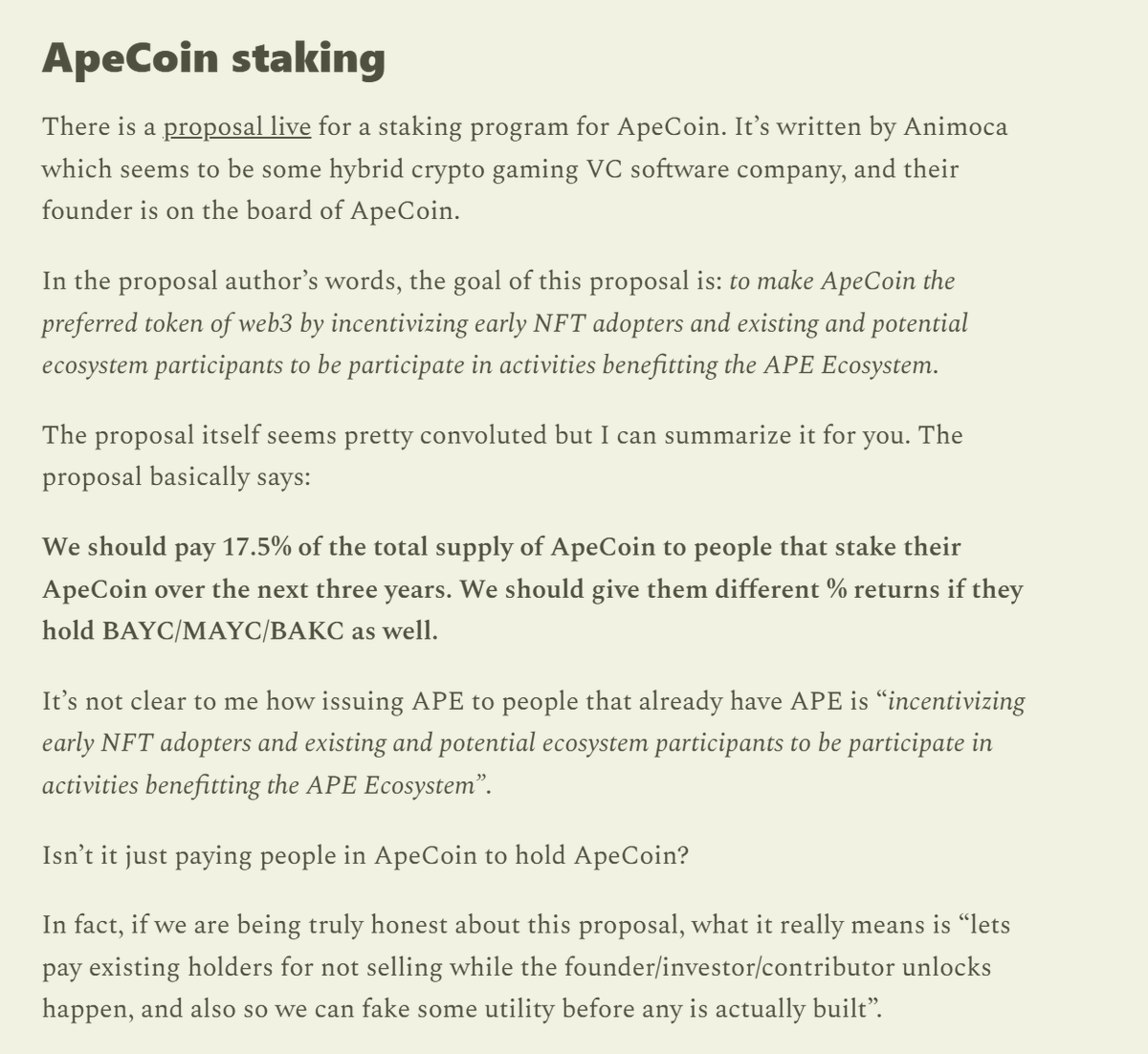
If you are a token pessimist, a crypto nihilist, or just bearish, this alignment problem is what you worry about.

Or, from the same article: "Staking mechanisms should be designed to support the goals of the ecosystem"
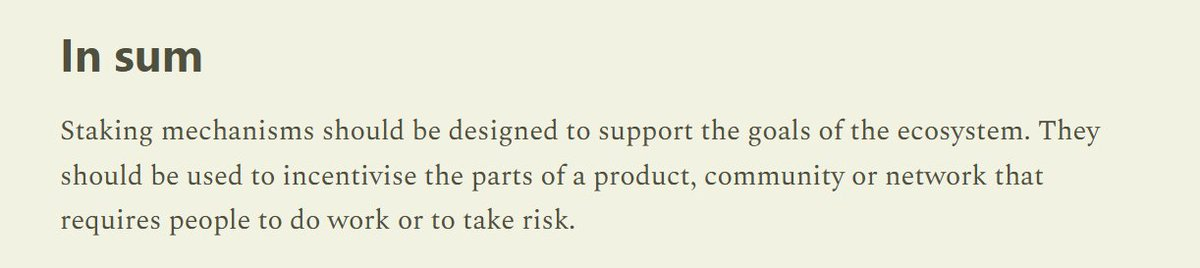
Locking token dilution behind KPIs that should actually reflect growth in the value of the MegaETH ecosystem is a much better mechanism than any vanilla staking mechanism we saw in the 2020-2022 liquidity mining era. In that era, tokens were being issued regardless of the team's fundamental progress or ecosystem growth.

Therefore, the net effect is that MEGA dilution is:

  • Conditionally constrained by corresponding MegaETH ecosystem growth
  • Diluted into the hands of those least likely to sell MEGA

This does not guarantee that MEGA value will rise as a result—the market will do what the market wants. But it is an effective and honest attempt to fix a core underlying problem that seems to plague the entire crypto token industrial complex.

Treating Tokens as Equity

Historically, teams have been "spraying and praying" their tokens across the ecosystem. Airdrops, mining rewards, grants, etc.—teams would not engage in these activities if they were distributing something truly valuable.

Because teams distributed tokens like worthless governance tokens, the market priced them as worthless governance tokens.

You can see the same philosophy in MegaETH's stance on CEX listings after Binance opened MEGA token futures on its platform (historically Binance's attempt to extort teams):
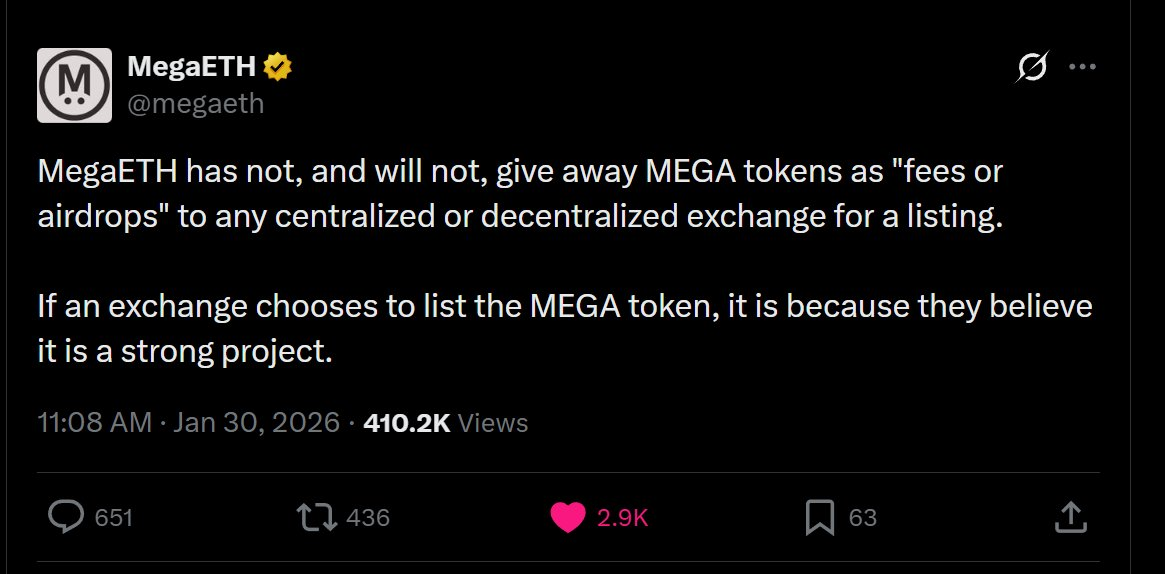
Hopefully, teams will start being more selective with their token distribution. If teams start treating their tokens as precious, perhaps the market will respond in kind.

Cap's Stablecoin Airdrop

The stablecoin protocol Cap introduced a "stablecoin airdrop" (stabledrop) instead of a traditional airdrop. Instead of airdropping the native governance token CAP, they distributed the native stablecoin cUSD to users who earned Cap points.

This approach rewards points farmers with real value, thus fulfilling the social contract. Users who deposited USDC into Cap's supply side accepted smart contract risk and opportunity cost, and the stablecoin airdrop compensated them accordingly.

For those who want CAP itself, Cap is conducting a token sale via a Uniswap CCA. Anyone seeking CAP tokens must become a real investor and commit real capital.

Filtering for Committed Holders

The combination of a stablecoin airdrop plus a token sale filters for committed holders. A traditional CAP airdrop would flow to speculative farmers likely to sell immediately. By requiring a capital investment through the token sale, Cap ensures CAP flows to participants willing to accept full downside risk for upside potential—a group more likely to hold long-term.

The theory is that this structure gives CAP a higher probability of success by creating a concentrated holder base aligned with the protocol's long-term vision, rather than a less precise airdrop mechanism that puts tokens into the hands of those focused solely on short-term profits.

Watch this video:

https://x.com/DeFiDave22/status/2013641379038081113

Token Design is Maturing

Protocols are getting smarter and more precise with their token distribution mechanisms. No more shotgun spray-and-pray token issuance—MegaETH and Cap are choosing to be highly selective about who gets their tokens.

"Optimizing for distribution" is no longer the thing—perhaps a toxic hangover from the Gensler era. Instead, these two teams are optimizing for concentration to provide a stronger foundational holder base.

I hope that as more apps launch in 2026, they can observe and learn from these strategies, and even improve upon them, so the "good coins problem" is no longer a problem, and we are left with only "good coins".


Crypto di tendenza

Domande pertinenti

QWhat is the 'good coins problem' mentioned in the article, and why does it exist?

AThe 'good coins problem' refers to the issue that most tokens are considered garbage because they haven't been treated with the same legal and strategic seriousness as equity by teams. Historically, teams did not respect tokens as much as equity in traditional companies, and the market reflected this through token prices.

QHow does MegaETH's KPI plan work to conditionally unlock its tokens?

AMegaETH locks 53% of its MEGA tokens in a 'KPI plan,' where tokens only unlock if specific Key Performance Indicators are met. These KPIs include ecosystem growth (TVL, USDM supply), MegaETH decentralization (L2Beat stage progress), MegaETH performance (IBRL), and Ethereum decentralization. This ensures tokens enter the market only when real growth occurs, reducing dilution for holders.

QWhat is Cap Protocol's 'stabledrop' and how does it differ from traditional airdrops?

ACap Protocol's 'stabledrop' distributes its native stablecoin cUSD to users who earned Cap points, instead of airdropping the governance token CAP. This rewards users with real value for their participation. Those who want CAP tokens must become real investors by purchasing them through a Uniswap CCA token sale, ensuring committed holders.

QWhy does the article suggest that token design is evolving towards more selective distribution mechanisms?

AToken design is evolving because teams like MegaETH and Cap are moving away from 'spray-and-pray' distribution methods (e.g., indiscriminate airdrops) to highly selective mechanisms. These strategies, such as KPI-based unlocks and stabledrops, aim to distribute tokens only to committed holders, aligning incentives and creating a stronger base for long-term success.

QHow does MegaETH's approach to token distribution resemble Elon Musk's Tesla compensation plan?

AMegaETH's KPI plan is similar to Elon Musk's Tesla compensation philosophy, where Musk's equity grants vested only when Tesla achieved increasing market cap and revenue targets. Similarly, MegaETH's tokens unlock only when the protocol meets specific growth and performance KPIs, tying token issuance to tangible ecosystem progress.

Letture associate

UNI Doubles in Two Months Against the Trend: A 5-Year-Overdue Value Realization

Amidst a generally stagnant crypto market in June and July, UNI, the governance token of Uniswap, saw a significant surge, nearly doubling in price from around $2.3 to $4.6. This rally represents a delayed but significant value reassessment, triggered by the practical implementation of its long-debated "fee switch" mechanism. The key turning point was the on-chain execution of the UNIfication proposal in December 2025. It activated a protocol fee on select pools, directed Unichain sequencer revenue (net of costs) to a communal treasury, executed a one-time burn of 100 million UNI, and established a system where all protocol revenue flows into a "TokenJar" contract. This treasury has a single exit: purchasing and permanently burning UNI via a "Firepit" contract. Initially, the market reacted tepidly as the generated revenue and corresponding burn rate were modest. The narrative shifted dramatically in July 2025 with two major developments. First, the launch of Robinhood Chain, tailored for tokenized stocks, rapidly became a primary source of volume and fees for Uniswap, at one point contributing nearly half of its weekly fees. Second, governance votes successfully expanded the fee mechanism to v4 pools and initiated a temperature check for fees on Robinhood Chain. The activation of v4 fees caused the protocol's daily revenue earmarked for UNI burns to nearly triple. The core of UNI's recent price action is the transition from a pure governance token to a cash-flow asset with a permanent, protocol-funded buyer. Its effectiveness is amplified by UNI's mature and widely distributed supply, with no major impending unlocks to dilute the impact of the buybacks. The sustainability of this rally now hinges on whether the transaction volume, particularly on Robinhood Chain, persists after its initial gas subsidies expire, determining if this is a genuine value realization or a subsidy-fueled spike.

marsbit1 h fa

UNI Doubles in Two Months Against the Trend: A 5-Year-Overdue Value Realization

marsbit1 h fa

Breaking: Google Earth Urgently Pulls Back Nano Banana 2 Image Generation Feature!

Google Earth's newly launched "Create image" feature, powered by the Nano Banana 2 AI image generation model, was abruptly withdrawn shortly after its release due to being "played" by users. The feature allowed users to generate and overlay AI-created visuals directly onto real-world satellite and 3D maps in Google Earth. The tool enabled creative applications like historical recreations (e.g., visualizing ancient Pompeii), generating informational graphics for landmarks, and envisioning architectural projects or futuristic cityscapes on real terrain. It operated under "geospatial grounding," meaning the AI respected the underlying geography, topography, and perspective of the chosen map view. The model also integrated with Gemini to retrieve relevant factual information. However, upon release, users quickly tested its limits. A prominent example involved reimagining Philadelphia's historic Independence Hall as a post-apocalyptic ruin overrun by "happy" zombies, evil clowns, and giant alien mechs. This highlighted both the feature's playful potential and its risks regarding the generation of inappropriate or misleading content on realistic maps, leading to its swift temporary removal. Google stated it would re-release the feature after implementing "enhanced guardrails." Analysts note this move strategically leverages Google's vast proprietary geospatial data, positioning its AI not just for artistic generation but for spatially accurate world visualization—a unique advantage in the competitive AI image generation landscape.

marsbit2 h fa

Breaking: Google Earth Urgently Pulls Back Nano Banana 2 Image Generation Feature!

marsbit2 h fa

Altman Admits: Overestimated AI Snatching Jobs! Huang Renxun: The Unemployment Narrative Is Completely Backwards

Sam Altman has revised his earlier predictions about AI rapidly replacing jobs, admitting he overestimated the speed at which AI would eliminate entry-level white-collar roles. Speaking on the "Invest Like the Best" podcast, he stated that people do not truly want an AI CEO, as accountability and human connection remain critical. He found that individuals prefer interacting with people who can be held responsible for decisions. Similarly, NVIDIA's Jensen Huang argued that the narrative of AI destroying jobs is misguided. He distinguishes between tasks and jobs, noting that while AI can automate specific tasks, entire jobs—encompassing communication, judgment, coordination, and accountability—are not eliminated. He cited examples like radiologists and software engineers, where demand for these roles has increased as AI handles repetitive tasks, allowing for business expansion and the creation of more positions. Data from a University of Maryland and LinkUp study supports this, showing that U.S. job postings for new graduates have actually risen, countering the fear of vanishing entry-level roles. However, a significant shift is occurring: the traditional entry-level tasks that help newcomers gain experience are being automated, making initial career access more challenging. The key insight is that as AI takes over standardized tasks, the enduring value of human work shifts toward areas of responsibility, trust-building, and final decision-making—aspects that AI cannot replicate. The real "moat" for professionals lies in these irreplaceable human elements.

marsbit3 h fa

Altman Admits: Overestimated AI Snatching Jobs! Huang Renxun: The Unemployment Narrative Is Completely Backwards

marsbit3 h fa

Trading

Spot

Articoli Popolari

Come comprare AR

Benvenuto in HTX.com! Abbiamo reso l'acquisto di Arweave (AR) semplice e conveniente. Segui la nostra guida passo passo per intraprendere il tuo viaggio nel mondo delle criptovalute.Step 1: Crea il tuo Account HTXUsa la tua email o numero di telefono per registrarti il tuo account gratuito su HTX. Vivi un'esperienza facile e sblocca tutte le funzionalità,Crea il mio accountStep 2: Vai in Acquista crypto e seleziona il tuo metodo di pagamentoCarta di credito/debito: utilizza la tua Visa o Mastercard per acquistare immediatamente ArweaveAR.Bilancio: Usa i fondi dal bilancio del tuo account HTX per fare trading senza problemi.Terze parti: abbiamo aggiunto metodi di pagamento molto utilizzati come Google Pay e Apple Pay per maggiore comodità.P2P: Fai trading direttamente con altri utenti HTX.Over-the-Counter (OTC): Offriamo servizi su misura e tassi di cambio competitivi per i trader.Step 3: Conserva Arweave (AR)Dopo aver acquistato Arweave (AR), conserva nel tuo account HTX. In alternativa, puoi inviare tramite trasferimento blockchain o scambiare per altre criptovalute.Step 4: Scambia Arweave (AR)Scambia facilmente Arweave (AR) nel mercato spot di HTX. Accedi al tuo account, seleziona la tua coppia di trading, esegui le tue operazioni e monitora in tempo reale. Offriamo un'esperienza user-friendly sia per chi ha appena iniziato che per i trader più esperti.

676 Totale visualizzazioniPubblicato il 2024.12.11Aggiornato il 2026.06.02

Come comprare AR

Discussioni

Benvenuto nella Community HTX. Qui puoi rimanere informato sugli ultimi sviluppi della piattaforma e accedere ad approfondimenti esperti sul mercato. Le opinioni degli utenti sul prezzo di AR AR sono presentate come di seguito.

活动图片