Australia Interest Rate Hike Fears Influence $BMIC Macro Investment Tones

bitcoinistPubblicato 2026-02-09Pubblicato ultima volta 2026-02-09

Introduzione

The Reserve Bank of Australia (RBA) has raised the cash rate by 25 basis points to 3.85%, signaling a hawkish stance amid persistent inflation and a tight labor market. This contrasts with other major central banks and reflects a 'higher for longer' interest rate environment. The tightening monetary policy is driving investors toward secure, utility-focused assets rather than speculative ones. A key emerging risk is the 'Harvest Now, Decrypt Later' threat, where encrypted data is collected now to be decrypted later using quantum computing. This has increased interest in quantum-resistant cryptographic infrastructure. BMIC ($BMIC) is highlighted as a project offering a post-quantum financial stack that eliminates public key exposure risks, using AI-enhanced threat detection and ERC-4337 Smart Accounts. The project has raised over $444K in its presale, indicating investor confidence in quantum-proof blockchain solutions as essential future-proof infrastructure.

Trusted Editorial content, reviewed by leading industry experts and seasoned editors. Ad Disclosure

Quick Facts:

  • ➡️ The RBA’s hawkish stance creates a high-rate environment that forces investors to prioritize utility and security over speculative assets.
  • ➡️ ‘Harvest Now, Decrypt Later’ threats are driving capital toward infrastructure that can withstand future quantum computing attacks.
  • ➡️ The shift from legacy encryption to quantum-proof standards represents a critical infrastructure upgrade for the entire blockchain industry.
  • ➡️ BMIC ($BMIC) offers a post-quantum financial stack that eliminates public key exposure risks.

The Reserve Bank of Australia (RBA) has solidified its position as a global hawkish outlier by raising the cash rate by 25 basis points to 3.85%. This decision marks the first increase since 2023, driven by heightened concerns over a resurgence in inflation and a consistently tight labor market.

While peers like the Federal Reserve and European Central Bank explored easing cycles earlier in the year, the RBA’s latest move signals a ‘higher for longer’ regime, with market pricing now implying two additional hikes may follow before the end of 2026.

Global Market Divergence and Capital Flight

This domestic tightening arrives amidst significant global volatility. While the RBA pivots toward further restrictions, other major economies present a mixed bag of resilience and risk:

  • Central bank disparity: The ECB held its deposit rate at 2.00% as eurozone inflation dipped to 1.7%, while the Bank of England maintained rates at 3.75% despite downward growth revisions.
  • Equity market turmoil: US software stocks faced a brutal 7.5% weekly decline due to fears of AI disruption from next-gen agents like Claude Cowork, dragging the Nasdaq 100 down by 1.9%.
  • Asian retreat: The Hang Seng Index retreated 3.0% as investors reassessed stretched valuations in the chipmaking and tech sectors.

This mixed bag makes investors want security. As legacy cryptographic standards show fragility under macro stress, sophisticated investors are rotating toward infrastructure plays that address systemic security threats. The thesis is moving rapidly from raw accumulation to asset preservation, highlighting the value of protocols like BMIC ($BMIC) and its quantum-secure financial stack as a sanctuary for smart money seeking technological utility over pure speculation.

Hawkish Policy Drives Demand For Quantum-Proof Infrastructure

Connecting Australian interest rates to quantum security might sound like a stretch (at first glance), but the logic is rooted in cold, hard risk management. When central banks tighten the screws, the margin for error in investment portfolios vanishes. Institutional and enterprise-grade investors begin to price in ‘tail risks,’ those low-probability, high-impact nightmares that could wipe out value instantly.

Right now, the biggest unpriced risk in the market is the ‘Harvest Now, Decrypt Later’ threat. State actors and malicious entities are vacuuming up encrypted blockchain data today, just waiting for quantum computers to mature enough to break the standard elliptic curve cryptography (ECC) protecting nearly every wallet. The RBA’s restrictive policy forces capital efficiency; there is simply no room for assets that could become obsolete or vulnerable within the decade. It’s this that makes $BMIC one of the best crypto to watch. 

BMIC tackles this head-on. It deploys the only platform offering wallet, staking, and payments protected by post-quantum cryptography. Unlike legacy wallets that rely on key generation that could eventually be cracked, BMIC uses zero public-key exposure and AI-enhanced threat detection.
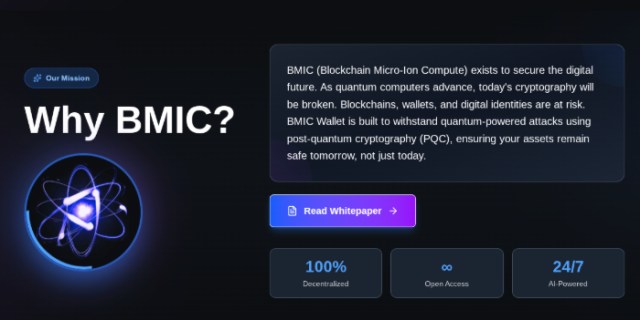
For investors navigating a tightening macro environment, this represents an infrastructure hedge. It suggests that while market volatility fluctuates with rate announcements, the fundamental need for a Quantum Meta-Cloud that secures digital sovereignty is interest-rate agnostic. Plus, the project’s use of ERC-4337 Smart Accounts cements this utility, allowing for a user experience that bridges the gap between complex security protocols and everyday usability.

EXPLORE THE BMIC SECURITY PACKAGE

Smart Money Rotation Visible In $433k Presale Data

While broader market sentiment remains jittery due to macro headwinds, capital flows into the BMIC ecosystem tell a different story. According to live commercial data, the project has successfully raised $444K, with the token currently priced at $0.049474.

This capital injection during a liquidity crunch is significant. It suggests investors are distinguishing between speculative vaporware and necessary infrastructure. The presale metrics indicate early positioning before the ‘quantum threat’ narrative hits the mainstream financial news cycle.

The tokenomics structure supports this long-term view: $BMIC isn’t just a speculative vehicle; it serves as ecosystem fuel for the Quantum Meta-Cloud, offering utility in governance and ‘burn-to-compute’ mechanics.

Pricing at roughly five cents represents a specific entry point for those betting on the inevitable migration from legacy encryption to quantum-resistant standards. Just as the internet migrated from HTTP to HTTPS to secure data, the blockchain is poised for a migration to post-quantum standards. The amount raised implies that a cohort of forward-thinking investors is already locking in their stake in this transition.

By solving the problem of public key exposure, BMIC is positioning itself as the ‘https’ moment for Web3, offering a value proposition that remains compelling whether the RBA hikes or cuts rates in the coming quarter.

CHECK OUT THE $BMIC PRESALE

The content provided in this article is for informational purposes only and does not constitute financial advice. Cryptocurrency investments are volatile and high-risk. Always conduct your own due diligence before investing.

Editorial Process for bitcoinist is centered on delivering thoroughly researched, accurate, and unbiased content. We uphold strict sourcing standards, and each page undergoes diligent review by our team of top technology experts and seasoned editors. This process ensures the integrity, relevance, and value of our content for our readers.

Ben Wallis

Follow

Ben is a freelance writer, and AI editor specializing in crypto developments (mainly altcoins) and the intricate ways global economics shape the digital asset space. His B.Ed. in Education provides a unique foundation for his writing, enabling him to distill complex crypto concepts and market shifts into clear, digestible insights. This skill is key to helping readers adapt and apply their understanding to the ever-evolving world of crypto investment. Passionate about making crypto accessible, Ben crafts content designed to educate a broad audience, from current market events to the essential foundational knowledge that underpins them. His goal is to empower readers through understanding. When he’s not immersed in crypto analysis and breaking down complex topics, Ben is an avid Pokémon fan and enjoys all things Disney.

Full Profile

Related Posts

Super Bowl Karaoke: Coinbase Ad Sparks Mixed Reactions

Arthur Hayes Puts $100K On Hyperliquid (HYPE) Outrunning Every $1B+ Altcoin

CoinShares Quantum Risk Report Protects Bitcoin Hyper Network Integrity

Jack Dorsey’s Block Job Cuts Signal Operational Efficiency Push As SUBBD Token Drives Creator Economy 2.0

Bitcoin Rebounds Near $71K Level Securing Maxi Doge Market Stability

Crypto Alert: 2 Victims Lose Over $60M In Address Poisoning Scam

Domande pertinenti

QWhat was the Reserve Bank of Australia's (RBA) latest interest rate decision and why was it significant?

AThe RBA raised the cash rate by 25 basis points to 3.85%, marking its first increase since 2023. This was significant because it solidified the RBA's position as a global hawkish outlier, driven by concerns over a resurgence in inflation and a tight labor market, signaling a 'higher for longer' interest rate regime.

QWhat is the 'Harvest Now, Decrypt Later' threat mentioned in the article?

AThe 'Harvest Now, Decrypt Later' threat refers to a strategy where state actors and malicious entities collect and store encrypted blockchain data today, with the future intention of decrypting it once quantum computers become powerful enough to break the current standard elliptic curve cryptography (ECC) that protects digital wallets.

QHow does the BMIC ($BMIC) project address quantum computing security threats?

ABMIC offers a post-quantum financial stack that eliminates public key exposure risks. It provides a wallet, staking, and payments platform protected by post-quantum cryptography and AI-enhanced threat detection, positioning itself as a quantum-secure infrastructure for the blockchain industry.

QWhat was the total amount raised in the $BMIC presale and what does this indicate about investor sentiment?

AThe $BMIC presale successfully raised $444,000. This capital injection during a period of macroeconomic uncertainty and liquidity crunch indicates that investors are distinguishing between speculative assets and necessary infrastructure, positioning themselves early for the anticipated migration to quantum-resistant encryption standards.

QAccording to the article, how does a hawkish monetary policy from the RBA influence investment behavior towards cryptocurrencies?

AA hawkish RBA policy creates a high-interest-rate environment that forces investors to prioritize utility and security over pure speculation. It reduces the margin for error, driving demand for assets that offer technological utility and act as a hedge against systemic risks, such as quantum computing threats to cryptographic security.

Letture associate

Google and Amazon Simultaneously Invest Heavily in a Competitor: The Most Absurd Business Logic of the AI Era Is Becoming Reality

In a span of four days, Amazon announced an additional $25 billion investment, and Google pledged up to $40 billion—both direct competitors pouring over $65 billion into the same AI startup, Anthropic. Rather than a typical venture capital move, this signals the latest escalation in the cloud wars. The core of the deal is not equity but compute pre-orders: Anthropic must spend the majority of these funds on AWS and Google Cloud services and chips, effectively locking in massive future compute consumption. This reflects a shift in cloud market dynamics—enterprises now choose cloud providers based on which hosts the best AI models, not just price or stability. With OpenAI deeply tied to Microsoft, Anthropic’s Claude has become the only viable strategic asset for Google and Amazon to remain competitive. Anthropic’s annualized revenue has surged to $30 billion, and it is expanding into verticals like biotech, positioning itself as a cross-industry AI infrastructure layer. However, this funding comes with constraints: Anthropic’s independence is challenged as it balances two rival investors, its safety-first narrative faces pressure from regulatory scrutiny, and its path to IPO introduces new financial pressures. Globally, this accelerates a "tri-polar" closed-loop structure in AI infrastructure, with Microsoft-OpenAI, Google-Anthropic, and Amazon-Anthropic forming exclusive model-cloud alliances. In contrast, China’s landscape differs—investments like Alibaba and Tencent backing open-source model firm DeepSeek reflect a more decoupled approach, though closed-source models from major cloud providers still dominate. The $65 billion bet is ultimately about securing a seat at the table in an AI-defined future—where missing the model layer means losing the cloud war.

marsbit3 h fa

Google and Amazon Simultaneously Invest Heavily in a Competitor: The Most Absurd Business Logic of the AI Era Is Becoming Reality

marsbit3 h fa

Computing Power Constrained, Why Did DeepSeek-V4 Open Source?

DeepSeek-V4 has been released as a preview open-source model, featuring 1 million tokens of context length as a baseline capability—previously a premium feature locked behind enterprise paywalls by major overseas AI firms. The official announcement, however, openly acknowledges computational constraints, particularly limited service throughput for the high-end DeepSeek-V4-Pro version due to restricted high-end computing power. Rather than competing on pure scale, DeepSeek adopts a pragmatic approach that balances algorithmic innovation with hardware realities in China’s AI ecosystem. The V4-Pro model uses a highly sparse architecture with 1.6T total parameters but only activates 49B during inference. It performs strongly in agentic coding, knowledge-intensive tasks, and STEM reasoning, competing closely with top-tier closed models like Gemini Pro 3.1 and Claude Opus 4.6 in certain scenarios. A key strategic product is the Flash edition, with 284B total parameters but only 13B activated—making it cost-effective and accessible for mid- and low-tier hardware, including domestic AI chips from Huawei (Ascend), Cambricon, and Hygon. This design supports broader adoption across developers and SMEs while stimulating China's domestic semiconductor ecosystem. Despite facing talent outflow and intense competition in user traffic—with rivals like Doubao and Qianwen leading in monthly active users—DeepSeek has maintained technical momentum. The release also comes amid reports of a new funding round targeting a valuation exceeding $10 billion, potentially setting a new record in China’s LLM sector. Ultimately, DeepSeek-V4 represents a shift toward open yet realistic infrastructure development in the constrained compute landscape of Chinese AI, emphasizing engineering efficiency and domestic hardware compatibility over pure model scale.

marsbit3 h fa

Computing Power Constrained, Why Did DeepSeek-V4 Open Source?

marsbit3 h fa

Trading

Spot
Futures
活动图片





