Audiera price prediction: Can BEAT break above $3 without fresh buying?

ambcryptoPubblicato 2026-07-14Pubblicato ultima volta 2026-07-14

Introduzione

Escalating U.S.-Iran tensions impacted markets, with the S&P 500 and Dow Jones declining. Bitcoin faced selling pressure, while Audiera (BEAT) gained 0.74% despite a nearly halved daily trading volume. BEAT had previously rallied 18% despite a token release, but now faces a key resistance zone between $3.0 and $3.20. Technical indicators on the 1-day chart show bearish momentum. For BEAT to break above $3.20, it requires sustained organic buying pressure and higher lows. While recent token burns on July 13 may boost confidence, the token remains under scrutiny due to past allegations of similarities to other projects and an 87% price crash from June 12-18. Investor caution is advised due to lingering concerns over price manipulation and inflated valuation.

The U.S.-Iran ceasefire has ended, and hostilities have resumed. President Donald Trump stated the U.S. would be reinstating the blockade on Iranian ports, driving crude oil prices up on Monday, the 13th of July, and hurting stock markets.

The S&P 500 was down 49 points, and the Dow Jones Index was down 33 points, or 0.64% and 0.63% respectively, from their highs of the day.

A wave of Bitcoin [BTC] selling was spotted, and long positions were closed in the derivatives market. This leverage unwind has fueled the recent price reset and helped explain why crypto was down for the day.

Audiera [BEAT] was up 0.74% in the past 24 hours, but its daily trading volume has nearly halved from the previous day.

Recently, AMBCrypto reported that the $824 million market capitalization altcoin was able to rally 18% on high trading volume, even after a release of 21.25 million BEAT tokens. This represented 7.3% of the circulating supply.

Can organic demand drive BEAT prices higher?
Source: BEAT on TradingView

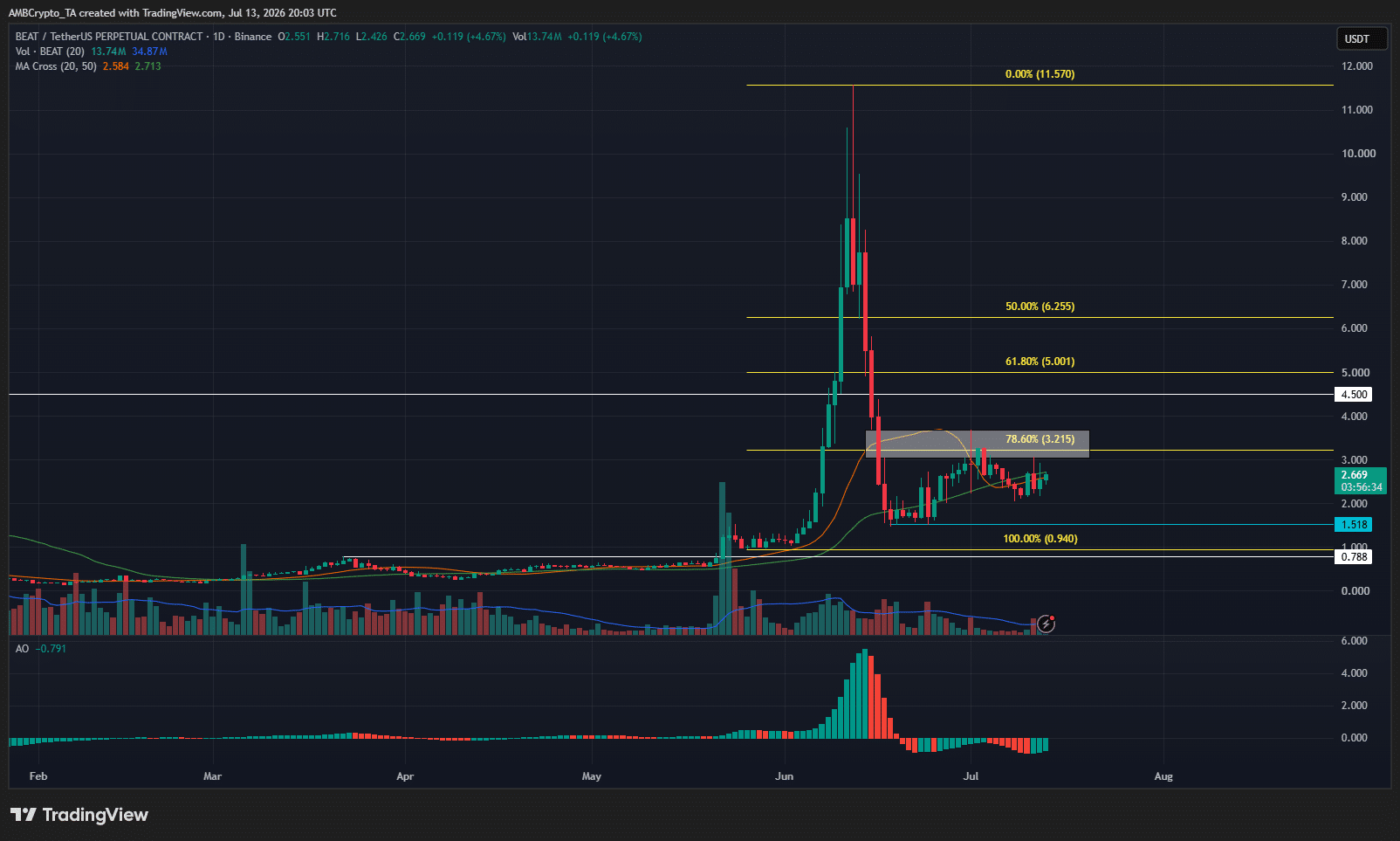
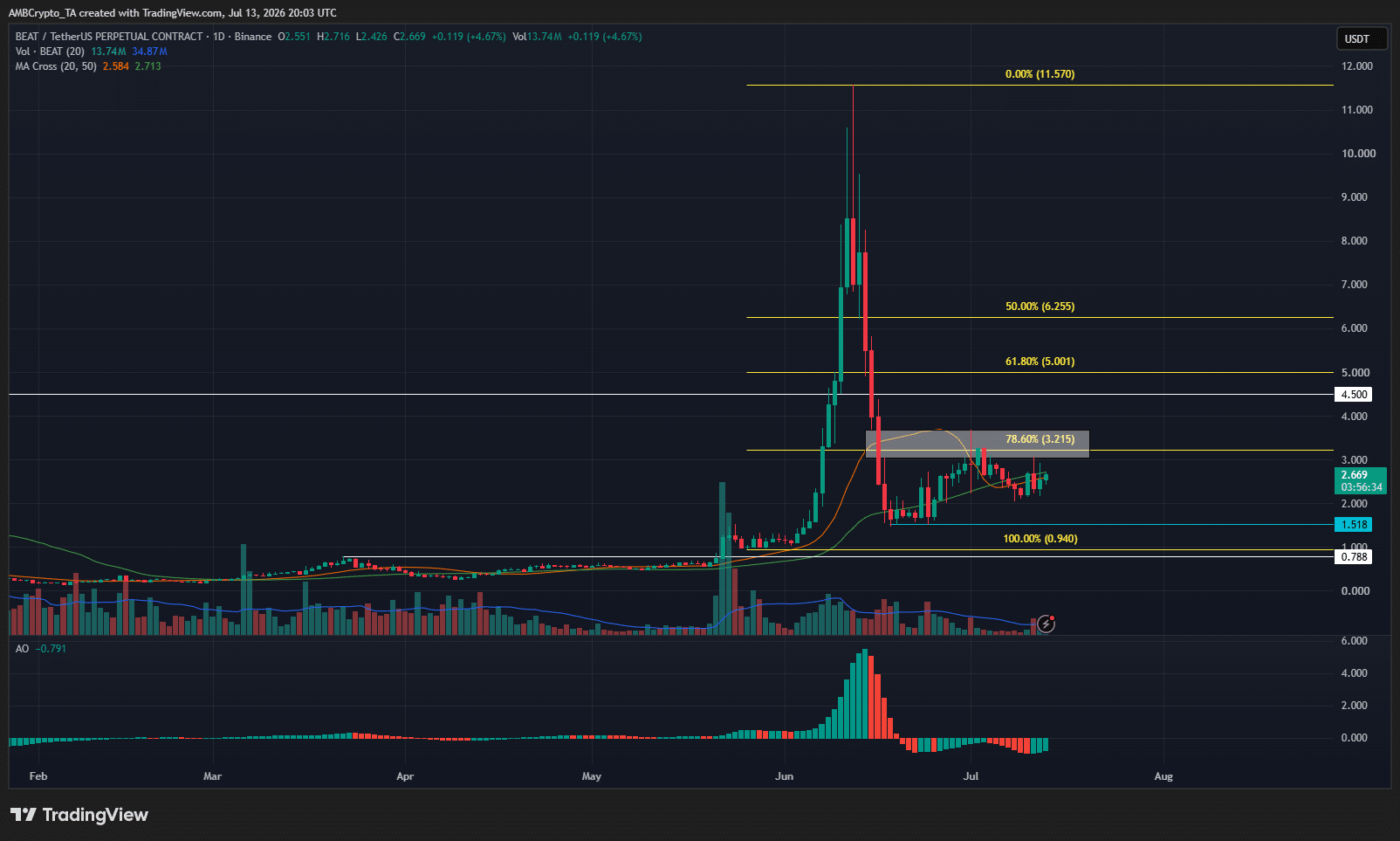
The swing structure remained bullish, but the $3.0-$3.20 area has become a local supply zone. The momentum was bearish on the 1-day timeframe, the Awesome Oscillator warned.

If BEAT can make higher lows in the coming days, it would signal that buyers were convinced of further gains. Such demand might be able to push prices past $3.20.

However, for this scenario to play out, BEAT needs to attract more capital towards itself.

Traders’ call to action- Caution
Source: Audiera on X

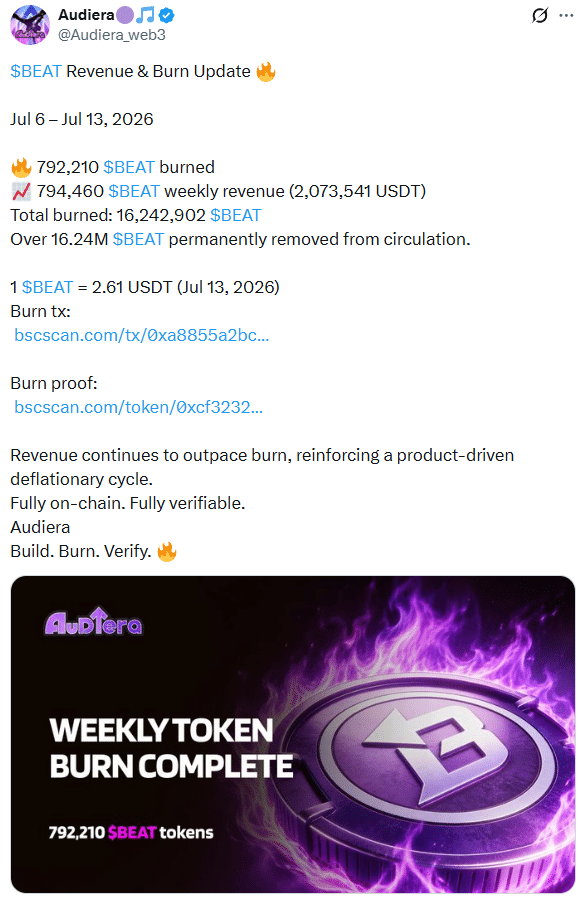
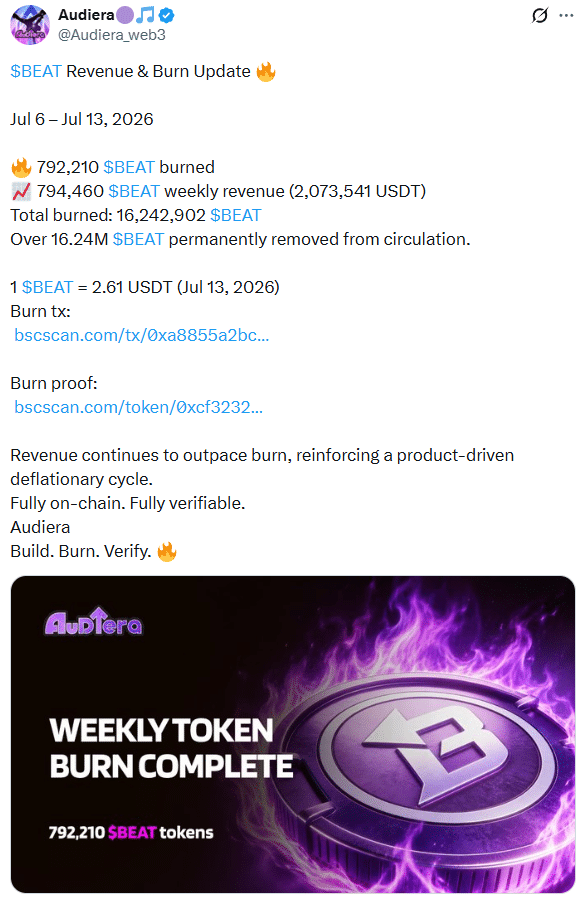
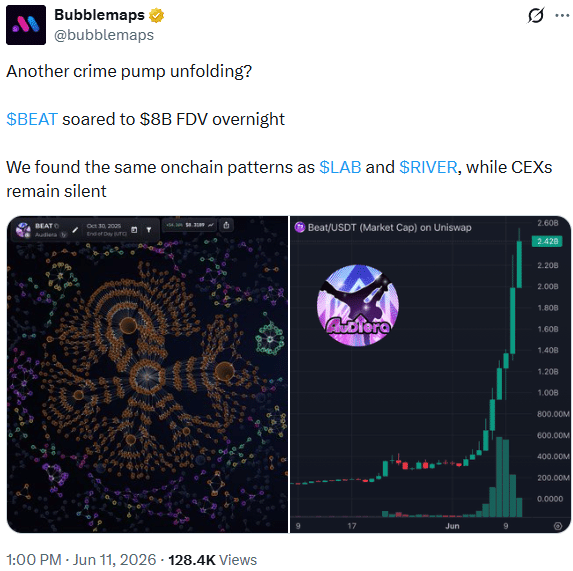
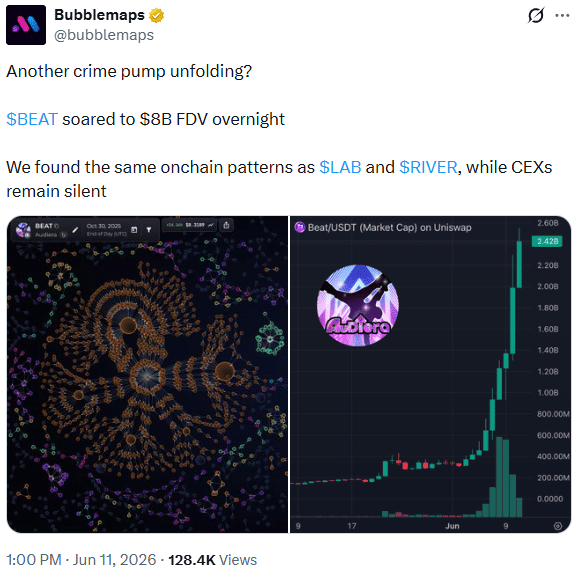
The news of the 792,210 BEAT burn on July 13 can buoy market participant confidence. Yet, the rally to $11.5 also coincided with public allegations that the Dance to Earn token showed onchain similarities to LAB and RIVER.
Source: Bubblemaps on X

From June 12 to 18, BEAT underwent an 87% correction, falling from $11.57 to $1.459. The visual analytics platform posted that they had no conclusive evidence tying BEAT to LAB and RIVER. Still, investor caution is warranted.


Final Summary

  • BEAT saw short-term upward momentum, and the weekly BEAT burns can help fuel a recovery.
  • Allegations of price manipulation and overinflated fully diluted value, or FDV, have not gone away.


Domande pertinenti

QWhat recent global event led to a decline in stock markets and Bitcoin, according to the article?

AThe resumption of hostilities between the U.S. and Iran, specifically the U.S. reinstating a blockade on Iranian ports, drove up crude oil prices and contributed to the decline in stock markets and Bitcoin.

QDespite the broader crypto market being down, what was BEAT's 24-hour price performance?

ABEAT was up 0.74% in the past 24 hours, although its daily trading volume had nearly halved from the previous day.

QWhat are the key price levels mentioned in the article that form a local supply zone for BEAT?

AThe article identifies the $3.0-$3.20 area as a local supply zone that BEAT needs to break through for further gains.

QWhat positive action taken by the Audiera project on July 13th might boost investor confidence?

AThe project executed a burn of 792,210 BEAT tokens on July 13th, which can buoy market participant confidence.

QWhat major concern regarding BEAT's fundamentals is highlighted in the article's final summary?

AThe final summary highlights that allegations of price manipulation and an overinflated fully diluted value (FDV) for BEAT have not gone away.

Letture associate

Solana's Historic First Governance Vote Concludes: Why Did SGP-003 Spark Massive Controversy?

Solana has completed its first-ever formal on-chain governance vote, marking a shift towards decentralized decision-making. Three proposals, SGP-0001, SGP-0002, and SGP-0003, were voted on. SGP-0001, establishing the foundational governance framework, and SGP-0002, accelerating the reduction of SOL's inflation rate, both passed. However, the most contentious proposal, SGP-0003, failed to reach the required supermajority. SGP-0003 proposed a significant change to Solana's fee structure, introducing a variable "Resource Fee" based on computational unit (CU) consumption, which would be entirely burned. Supporters, including some core developers, argued it would create fairer resource pricing and increase SOL's deflationary pressure. Opponents, led by major DeFi applications like Jupiter and Drift, criticized it as an effective tax on complex applications, warning it would unpredictably increase operational costs and undermine business models built on Solana's low fees. The vote outcome highlights a critical tension within Solana's growing ecosystem: balancing the interests of SOL holders (through deflationary mechanisms), validators (through rewards), and application developers (through cost predictability). As Solana evolves from a high-performance blockchain to one hosting substantial economic activity, governance is becoming central to its future development and competitiveness.

marsbit29 min fa

Solana's Historic First Governance Vote Concludes: Why Did SGP-003 Spark Massive Controversy?

marsbit29 min fa

Wash's Jackson Hole Debut: Bidding Farewell to 'Forward Guidance', Reshaping Fed Discipline Amidst the Squeeze Between AI and Inflation

In his first Jackson Hole speech, new Fed Chair Kevin Warsh signaled a significant shift in monetary policy communication. He declared that "forward guidance," a tool heavily used since the financial crisis, has outlived its usefulness in normal times and should be retired. He cautioned that over-reliance on it can distort market signals and constrain the Fed's flexibility. Instead, Warsh emphasized a return to data-dependence and decision-making discipline. Warsh outlined seven key principles to guide policy: anchoring the 2% inflation target, pursuing the employment mandate, using short-term rates as the primary tool, acknowledging the importance of money, and maintaining purposeful, restrained communication. He stressed that policy should focus on trends, not single data points. On the current economic outlook, Warsh noted that the labor market is consistent with full employment but inflation remains "far above" the Fed's target. He highlighted that over half of the PCE basket's components are still rising above 3% annually. While acknowledging AI's transformative potential for productivity and capital allocation, he admitted its full economic impact remains uncertain and is not a factor in current policy decisions. His core message was a commitment to policy discipline rather than pre-set decisions. Warsh stated the Fed's primary focus must be on restoring price stability, vowing, "We still have work to do," until there is clear evidence inflation is moving decisively toward 2%. He concluded by framing effective monetary policy as crucial for economic prosperity and U.S. global leadership.

Odaily星球日报1 h fa

Wash's Jackson Hole Debut: Bidding Farewell to 'Forward Guidance', Reshaping Fed Discipline Amidst the Squeeze Between AI and Inflation

Odaily星球日报1 h fa

Trading

Spot
活动图片