Attack on MM 2: Market Maker Order Book and Order Flow

深潮Pubblicato 2025-12-28Pubblicato ultima volta 2025-12-28

Introduzione

"Attack of the MM 2: Market Maker Order Books and Order Flow" by Dave explores the dynamics of market making in crypto, focusing on the Limit Order Book (LOB) and order flow. The LOB is the market maker's battlefield, defined by depth, tick size, and the concept of price improvement—providing better prices than the current best bid/ask to create market value. Market makers profit from the bid-ask spread, which covers order processing costs, inventory risk (holding assets amid price fluctuations), and adverse selection risk (being exploited by informed "toxic" traders). The spread types include quoted, effective, and realized spread, with the latter factoring in future mid-prices to measure true profitability. Order flow involves managing incoming trades, with a focus on identifying "toxic flow" from informed traders who can cause losses. Market makers use metrics like VPIN (Volume-weighted Probability of Informed Trading) to detect one-sided pressure and respond by pulling quotes, widening spreads, or reducing order sizes to mitigate risk. The article hints at deeper institutional strategies in future installments.

Author: Dave

Why do I always have bad luck shortly after buying altcoins? Why couldn't the seemingly invincible market makers handle the sell orders on 10/11?

Why did every market maker I talked to after 10/11 casually say they didn't lose much / even made money that day? This article will introduce you to the market maker's order book and order flow.

1. Limit Order Book (LOB)

The market maker's battlefield is not the candlestick chart, but the LOB.

Core concepts:

  • Depth: The volume of orders at each price level.

  • Tick Size: The minimum unit of price movement. In a high-frequency environment, tick size is crucial for queuing strategies.

  • Price Improvement: When you provide a price better than the current National Best Bid and Offer (NBBO), you create value for the market.

For example, if the current BTC bid is 100k and the ask is 110k, if you offer a price of 101k, you narrow the spread and create value for the market.

While writing this article, I was thinking about how to explain this section to you all. Later, I felt that nothing would be clearer than showing a real order book. Let me do a little promotion for a friend at BG. Using BGB as an example:
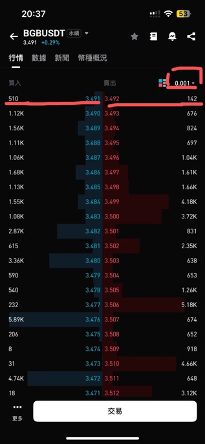
The above is the BGB order book at the minimum tick size. We see the minimum is 0.001. The current depth is only a little over $1000, the spread is controlled to be very small, hitting the minimum tick size. Simultaneously, the depth is distributed in a "Christmas tree" shape—the further from the spread, the larger the order size. However, when we increase the tick size a bit, we find that the depth should be distributed in a horn shape: the closer to the spread, the larger the order size and the more liquidity; the further away, the fewer the orders (one of the reasons for the liquidity vacuum on 10/11).

Speaking of Christmas trees, this article's scheduled release time is 12.24, Christmas Eve. Merry Christmas to everyone!

2. Market Maker Profit Source: Spread

The spread is not just profit; it is primarily composed of three costs:

  1. Order Processing Cost: Exchange fees, hardware latency, manpower.

  2. Inventory Risk: The risk of price moving against you while holding a position, which we covered in the previous episode.

  3. Adverse Selection Cost: This is the core—when you trade, the counterparty might have information you don't. This means you might get tricked by an insider.

  4. There are also three types of spreads: Quoted Spread, Effective Spread, and Realized Spread. The Quoted Spread is the easiest to understand: the ask-bid difference. The Realized Spread measures the actual profit the market maker keeps after price adjustments: 2 x (P_trade – P_futuremid), which includes the future mid-price, somewhat like considering opportunity cost.

3. Order Flow

Order flow is the stream of orders received by the market maker. This is a deep topic. Market makers perform various operations on order flow, such as hedging, matching, adjusting quotes, etc., in order to manage their book (ledger?). This involves many professional concepts and operational techniques, and can even involve legal issues, such as agency trades not being able to be counterparties to principal trades due to conflict of interest. This article will only introduce the concepts of Order Flow Toxicity and VPIN. If any MM boss hires me, I'll update my followers on professional order flow management.

Toxic Flow refers to orders from informed traders who know the price is about to move, thus causing realized spread losses because they know P_futuremid through insider information. So, as market makers, we also need to be careful not to be tricked by toxic insiders.

Noise/Retail Flow comes from retail investors or funds passively adjusting their weights. This is the market maker's favorite "food".

To protect themselves, market makers' anti-toxicity mechanisms adjust quotes. A simple way to prevent "toxicity" is to assume all aggressive orders are toxic. Assuming a buy order, the MM immediately lowers the reservation price, shifting the entire quote down. This also answers the question left in the previous chapter: why do we always buy at the high? Because market makers adjust their quotes for risk control. But the smart you will surely ask another question: what if an insider buys a large amount? What if they rely on their information advantage and stubbornly impact the spread head-on? Yes, this might be what happened on 10/11, and it's also the reason why a large MM with billions in assets couldn't hold the line.

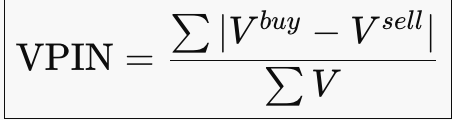
Core metric: VPIN (Volume-weighted Probability of Informed Trading).
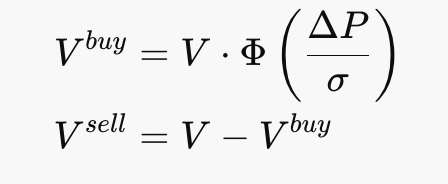
VPIN ≈ The probability that the market maker is currently being "continuously hit by one-sided flow" in the market. When significant one-sided pressure appears, MM inventory accumulates one-sidedly, and the mean reversion assumption fails. At this time, the MM will pull quotes (withdraw orders), temporarily stopping providing liquidity to wait for the order flow to return to symmetry. But what if the order flow doesn't return to symmetry? Or if the order flow deviation is too extreme and directly causes a blow-up? This is the 10/11 disaster. I'm thinking about doing an episode on how exchanges made money on 10/11. We'll see.

Back on topic, after a VPIN anomaly, MMs will pull quotes (withdraw orders) or widen the spread (to earn more service fees to compensate for price losses), and also reduce size to control the speed of inventory accumulation.

This episode is the end of the first part of our market maker story. From a retail perspective, the truth behind the legendary market manipulation by "whales" has been revealed. Next, I will introduce some more "institutional" topics from the MM's perspective. Hold on tight.

Anime episodes often end with a preview for the next episode, so let's do one for this article: If we entered the world of Jujutsu Kaisen, and order flow is "cursed energy," and quote operations are "cursed techniques," then in the next part, we will look at the "Domain Expansion" in market making.

To find out what happens next, stay tuned for the next episode.

Domande pertinenti

QWhat is the three main components that constitute the bid-ask spread for a market maker?

AThe bid-ask spread is primarily composed of three costs: Order Processing costs (exchange fees, hardware latency, manpower), Inventory Risk (the risk of holding a position while the price moves against you), and Adverse Selection cost (the risk of trading against an informed, or 'toxic', trader who has superior information).

QWhat is 'Order Flow Toxicity' and how do market makers typically protect themselves from it?

A'Order Flow Toxicity' refers to orders coming from informed traders who know the price is about to move, causing losses for the market maker. To protect themselves, market makers employ anti-toxicity mechanisms such as adjusting their reservation price (e.g., lowering quotes after a buy order), pulling their quotes (withdrawing liquidity), widening the spread, or reducing order size to control inventory accumulation.

QWhat does the VPIN metric measure and what action does a high VPIN value trigger for a market maker?

AVPIN (Volume-weighted Probability of Informed Trading) approximates the probability that a market maker is being hit by persistent one-sided order flow from informed traders. A high or abnormal VPIN value triggers risk management actions such as pulling quotes (withdrawing liquidity temporarily), widening the bid-ask spread, or reducing order size to manage the speed of inventory accumulation.

QAccording to the article, what is the key difference between 'Quoted Spread' and 'Realized Spread'?

AThe Quoted Spread is the simple difference between the best ask and bid prices (ask - bid). The Realized Spread is a more advanced metric that measures the profit a market maker actually keeps after price adjustments, calculated as 2 x (P_trade – P_futuremid), and it incorporates the future mid-price, resembling an opportunity cost.

QIn the context of a Limit Order Book (LOB), what is 'Price Improvement' and how is it created?

A'Price Improvement' occurs when a market participant provides a price that is better than the current best available price (the NBBO - National Best Bid and Offer). For example, if the best bid is 100,000 and the best ask is 110,000, a trader who places a bid at 101,000 provides price improvement by narrowing the spread, thus creating value for the market.

Letture associate

Single-Day Plunge of 30%, Arthur Hayes Suddenly Liquidates: Why Did ZEC Get Exploded by Security Issues?

On June 5th, Zcash founder Zooko Wilcox disclosed a critical soundness vulnerability in the project's latest Orchard privacy pool. This flaw, found in the elliptic curve multiplication constraints, could allow an attacker to create unlimited counterfeit ZEC within the shielded pool, with transactions appearing valid. The vulnerability was discovered in late May by security researcher Taylor Hornby, who utilized Anthropic's new Opus 4.8 AI model for a targeted audit. The Zcash ecosystem had already performed an emergency network upgrade to patch the issue. However, the detailed disclosure triggered severe market panic, causing ZEC's price to plummet over 30% in a single day. Notably, prominent investor Arthur Hayes announced he had sold his entire ZEC position following the news. The incident starkly challenges the "technological trust" narrative central to privacy coins. Despite years of top-tier cryptographic audits, the bug persisted until uncovered with advanced AI-assisted research. This highlights the growing gap between theoretical perfection and practical implementation in privacy technology. The event serves as a industry-wide warning: in an AI-driven security landscape, the assumption that "undiscovered equals safe" is obsolete. It underscores the urgent need for continuous, proactive security practices combining AI audits, formal verification, and rapid response mechanisms.

foresightnews_api45 min fa

Single-Day Plunge of 30%, Arthur Hayes Suddenly Liquidates: Why Did ZEC Get Exploded by Security Issues?

foresightnews_api45 min fa

Breaking the Curse of DeFi Cascading Liquidations, Vitalik Proposes a New Solution

**Vitalik Buterin Proposes New DeFi Design to Eliminate Forced Liquidations** Ethereum co-founder Vitalik Buterin has published a proposal for a new decentralized finance (DeFi) architecture aimed at removing the automatic liquidation mechanisms prevalent in current lending protocols. The core idea involves creating synthetic assets using options as building blocks, fundamentally avoiding the抵押借贷结构 that triggers forced sell-offs. The proposal responds to a recurring flaw in DeFi: during sharp market downturns, mass自动清算 of under-collateralized positions can exacerbate price declines, creating systemic selling pressure and market instability, as evidenced by recent crypto market volatility. Buterin's model would split an asset like 1 ETH into two option-like derivatives, P and N, pegged to a price index with a set strike price and expiration. At expiry, an oracle determines the settlement price to allocate the underlying ETH between P and N holders. This design eliminates the "cliff" of instant liquidation. Instead, a position's value would gradually drift from its target peg if not actively rebalanced by the user, transferring the rebalancing decision from the protocol to the user or automated tools. A key advantage is the reduced reliance on high-frequency, real-time oracle price feeds, which are vulnerable to manipulation and errors in current systems. The delayed settlement in the options model allows for more robust, fault-tolerant oracle designs. However, significant challenges remain for practical adoption. High transaction costs (slippage) from frequent rebalancing on automated market makers (AMMs) could erode user funds. The model may not be suitable for stablecoins requiring a strict 1:1 dollar peg, as it inherently allows for value drift. Success would depend on developing new liquidity provisioning models and deep markets for these synthetic assets. The proposal represents a fundamental rethinking of DeFi risk management, challenging the industry to explore alternatives to被动集中平仓 rather than merely optimizing existing liquidation processes. It remains a theoretical framework awaiting implementation and testing by development teams.

foresightnews_api48 min fa

Breaking the Curse of DeFi Cascading Liquidations, Vitalik Proposes a New Solution

foresightnews_api48 min fa

Bitcoin's Decline Marks the Transformation of Crypto

Title: The Decline of Bitcoin Marks the Transformation of Crypto While Bitcoin's price recently fell below $70,000, down approximately 45% from its peak, the broader crypto industry is not following it into decline. Instead, crypto is maturing and evolving beyond its dependence on Bitcoin's price movements. Two of Bitcoin's core functions are being usurped. First, AI has captured its role as the primary speculative asset. AI, with its tangible revenue, explosive demand, and massive capital inflows ($700-830 billion in 2024), is siphoning off the speculative "hot money" that once drove Bitcoin. It also contributes to a sustained high-interest-rate environment, further tightening liquidity for assets like Bitcoin. Second, dollar-pegged stablecoins like USDC and USDT have replaced Bitcoin as the crypto market's foundational currency and primary on/off-ramp. Most trading pairs and on-chain transactions are now settled in stablecoins, severing the historical link where all capital inflows had to pass through Bitcoin first. This decoupling allows projects to thrive based on their own fundamentals rather than Bitcoin's price. Examples include Hyperliquid, an on-chain derivatives exchange with annual revenues of $8-13 billion, and prediction market platform Polymarket, valued at $200 billion with $3.65 billion in annual fees. These projects are evaluated on traditional metrics like revenue and user growth. New opportunities are emerging, particularly around privacy. Privacy coins like Zcash (ZEC) are seeing surging demand, while infrastructure like NEAR enables private, cross-chain asset transfers without requiring users to hold a specific token—privacy becomes a universal service layer. In this new paradigm, stablecoins are the universal cash, various project tokens represent equity, and privacy-enabled cross-chain coordination layers (like NEAR) act as the critical infrastructure connecting a fragmented, multi-chain ecosystem. Bitcoin is now just one asset among many. The era where the entire crypto market moved in lockstep with Bitcoin is over. The industry's health should now be judged by project fundamentals—real revenue, active users, and tokenomics that capture value—and the development of the underlying infrastructure enabling a mature, dollar-denominated crypto economy.

foresightnews_api50 min fa

Bitcoin's Decline Marks the Transformation of Crypto

foresightnews_api50 min fa

Lightspark CEO: In Ten Years, Bitcoin Will Be as Invisible as TCP/IP, Yet Power Trillions in Daily Transactions

A decade from now, Bitcoin will function like TCP/IP — invisible yet foundational, supporting trillions in daily transactions globally, according to Lightspark CEO David Marcus. In this future, a coffee shop in Lagos receives instant payment, a manufacturer in São Paulo settles an invoice with a supplier in Ho Chi Minh City, and a freelancer in Bangalore gets paid weekly from an Austin startup — all via Bitcoin's settlement layer, with none of the parties consciously interacting with it. This vision parallels the adoption of open protocols: first driven by necessity where existing systems fail, then scaling rapidly as tools mature and economic benefits become clear. The structural shift begins with wallets. Modern non-custodial wallets, like Spark, allow users to hold dollars, local currency, and Bitcoin in a single address, seamlessly switching between them. This eliminates friction and revolutionizes global custody, moving significant deposits to user-controlled keys not by ideology, but by superior utility. As a result, Bitcoin becomes the default savings layer for billions, as its fixed supply and appreciating value make it a rational choice for savers holding it alongside stablecoins in their everyday wallets. Businesses follow a similar path, from small companies in emerging markets to multinational corporations, holding Bitcoin alongside operational stablecoins. The latest trend is direct Bitcoin transactions for commerce. When both parties hold Bitcoin, transacting in it becomes the simplest option — no conversions, no intermediary currency. This starts in niche areas like high-value B2B settlements but grows as infrastructure makes sending Bitcoin as easy as stablecoins. An accelerating force is AI agents. By 2036, AI agents conducting commerce on behalf of individuals and firms will increasingly choose Bitcoin for settlement. Optimizing for speed, finality, and minimal counterparty risk across jurisdictions, they find Bitcoin's global, neutral, and programmable network ideal for netting and settling obligations. Thus, Bitcoin is becoming the native currency for machine commerce, just as it has become a native savings asset for humans. The global monetary system is being rebuilt from the protocol layer: open infrastructure, default self-custody, Bitcoin settling everything underneath, with stablecoins as the interface. Most users won't think about Bitcoin when they transact — and they won't need to.

foresightnews_api55 min fa

Lightspark CEO: In Ten Years, Bitcoin Will Be as Invisible as TCP/IP, Yet Power Trillions in Daily Transactions

foresightnews_api55 min fa

Trading

Spot
Futures

Articoli Popolari

Come comprare FLOW

Benvenuto in HTX.com! Abbiamo reso l'acquisto di Flow (FLOW) semplice e conveniente. Segui la nostra guida passo passo per intraprendere il tuo viaggio nel mondo delle criptovalute.Step 1: Crea il tuo Account HTXUsa la tua email o numero di telefono per registrarti il tuo account gratuito su HTX. Vivi un'esperienza facile e sblocca tutte le funzionalità,Crea il mio accountStep 2: Vai in Acquista crypto e seleziona il tuo metodo di pagamentoCarta di credito/debito: utilizza la tua Visa o Mastercard per acquistare immediatamente FlowFLOW.Bilancio: Usa i fondi dal bilancio del tuo account HTX per fare trading senza problemi.Terze parti: abbiamo aggiunto metodi di pagamento molto utilizzati come Google Pay e Apple Pay per maggiore comodità.P2P: Fai trading direttamente con altri utenti HTX.Over-the-Counter (OTC): Offriamo servizi su misura e tassi di cambio competitivi per i trader.Step 3: Conserva Flow (FLOW)Dopo aver acquistato Flow (FLOW), conserva nel tuo account HTX. In alternativa, puoi inviare tramite trasferimento blockchain o scambiare per altre criptovalute.Step 4: Scambia Flow (FLOW)Scambia facilmente Flow (FLOW) nel mercato spot di HTX. Accedi al tuo account, seleziona la tua coppia di trading, esegui le tue operazioni e monitora in tempo reale. Offriamo un'esperienza user-friendly sia per chi ha appena iniziato che per i trader più esperti.

181 Totale visualizzazioniPubblicato il 2024.12.10Aggiornato il 2026.06.02

Come comprare FLOW

Discussioni

Benvenuto nella Community HTX. Qui puoi rimanere informato sugli ultimi sviluppi della piattaforma e accedere ad approfondimenti esperti sul mercato. Le opinioni degli utenti sul prezzo di FLOW FLOW sono presentate come di seguito.

活动图片