ASTER vs. Hyperliquid: Can USD1’s 34.3% growth shift market leadership?

ambcryptoPubblicato 2026-04-08Pubblicato ultima volta 2026-04-08

Introduzione

The market is shifting toward DeFi, with stablecoins acting as a key bridge between traditional and decentralized finance. In this context, Aster’s [ASTER] partnership with WorldLibertyFinancial [WLFI] positions WLFI’s native stablecoin, USD1, as the base layer for ASTER’s perpetual markets and real-world asset (RWA) initiatives. USD1’s market cap grew 34.3% this year, reflecting strong demand for structured, real-world assets. Despite broader market headwinds, the partnership aims to strengthen ASTER’s liquidity and competitiveness. While Hyperliquid [HYPE] dominated Q1 perpetual volume with $620 billion (compared to ASTER’s $318 billion) and saw its token rise 43%, ASTER declined 3.32%. The integration of USD1 could help ASTER narrow the gap with Hyperliquid and expand its presence in both trading and RWA markets.

The market is clearly shifting toward DeFi, and as a result, Layer 1s are rethinking how to stay ahead.

Consequently, it’s no surprise that most strategic partnerships are now centered around stablecoins. By acting as a bridge between TradFi and DeFi, they not only move capital on-chain more efficiently but also reduce friction and unlock access to key growth areas such as RWAs, AI, and NFTs.

In this context, Aster’s [ASTER] partnership with WorldLibertyFinancial [WLFI] fits perfectly. Under this deal, WLFI’s native stablecoin, USD1, becomes the base layer for ASTER’s perpetual markets and RWA initiatives, further reinforcing the broader trend of connecting traditional finance more closely with DeFi via stablecoins.
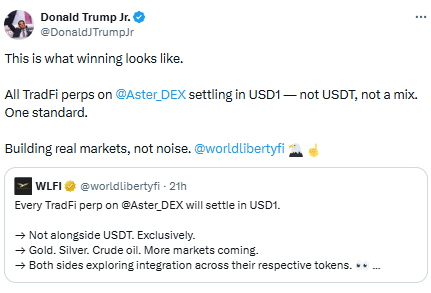
Source: X

Unsurprisingly, the market reacted quickly. The most buzzed-about response came from Donald Trump Jr. on X, calling the partnership a major “win” for both networks. That said, when we look at the technical positioning, it’s clear this move is about more than just strengthening fundamentals.

On the charts, both ASTER and WLFI have been impacted by ongoing macro FUD, closing near critical support levels that could soon be tested. At the same time, on the longer timeframe, these assets still have a significant way to go before reclaiming early-October price levels.

Naturally, the key question becomes, can this partnership actually drive meaningful price gains? That’s especially relevant when you consider that other DEX tokens like Hyperliquid [HYPE] have managed to stay relatively bullish despite the same macro headwinds.

ASTER bets on USD1 to reclaim ground

When you think of stablecoins, USDT usually comes to mind first.

That said, its technical setup doesn’t always tell the full story. So far this year, USDT’s market cap has only grown about 1.6%. Considering that this period overlaps with roughly a 20% correction across the broader crypto market, it’s clear that USDT flows still influence wider price action.

But capital isn’t just chasing speculation anymore. The RWA market, for example, has grown 35% this year, showing that money is moving into more structured, real-world assets. In this context, USD1’s 34.3% jump in market cap highlights how well-positioned stablecoins are driving real growth, making the ASTER-WLFI partnership a clearly strategic play.
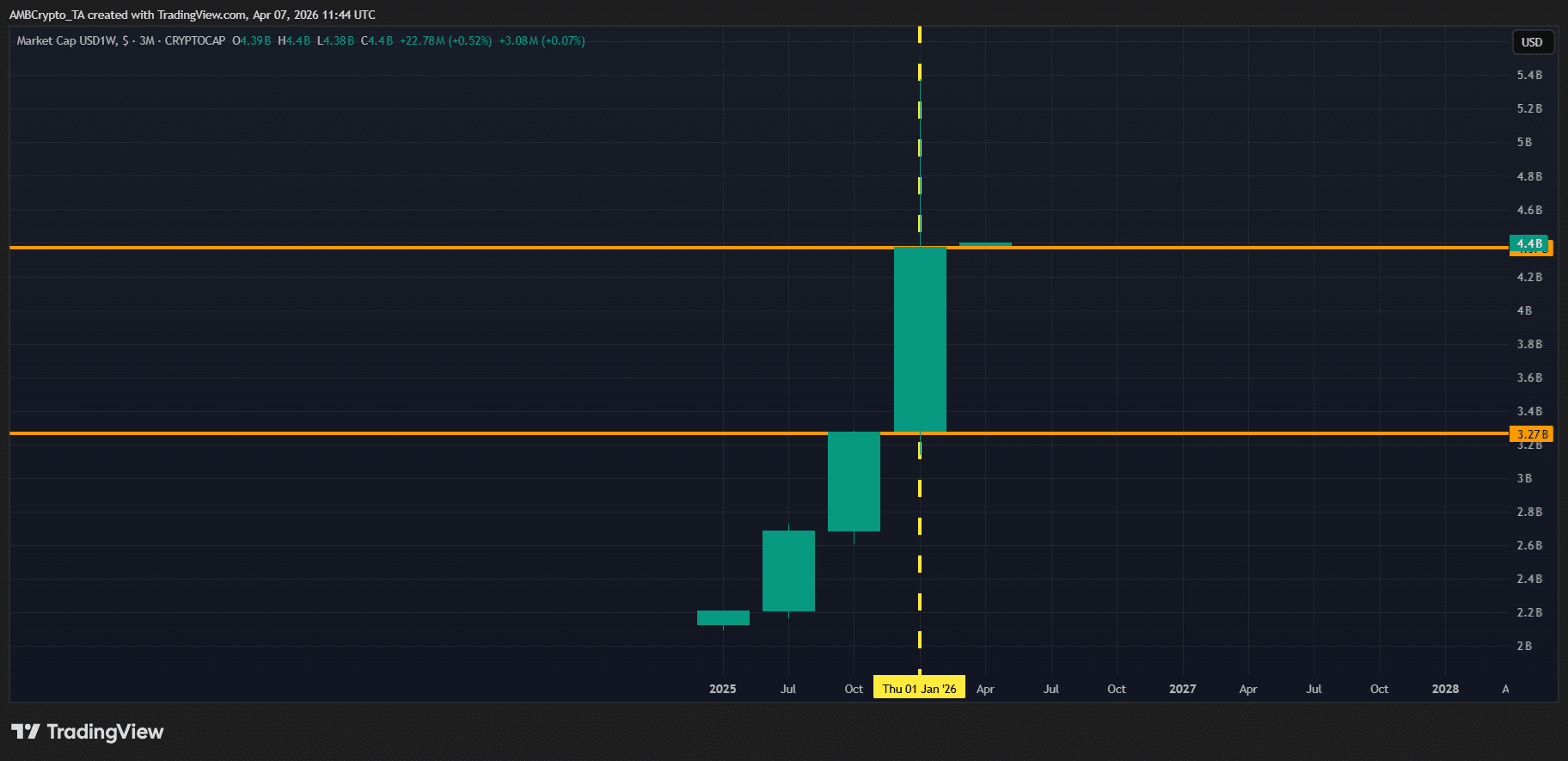
Source: TradingView (USD1)

Meanwhile, a similar divergence is visible in perpetual volume, which has cooled overall. Yet, on a chain-by-chain basis, Hyperliquid still dominates, reporting $620 billion in perp volume in Q1. Oil trading, in particular, has been a key driver, keeping Hyperliquid firmly in the lead even as broader market activity slows.

By comparison, ASTER posted $318 billion over the same period. Technically, that’s almost half of Hyperliquid’s volume. The impact shows in price action too, with HYPE ending Q1 up 43%, while ASTER slipped 3.32%. That said, the WLFI partnership puts ASTER in a position to strengthen its liquidity, potentially improving its competitiveness in the DEX perpetual market.

The main catalyst? USD1. Serving as the base layer for ASTER’s perpetual markets and RWA initiatives, it could be the lever that helps ASTER close the gap with Hyperliquid, creating a stronger presence across both trading and real-world asset markets.


Final Summary

  • USD1 now serves as the base layer for ASTER’s perpetual markets and RWA initiatives, strengthening liquidity.
  • While HYPE dominates perp volume, ASTER’s USD1 integration positions it to narrow the gap and expand its presence in both trading and real-world asset markets.


Crypto di tendenza

Domande pertinenti

QWhat is the main focus of the strategic partnership between Aster (ASTER) and WorldLibertyFinancial (WLFI)?

AThe partnership centers on WLFI's native stablecoin, USD1, becoming the base layer for ASTER's perpetual markets and Real-World Asset (RWA) initiatives, aiming to bridge traditional finance with DeFi and strengthen liquidity.

QHow did the market cap growth of USD1 compare to that of USDT, and what does this signify?

AUSD1's market cap grew by 34.3%, significantly outperforming USDT's 1.6% growth. This highlights how well-positioned stablecoins like USD1 are driving real growth, particularly in structured areas like RWA, as opposed to just speculation.

QHow did the trading volume and price performance of ASTER compare to Hyperliquid (HYPE) in Q1?

AIn Q1, Hyperliquid dominated with $620 billion in perpetual volume and its token HYPE ended the quarter up 43%. In comparison, ASTER posted $318 billion in volume (about half of HYPE's) and its token price slipped by 3.32%.

QWhat key advantage does the article suggest the USD1 integration could bring to ASTER?

AThe integration of USD1 as a base layer could serve as a lever to help ASTER strengthen its liquidity, improve its competitiveness in the perpetual markets, and narrow the gap with market leaders like Hyperliquid.

QBeyond speculation, what broader market trend is capital moving into, as evidenced by the growth of USD1?

ACapital is moving into more structured, real-world assets (RWA). The RWA market itself grew 35% this year, and USD1's significant growth is a reflection of this trend towards connecting traditional finance with DeFi.

Letture associate

Annual Salary of Millions Competing for Electricians, Meta Rushes to Open Its Own Technical School

The AI boom is facing an unexpected bottleneck: a severe shortage of skilled construction workers and electricians. As tech giants like Meta, OpenAI, and Alphabet race to build massive data centers—such as OpenAI's $16 billion "Stargate" project—they are hitting a critical labor wall. The U.S. needs an estimated 130,000 more electricians, 240,000 construction workers, and 150,000 supervisors by 2030 for AI infrastructure alone, but tens of thousands of electrician jobs go unfilled each year. While AI companies offer high premiums, with electricians earning up to $280,000 annually, worker scarcity still causes massive losses—delays on a single project can cost $14.2 million per month. The complexity of building AI data centers, which require immense power (equivalent to powering hundreds of thousands of homes), sophisticated electrical systems, and advanced liquid cooling solutions, demands highly skilled technicians who are in short supply. To combat this, companies are investing heavily in training. Meta has committed $115 million to a free training school offering tuition, housing, and stipends, targeting 5,000 new workers. OpenAI is partnering with unions to secure skilled labor. These efforts are paying off, with a significant rise in Gen Z interest in trade schools over college. However, the power demands are staggering. AI data centers are driving a rapid surge in electricity consumption, projected to account for up to 12% of U.S. power use by 2028 and raising costs for consumers. Furthermore, the construction boom is project-based, leading to a potential future glut of trained workers once building peaks, which could depress wages industry-wide. The race for AI supremacy now depends as much on skilled hands as on advanced chips.

marsbit1 h fa

Annual Salary of Millions Competing for Electricians, Meta Rushes to Open Its Own Technical School

marsbit1 h fa

OpenAI No Longer Sells Its Most Expensive Model for Profit

OpenAI is shifting its business strategy away from promoting its most expensive, flagship models for every task. Recent price cuts—80% for GPT-5.6 Luna and 20% for Terra—signal a deeper change: the company now actively advises users that many tasks don't require the most powerful model. Instead, OpenAI recommends a tiered approach: use the high-end GPT-5.6 Sol for complex planning and analysis, then delegate execution to cheaper models like Luna. This mirrors moves by Anthropic, which recently launched Claude Opus 5 at half the price of its top model, Fable 5. Both companies are de-emphasizing flagship models as primary revenue drivers, using them instead for brand prestige and technological showcases. The industry is entering a "mass-market" phase, similar to automotive, where high-volume, cost-effective models handle daily operations and drive scale. OpenAI's price reductions are partly enabled by AI models themselves optimizing underlying code and infrastructure, creating a self-reinforcing cycle of efficiency gains and cost reduction. Competition is shifting from "who is smartest" to "who offers the best value." The goal is no longer selling individual models but fostering widespread API adoption and ecosystem lock-in. By making AI calls cheap and ubiquitous, companies like OpenAI aim to become the indispensable, utility-like infrastructure powering automated workflows—the "water and electricity" of software, quietly embedded everywhere.

marsbit1 h fa

OpenAI No Longer Sells Its Most Expensive Model for Profit

marsbit1 h fa

Trading

Spot

Articoli Popolari

Come comprare ASTER

Benvenuto in HTX.com! Abbiamo reso l'acquisto di Aster (ASTER) semplice e conveniente. Segui la nostra guida passo passo per intraprendere il tuo viaggio nel mondo delle criptovalute.Step 1: Crea il tuo Account HTXUsa la tua email o numero di telefono per registrarti il tuo account gratuito su HTX. Vivi un'esperienza facile e sblocca tutte le funzionalità,Crea il mio accountStep 2: Vai in Acquista crypto e seleziona il tuo metodo di pagamentoCarta di credito/debito: utilizza la tua Visa o Mastercard per acquistare immediatamente AsterASTER.Bilancio: Usa i fondi dal bilancio del tuo account HTX per fare trading senza problemi.Terze parti: abbiamo aggiunto metodi di pagamento molto utilizzati come Google Pay e Apple Pay per maggiore comodità.P2P: Fai trading direttamente con altri utenti HTX.Over-the-Counter (OTC): Offriamo servizi su misura e tassi di cambio competitivi per i trader.Step 3: Conserva Aster (ASTER)Dopo aver acquistato Aster (ASTER), conserva nel tuo account HTX. In alternativa, puoi inviare tramite trasferimento blockchain o scambiare per altre criptovalute.Step 4: Scambia Aster (ASTER)Scambia facilmente Aster (ASTER) nel mercato spot di HTX. Accedi al tuo account, seleziona la tua coppia di trading, esegui le tue operazioni e monitora in tempo reale. Offriamo un'esperienza user-friendly sia per chi ha appena iniziato che per i trader più esperti.

727 Totale visualizzazioniPubblicato il 2025.09.25Aggiornato il 2026.06.02

Come comprare ASTER

Discussioni

Benvenuto nella Community HTX. Qui puoi rimanere informato sugli ultimi sviluppi della piattaforma e accedere ad approfondimenti esperti sul mercato. Le opinioni degli utenti sul prezzo di ASTER ASTER sono presentate come di seguito.

活动图片












