ASTER vs. Hyperliquid: Can USD1’s 34.3% growth shift market leadership?

ambcryptoPubblicato 2026-04-08Pubblicato ultima volta 2026-04-08

Introduzione

The market is shifting toward DeFi, with stablecoins acting as a key bridge between traditional and decentralized finance. In this context, Aster’s [ASTER] partnership with WorldLibertyFinancial [WLFI] positions WLFI’s native stablecoin, USD1, as the base layer for ASTER’s perpetual markets and real-world asset (RWA) initiatives. USD1’s market cap grew 34.3% this year, reflecting strong demand for structured, real-world assets. Despite broader market headwinds, the partnership aims to strengthen ASTER’s liquidity and competitiveness. While Hyperliquid [HYPE] dominated Q1 perpetual volume with $620 billion (compared to ASTER’s $318 billion) and saw its token rise 43%, ASTER declined 3.32%. The integration of USD1 could help ASTER narrow the gap with Hyperliquid and expand its presence in both trading and RWA markets.

The market is clearly shifting toward DeFi, and as a result, Layer 1s are rethinking how to stay ahead.

Consequently, it’s no surprise that most strategic partnerships are now centered around stablecoins. By acting as a bridge between TradFi and DeFi, they not only move capital on-chain more efficiently but also reduce friction and unlock access to key growth areas such as RWAs, AI, and NFTs.

In this context, Aster’s [ASTER] partnership with WorldLibertyFinancial [WLFI] fits perfectly. Under this deal, WLFI’s native stablecoin, USD1, becomes the base layer for ASTER’s perpetual markets and RWA initiatives, further reinforcing the broader trend of connecting traditional finance more closely with DeFi via stablecoins.
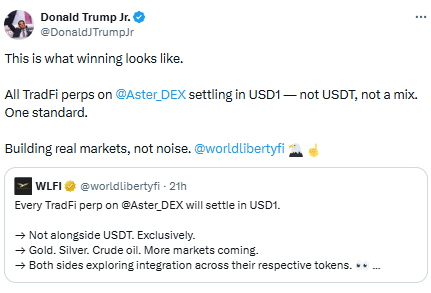
Source: X

Unsurprisingly, the market reacted quickly. The most buzzed-about response came from Donald Trump Jr. on X, calling the partnership a major “win” for both networks. That said, when we look at the technical positioning, it’s clear this move is about more than just strengthening fundamentals.

On the charts, both ASTER and WLFI have been impacted by ongoing macro FUD, closing near critical support levels that could soon be tested. At the same time, on the longer timeframe, these assets still have a significant way to go before reclaiming early-October price levels.

Naturally, the key question becomes, can this partnership actually drive meaningful price gains? That’s especially relevant when you consider that other DEX tokens like Hyperliquid [HYPE] have managed to stay relatively bullish despite the same macro headwinds.

ASTER bets on USD1 to reclaim ground

When you think of stablecoins, USDT usually comes to mind first.

That said, its technical setup doesn’t always tell the full story. So far this year, USDT’s market cap has only grown about 1.6%. Considering that this period overlaps with roughly a 20% correction across the broader crypto market, it’s clear that USDT flows still influence wider price action.

But capital isn’t just chasing speculation anymore. The RWA market, for example, has grown 35% this year, showing that money is moving into more structured, real-world assets. In this context, USD1’s 34.3% jump in market cap highlights how well-positioned stablecoins are driving real growth, making the ASTER-WLFI partnership a clearly strategic play.
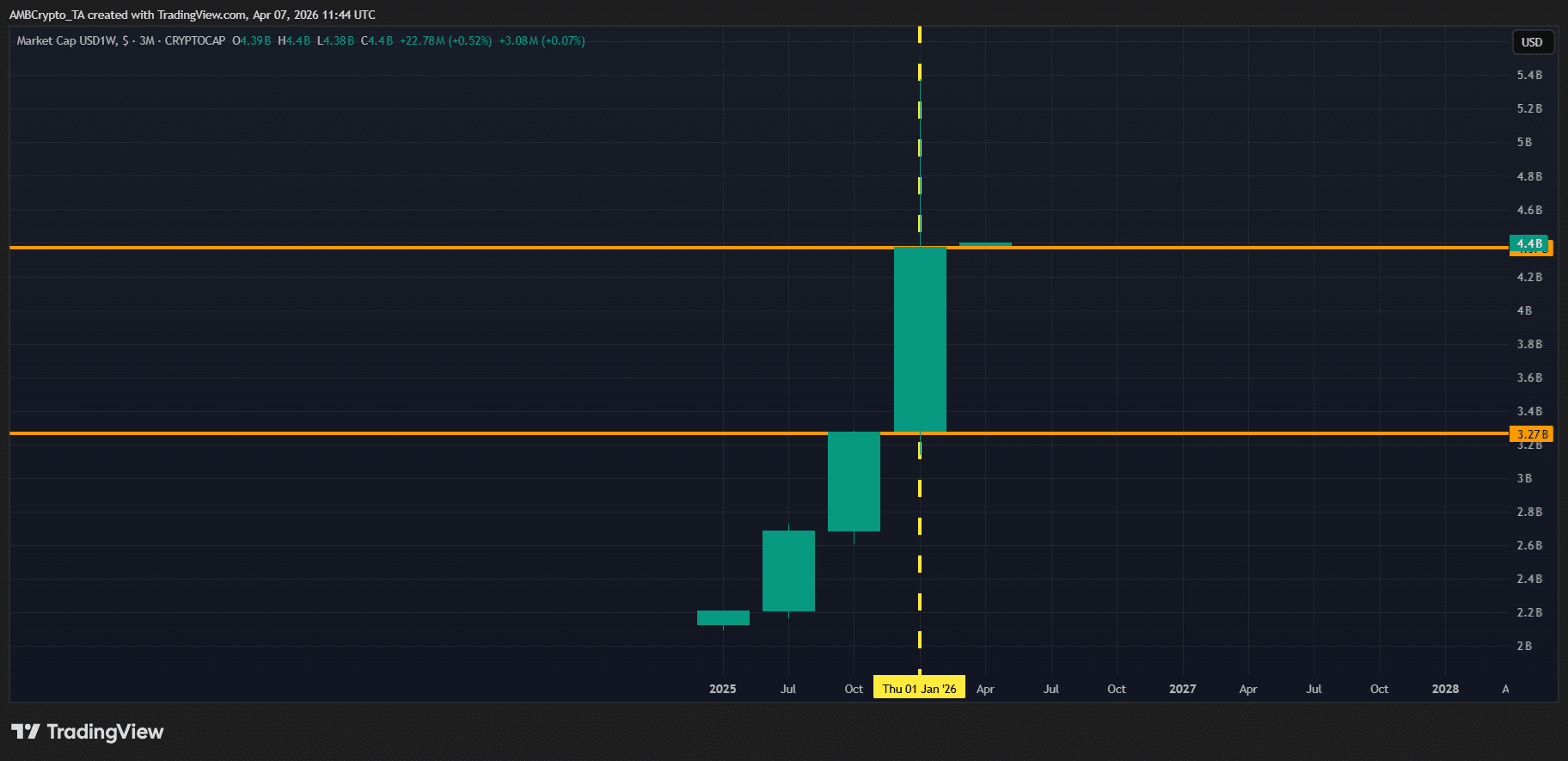
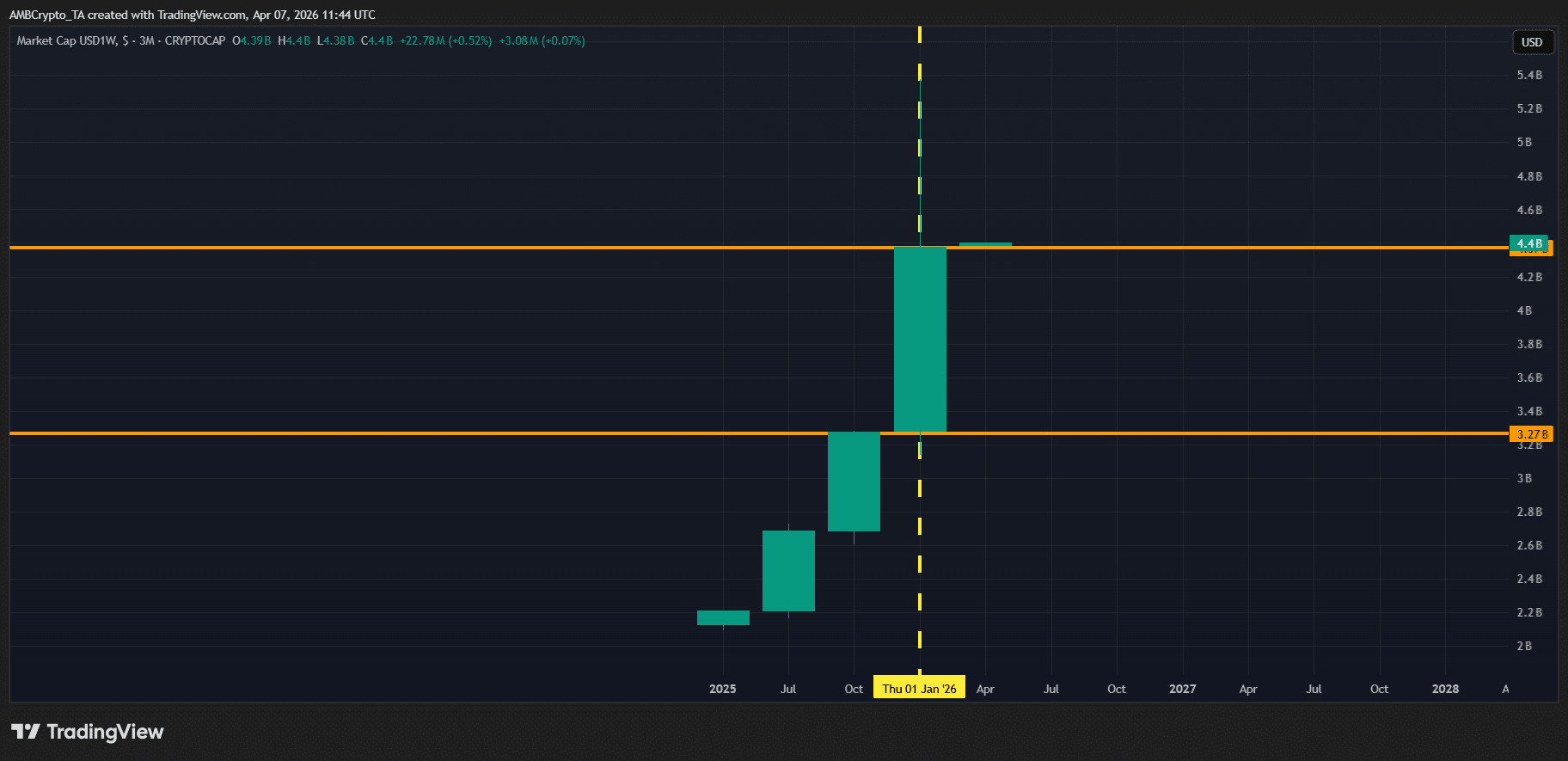
Source: TradingView (USD1)

Meanwhile, a similar divergence is visible in perpetual volume, which has cooled overall. Yet, on a chain-by-chain basis, Hyperliquid still dominates, reporting $620 billion in perp volume in Q1. Oil trading, in particular, has been a key driver, keeping Hyperliquid firmly in the lead even as broader market activity slows.

By comparison, ASTER posted $318 billion over the same period. Technically, that’s almost half of Hyperliquid’s volume. The impact shows in price action too, with HYPE ending Q1 up 43%, while ASTER slipped 3.32%. That said, the WLFI partnership puts ASTER in a position to strengthen its liquidity, potentially improving its competitiveness in the DEX perpetual market.

The main catalyst? USD1. Serving as the base layer for ASTER’s perpetual markets and RWA initiatives, it could be the lever that helps ASTER close the gap with Hyperliquid, creating a stronger presence across both trading and real-world asset markets.


Final Summary

  • USD1 now serves as the base layer for ASTER’s perpetual markets and RWA initiatives, strengthening liquidity.
  • While HYPE dominates perp volume, ASTER’s USD1 integration positions it to narrow the gap and expand its presence in both trading and real-world asset markets.


Domande pertinenti

QWhat is the main focus of the strategic partnership between Aster (ASTER) and WorldLibertyFinancial (WLFI)?

AThe partnership centers on WLFI's native stablecoin, USD1, becoming the base layer for ASTER's perpetual markets and Real-World Asset (RWA) initiatives, aiming to bridge traditional finance with DeFi and strengthen liquidity.

QHow did the market cap growth of USD1 compare to that of USDT, and what does this signify?

AUSD1's market cap grew by 34.3%, significantly outperforming USDT's 1.6% growth. This highlights how well-positioned stablecoins like USD1 are driving real growth, particularly in structured areas like RWA, as opposed to just speculation.

QHow did the trading volume and price performance of ASTER compare to Hyperliquid (HYPE) in Q1?

AIn Q1, Hyperliquid dominated with $620 billion in perpetual volume and its token HYPE ended the quarter up 43%. In comparison, ASTER posted $318 billion in volume (about half of HYPE's) and its token price slipped by 3.32%.

QWhat key advantage does the article suggest the USD1 integration could bring to ASTER?

AThe integration of USD1 as a base layer could serve as a lever to help ASTER strengthen its liquidity, improve its competitiveness in the perpetual markets, and narrow the gap with market leaders like Hyperliquid.

QBeyond speculation, what broader market trend is capital moving into, as evidenced by the growth of USD1?

ACapital is moving into more structured, real-world assets (RWA). The RWA market itself grew 35% this year, and USD1's significant growth is a reflection of this trend towards connecting traditional finance with DeFi.

Letture associate

Crypto is dead, Perps are forever

The crypto industry is shifting from a focus on creating native assets (like altcoins and protocol tokens) to becoming a "global asset pipeline." Native cryptocurrencies, except for Bitcoin, are seen as failing in their value storage and utility promises, with demand driven largely by speculation. Attention and liquidity are now moving toward real-world assets (RWAs) like U.S. stocks, bonds, gold, and oil traded on-chain via perpetual contracts (Perps). Stablecoins like USDT and USDC set the precedent, proving blockchain's core strength is efficient global settlement and transfer, not inventing new monetary systems. Meanwhile, assets like Ethereum and many DeFi tokens struggle as their narratives weaken against tangible traditional assets and the rapid real-world progress of AI. Perpetual contracts have emerged as a pivotal innovation. They simplify trading by offering pure price exposure to any asset, bypassing complexities of ownership, custody, and traditional market hours. Projects like Hyperliquid gained traction by combining CEX-like efficiency with on-chain transparency, capitalizing on post-FTX distrust, macroeconomic volatility, and the surge in demand for 24/7 stock trading. In conclusion, while the era of speculative native "crypto assets" may be over, perpetual contracts persist as the industry's most potent financial instrument—transforming all assets into globally accessible, constantly tradable instruments centered on price speculation.

marsbit1 min fa

Crypto is dead, Perps are forever

marsbit1 min fa

Tencent, Alibaba, ByteDance in a Battle for the Skill Store

Skill is becoming a key concept in the AI field, essentially serving as a structured "instruction manual" for AI Agents that specifies tool calls, decision logic, and output standards. This allows Agents to execute predefined tasks. As the number of Skills grows, distribution platforms have emerged. Major tech companies are swiftly entering this space. In March, Tencent, Alibaba, and ByteDance launched Skill stores within their respective Agent platforms. Subsequently, players like Zhipu AI, Meituan, and Xiaohongshu joined the fray. This competition for the "Skill store" is fundamentally a battle for the AI-era user entry point; whoever controls distribution controls the users. While ByteDance's Coze has experimented with paid Skills, most platforms offer them for free. The real value lies not in the stores themselves but in using them to attract and retain users within an ecosystem, driving revenue from services like cloud computing, model calls, or advertising. The landscape features three main player types: 1) **Internet giants** (e.g., Alibaba, ByteDance, Tencent, Meituan), leveraging Skills to drive traffic and monetize through their broader ecosystems (cloud services, transactions, ads). 2) **Large model companies** (e.g., Zhipu AI, Moonshot AI), using Skill stores to increase user engagement and monetize model API calls. 3) **Content platforms** (e.g., Xiaohongshu), treating Skills as a new content format to generate traffic and ad revenue. However, transforming Skill stores into a sustainable business faces significant hurdles. Key challenges include: the **difficulty in pricing Skills** due to inconsistent outputs across different models and contexts; **lack of cost transparency** (varying token consumption); **security risks** like Skill poisoning; and the **absence of standardized protocols** for development and evaluation. Unlike standardized mobile apps, Skills are often personalized workflows resistant to uniformity, which hinders the establishment of a reliable review and monetization system akin to the App Store. While there is genuine user demand for paid Skills—particularly in enterprise (e.g., contract review) and certain personal productivity scenarios—current platforms offer developers limited and unpredictable distribution. The future of Skill stores depends on overcoming these standardization, evaluation, and safety challenges to make acquiring a Skill as straightforward as downloading an app. For now, the stores function more as display shelves than robust marketplaces.

marsbit1 min fa

Tencent, Alibaba, ByteDance in a Battle for the Skill Store

marsbit1 min fa

The Crypto Scene Is Dead, Perpetual Swaps Are Eternal

The crypto industry is undergoing a fundamental shift. The era defined by minting novel, native digital assets (altcoins) is fading. These assets, lacking real-world cash flows or clear value, are losing relevance as attention and capital flow elsewhere. Two powerful external forces are reshaping the space. First, traditional assets like U.S. stocks, bonds, gold, and oil are being tokenized and traded on-chain. Second, the explosive growth of AI, with its tangible products, has overshadowed crypto's once-dominant "future narrative." This marks a critical pivot: crypto is transitioning from being a "factory for new assets" to becoming a "global conduit for existing assets." Its validated utility is not complex financial reinvention but efficient global settlement, transfer, and trading—the original promise of blockchain. Stablecoins like USDT and USDC exemplify this, offering faster dollar movement rather than replacing it. Consequently, native ecosystems like Ethereum face profound challenges. While still crucial infrastructure, ETH struggles to capture value as users interact with Layer 2s or trade traditional assets without needing to hold it. DeFi's grand narrative of rebuilding finance has narrowed to core needs like cheap transfers and deep liquidity. The true breakout innovation is the perpetual contract (Perp). It brilliantly bypasses the complexities of direct asset ownership (custody, compliance, dividends) by creating pure price exposure. Users can speculate on the price movement of *any* asset—NVIDIA, gold, oil—24/7, globally, and with leverage. This "price casino" model, while risky and ethically fraught, delivers unmatched liquidity and accessibility. Projects like Hyperliquid succeeded not by inventing new mechanics but by perfecting the timing and execution of this model. Key drivers included making on-chain Perps feel like centralized exchanges, post-FTX trust migration towards transparency, and rising demand to trade macro assets and equities round-the-clock. In conclusion, the crypto world's most enduring successes are the dollar (via stablecoins), Bitcoin, and trading. Its new frontier is not creating alternative assets but providing a seamless, perpetual trading layer—a new API—for the world's existing financial system. The age of native altcoins is over; the age of perpetual synthetic exposure has begun.

Odaily星球日报10 min fa

The Crypto Scene Is Dead, Perpetual Swaps Are Eternal

Odaily星球日报10 min fa

After Marvell's 32% Surge, the Chinese Chip Family Behind It Emerges

The stock price of Marvell Technology surged 32.5% on June 2nd, driven by NVIDIA CEO Jensen Huang highlighting its custom ASICs and optical interconnects as core to AI data center architecture. This event brought attention to the Chinese semiconductor family behind Marvell: the Dai siblings. The story centers on three siblings, all UC Berkeley graduates, whose three-decade entrepreneurial journey aligns with major semiconductor industry shifts. In 1995, youngest sister Dai Wei Li co-founded Marvell with her husband Sehat Sutardja and his brother, focusing on storage controllers. Eldest brother Dai Wei Min founded EDA company Ultima, later sold to Cadence, and later founded VeriSilicon (芯原) in China, becoming a leading semiconductor IP provider. Second brother Dai Wei Jin co-founded EDA firm Silicon Perspective (sold to Cadence) and GPU IP company Vivante, later acquired by VeriSilicon. The combined "Dai-Sutardja" family network extends beyond Marvell. Their ventures and investments form a comprehensive ecosystem for the post-Moore's Law, chiplet era. Key holdings include: Dream Big Semiconductor (AI SuperNICs, acquired by Arm), Alphawave (high-speed SerDes IP, acquired by Qualcomm), and Silicon Box (a chiplet advanced packaging foundry). VeriSilicon itself thrives on the AI ASIC and IP boom in China. Collectively, the family's AI infrastructure-related portfolio is estimated at over $22 billion. Their strategy represents a distinct path: building critical components for open standards and key manufacturing capacity in the chiplet era, rather than pursuing standalone AI chip dominance. While this path may not create the next NVIDIA, it has enabled repeated successful exits and sustained influence within the global semiconductor industry.

marsbit1 h fa

After Marvell's 32% Surge, the Chinese Chip Family Behind It Emerges

marsbit1 h fa

Trading

Spot
Futures

Articoli Popolari

Come comprare ASTER

Benvenuto in HTX.com! Abbiamo reso l'acquisto di Aster (ASTER) semplice e conveniente. Segui la nostra guida passo passo per intraprendere il tuo viaggio nel mondo delle criptovalute.Step 1: Crea il tuo Account HTXUsa la tua email o numero di telefono per registrarti il tuo account gratuito su HTX. Vivi un'esperienza facile e sblocca tutte le funzionalità,Crea il mio accountStep 2: Vai in Acquista crypto e seleziona il tuo metodo di pagamentoCarta di credito/debito: utilizza la tua Visa o Mastercard per acquistare immediatamente AsterASTER.Bilancio: Usa i fondi dal bilancio del tuo account HTX per fare trading senza problemi.Terze parti: abbiamo aggiunto metodi di pagamento molto utilizzati come Google Pay e Apple Pay per maggiore comodità.P2P: Fai trading direttamente con altri utenti HTX.Over-the-Counter (OTC): Offriamo servizi su misura e tassi di cambio competitivi per i trader.Step 3: Conserva Aster (ASTER)Dopo aver acquistato Aster (ASTER), conserva nel tuo account HTX. In alternativa, puoi inviare tramite trasferimento blockchain o scambiare per altre criptovalute.Step 4: Scambia Aster (ASTER)Scambia facilmente Aster (ASTER) nel mercato spot di HTX. Accedi al tuo account, seleziona la tua coppia di trading, esegui le tue operazioni e monitora in tempo reale. Offriamo un'esperienza user-friendly sia per chi ha appena iniziato che per i trader più esperti.

663 Totale visualizzazioniPubblicato il 2025.09.25Aggiornato il 2026.06.02

Come comprare ASTER

Discussioni

Benvenuto nella Community HTX. Qui puoi rimanere informato sugli ultimi sviluppi della piattaforma e accedere ad approfondimenti esperti sul mercato. Le opinioni degli utenti sul prezzo di ASTER ASTER sono presentate come di seguito.

活动图片