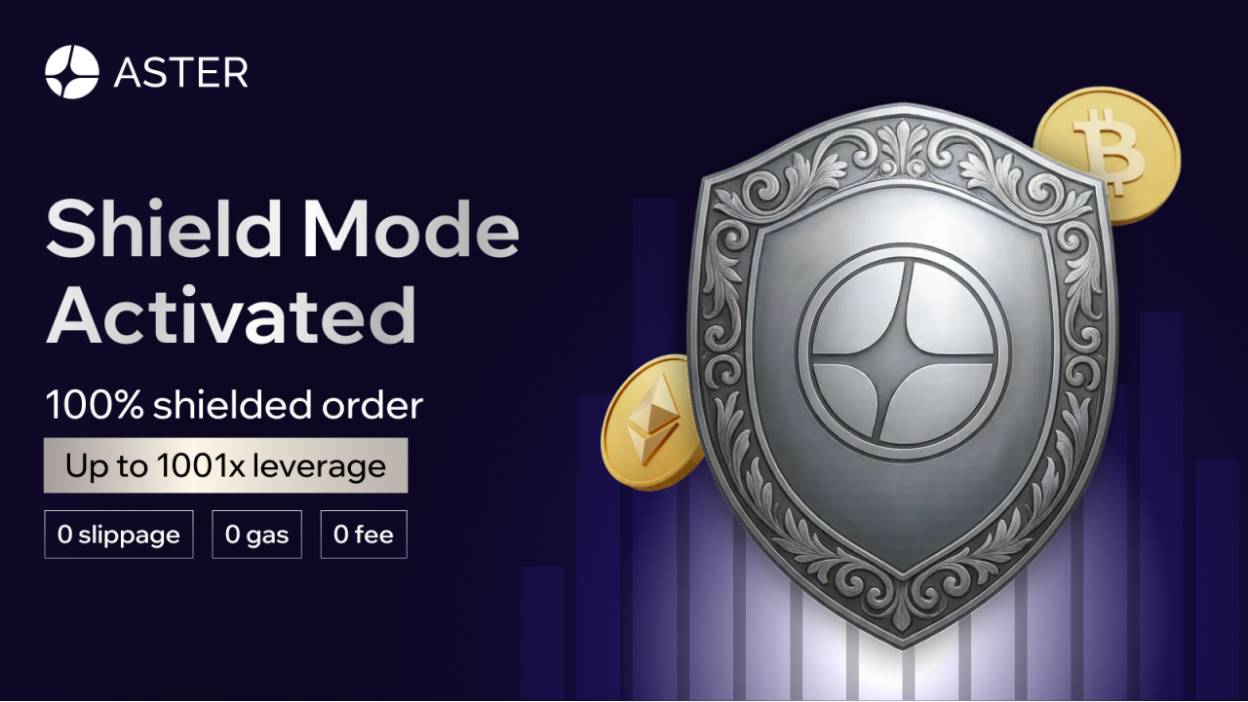
Aster Launches Shield Mode: A High-Performance Trading Protection Mode for On-Chain Traders

深潮Pubblicato 2025-12-15Pubblicato ultima volta 2025-12-15

Introduzione

Aster, a high-performance on-chain trading platform supported by YZi Labs, has launched Shield Mode, a new protected trading feature integrated directly into Aster Perpetual. This mode is designed for advanced traders, offering up to 1001x leverage, zero slippage, no opening fees, and fully on-chain settlement. It enhances privacy by allowing users to open and manage positions without interacting directly with the public order book, protecting trading strategies from exposure. Shield Mode also eliminates gas costs, accelerates execution, and will soon support flexible fee models: a commission-based structure or a profit-and-loss based fee. All Shield Mode trades are fee-free until the end of the year. This release marks a key step in Aster's vision to become a next-generation platform for professional on-chain trading.

Aster, a high-performance, privacy-focused on-chain trading platform supported by YZi Labs, today announced the official launch of Shield Mode. This trading feature, as a new protection mode, is directly integrated into Aster Perpetual, aiming to incorporate the complete 1001x leverage trading experience into a faster, more secure, and flexible on-chain trading environment.

Shield Mode is a significant milestone in Aster's vision to advance the next generation of on-chain trading platforms. This mode is designed for advanced traders while providing solutions to the core challenges exchanges face in fully transparent on-chain markets.

Regarding the official launch of Shield Mode, Aster CEO Leonard stated:

Shield Mode is our understanding and interpretation of the future of on-chain trading. The future of on-chain trading is not just about leverage and speed, but also about the emphasis on control, privacy, and protection mechanisms. We are building a platform where traders can perform at their highest level without being forced to expose their trading strategies to the entire market.

Evolution of On-Chain Trading: From 1001x Leverage to Shield Mode

Aster's 1001x leverage product is renowned for pushing the boundaries of on-chain perpetual trading, offering up to 1001x leverage, zero slippage, zero opening fees, and fully on-chain settlement. As on-chain trading infrastructure matures, traders are increasingly aware of the dual nature of fully transparent trading, particularly the risks associated with exposing strategies and intentions in on-chain markets.

In mid-2025, Aster introduced the Hidden Orders feature on its perpetual contract platform, allowing traders to hide order prices and quantities from the public order book while maintaining deep liquidity. This was a crucial step in giving traders greater operational privacy and freedom on-chain.

Shield Mode builds on this foundation with further upgrades, combining high-performance leveraged trading with enhanced trade intent protection to create a smoother and more controllable trading experience.

Shield Mode: The Next-Generation Trading Mode on Aster

Shield Mode is a new trading mode built directly on Aster Perpetual, integrating the 1001x leverage trading experience into a single interface and account system. In this mode, traders can more easily open and manage long or short positions without directly interacting with the public order book, while seamlessly accessing high-leverage trading without cross-chain switches, fragmented operations, or frequent on-chain signatures.

The advantages of Aster's 1001x trading model continue in Shield Mode, including up to 1001x leverage for BTC and ETH, zero slippage, and zero opening fees. Shield Mode further eliminates closing fees, completely removes Gas costs, and accelerates trade execution.

These improvements collectively set a new benchmark for on-chain perpetual contract trading: a high-level on-chain trading experience that combines cost efficiency with extreme performance.

Flexible Fee Structure to Adapt to Diverse Trading Strategies

Shield Mode is designed to support a flexible fee model, allowing traders to choose their payment method based on strategic preferences. In subsequent updates, traders will be able to choose between two modes:

  • Commission Mode: Charges a fixed percentage fee based on trading volume, suitable for high-frequency, stable trading.
  • PnL Mode: Charges fees only on profitable trades, suitable for performance-oriented strategies.

To celebrate the launch of Shield Mode, all trades in this mode will be fee-free from now until the end of the year. This flexibility gives traders greater autonomy over cost control, allowing users with different risk preferences and trading behaviors to find a suitable fee structure.

Laying the Foundation for Aster's Next Phase of Development

Shield Mode embodies Aster's macro vision beyond a single trading function. By introducing a protected trading mode for on-chain markets, Aster provides traders with greater decision-making autonomy and strategic protection capabilities.

Simultaneously, fully integrating the 1001x experience into Aster Perpetual lays the groundwork for unifying Aster's core products under a seamless system in the future, simplifying the path for traders to access high leverage and manage positions.

Combined with zero Gas costs and zero fee characteristics, this mode redefines the efficiency and performance standards of on-chain perpetual trading. This release marks Aster's evolution not only as a decentralized exchange but also as a platform specifically designed for professional and high-performance trading in the next generation of on-chain finance.

About Aster

As an on-chain trading platform, Aster supports high-performance perpetual contracts and spot trading, featuring MEV-aware trading mechanisms, advanced order types like Hidden Orders, and the protected trading mode Shield Mode across multiple blockchains.

Beyond trading features, Aster enhances capital efficiency through Trade & Earn and connects real traders with early liquidity opportunities via Rocket Launch to drive ecosystem growth.

Supported by YZi Labs, Aster is building its own Aster Chain and launching multi-phase airdrop and incentive programs for the global community.

To learn more, visit the Aster Official Website or the Official X Account.


Crypto di tendenza

Domande pertinenti

QWhat is Aster Shield Mode and what are its main benefits for on-chain traders?

AAster Shield Mode is a new trading protection mode integrated into Aster Perpetual, designed to provide a high-performance trading environment with enhanced privacy and control. Its main benefits include combining 1001x leverage trading with protection of trading intent, eliminating gas costs and closing fees, accelerating trade execution, and offering a flexible fee structure.

QHow does Shield Mode address the challenges of fully transparent on-chain markets?

AShield Mode addresses the challenges of on-chain market transparency by allowing traders to open and manage positions without directly interacting with the public order book. This protects their trading strategies and intentions from being exposed to the entire market, providing greater operational privacy and freedom.

QWhat trading advantages does Shield Mode inherit from Aster's 1001x leverage model?

AShield Mode inherits key advantages from Aster's 1001x leverage model, including up to 1001x leverage on BTC and ETH, zero slippage, zero opening fees, and fully on-chain settlement. It further enhances this by removing closing fees and gas costs entirely.

QWhat flexible fee structures will be available in Shield Mode for different trading strategies?

AShield Mode will offer two flexible fee structures: Commission Mode, which charges a fixed percentage fee based on trading volume (suitable for high-frequency, stable trading), and PnL Mode, which only charges fees on profitable trades (suitable for performance-oriented strategies).

QHow does the launch of Shield Mode contribute to Aster's broader vision for on-chain trading?

AThe launch of Shield Mode is a key milestone in Aster's vision for next-generation on-chain trading platforms. It provides traders with greater decision-making autonomy and strategy protection, integrates the 1001x experience into a seamless system, and sets new standards for cost efficiency and performance in on-chain perpetual trading.

Letture associate

Who Decides the Rules of Bitcoin? BIP-110 Ignites Governance Debate

Bitcoin's governance is once again at the center of a heated debate, this time ignited by BIP-110, the "Reduced Data Temporary Softfork." This proposal aims to curb non-monetary data (like inscriptions and Runes) by introducing seven new consensus-layer restrictions over a year, such as limiting new output scripts to 34 bytes and restoring the OP_RETURN cap to 83 bytes. The controversy stems from BIP-110's fundamental shift: it moves the battle against "spam" from node relay and miner policies to the consensus layer, rendering currently valid transactions invalid. Supporters, arguing that default policy governance has failed (highlighted by Bitcoin Core v30's relaxation of OP_RETURN limits), see this as necessary to protect node resources and Bitcoin's monetary focus. Opponents, led by figures like Michael Saylor and Adam Back, warn it dangerously centralizes governance. Saylor listed 110 reasons against it, criticizing its low 55% miner activation threshold and potential for chain splits. Back emphasized Bitcoin's "permissionless" ethos, arguing no single group should impose value judgments via consensus rules. Further complicating matters, technical critiques suggest BIP-110 may be technically circumventable, and a "BlockSlop" vulnerability in its upgrade path poses a consensus risk. The debate has drawn in diverse stakeholders: miners (with pools like Ocean signaling support and Foundry polling clients), node operators (like Bitcoin Knots), and new players like corporate treasury holder MicroStrategy (Saylor), whose market influence adds a novel dimension. Ultimately, BIP-110 acts as a governance stress test, exposing the unresolved question: who decides Bitcoin's rules? It pits the authority of miners, node operators, developers, and capital holders against each other, with each side claiming to defend Bitcoin's core principles of neutrality and security.

marsbit10 min fa

Who Decides the Rules of Bitcoin? BIP-110 Ignites Governance Debate

marsbit10 min fa

Who Decides Bitcoin's Rules? BIP-110 Ignites Governance Debate

Title: Who Decides Bitcoin's Rules? BIP-110 Ignites Governance Debate A new technical proposal, BIP-110 (Reduced Data Temporary Softfork), has sparked a fundamental governance debate within the Bitcoin community. It aims to impose new consensus rules for one year to limit non-financial data (like inscriptions and Runes) on-chain, moving beyond simple node and miner policy filters to invalidate currently valid transactions. Supporters argue that default policies have failed due to workarounds, necessitating consensus-layer changes to protect Bitcoin's core monetary function from data spam. Critics, including Michael Saylor and Adam Back, contend this dangerously centralizes judgment, undermines permissionlessness, and sets a risky governance precedent. They advocate for market-based solutions like fees or Layer 2s instead. The debate exposes deeper tensions: miners are divided on activation; node operators assert their sovereignty; Bitcoin Core developers influence defaults without direct accountability; and large corporate holders like MicroStrategy now wield narrative influence. Technically, BIP-110 may not fully block data and carries a disclosed consensus bug risk. Ultimately, BIP-110 acts as a stress test, forcing the community to confront the unresolved question: who legitimately decides what Bitcoin is and how it evolves, amidst competing claims from miners, nodes, developers, and capital holders.

链捕手22 min fa

Who Decides Bitcoin's Rules? BIP-110 Ignites Governance Debate

链捕手22 min fa

Zcash's New Node Zakura Goes Live: Privacy Payments Can Reach 50,000 TPS, Aiming to Rival Visa and Mastercard

Zcash, a privacy-focused cryptocurrency, has launched a new full node software called Zakura version 1.0.0. Developed by Zcash co-founder Sean Bowe and Dev Ojha, with private ZEC donations, its goal is to enable Zcash to process over 50,000 transactions per second (TPS)—matching the scale of Visa and Mastercard—while maintaining full transaction privacy and verifiability. This addresses a key bottleneck, as Zcash currently handles only about 1 private transaction per second. Zakura is a fork of the Zcash Foundation's Zebra node. It features chain pruning and snapshots, reducing disk usage and allowing new nodes to sync in under two minutes. It also offers compatibility with the legacy `zcashd` client interface. The scalability challenge stems from the large data size of privacy proofs. Bowe's Tachyon project aims to use recursive proofs to reduce consensus-layer data needs from ~500 MB/s to ~100 MB/s. For wallet scalability, Valar Group is researching Private Information Retrieval (PIR) tech to allow wallets to fetch their data privately. Zakura supports fast block propagation and the upcoming "Ironwood" network upgrade (NU6.3), scheduled for activation around July 28th. Ironwood was created to contain a critical inflation bug discovered in the Orchard shielded pool in May 2024. The fix uses "turnstiles" to trap any counterfeit ZEC created during the vulnerability period within the shielded pool, preventing it from entering circulation and restoring supply integrity.

marsbit37 min fa

Zcash's New Node Zakura Goes Live: Privacy Payments Can Reach 50,000 TPS, Aiming to Rival Visa and Mastercard

marsbit37 min fa

Replicating the "DeepSeek Moment"? Wall Street Unanimously Says: Kimi K3 Instead Strengthens Computing Power Demand

Title: Wall Street Sees Kimi K3 as a Catalyst for Compute Demand, Not a "DeepSeek Moment 2.0" Summary: Following the release of Moonshot AI's powerful open-source model Kimi K3, initial market reaction mirrored the "DeepSeek moment" that sparked a sell-off in compute stocks earlier in 2025, fearing reduced demand for AI infrastructure. However, major Wall Street banks including UBS, Nomura, BofA, and Citi argue the opposite: K3 will accelerate, not weaken, demand for compute, memory, storage, and networking. Their analysis centers on K3's specifications—2.8 trillion parameters, 1M token context, and MoE architecture—which represent a "scale" story rather than a pure "efficiency" one like DeepSeek R1. These features increase pressure on inference, memory (especially KV cache), and storage. Analysts invoke Jevons Paradox: as high-quality models become more affordable (K3 is cheaper than top closed models but not the cheapest), usage and token volumes expand, ultimately increasing total compute consumption. The reports highlight that competition will force leading US AI labs (OpenAI, Anthropic, Google) to invest more in training and iteration to maintain their edge. Furthermore, the rise of capable open-source models like K3 is expanding the global AI developer ecosystem, with Chinese models now accounting for over 45% of developer traffic. Key beneficiaries identified across the AI infrastructure chain include memory/storage players (e.g., Micron, Samsung), compute leaders (Nvidia, TSMC), networking suppliers (due to "super-node" cluster needs for deploying K3), and cloud platforms (e.g., Alibaba) that host diverse model ecosystems. The consensus is that stronger open-source models are an entry point for the next wave of infrastructure demand diffusion, provided workload growth outpaces efficiency gains.

链捕手40 min fa

Replicating the "DeepSeek Moment"? Wall Street Unanimously Says: Kimi K3 Instead Strengthens Computing Power Demand

链捕手40 min fa

Trading

Spot

Articoli Popolari

Come comprare O

Benvenuto in HTX.com! Abbiamo reso l'acquisto di O1 exchange (O) semplice e conveniente. Segui la nostra guida passo passo per intraprendere il tuo viaggio nel mondo delle criptovalute.Step 1: Crea il tuo Account HTXUsa la tua email o numero di telefono per registrarti il tuo account gratuito su HTX. Vivi un'esperienza facile e sblocca tutte le funzionalità,Crea il mio accountStep 2: Vai in Acquista crypto e seleziona il tuo metodo di pagamentoCarta di credito/debito: utilizza la tua Visa o Mastercard per acquistare immediatamente O1 exchangeO.Bilancio: Usa i fondi dal bilancio del tuo account HTX per fare trading senza problemi.Terze parti: abbiamo aggiunto metodi di pagamento molto utilizzati come Google Pay e Apple Pay per maggiore comodità.P2P: Fai trading direttamente con altri utenti HTX.Over-the-Counter (OTC): Offriamo servizi su misura e tassi di cambio competitivi per i trader.Step 3: Conserva O1 exchange (O)Dopo aver acquistato O1 exchange (O), conserva nel tuo account HTX. In alternativa, puoi inviare tramite trasferimento blockchain o scambiare per altre criptovalute.Step 4: Scambia O1 exchange (O)Scambia facilmente O1 exchange (O) nel mercato spot di HTX. Accedi al tuo account, seleziona la tua coppia di trading, esegui le tue operazioni e monitora in tempo reale. Offriamo un'esperienza user-friendly sia per chi ha appena iniziato che per i trader più esperti.

150 Totale visualizzazioniPubblicato il 2026.06.19Aggiornato il 2026.06.29

Come comprare O

Come comprare PROS

Benvenuto in HTX.com! Abbiamo reso l'acquisto di Pharos (PROS) semplice e conveniente. Segui la nostra guida passo passo per intraprendere il tuo viaggio nel mondo delle criptovalute.Step 1: Crea il tuo Account HTXUsa la tua email o numero di telefono per registrarti il tuo account gratuito su HTX. Vivi un'esperienza facile e sblocca tutte le funzionalità,Crea il mio accountStep 2: Vai in Acquista crypto e seleziona il tuo metodo di pagamentoCarta di credito/debito: utilizza la tua Visa o Mastercard per acquistare immediatamente PharosPROS.Bilancio: Usa i fondi dal bilancio del tuo account HTX per fare trading senza problemi.Terze parti: abbiamo aggiunto metodi di pagamento molto utilizzati come Google Pay e Apple Pay per maggiore comodità.P2P: Fai trading direttamente con altri utenti HTX.Over-the-Counter (OTC): Offriamo servizi su misura e tassi di cambio competitivi per i trader.Step 3: Conserva Pharos (PROS)Dopo aver acquistato Pharos (PROS), conserva nel tuo account HTX. In alternativa, puoi inviare tramite trasferimento blockchain o scambiare per altre criptovalute.Step 4: Scambia Pharos (PROS)Scambia facilmente Pharos (PROS) nel mercato spot di HTX. Accedi al tuo account, seleziona la tua coppia di trading, esegui le tue operazioni e monitora in tempo reale. Offriamo un'esperienza user-friendly sia per chi ha appena iniziato che per i trader più esperti.

144 Totale visualizzazioniPubblicato il 2026.06.22Aggiornato il 2026.06.29

Come comprare PROS

Cosa è VERONA

I. Introduzione al Progetto VERONA è una blockchain costruita per tutti, ovunque attraverso l'astrazione della catena. Utilizzando il suo livello di astrazione generalizzato, VERONA si distingue integrando funzionalità blockchain complesse, come conti, firme e interoperabilità, direttamente a livello di protocollo. Questo approccio consente di interagire con le applicazioni blockchain senza la necessità di comprendere le tecnologie sottostanti.1) Informazioni di Base Nome:VERONA(VERONA)III. Link Correlati Link al sito ufficiale:https://xion.burnt.com/ Whitepaper:https://xion.burnt.com/whitepaper.pdf Esploratori:https://explorer.burnt.com/ Social Media: https://x.com/burnt_xion Nota: L'introduzione al progetto proviene dai materiali pubblicati o forniti dal team ufficiale del progetto, che è solo a scopo di riferimento e non costituisce consulenza per investimenti. HTX non si assume responsabilità per eventuali perdite dirette o indirette risultanti.

162 Totale visualizzazioniPubblicato il 2026.06.22Aggiornato il 2026.06.22

Cosa è VERONA

Discussioni

Benvenuto nella Community HTX. Qui puoi rimanere informato sugli ultimi sviluppi della piattaforma e accedere ad approfondimenti esperti sul mercato. Le opinioni degli utenti sul prezzo di A A sono presentate come di seguito.

活动图片