As the Yuan Breaks 7, Why Is the Dollar Stablecoin USDT Trading at a Deep Discount?

比推Pubblicato 2025-12-30Pubblicato ultima volta 2025-12-30

Introduzione

The Chinese yuan (CNH) broke through the key 7.0 per dollar level in late December 2025, reaching its strongest point since Q3 2024. Concurrently, the USDT stablecoin experienced a rare and significant discount in its over-the-counter (OTC) price in China, falling to around 6.83 yuan—a negative premium of approximately 2.48% against the official exchange rate. This divergence is attributed to two main factors. First, a major external driver is the weakening US dollar. The dollar index fell 9% in 2025, its worst performance in eight years, driven by expectations of a more dovish Federal Reserve under new leadership and a reassessment of the "US exceptionalism" trade. This provided room for non-US currencies like the yuan to appreciate. Second, and more critically for USDT, was a significant regulatory crackdown in China. In early December 2025, Chinese regulators explicitly brought stablecoins like USDT under supervision to combat illegal cross-border capital flows and money laundering. This caused OTC traders to pause operations and many holders to panic-sell their USDT for yuan, creating a surge in supply and a collapse in demand that severely depressed its local price. Analysts conclude that the era of a perpetually strong dollar providing one-way gains is over. Market participants are now advised to move away from betting on unilateral currency moves and instead adopt a risk-neutral stance in a new environment of heightened volatility.

Author: ChandlerZ, Foresight News

Original Title: What Does the Simultaneous Occurrence of the Yuan Breaking 7 and the Discount on the Dollar Stablecoin Mean?


At the end of 2025, the foreign exchange market is undergoing a quiet but intense asset repricing.

In late December, the offshore yuan (CNH) exchange rate against the US dollar broke through the 7.0 mark during intraday trading, reaching as high as the 6.99 range, hitting a new high since the third quarter of 2024. The onshore yuan against the US dollar also touched 7.0133.

While the official exchange rate was still fluctuating around the 7.0 mark, the OTC price of USDT had already fallen below 6.90 much earlier. As of the time of writing, data from multiple exchanges show that the USDT OTC price (Buy 1) is approximately 6.83 yuan, representing a negative premium rate of 2.48% relative to the current exchange rate of 7.0040.

This inversion was almost unimaginable during the strong dollar cycle of the past three years.

The Collapse of the Dollar 'High Ground'

The decline of the US dollar in 2025 is the most important external backdrop for the yuan's strength.

In 2025, the US dollar index plummeted by 9% for the year, marking its worst performance in eight years, reflecting, to some extent, a global reassessment of "US Exceptionalism".
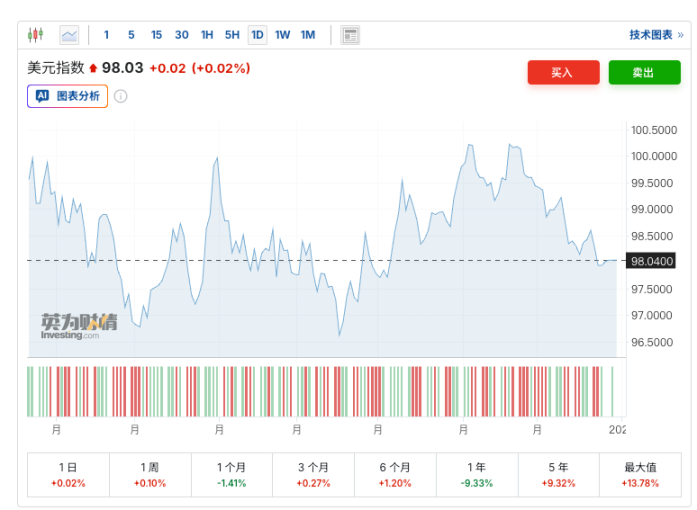
First is the gravitational pull of valuation regression. Although the dollar index has rebounded nearly 2% from its September low, from a fundamental perspective, the dollar is still outrageously "expensive." Data from the Bank for International Settlements (BIS) shows that as of October, the dollar's real broad effective exchange rate (REER), although down from its historical high of 115.1 in January to 108.7, remains at an absolute high. Karl Schamotta, Chief Market Strategist at global corporate payments company Corpay, stated bluntly: "From a fundamental perspective, the dollar is still overvalued."
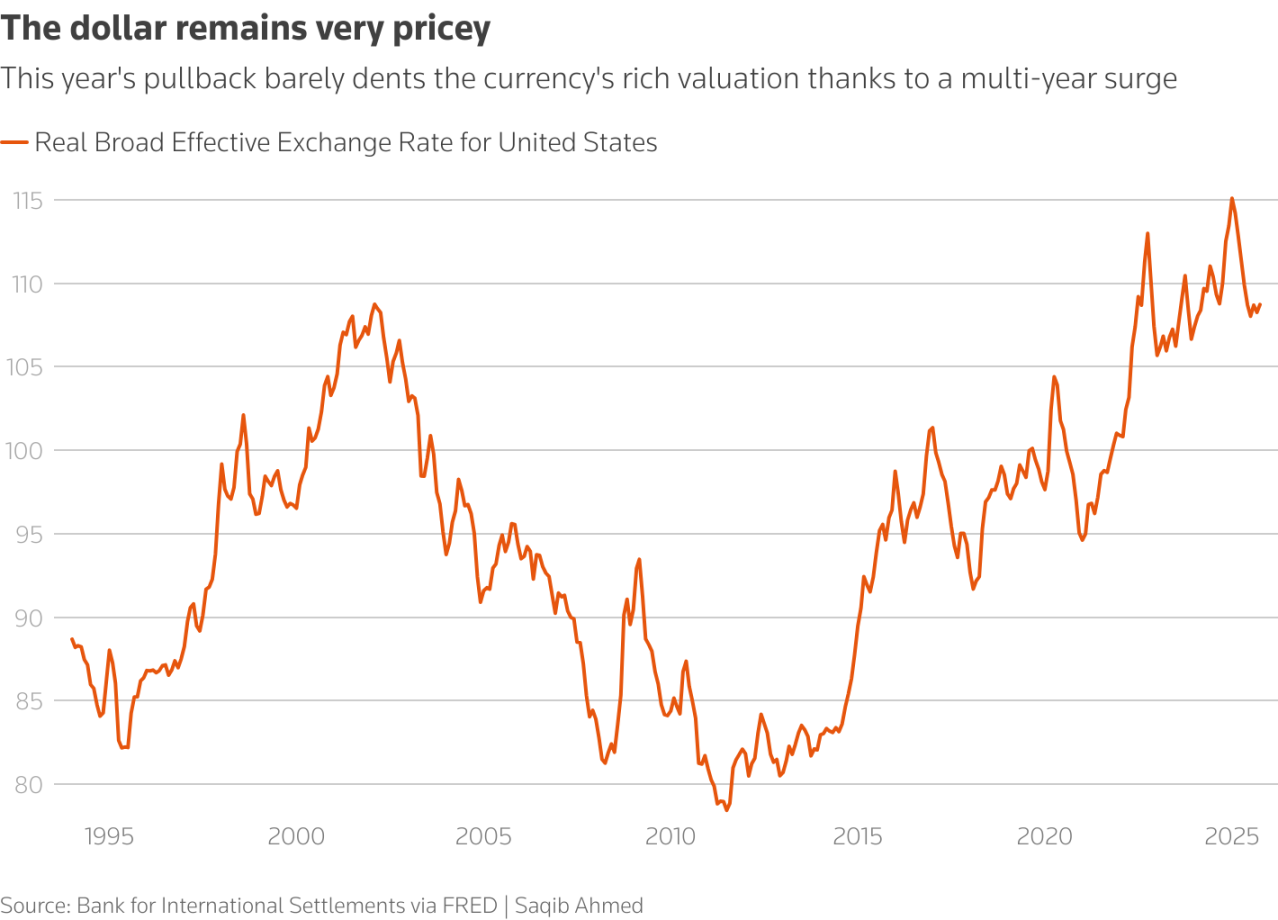
The line chart shows that due to years of sustained gains, this year's correction has barely impacted the dollar's high valuation.

Second is the dovish expectations for the new Fed. The market is pricing in a more accommodative 2025. With Powell set to step down and the Trump administration favoring low-interest-rate policies, leading candidates for his successor, including White House economic adviser Kevin Hassett and former Fed Governor Kevin Warsh, have all shown clear dovish tendencies.

Reuters noted in its year-end market report that the drop in the dollar index is driven more by expectations of Fed rate cuts, narrowing interest rate differentials with other economies, and changes in risk premiums due to the US fiscal deficit and political uncertainty.

And as the relative returns and safety premium of dollar assets are repriced, non-US currencies gain some upward room.

Institutional Consensus: Short-term Upward Momentum, Long-term Intensified Game

With the psychological barrier of 7.0 broken, the biggest question in the current market is whether this marks the start of a new long-term yuan appreciation cycle or is merely a short-term rebound driven by sentiment.

Standing on the threshold of 2026, the consensus among institutions is trending towards冷静 (calmness): short-term惯性向上 (inertia upward), long-term博弈加剧 (game intensifies).

Huachuang Securities believes that in terms of domestic supply and demand, the core factor behind it is foreign exchange settlement and sales. Although December's FX settlement and sales data have not yet been released, logical deduction suggests that the yuan's appreciation itself affects corporate expectations and behavior regarding FX settlement. Coupled with the typically strong seasonal characteristic of higher FX settlement at year-end, these two factors may have jointly driven the stronger performance of domestic supply and demand factors in the second phase of appreciation. On one hand, the continuous appreciation of the yuan exchange rate affects corporate expectations regarding FX settlement decisions; on the other hand, net FX settlement is usually strong at year-end.

However, the macro research team at Guotai Junan Securities also pointed out that the formation of yuan appreciation expectations is not without obstacles. Measuring domestic capital expectations using gold purchasing power parity, the volatility in 2025 was actually not low. Trade frictions in April once pushed domestic capital's depreciation expectations above 7.5, while the start of the Fed's rate cut cycle in September brought domestic capital's appreciation expectations to around 7.0. The reason is essentially that, in an environment where the internal economy has not yet shown significant elasticity, most investors remain somewhat hesitant about trend appreciation.

What Are the Reasons for USDT's Deep Discount?

Crypto market data analyst @Phyrex_Ni analyzed that the deep discount on USDT is mainly due to three reasons:

First: On a macro level, the Chinese yuan is currently strengthening significantly against the US dollar. Since the second half of 2025, the yuan has continued to strengthen. Reasons include the continuation of the Fed's rate-cutting cycle, the weakening US dollar index, and improved Chinese economic data. Holding USDT is equivalent to indirectly holding US dollar assets, which will incur exchange rate losses in the context of yuan appreciation. That is to say, the market itself, anticipating further yuan strength, has already priced in some exchange rate deviation, but this is not the main reason, only a very minor secondary factor.

Second: Chinese regulatory policies have tightened significantly. In early December 2025, the PBOC and twelve other departments jointly issued a document strengthening the crackdown on virtual currency trading speculation, explicitly bringing stablecoins (like USDT) into the regulatory scope, focusing on illegal cross-border capital flows, money laundering, and underground banks using USDT. This has led many OTC merchants and traders to suspend or reduce operations, causing market liquidity to tighten. Some holders, fearing account freezes or regulatory risks, are eager to sell USDT for yuan, increasing supply while demand plummets, directly depressing P2P prices. Historically, every regulatory upgrade in China (e.g., the 2021 ban) has led to negative OTC premiums for USDT. This time the力度 (force) is greater, so the deviation in USDT's exchange rate against the yuan is larger.

Third: The overall crypto market is volatile, and coupled with regulatory negative news, retail and institutional demand for USDT has decreased. Some investors based in mainland China, seeking to avoid risks, hope to offload their USDT as soon as possible, similar to the current negative premium cycle in China's real estate market.

Under the dual pressures of a turning macro cycle and tightening regulatory boundaries, the one-sided safe-haven logic of "holding US dollars means guaranteed gains" that prevailed over the past three years has completely失效 (failed).

For all market participants, the core task now is no longer to bet on whether the next point will be 6.8 or 7.0, but to告别 (bid farewell to) the path dependency on unilateral dollar appreciation. In a future where volatility is significantly elevated, the focus must回归风险中性 (return to risk neutrality).


Twitter:https://twitter.com/BitpushNewsCN

BitPush TG Discussion Group:https://t.me/BitPushCommunity

BitPush TG Subscription: https://t.me/bitpush

Original link:https://www.bitpush.news/articles/7599178

Crypto di tendenza

Domande pertinenti

QWhy did the offshore Chinese yuan (CNH) break through the 7.0 mark against the US dollar in December 2025?

AThe offshore Chinese yuan broke through the 7.0 mark due to a significant decline in the US dollar, which fell 9% throughout 2025, marking its worst performance in eight years. This reflected a global reassessment of 'US Exceptionalism,' alongside expectations of a more dovish Federal Reserve under potential new leadership and narrowing interest rate differentials with other economies.

QWhat were the main reasons for the deep discount in USDT's over-the-counter price relative to the official USD/CNY exchange rate?

AThe deep discount in USDT's price was primarily caused by China's stringent regulatory crackdown on cryptocurrency transactions, including stablecoins like USDT, which reduced market liquidity and increased selling pressure. Additionally, the appreciation of the yuan against the dollar made holding USDT less attractive, and overall crypto market volatility further dampened demand.

QHow did market expectations for the Federal Reserve's policy in 2025 influence the US dollar's performance?

AMarket expectations for a more dovish Federal Reserve in 2025, driven by potential new leadership favoring low-interest policies under the Trump administration, contributed to the US dollar's decline. This led to reduced relative yields and safety premiums for dollar assets, encouraging capital flow into non-US currencies like the yuan.

QWhat role did China's regulatory policies play in affecting USDT's market dynamics?

AChina's regulatory policies, specifically a joint announcement by 13 departments in December 2025 targeting virtual currency transactions and stablecoins like USDT, significantly reduced market liquidity. This caused many traders to pause operations and led to increased selling of USDT as users sought to avoid regulatory risks, resulting in a supply-demand imbalance and deep discount.

QWhat is the consensus among major financial institutions regarding the future trend of the yuan's exchange rate?

AMajor financial institutions consensus is that the yuan may experience short-term upward momentum due to factors like seasonal year-end forex settlements and changing corporate expectations, but long-term trends will involve increased volatility and uncertainty, especially given internal economic challenges and fluctuating investor sentiment towards sustained appreciation.

Letture associate

Unlocking $100 Million in Liquidity? Pump.fun's New Policy Tests the 5-Minute Pump Technique

Pump.fun, a popular meme coin launchpad, has introduced a new standard mechanism called BOOST. It aims to address a significant capital efficiency issue: when a newly launched token graduates from its initial bonding curve to a liquidity pool (LP), roughly 20% of its liquidity becomes permanently locked as "dead liquidity," estimated to waste over $100 million annually. Instead of locking these funds permanently, BOOST repurposes them. Upon a token's migration, approximately 20% of the settlement funds (e.g., 17.6 SOL or ~$2516 USDC) are used to buy back the token on the open market over a 5-minute period via a Time-Weighted Average Price (TWAP) mechanism. All purchased tokens are immediately burned. This creates a brief, systematic buy pressure immediately after migration, potentially generating a short-term price surge ("pump") while permanently reducing the token's circulating supply. The goal is to enhance the immediate post-launch trading experience, potentially increasing trader retention and sustainable protocol revenue, which funds ongoing token buybacks. However, concerns exist that this artificial 5-minute boost could lower the barrier for launching low-quality tokens and lead to steeper price crashes once the buy pressure stops, if followed by large sell-offs. The feature automatically applies to tokens migrating after July 21, 2024, but not to previously migrated tokens or those launched via the Mayhem AI Agent lab.

marsbit6 min fa

Unlocking $100 Million in Liquidity? Pump.fun's New Policy Tests the 5-Minute Pump Technique

marsbit6 min fa

Podcast Notes | Conversation with GSR Asset Management Head: To Determine if This Crypto Rally is Real, Just Watch the Lending Rates on Aave

Podcast Summary: Dialogue with GSR's Head of Asset Management: To Determine if This Crypto Rally is Real, Just Check Lending Rates on Aave Andy Baehr, Managing Director of Asset Management at GSR, discusses the current crypto market, characterizing it as stuck in a state of "ambivalence" with short-lived, unsustainable rallies. He outlines a simple framework: the market moves between "ambivalence" and "conviction" (sustained upward momentum). Currently, every rally resembles a single-stage rocket booster that quickly fizzles out. Baehr identifies three key signals to watch: 1) DeFi lending rates, 2) the potential passage of the CLARITY Act, and 3) the market forming a consensus on the "Fed hawkish peak." He emphasizes that the most immediate indicator for the sustainability of the recent CPI-triggered rally is the USDC borrowing rate on Aave, currently around 3.75%—close to U.S. Treasury yields. The absence of a credit spread indicates low leverage demand and a lack of market energy. He explains that a healthy, sustained rally requires layered buying pressure. Last year's rally progressed from an ETH short squeeze to crypto-native trader influx and finally to ETF inflows. Currently, this structure is missing. Other potential structural buyers like Digital Asset Treasury (DAT) companies are absent, and ETF flows have proven transient. Baehr notes that while small-cap crypto tokens outperformed large caps in Q2—a potential sign of capitation in major assets—capital is also flowing to more exciting opportunities like AI stocks and tech IPOs, leaving crypto sidelined. Regarding DeFi, he highlights that platforms like Aave provide a clear, real-time signal of leverage demand through their supply/demand-driven interest rates. A significant, sustained rate increase would signal genuine market conviction. He also observes the quiet emergence of fixed-income-like products and vaults in DeFi. On regulation, the probability of the CLARITY Act passing before the August 7th deadline has dropped linearly from 75% to below 40% on Polymarket. Baehr suggests its passage would be treated as a bullish surprise, a potent driver for price movement. However, political hurdles, including ethical clause debates and disclosures about the First Family's crypto profits, remain significant obstacles. Ultimately, the market awaits clarity on the Fed's terminal rate under Chair Warsh. Until the "Fed Solstice"—the point where the market collectively understands the peak of hawkish policy—sustained conviction will be difficult to achieve.

marsbit37 min fa

Podcast Notes | Conversation with GSR Asset Management Head: To Determine if This Crypto Rally is Real, Just Watch the Lending Rates on Aave

marsbit37 min fa

Trading

Spot

Articoli Popolari

Come comprare O

Benvenuto in HTX.com! Abbiamo reso l'acquisto di O1 exchange (O) semplice e conveniente. Segui la nostra guida passo passo per intraprendere il tuo viaggio nel mondo delle criptovalute.Step 1: Crea il tuo Account HTXUsa la tua email o numero di telefono per registrarti il tuo account gratuito su HTX. Vivi un'esperienza facile e sblocca tutte le funzionalità,Crea il mio accountStep 2: Vai in Acquista crypto e seleziona il tuo metodo di pagamentoCarta di credito/debito: utilizza la tua Visa o Mastercard per acquistare immediatamente O1 exchangeO.Bilancio: Usa i fondi dal bilancio del tuo account HTX per fare trading senza problemi.Terze parti: abbiamo aggiunto metodi di pagamento molto utilizzati come Google Pay e Apple Pay per maggiore comodità.P2P: Fai trading direttamente con altri utenti HTX.Over-the-Counter (OTC): Offriamo servizi su misura e tassi di cambio competitivi per i trader.Step 3: Conserva O1 exchange (O)Dopo aver acquistato O1 exchange (O), conserva nel tuo account HTX. In alternativa, puoi inviare tramite trasferimento blockchain o scambiare per altre criptovalute.Step 4: Scambia O1 exchange (O)Scambia facilmente O1 exchange (O) nel mercato spot di HTX. Accedi al tuo account, seleziona la tua coppia di trading, esegui le tue operazioni e monitora in tempo reale. Offriamo un'esperienza user-friendly sia per chi ha appena iniziato che per i trader più esperti.

151 Totale visualizzazioniPubblicato il 2026.06.19Aggiornato il 2026.06.29

Come comprare O

Come comprare PROS

Benvenuto in HTX.com! Abbiamo reso l'acquisto di Pharos (PROS) semplice e conveniente. Segui la nostra guida passo passo per intraprendere il tuo viaggio nel mondo delle criptovalute.Step 1: Crea il tuo Account HTXUsa la tua email o numero di telefono per registrarti il tuo account gratuito su HTX. Vivi un'esperienza facile e sblocca tutte le funzionalità,Crea il mio accountStep 2: Vai in Acquista crypto e seleziona il tuo metodo di pagamentoCarta di credito/debito: utilizza la tua Visa o Mastercard per acquistare immediatamente PharosPROS.Bilancio: Usa i fondi dal bilancio del tuo account HTX per fare trading senza problemi.Terze parti: abbiamo aggiunto metodi di pagamento molto utilizzati come Google Pay e Apple Pay per maggiore comodità.P2P: Fai trading direttamente con altri utenti HTX.Over-the-Counter (OTC): Offriamo servizi su misura e tassi di cambio competitivi per i trader.Step 3: Conserva Pharos (PROS)Dopo aver acquistato Pharos (PROS), conserva nel tuo account HTX. In alternativa, puoi inviare tramite trasferimento blockchain o scambiare per altre criptovalute.Step 4: Scambia Pharos (PROS)Scambia facilmente Pharos (PROS) nel mercato spot di HTX. Accedi al tuo account, seleziona la tua coppia di trading, esegui le tue operazioni e monitora in tempo reale. Offriamo un'esperienza user-friendly sia per chi ha appena iniziato che per i trader più esperti.

145 Totale visualizzazioniPubblicato il 2026.06.22Aggiornato il 2026.06.29

Come comprare PROS

Cosa è VERONA

I. Introduzione al Progetto VERONA è una blockchain costruita per tutti, ovunque attraverso l'astrazione della catena. Utilizzando il suo livello di astrazione generalizzato, VERONA si distingue integrando funzionalità blockchain complesse, come conti, firme e interoperabilità, direttamente a livello di protocollo. Questo approccio consente di interagire con le applicazioni blockchain senza la necessità di comprendere le tecnologie sottostanti.1) Informazioni di Base Nome:VERONA(VERONA)III. Link Correlati Link al sito ufficiale:https://xion.burnt.com/ Whitepaper:https://xion.burnt.com/whitepaper.pdf Esploratori:https://explorer.burnt.com/ Social Media: https://x.com/burnt_xion Nota: L'introduzione al progetto proviene dai materiali pubblicati o forniti dal team ufficiale del progetto, che è solo a scopo di riferimento e non costituisce consulenza per investimenti. HTX non si assume responsabilità per eventuali perdite dirette o indirette risultanti.

163 Totale visualizzazioniPubblicato il 2026.06.22Aggiornato il 2026.06.22

Cosa è VERONA

Discussioni

Benvenuto nella Community HTX. Qui puoi rimanere informato sugli ultimi sviluppi della piattaforma e accedere ad approfondimenti esperti sul mercato. Le opinioni degli utenti sul prezzo di A A sono presentate come di seguito.

活动图片