As the Crypto Market Cools, How is Neutrl Turning Tokenized Stocks into a New 'Yield Farm'?

marsbitPubblicato 2026-08-12Pubblicato ultima volta 2026-08-12

Introduzione

As crypto markets cool, Neutrl explores turning tokenized stocks into a new yield source. The protocol focuses on delta-neutral strategies, shifting from crypto-native yields (like funding rates) which thin during downturns, to opportunities in pre-IPO and locked-up shares. The supply of these shares follows corporate calendars (IPOs, employee unlocks) independent of crypto cycles. Neutrl's strategy involves purchasing locked shares at a discount (e.g., 15%) and hedging by shorting equivalent perpetual futures. This creates a market-neutral position. During the lock-up period, the short position can earn significant funding rates from the nascent stock perpetuals market. A representative six-month trade could yield ~20.5%: ~15% from the entry discount and ~5.5% from funding rates, regardless of the stock's price movement. The opportunity is large, with the eligible locked stock pool estimated at 4.5x the size of filtered crypto unlock pipelines. As tokenization expands to assets like commodities and rates, each new market with liquid shorting tools can apply this same arbitrage framework, offering yield uncorrelated to crypto volatility.

Author: ponyo_fp, Four Pillars

Compiler: AididiaoJP, Foresight News

Key Takeaways

  • Funding rates, basis, and lock-up discounts are essentially 'taxes' on crypto speculation. Consequently, when demand for stablecoins is high, the real yield on synthetic dollars tends to be compressed.
  • The supply schedule of stock lock-ups depends on IPO timetables and insider liquidity arrangements, having no relation to crypto market cycles.
  • The daily trading volume of stock perpetual contracts has surged from $84 million to $5.5 billion, giving crypto asset managers their first real ability to hedge stock exposure.
  • A typical locked-stock transaction yields approximately 20.5 percentage points over a six-month holding period—15 points from the entry discount and 5.5 points from funding rate positions, independent of the stock's price movement.
  • The size of the eligible locked-stock pool is about 4.5 times that of the filtered crypto unlock pipeline.
  • Looking ahead, any market that develops liquid shorting instruments—commodities, interest rates, or the next tokenized asset—will follow the same trading logic.

Neutrl is exploring extending its delta-neutral strategy to tokenized stocks and pre-IPO shares. Below, we break down the logic behind this, how much a representative trade can earn, why the opportunity is significant, and why the buyer market is still nascent.

Note: Neutrl is an on-chain market-neutral synthetic dollar protocol. It issues NUSD (a tradable, composable synthetic dollar) and sNUSD (the staked, yield-bearing version). The core approach is to package OTC arbitrage, locked token discount trades, and basis/funding rate arbitrage—strategies typically accessible only to institutions and hedge funds—onto the blockchain, allowing everyday users to earn relatively stable, non-directional yields. While similar to synthetic dollar protocols like Ethena, it places greater emphasis on the structural opportunity of OTC locked token discounts and is currently exploring expanding its strategy to areas like tokenized stocks and pre-IPO shares.

The Structural Mismatch of Yield

Synthetic dollars inherently have a structural mismatch: when the crypto market cools, capital most often flocks to stablecoins seeking a low-volatility haven; yet precisely at that time, the yield on synthetic dollars thins. The reason is that funding rates, basis, and unlock discounts all stem from crypto speculation. Until recently, there were almost no hedgeable assets outside the crypto cycle, making this mismatch unsolvable. But this year, a second dimension of timing is emerging.

In the first half of 2026, the 30-day average trading volume of the top 30 altcoin perpetual contracts fell from $8.4 billion to $5.9 billion, a 30% contraction. As volume shrinks, so does the room supporting funding rates and basis. Delta-neutral strategies built entirely on crypto-native spreads tend to perform best when markets are quiet and weakest when they are lively. Switching trading assets doesn't change this, as these spreads almost all breathe with the same crypto cycle.

But the supply of stock lock-ups follows a different rhythm. IPO schedules, employee unlock windows, and shares from fund lock-up periods release gradually according to their own calendars. Packed listing schedules, funds nearing distribution deadlines, insiders needing liquidity per plans set years ago—none of these are correlated with Bitcoin. These discounts have existed in private secondary markets for years; the barrier has never been insufficient supply, but rather a lack of hedging tools. A discount without a hedge isn't yield; it's just exposure with a story attached.
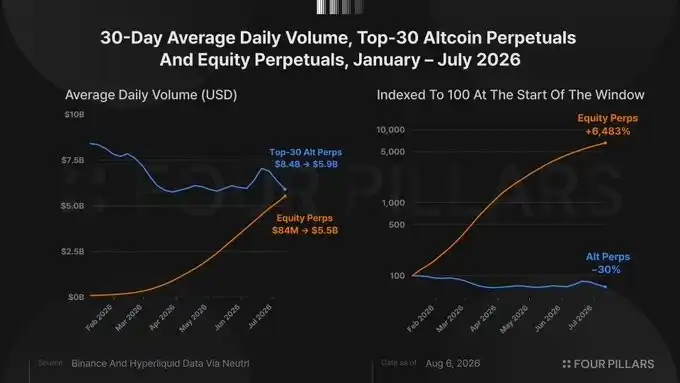
A market becomes truly investable when it becomes shortable. Holders of tokenized stocks grew from about 70,000 in September last year to over 670,000 by July this year. Simultaneously, the daily trading volume of stock perpetual contracts leapt from $84 million to $5.5 billion within six months. Crossing this threshold transforms the asset class of locked, discounted shares from 'visible' to 'investable.'

This is precisely the logic behind Neutrl's focus—not layering a strategy on top of existing logic, but finding a yield channel with a driver completely independent of the crypto cycle.

A Robust Yield of Approximately 20 Percentage Points

The most intuitive way is to examine a representative transaction under evaluation by Neutrl (specific target undisclosed, still under discussion). The trading desk plans to acquire shares in a late-stage private company at a 15% discount to the reference price, with a lock-up of about six months (corresponding to the pre- and post-IPO window). This 15% is not the market average nor a fixed rate; it's merely indicative terms for a current evaluation. Discounts vary with lock-up duration, transfer restrictions, and seller liquidity needs.

On the hedge side, they short an equivalent notional amount of the same stock's perpetual contract. From day one, the delta is near zero; the profit or loss no longer depends on stock price movement, only on whether the discount converges after the lock-up expires and the yield generated from the hedge during the holding period.
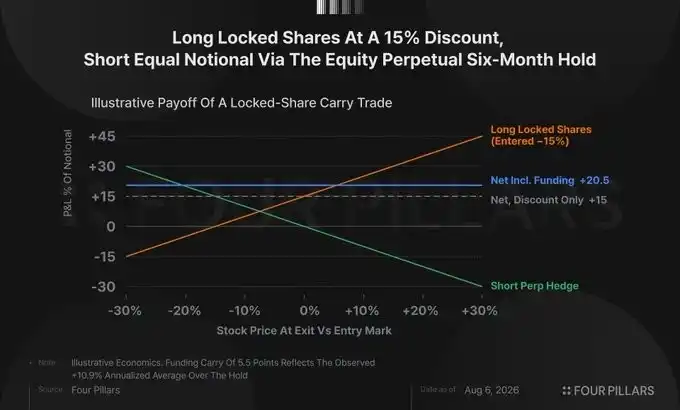
The hedge itself also generates yield. During the actual observation window from late May to mid-July, the annualized funding rate for the short side of stock perpetual contracts averaged 10.9%, with volatility ranging from approximately -35% to +55%. Such dramatic swings are common in young funding rate markets not yet smoothed by professional capital. Estimated over a six-month holding period, this contributes about 5.5 percentage points. Adding the initial 15-point discount, the overall yield is roughly 20.5 percentage points, with directional exposure hedged. The final result is a smooth yield line—regardless of the stock's final price movement, it runs about 20 percentage points above zero.
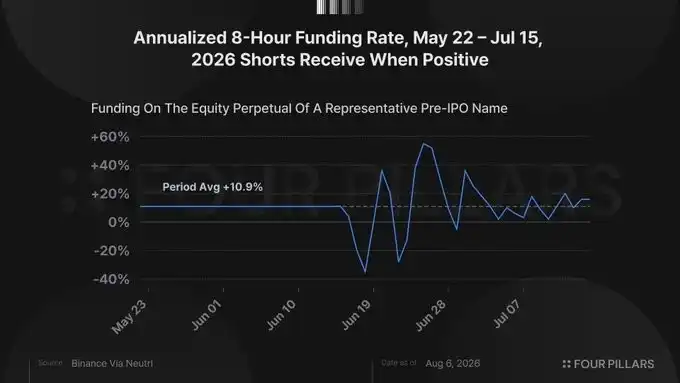
Why is the market willing to pay such high rates for the short side? Because demand is one-sided. The buyers of stock perpetual contracts are traders seeking round-the-clock, leveraged stock exposure, bypassing traditional trading hours and broker restrictions. They far outnumber the professional capital willing to sit on the other side. Young perpetual markets have historically offered rich compensation to shorts until sufficient arbitrage capital flows in, compressing spreads to lower levels. The stock perpetual market is at the starting point of this curve, with a substantial underlying pool. Excluding the largest single stock, the size of the eligible locked-stock pool is approximately $48.2 billion, about 4.5 times the size of the filtered crypto unlock pipeline. Including that stock pushes the estimated size to $1.74 trillion. Spreads are fattest when a market is born—this isn't a flaw in the argument; it *is* the argument.

One Trading Framework, Covering All Shortable Assets

For stakers, the real change is independence. The income stream from listing calendars and lock-up expirations continues to pay out even as crypto-native markets quiet down—precisely when stablecoin holders need yield most.

Stocks are the first market outside crypto to develop liquid shorting instruments, but they won't be the last. Commodities follow closely, then interest rates, and then, the next tokenized asset. Every newly opened perpetual market adds a layer of previously visible but unreachable spreads. Expansion itself is the essence of this business model. Neutrl's approach is: buy the locked asset, short the liquid asset, and capture the spread between them as long as both coexist. This opportunity set will compound alongside the process of tokenization.


Domande pertinenti

QAccording to the article, what is the core structural mismatch faced by synthetic dollar strategies, and what new dimension is helping to address it?

ASynthetic dollar strategies face a structural mismatch where stablecoin demand (and the need for yield) is highest when the crypto market cools down, but the yields from crypto-native sources like funding rates, basis, and unlock discounts are thinnest precisely during those periods because they depend on speculative crypto activity. A new dimension addressing this is the emergence of tokenized stocks and their liquid perpetual markets, which offer a yield source (discounted pre-locked shares and funding rate income) driven by a calendar (IPO schedules, lock-up releases) completely independent of the crypto cycle.

QDescribe the two main components of the approximately 20.5% return from Neutrl's representative tokenized stock trade outlined in the article.

AThe approximately 20.5% return over a six-month period comes from two main components: 1) An **entry discount** of around 15 percentage points for purchasing pre-locked shares of a late-stage private company. 2) A **funding rate yield** of around 5.5 percentage points earned from holding a short position in the corresponding stock's perpetual futures contract during the holding period. This return is delta-neutral, meaning it does not depend on the underlying stock's price movement.

QWhy does the funding rate for stock perpetuals currently provide such a high yield to the short side, according to the article's analysis?

AThe funding rate for stock perpetuals provides a high yield to the short side because the market demand is heavily one-sided. The buyers are primarily traders seeking 24/7 leveraged equity exposure without traditional market or broker restrictions. Their numbers far exceed the amount of professional arbitrage capital currently operating on the opposite (short) side. This imbalance is typical in young perpetual markets before sufficient arbitrage capital enters to compress the spreads.

QWhat key market development made locked, discounted equity shares a truly investable asset class rather than just a visible opportunity?

AThe key development was the market becoming **shortable**. Specifically, the explosive growth of liquid stock perpetual futures markets, where daily trading volume surged from $84 million to $55 billion within six months. This provided the necessary hedging tool, transforming discounted, locked shares from a risky directional bet into a source of delta-neutral, structured yield.

QWhat is the broader implication of Neutrl's strategy framework beyond just tokenized stocks, as suggested in the article's conclusion?

AThe broader implication is that Neutrl's core framework—buying a locked/illiquid asset and shorting its liquid derivative to capture the spread—is a template applicable to any new market that develops liquid shorting instruments. The article suggests that commodities, interest rates, and any future tokenized assets will follow the same pattern. Each new liquid perpetual market unlocks a new layer of previously inaccessible yield, meaning the opportunity set for this strategy will compound alongside the process of asset tokenization.

Letture associate

ArthurHayes新文:押注日元升值,ENA未来几月或涨5至10倍

Arthur Hayes argues that the Japanese Yen is significantly undervalued and posits that its appreciation against the US Dollar is imminent. He outlines three potential mechanisms for this shift, dismissing the first two—the Bank of Japan raising interest rates and domestic institutions selling foreign assets—as politically or economically unfeasible. He identifies the third and preferred method: the Japanese Ministry of Finance (MOF) using its holdings of US Treasuries as collateral in the Fed's FIMA repo facility to borrow US dollars, then selling those dollars to buy Yen in the forex market. Hayes believes US Treasury Secretary Bessant has signaled support for this approach, which requires the Fed's Foreign Currency Subcommittee, led by Chairman Walsh, to remove lending limits on the FIMA tool. Hayes asserts that implementing this "Scheme 3" would lead to a significant expansion of US dollar liquidity. He predicts this surge in liquidity will act as a catalyst, driving up the prices of assets like Bitcoin and physical gold. Within the crypto space, he views Ethereum (ETH) as undervalued and singles out Ethena's ENA token as a speculative play with potential for 5-10x gains in the coming months, contingent on a recovery in Bitcoin basis trades that would boost demand for its USDe stablecoin. He concludes that investors should watch for the Fed's rule change as the key trigger for these market movements.

marsbit8 min fa

ArthurHayes新文:押注日元升值,ENA未来几月或涨5至10倍

marsbit8 min fa

Is It Time to End the Era of Perp DEXes Burning Cash for Growth?

The article questions whether the era of perpetual decentralized exchanges (Perp DEXes) relying heavily on token incentives for growth should end. It argues that while token incentives (points, airdrops, farming) are useful for bootstrapping liquidity and attracting users, they often attract short-term, incentive-driven behavior rather than genuine, long-term traders. The piece analyzes how platforms use future token value to acquire current trading volume and liquidity, but notes this creates data that is difficult to interpret. A key test comes after the Token Generation Event (TGE), when the removal of incentive expectations reveals whether user retention is based on product quality or continued subsidies. Data from platforms like Hyperliquid, Lighter, and edgeX shows varying success in converting airdrop attention into sustained trading relationships post-TGE. Post-TGE, the focus often shifts from distributing tokens to supporting the token's value through mechanisms like fee revenue buybacks and burns. However, this ties value redistribution to token holdings rather than direct trading contributions. Analysis of user behavior on platforms like Hyperliquid reveals that holding a platform's token, participating in its financial products, and engaging in perpetual trading are often distinct activities, indicating that broad token ownership does not equate to genuine trading demand. This creates a tension for platforms, which must manage both a trading market and a token market with potentially conflicting goals. The article concludes by introducing PopDEX, an approach backed by Foresight Ventures, which proposes a different model. Instead of channeling value first through a platform token, PopDEX aims to establish a "100% value return" framework. This system is designed to directly and transparently redistribute the value generated from trading fees back to those who create it—such as active traders, referrers, and affiliates—based on verifiable market contributions. The piece suggests that as the Perp DEX industry matures, exploring alternative incentive structures that move beyond pure token-driven growth is a necessary evolution.

marsbit16 min fa

Is It Time to End the Era of Perp DEXes Burning Cash for Growth?

marsbit16 min fa

Chinese Data Generation Team Makes Debut in Nature Journal

A Hong Kong-based startup, Weina AI, has become China's first and the world's fourth data-generation technology company to publish in a leading Nature journal (IF>10 in recent three years) with a paper on AI-assisted kidney cancer surgery decision-making. Founded by Professor Liu Qifeng, who previously led the creation of the world's first thousand-card H800 SuperPod cluster at HKUST, the company focuses on enhancing AI's "questioning" ability to generate high-quality reasoning Q&A data, which is key for AI self-learning. The published Nature Communications paper, co-authored with medical experts, addressed a clinical challenge in renal surgery. Using an RDPM model on multi-source data from 1,621 patients, the AI achieved high predictive accuracy for long-term kidney function decline, providing a quantitative basis for surgical decisions. Professor Liu outlines AI development in three stages: from data to models, from models to token generation, and crucially, from tokens back to data—where AI actively generates questions, reasoning steps, and verified answers (cQrA: context, Question, reasoning, Answer). Weina AI's mission is to create this "data → model → token → data" feedback loop, enabling Agentic AI to autonomously evolve in professional domains. This moves beyond costly manual data annotation by using AI agents to generate scalable, chain-of-thought data. The company raised a HK$50 million seed round led by Lenovo Capital. Instead of focusing deeply on one sector, it adopted a "breadth-first" strategy, successfully deploying its technology across four high-accuracy, disparate fields: value-alignment safety, government affairs, insurance, and horse racing, proving cross-industry replicability. Liu argues that the future core of AI is not the model or data alone, but this self-reinforcing closed loop. This logic extends to embodied AI, where training shifts from imitation to autonomous generation of action data (cTrA: context, Task, reasoning, Action) through trial, error, and feedback. Weina AI's vision is to leverage this paradigm to "generate the world."

marsbit16 min fa

Chinese Data Generation Team Makes Debut in Nature Journal

marsbit16 min fa

Trading

Spot
活动图片