Arthur Hayes' Latest Article: After Trump 'Colonizes' Venezuela, the Money Printing Press Will Go Wild, Last Year's Biggest Loss Was PUMP

marsbitPubblicato 2026-01-06Pubblicato ultima volta 2026-01-06

Introduzione

Arthur Hayes analyzes the geopolitical and economic implications of the U.S. intervention in Venezuela under a hypothetical Trump administration, framing it as a strategic move to control oil resources and influence domestic politics. The core argument is that elected politicians prioritize reelection above all else. For Trump, winning the 2026 midterms and 2028 presidential election requires stimulating the economy through money printing and deficit spending to boost nominal GDP and financial assets. However, rising inflation, especially in gasoline prices, could anger voters and cost elections. Thus, controlling Venezuela’s oil is crucial to suppress energy inflation. Hayes posits that if GDP grows while oil prices remain stable or fall, Republicans will likely win. If both GDP and oil prices rise sharply, Democrats may gain power due to voter discontent. Oil prices act as a trigger: if they spike, it could force policymakers to tighten monetary policy, increasing volatility (as measured by the MOVE index) and Treasury yields, potentially causing a market sell-off. The baseline scenario expects subdued oil prices and aggressive money printing, which would be bullish for Bitcoin and crypto assets. Hayes advises monitoring oil and bond yields for signs of policy change. His trading strategy involves macro-driven positions in crypto, with a focus on privacy tokens like ZEC for alpha, while reducing exposure to meme coins. He plans to take profits if oil inflation accelerates...

Original: Arthur Hayes

Compilation: Yuliya, PANews

Imagine a video call between U.S. President Trump and Venezuelan President Pepe Maduro, while Maduro was on a flight from Caracas to New York.

Trump: "Pepe Maduro, you are such a bad guy. Your country's oil is mine now, USA!"

Pepe Maduro: "Trump, you madman!"

*Note: Arthur Hayes refers to the Venezuelan president as "Pepe Maduro" in the article instead of his real name Nicolás Maduro. "Pepe" is a common nickname for "José" in Spanish, although Maduro's name is Nicolás.

One can apply various positive or negative labels to this historic, disruptive, authoritarian, militaristic event of the U.S. "kidnapping" or "legally arresting" the leader of a sovereign nation. Countless AI-assisted writers will likely churn out endless articles interpreting these events and predicting the future. They will judge these actions from a moral perspective and advise how other countries should respond. But this article is not about that. The core question is only one: Will the U.S. "colonization" of Venezuela push the price of Bitcoin/cryptocurrency up or down?

The Only Rule of Politics: Re-election

To answer this question, we must understand a simple, brutal political reality: All elected politicians, at all times, focus on only one thing—winning re-election. Grand narratives like God, country, etc., all come after winning votes. Because if you don't have power, you can't bring about change, so in a way, this obsession with re-election is rational.

For Trump, two elections are crucial: the 2026 midterms and the 2028 presidential election. Although he himself does not need to run in 2026 and cannot run for a third presidential term in 2028, the loyalty and obedience of his political supporters depend on their respective re-election prospects. Those who defected from the "Make America Great Again" (MAGA) camp did so precisely because they believed their future election prospects would dim if they continued to follow Trump's orders.
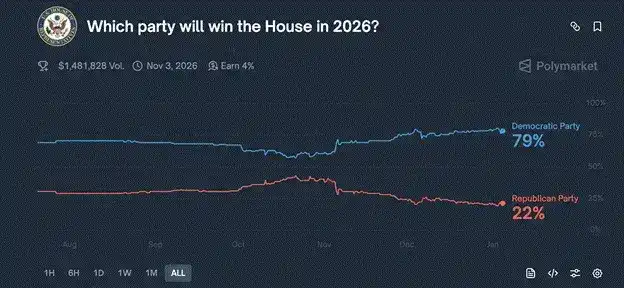
So, how can Trump ensure that the undecided swing voters, those not yet committed to the Democratic (Blue) or Republican (Red) camps, cast the "right" vote in November 2026 and 2028?

Currently, it seems likely that the Blue Democrats will retake the House of Representatives. For Trump to be a winner, he must act immediately. There is not much time left for policy adjustments to change voters' minds.

What Do Voters Care About? The Economy, Especially Oil Prices

So, how to please swing voters? All the flashy culture wars are worthless compared to the voter's wallet. Voters only care about the economy, about whether they feel richer or poorer when they vote.

For Trump, the easiest way to stimulate the economy is to turn on the money printing press and boost nominal GDP. This drives up financial asset prices, pleasing the wealthy class who will "reward" him with campaign donations. However, in the U.S., it's one person, one vote. If money printing leads to serious inflation and the cost of living soars for the general public, they will vote the ruling party out.

Trump and Treasury Secretary Besant have indicated they will let the economy run hot. The question is, how will they suppress inflation? The kind of inflation that kills re-election chances is inflation in food and energy.

For the average American, the most sensitive inflation indicator is gasoline prices. Because the U.S. public transportation system is poor, almost everyone drives, and oil prices directly affect everyone's cost of living.

Therefore, Trump and his deputies "colonized" Venezuela for its oil.

When talking about Venezuelan oil, many will quickly point out that the country has the world's largest proven reserves. But how much oil is in the ground doesn't matter. The question is, can it be extracted profitably? Trump clearly believes that by developing Venezuela's oil resources, oil can be shipped to Gulf Coast refineries, and cheap gasoline will appease the populace by suppressing energy inflation.

Whether this strategy is correct will be answered by the West Texas Intermediate (WTI) and Brent crude oil markets. As nominal GDP and dollar credit supply increase, will oil prices rise or fall? If GDP and oil prices rise together, the Blue Democrats win; if GDP rises while oil prices remain flat or fall, the Red Republicans win.

The best part of this framework is that oil prices will reflect all reactions from other oil-producing and military powers (most importantly Saudi Arabia, Russia, and China) to the U.S. "colonization" of Venezuela. Another advantage is that the market is reflexive. We know Trump adjusts policy based on stock prices, U.S. Treasuries, and oil prices. As long as stock prices keep rising and oil prices stay low, he will continue printing money and pursuing "colonization" policies to obtain oil. As investors, we can react on the same timeframe as Trump, which is the best scenario we can hope for. This reduces the need to predict the outcome of a complex geopolitical system. Traders just need to read the charts and adapt.

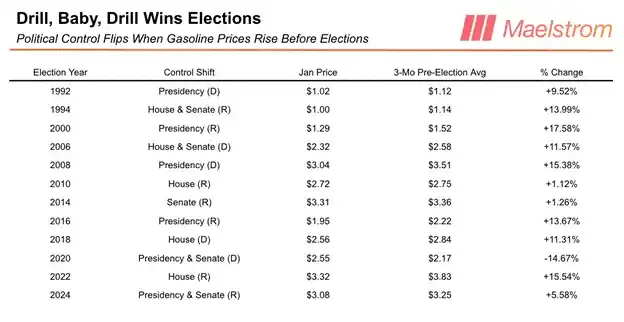
Here are some charts and statistical analysis that clearly show why Trump must boost nominal GDP while suppressing oil prices to win the election:
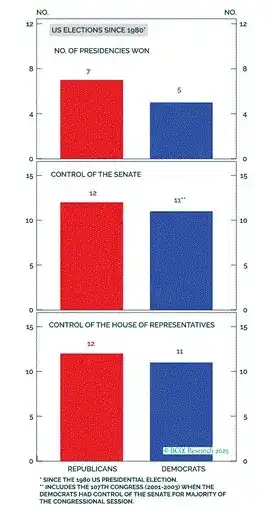
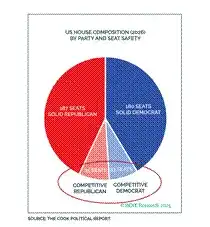
  • Political Landscape: The Red and Blue camps are evenly matched, with only a small portion of Americans deciding which camp controls the government.
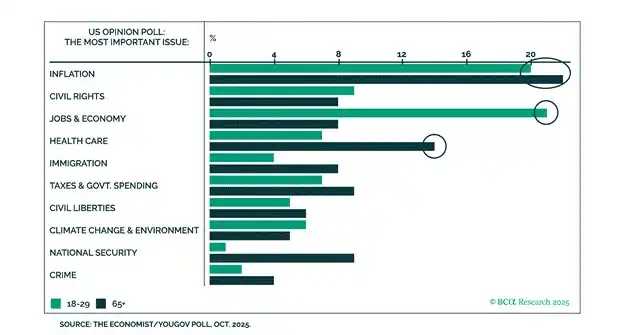
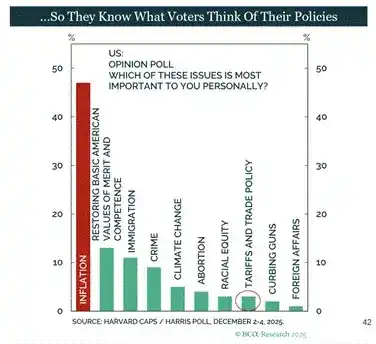
  • Voter Focus: The economy and inflation are the top two concerns for voters; everything else is irrelevant.
  • "The 10% Rule": When the national average gasoline price in the three months before the election rises by 10% or more compared to the January average of the same year, control of one or more branches of government changes hands.
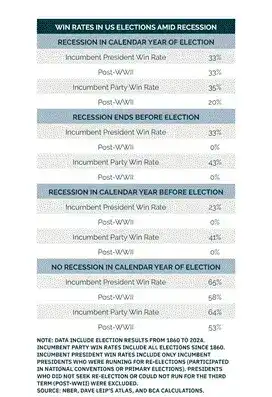
  • Election Prospects: If a recession is avoided, the Red camp has the best chance of winning the 2028 presidential election.

These charts clearly show that Trump must make the economy run hot without causing gasoline prices to rise.

Bitcoin's Trajectory Under Two Scenarios

We face two scenarios: one where nominal GDP/credit and oil prices both rise; and another where nominal GDP/credit rises while oil prices fall. How will Bitcoin react?

To understand this, one must first clarify a core point: Oil prices are crucial not because they affect mining costs, but because they have the power to force politicians to stop printing money.

Bitcoin consumes energy through Proof-of-Work (PoW) mining, making it a pure monetary abstraction. Therefore, the energy price itself is irrelevant to the Bitcoin price, as all miners' costs change synchronously, which does not alter Bitcoin's intrinsic value logic.

The real power of oil prices lies in them being a "trigger" for political and financial disaster.

The Chain Reaction of Runaway Oil Prices

If economic expansion causes oil prices to rise too fast and too high, it will trigger the following series of devastating chain reactions:

Runaway oil prices mean a surge in the cost of living for the people, which will directly ignite voter anger and put those in power at great risk of being ousted. To retain power, they must suppress oil prices at all costs (e.g., by stealing oil from other countries or slowing credit creation). The 10-year U.S. Treasury yield and the MOVE index, which measures volatility in the U.S. bond market, will tell us when oil prices are too high.

Investors face a difficult choice: invest in financial assets or physical assets. When energy costs are low and stable, investing in financial assets like government bonds is reasonable. But when energy costs are high and volatile, investing in energy commodities is wiser. Therefore, when oil prices reach a certain level, investors will demand higher yields from government bonds, especially the 10-year U.S. Treasury.

When the 10-year Treasury yield approaches 5%, market volatility may increase significantly, and the MOVE index could spike. Current U.S. politics make it difficult to curb deficit spending; "free benefits" often win in elections. However, as oil prices rise and yields approach critical levels, the market may come under pressure. Because the current fiat financial system is embedded with massive leverage, when volatility rises, investors must sell assets, or they will be wiped out.

For example, last year's April 2nd "Liberation Day" and the subsequent April 9th Trump "TACO" (Tariff Action) is an example. Trump threatened extremely high tariffs, which would have reduced global trade and financial flow imbalances, creating a strong deflationary effect. The market plummeted, and the MOVE index briefly surged to 172 intraday. The next day, Trump "paused" the tariffs, and the market bottomed and rebounded violently.
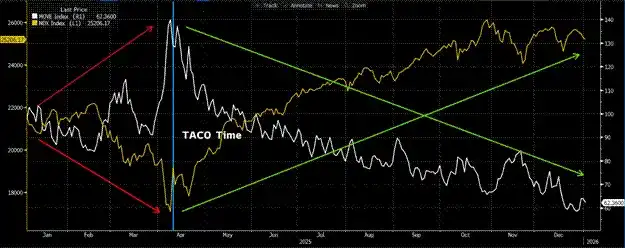
MOVE Index (White) vs. Nasdaq 100 Index (Yellow)

On such issues, trying to use historical data to precisely determine at what level oil prices and the 10-year yield will force Trump to tighten money printing is not meaningful. We will know it when we see it happen. If oil prices and yields rise sharply, then one should reduce bullishness on risk assets.

The current base case scenario is: Oil prices will remain stable or even fall, while Trump and Besant will print money like crazy, as in 2020. The reason is that the market will initially believe that U.S. control of Venezuelan oil will significantly increase daily crude production. Whether engineers can actually achieve millions of barrels per day in Venezuela is not important.

What really matters is: Trump will print money faster than Israeli Prime Minister Benjamin Netanyahu changes his reasons for attacking Iran. If this logic is still not enough to convince someone that it's time to go long on all risk assets, just remember one thing: Trump is the most socialist U.S. president since Roosevelt. He printed trillions of dollars in 2020 and, unlike previous presidents, sent money directly to everyone. You can be sure he will not lose an election by under-printing.

Based on statements from Trump and his core team, we know credit will expand. Red Republican lawmakers will engage in deficit spending, Besant's Treasury will issue debt to finance it, and the Federal Reserve (whether Powell or his successor) will print money to buy these bonds. As Lyn Alden says, "Nothing can stop this train." As the quantity of dollars expands, the prices of Bitcoin and certain cryptocurrencies will soar.
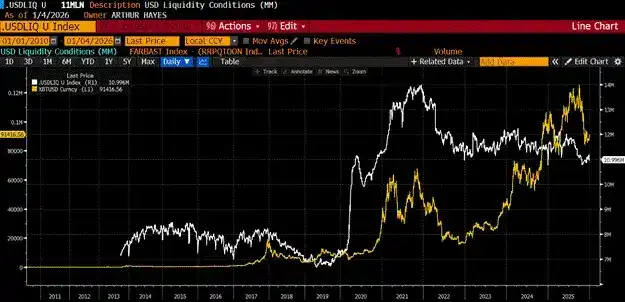
Trading Strategy

Arthur Hayes' biggest loss last year came from trading the token PUMP after its launch. Also, remember to stay away from Meme coins; the only Meme coin trade he made money on last year was TRUMP. On the bright side, most profits came from trading HYPE, BTC, PENDLE, and ETHFI. Although only 33% of trades were profitable, position sizing was managed well, and the average profit of winning trades was 8.5 times the average loss of losing trades.

Arthur Hayes plans to improve this year by: Focusing on what he is good at, which is making large, medium-term position deployments based on clear macro liquidity theses combined with a credible "altcoin" narrative. When trading "shitcoins" or Meme coins for entertainment purposes, he will reduce position size.

Looking ahead, this year's dominant narrative will revolve around "privacy." ZEC will be the bellwether in the privacy field. Maelstrom was already heavily long on this token in Q3 2025. The plan is to find at least one "altcoin" in the privacy space that can lead the trend and bring excess returns to the portfolio in the coming years. To achieve returns that outperform BTC and ETH, he plans to sell some Bitcoin and Ethereum in exchange for more explosive "altcoins" in the privacy and DeFi fields.

Once oil prices rise and cause a slowdown in credit expansion, he will take profits opportunistically, accumulate more Bitcoin, and buy some mETH.


Domande pertinenti

QAccording to Arthur Hayes, what is the primary goal of all elected politicians?

AThe primary goal of all elected politicians is to win re-election.

QWhat is the single most important issue for voters, as stated in the article?

AThe single most important issue for voters is the economy.

QWhy did Trump 'colonize' Venezuela, according to the author's analysis?

ATrump 'colonized' Venezuela for its oil, in order to produce cheap gasoline and suppress energy inflation to appease the American populace.

QWhat is the '10% Rule' mentioned in the article regarding elections?

AThe '10% Rule' states that when the national average gas price in the three months before an election is 10% or more higher than the average price in January of the same year, control of one or more branches of government changes hands.

QWhat is the author's main trading focus and narrative for the year, as stated at the end of the article?

AThe author's main trading focus for the year is on 'privacy', with ZEC being the bellwether for the privacy narrative.

Letture associate

When Doing Cryptocurrency Payment, the First Thing is Licenses, What is the Second?

When launching a crypto payment business, obtaining the necessary licenses is the crucial first step. However, the second, and arguably more critical, step is designing a comprehensive operational framework that forms a coherent business loop. This loop must be clearly understood and executable by all stakeholders: banks, payment partners, exchanges, on-chain analytics providers, regulators, and your internal team. Many projects mistakenly believe a single license permits all operations. Licenses merely grant entry; they don't define how the specific business functions. The real challenge lies in detailing every aspect of the workflow. This involves clarifying the customer base, the flow of fiat and crypto assets, the settlement process, and establishing clear lines of responsibility for risks like AML compliance, sanctions screening, chargebacks, and regulatory inquiries. A robust framework must answer seven core questions: Who are the clients and merchants? Who collects fiat and crypto? Who handles conversion and custody? And who is ultimately accountable for compliance and risk management? Projects often fail not from a lack of licensing, but during due diligence when they cannot convincingly explain these operational details. Therefore, beyond securing licenses, the priority must be constructing a closed-loop system. This system ensures the business model is transparent, risks are managed, responsibilities are delineated, contracts are aligned, and the entire process is comprehensible to partners and regulators. The true competitive edge in crypto payments lies not in acquiring a license quickly, but in integrating licensing, banking, compliance, and operations into a sustainable and executable whole.

marsbit32 min fa

When Doing Cryptocurrency Payment, the First Thing is Licenses, What is the Second?

marsbit32 min fa

Arthur Hayes Analysis: AI Bubble Nears Burst, Crypto Market Faces Short-Term Pressure

Arthur Hayes argues that the current AI market is a bubble poised to burst, which will exert downward pressure on the crypto market in the near term. The core trigger is rising oil prices due to the US-Iran conflict and a blockade of the Strait of Hormuz. Higher energy costs directly increase the operational expenses of AI data centers, squeezing profit margins for companies like Google, Anthropic, and OpenAI. Hayes predicts that persistent inflation from high oil prices will force Trump, in a bid to win the November election, to turn public sentiment against the AI industry. He may propose regulations and taxes on data centers and AI companies to appeal to voters concerned about costs and job displacement. Such political rhetoric could shatter market confidence. Furthermore, the market is unlikely to healthily absorb the massive concurrent IPOs of SpaceX, Anthropic, and OpenAI, which together seek valuations in the trillions. The combination of soaring energy costs, overwhelming equity supply, and negative political pressure will puncture the AI bubble. Hayes notes that nearly all new USD liquidity since 2022 has flowed into AI, leaving crypto like Bitcoin behind. When the AI bubble bursts, liquidity will contract sharply, pulling down all risk assets, including cryptocurrencies. In response, Hayes's fund, Maelstrom, has sold all AI-related stocks and non-core cryptocurrencies. It maintains core positions in Bitcoin and Ethereum while increasing exposure to energy sector equities, betting on rising oil and gas prices. He expects Bitcoin to bottom after the AI-led market decline, before rallying again with future monetary easing.

Foresight News46 min fa

Arthur Hayes Analysis: AI Bubble Nears Burst, Crypto Market Faces Short-Term Pressure

Foresight News46 min fa

To C, To B, and the Next Big Thing Called To A

After To C and To B, the Next Wave is To A: Serving AI Agents In a recent quarterly earnings call, Meituan's Wang Xing introduced a new concept: To A (To Agent), signifying that future business services will increasingly target AI Agents as primary clients, not just consumers or merchants. This shift implies that internet giants must now consider how to make their services more appealing for AI Agents to recommend, fundamentally altering traditional distribution logic. This "To A era" is prompting an unusual trend of alliances among major tech companies. Unlike previous competitive battles, firms like Meituan, Tencent, JD.com, Huawei, OPPO, and OpenAI are rapidly forming partnerships. The reason is strategic: as AI Agents become the primary user interface, handling tasks from a single command (e.g., "Book a Japanese restaurant for tomorrow"), the risk for platforms is being bypassed entirely. Companies are positioning themselves within this new value chain. Three primary strategies are emerging: 1. **Super-Entry Points + Service Providers:** Platforms like Tencent's Yuanbao, WeChat, and ChatGPT aim to be the first-stop Agent, integrating various services (food delivery, shopping, travel) from partners like Meituan and JD.com. 2. **Apps as Callable Services:** Companies like Meituan, JD.com, and Uber are ensuring their core services remain accessible and callable by external Agents, shifting from front-end apps to back-end capabilities. 3. **System-Level Agent Entry Points:** Smartphone makers (Huawei, Honor, OPPO) are leveraging their OS-level AI assistants to control the initial user command, redistributing it to relevant service apps. While alliances offer mutual benefit—entry points gain service capabilities, and service providers gain traffic—inherent conflicts of interest exist. A dominant Agent platform could eventually attempt to connect directly with suppliers (restaurants, hotels), bypassing current aggregators like Meituan or Ctrip. Other unresolved challenges include the potential for Agent recommendations to become a new form of paid ranking and unclear accountability for faulty recommendations. The current rush to form alliances is a defensive move by service providers to secure their position before the landscape solidifies. In this To A-driven restructuring, the greatest risk is not losing the race but failing to hear the starting gun.

marsbit55 min fa

To C, To B, and the Next Big Thing Called To A

marsbit55 min fa

The More Lifelike the Robot, the More Terrifying? Unveiling the 'Uncanny Valley Effect' in the Era of Humanoid Robots

As humanoid robots become increasingly lifelike, they confront a significant psychological barrier known as the "Uncanny Valley Effect," a concept proposed by Japanese roboticist Masahiro Mori in 1970. This phenomenon describes a dip in human comfort and acceptance when robots appear almost, but not perfectly, human. Minor imperfections in facial expressions, eye movements, or skin texture trigger a subconscious sense of unease, as the brain detects something trying, yet failing, to mimic a person. Examples range from the controversial human-like robot Sophia to animated characters in films like *The Polar Express*. The effect poses a key design challenge for robotics companies. Some, like Boston Dynamics, avoid it entirely by creating highly capable but visibly mechanical robots. Others, like Hanson Robotics, push for greater human likeness despite the risk. For consumer robots, especially in homes, most manufacturers opt for stylized or clearly mechanical designs to ensure broader acceptance. While the Uncanny Valley remains a powerful force, its impact may diminish over time through technological advancements that achieve near-perfect realism or through generational familiarity as people grow accustomed to interacting with humanoid machines. Ultimately, navigating this psychological frontier requires as much understanding of human perception as of robotics technology itself.

marsbit56 min fa

The More Lifelike the Robot, the More Terrifying? Unveiling the 'Uncanny Valley Effect' in the Era of Humanoid Robots

marsbit56 min fa

Trading

Spot
Futures

Articoli Popolari

Come comprare PUMP

Benvenuto in HTX.com! Abbiamo reso l'acquisto di Pump.fun (PUMP) semplice e conveniente. Segui la nostra guida passo passo per intraprendere il tuo viaggio nel mondo delle criptovalute.Step 1: Crea il tuo Account HTXUsa la tua email o numero di telefono per registrarti il tuo account gratuito su HTX. Vivi un'esperienza facile e sblocca tutte le funzionalità,Crea il mio accountStep 2: Vai in Acquista crypto e seleziona il tuo metodo di pagamentoCarta di credito/debito: utilizza la tua Visa o Mastercard per acquistare immediatamente Pump.funPUMP.Bilancio: Usa i fondi dal bilancio del tuo account HTX per fare trading senza problemi.Terze parti: abbiamo aggiunto metodi di pagamento molto utilizzati come Google Pay e Apple Pay per maggiore comodità.P2P: Fai trading direttamente con altri utenti HTX.Over-the-Counter (OTC): Offriamo servizi su misura e tassi di cambio competitivi per i trader.Step 3: Conserva Pump.fun (PUMP)Dopo aver acquistato Pump.fun (PUMP), conserva nel tuo account HTX. In alternativa, puoi inviare tramite trasferimento blockchain o scambiare per altre criptovalute.Step 4: Scambia Pump.fun (PUMP)Scambia facilmente Pump.fun (PUMP) nel mercato spot di HTX. Accedi al tuo account, seleziona la tua coppia di trading, esegui le tue operazioni e monitora in tempo reale. Offriamo un'esperienza user-friendly sia per chi ha appena iniziato che per i trader più esperti.

319 Totale visualizzazioniPubblicato il 2024.12.12Aggiornato il 2026.06.02

Come comprare PUMP

Discussioni

Benvenuto nella Community HTX. Qui puoi rimanere informato sugli ultimi sviluppi della piattaforma e accedere ad approfondimenti esperti sul mercato. Le opinioni degli utenti sul prezzo di PUMP PUMP sono presentate come di seguito.

活动图片