Arthur Hayes’ Bombshell CLARITY Act Warning Just Resurfaced — And The Timing Couldn’t Be Worse

bitcoinistPubblicato 2026-05-20Pubblicato ultima volta 2026-05-20

Introduzione

BitMEX co-founder Arthur Hayes has strongly opposed the CLARITY Act, urging for its veto. He argues that regulation is structurally incompatible with Bitcoin and decentralized systems, which derive value from operating outside regulatory frameworks. Hayes contends the bill primarily benefits centralized exchanges and institutions seeking traditional capital, not decentralized assets. He believes Bitcoin's price is driven by global liquidity and money supply, not legislation. His comments resurface as the CLARITY Act gains significant momentum, having just cleared the Senate Banking Committee with a bipartisan 15-9 vote. The bill now moves toward further reconciliation and votes, with industry warnings that delay could push action to 2030. Hayes's investment positions reflect his thesis: his largest holdings outside Bitcoin are Hyperliquid's HYPE and privacy-focused ZCash, assets rooted in decentralization rather than regulatory accommodation. This stance creates a stark divide as the crypto industry nears a potential U.S. regulatory framework.

Arthur Hayes, co-founder of BitMEX and Chief Investment Officer of Maelstrom, called for the CLARITY Act to be vetoed in a recent interview with Scott Melker, host of The Wolf of All Streets — comments that have resurfaced at a moment of peak legislative momentum, just days after the bill cleared the Senate Banking Committee with a bipartisan 15-9 vote.

Speaking with Melker, Hayes delivered his position without qualification. “The CLARITY Act should be vetoed. We don’t need no regulation.” The remark, amplified by Wu Blockchain (@WuBlockchain) on X, puts him in direct and public opposition to virtually every major centralized exchange, lobby group, and corporate executive in the space — all of whom have spent months treating the bill as the most consequential piece of crypto legislation in US history.

Why Hayes Says The Industry Is Wrong

The argument Hayes is making is not that regulation is inconvenient. It is that regulation is structurally incompatible with what Bitcoin and decentralized systems actually are.

His framing is pointed: the companies lobbying hardest for the CLARITY Act — exchanges, custodians, and institutional platforms — are entities that need regulatory frameworks to operate and attract traditional capital.

The bill clears their path. It does not, in Hayes’ view, do anything meaningful for Bitcoin or genuinely decentralized systems, which derive their value precisely from operating outside any regulatory architecture. “Regulation is for people who own centralized companies — obviously they want this, that makes complete sense,” he said, per reporting of his remarks at Consensus Miami 2026 where he expanded on the same thesis.

The macro argument runs beneath the regulatory one. Hayes has consistently maintained that Bitcoin’s price is driven by global liquidity conditions and fiat money supply expansion — not legislative milestones. “So what is CLARITY going to bring? Nothing — unless there’s more money printing,” he said. “Otherwise, there’s no value here, because it’s just another asset on a bank balance sheet,” per Yahoo Finance’s reporting of his Consensus remarks. AI-related job disruption and rising geopolitical tensions, he argued, may ultimately force central banks toward fresh liquidity injections — and that, not the CLARITY Act, is what actually moves Bitcoin.

The Bill That Just Got Harder To Stop

Hayes’ comments land at an uncomfortable moment for anyone who shares his skepticism. The CLARITY Act cleared the Senate Banking Committee with a 15-9 vote — two Democrats, Ruben Gallego and Andy Kim, crossed the aisle to support it — a margin that surprised even supporters who had anticipated a strict party-line outcome, per Scott Melker’s reporting on Yahoo Finance. The bill now moves toward reconciliation with the Senate Agriculture Committee’s version, a floor vote requiring seven Democratic senators, and ultimately a presidential signature.

Ripple CEO Brad Garlinghouse, speaking at Consensus Miami, warned that if passage doesn’t happen before the summer recess, the probability drops sharply — potentially pushing any action to 2030 or beyond, per dMarket Forces. Senator Bernie Moreno has described the current window as Congress’s last real opportunity before the 2026 midterm calendar complicates everything.

The Portfolio Behind The Conviction

Hayes’ own positions reflect the worldview driving his CLARITY Act argument. Outside Bitcoin, his two largest holdings are HYPE — Hyperliquid’s token, which he targets at $150 by August 2026 — and ZCash, a privacy-focused cryptocurrency he has set a $10,000 long-term price target for, per Stocktwits’ reporting of his Consensus remarks.
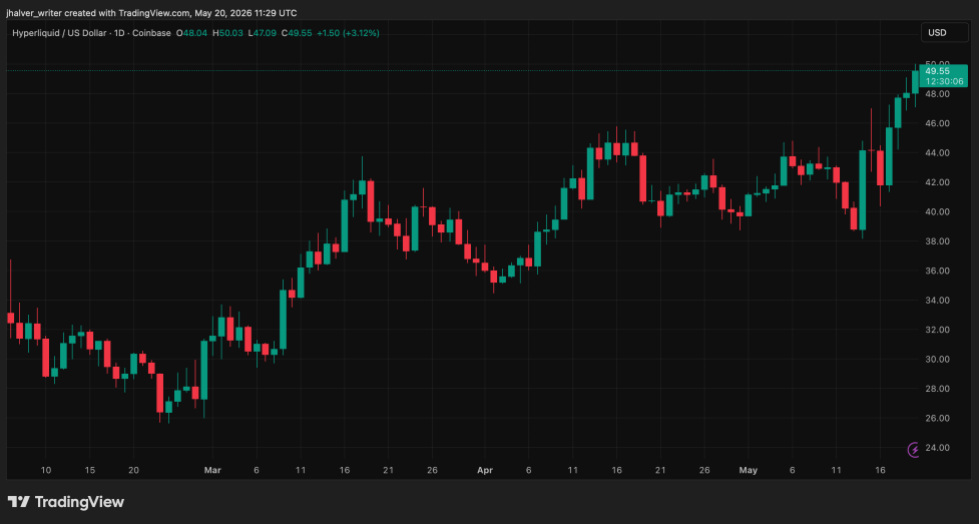
HYPE's price trends to the upside as seen on the daily chart. Source: HYPEUSD on Tradingview

Both are assets whose value proposition is rooted in decentralization and censorship resistance rather than regulatory accommodation. Neither benefits meaningfully from the CLARITY Act. The portfolio is an argument made in capital.

This development marks a critical and genuinely uncomfortable moment for the nascent sector. The industry is closer than it has ever been to a durable US regulatory framework — the Senate Banking Committee just proved it — and one of Bitcoin’s most prominent voices is on record saying that getting there may be exactly the wrong outcome.

Cover image from ChatGPT, HYPEUSD chart from Tradingview

Domande pertinenti

QAccording to Arthur Hayes, why is the CLARITY Act incompatible with Bitcoin and decentralized systems?

AArthur Hayes argues that regulation is structurally incompatible with Bitcoin and decentralized systems because their value is derived from operating outside any regulatory architecture. He states that the CLARITY Act primarily benefits centralized entities like exchanges and custodians who need regulatory frameworks, but does nothing meaningful for genuinely decentralized systems.

QWhat was the margin of the Senate Banking Committee vote on the CLARITY Act, as mentioned in the article?

AThe CLARITY Act cleared the Senate Banking Committee with a bipartisan 15-9 vote.

QBesides Bitcoin, what are Arthur Hayes's two largest cryptocurrency holdings, and what are his price targets for them?

AArthur Hayes's two largest holdings besides Bitcoin are HYPE (Hyperliquid's token) and ZCash. He has a price target of $150 for HYPE by August 2026 and a long-term target of $10,000 for ZCash.

QWhat does Arthur Hayes believe is the primary driver of Bitcoin's price, according to the article?

AArthur Hayes believes that Bitcoin's price is driven primarily by global liquidity conditions and fiat money supply expansion, not by legislative milestones like the CLARITY Act.

QWhat warning did Ripple CEO Brad Garlinghouse give regarding the timeline for passing the CLARITY Act?

ARipple CEO Brad Garlinghouse warned that if the CLARITY Act is not passed before the summer recess, the probability of passage drops sharply, potentially pushing any legislative action to 2030 or beyond.

Letture associate

Claude Code Introduces Dynamic Workflows: Enabling AI to Form Teams and Collaborate

Claude Code introduces dynamic workflows, enabling AI to coordinate teams of specialized agents for complex tasks. This transforms Claude from a code assistant into a programmable workbench. Workflows address key limitations of single-agent systems: agentic laziness (premature task completion), self-preferential bias (favoring own outputs), and goal drift (losing sight of original objectives). The system allows Claude to dynamically create execution frameworks using JavaScript. It can split tasks, dispatch parallel agents for isolated work (e.g., in separate worktrees), implement adversarial validation, run tournaments, and synthesize results. This multi-agent approach is valuable for tasks requiring deep research, factual verification, code migration, root cause analysis, large-scale triage, and qualitative sorting. Key patterns include: classify-and-route, fan-out-and-synthesize, adversarial verification, generate-and-filter, tournaments, and loop-until-done. While token usage is higher, workflows excel where tasks resemble programming—needing problem decomposition, isolated context, hypothesis testing, and handling many details. They extend Claude Code's utility beyond technical work to areas like business plan review, resume screening, and naming brainstorm. The feature is not a universal solution but points to a future where AI tool competitiveness depends on organizing reliable, reusable, and auditable execution flows for complex goals.

marsbit12 min fa

Claude Code Introduces Dynamic Workflows: Enabling AI to Form Teams and Collaborate

marsbit12 min fa

Hyperliquid, Wall Street's 24/7 Trading Convenience Store

Hyperliquid: The 24/7 Trading "Convenience Store" for Wall Street Hyperliquid, a decentralized cryptocurrency exchange, has become a go-to platform for Wall Street traders seeking to trade around the clock, especially during traditional market closures. Founded by Jeff Yan, a former quantitative trader, after the FTX collapse, the platform emphasizes user self-custody of assets. It offers a wide range of perpetual contracts—leveraged derivatives with no expiry—on assets from Bitcoin and crude oil to the S&P 500 and even pre-IPO companies like SpaceX. A notable example involves a hedge fund trader who capitalized on geopolitical news over a weekend, securing a 243% return on oil derivatives before markets reopened. The platform, run by just 11 employees, generated approximately $800 million in revenue last year, and its native token HYPE has seen significant growth. Its rise highlights the merging of traditional finance and crypto. While U.S. users are currently restricted, recent CFTC rule changes could open access. The platform is known for its transparency, having processed $10 billion in liquidations during a market crash while competitors faltered. Regulators warn of the high risks and complexity of perpetual contracts for retail investors. Key to its appeal is a strong community culture, direct engagement with founders, and a simple interface. Despite rules against VPN use, it attracts global users with its permissionless approach. Hyperliquid plans to expand into prediction markets and options, aiming to eventually host all financial activity.

marsbit12 min fa

Hyperliquid, Wall Street's 24/7 Trading Convenience Store

marsbit12 min fa

Who Funds the Agents?

**Summary: Who Funds AI Agents?** OpenAI recently shut down a feature allowing AI agents to shop for users, highlighting the challenge of creating a secure and regulated environment for agent-driven transactions. While payment infrastructure exists, a crucial governance layer—defining spending limits, fraud detection, tax handling, and return policies—is largely missing. The potential is enormous: AI agents already processed $73M across 176M transactions last year, with McKinsey forecasting this could grow to $3-5T in global consumer commerce by 2030. The core competition isn't just about processing payments, which can be very cheap (especially with crypto-based settlement), but about controlling the rules that govern agent spending. Key players like Stripe and Coinbase are racing to dominate this governance layer. Stripe's acquisition of wallet provider Privy allows it to set spending policies, identity checks, and human-in-the-loop approvals directly at the wallet level. Similarly, Coinbase's stack, including its x402 protocol and AgentKit, embeds governance rules. This vertical integration across settlement, wallet, and governance layers is becoming the dominant strategy. Control over the governance layer is where significant future value lies. If agents handle trillions in transactions, even a small fee for managing compliance, fraud prevention, and policy enforcement could generate billions in annual revenue. The companies that successfully integrate across the payment stack will capture value from idle agent balances, transaction fees, and governance services, positioning themselves as the foundational banks of the AI agent economy.

marsbit40 min fa

Who Funds the Agents?

marsbit40 min fa

Trading

Spot
Futures

Articoli Popolari

Come comprare T

Benvenuto in HTX.com! Abbiamo reso l'acquisto di Threshold Network Token (T) semplice e conveniente. Segui la nostra guida passo passo per intraprendere il tuo viaggio nel mondo delle criptovalute.Step 1: Crea il tuo Account HTXUsa la tua email o numero di telefono per registrarti il tuo account gratuito su HTX. Vivi un'esperienza facile e sblocca tutte le funzionalità,Crea il mio accountStep 2: Vai in Acquista crypto e seleziona il tuo metodo di pagamentoCarta di credito/debito: utilizza la tua Visa o Mastercard per acquistare immediatamente Threshold Network TokenT.Bilancio: Usa i fondi dal bilancio del tuo account HTX per fare trading senza problemi.Terze parti: abbiamo aggiunto metodi di pagamento molto utilizzati come Google Pay e Apple Pay per maggiore comodità.P2P: Fai trading direttamente con altri utenti HTX.Over-the-Counter (OTC): Offriamo servizi su misura e tassi di cambio competitivi per i trader.Step 3: Conserva Threshold Network Token (T)Dopo aver acquistato Threshold Network Token (T), conserva nel tuo account HTX. In alternativa, puoi inviare tramite trasferimento blockchain o scambiare per altre criptovalute.Step 4: Scambia Threshold Network Token (T)Scambia facilmente Threshold Network Token (T) nel mercato spot di HTX. Accedi al tuo account, seleziona la tua coppia di trading, esegui le tue operazioni e monitora in tempo reale. Offriamo un'esperienza user-friendly sia per chi ha appena iniziato che per i trader più esperti.

386 Totale visualizzazioniPubblicato il 2024.12.10Aggiornato il 2026.06.02

Come comprare T

Discussioni

Benvenuto nella Community HTX. Qui puoi rimanere informato sugli ultimi sviluppi della piattaforma e accedere ad approfondimenti esperti sul mercato. Le opinioni degli utenti sul prezzo di T T sono presentate come di seguito.

活动图片













