Arthur Hayes argues new Fed liquidity tool “RMP” masks renewed money printing

cointelegraphPubblicato 2025-12-19Pubblicato ultima volta 2025-12-19

Introduzione

Arthur Hayes, former BitMEX CEO, argues the Federal Reserve's new "Reserve Management Purchases" (RMP) program is effectively a disguised form of quantitative easing (QE). He claims that by purchasing short-term Treasury bills and managing liquidity, the Fed is financing government spending while avoiding the political stigma of QE. Hayes warns this is highly inflationary and erodes the purchasing power of ordinary citizens, while benefiting holders of scarce assets like Bitcoin, gold, and silver. The article notes the Fed recently cut rates and announced $40 billion in short-term Treasury purchases, which Chair Jerome Powell framed as a technical adjustment. However, analysts suggest mixed signals may dampen a sustained Bitcoin rally. Polymarket data indicates a high probability of no further rate cuts in January.

Arthur Hayes, co-founder and former CEO of crypto exchange BitMEX, argued in a Substack essay published Friday that the Federal Reserve’s new “reserve management purchases” (RMP) program is effectively a rebranded form of quantitative easing.

Hayes argues that by buying short-term Treasury bills and recycling liquidity through money markets, the Fed is effectively financing government spending while avoiding the political stigma of quantitative easing, even as officials frame the program as a technical liquidity operation.

“The RMP is a thinly disguised way for the Fed to cash the government’s checks. This is highly inflationary from both a financial and real goods/services perspective,” he wrote.
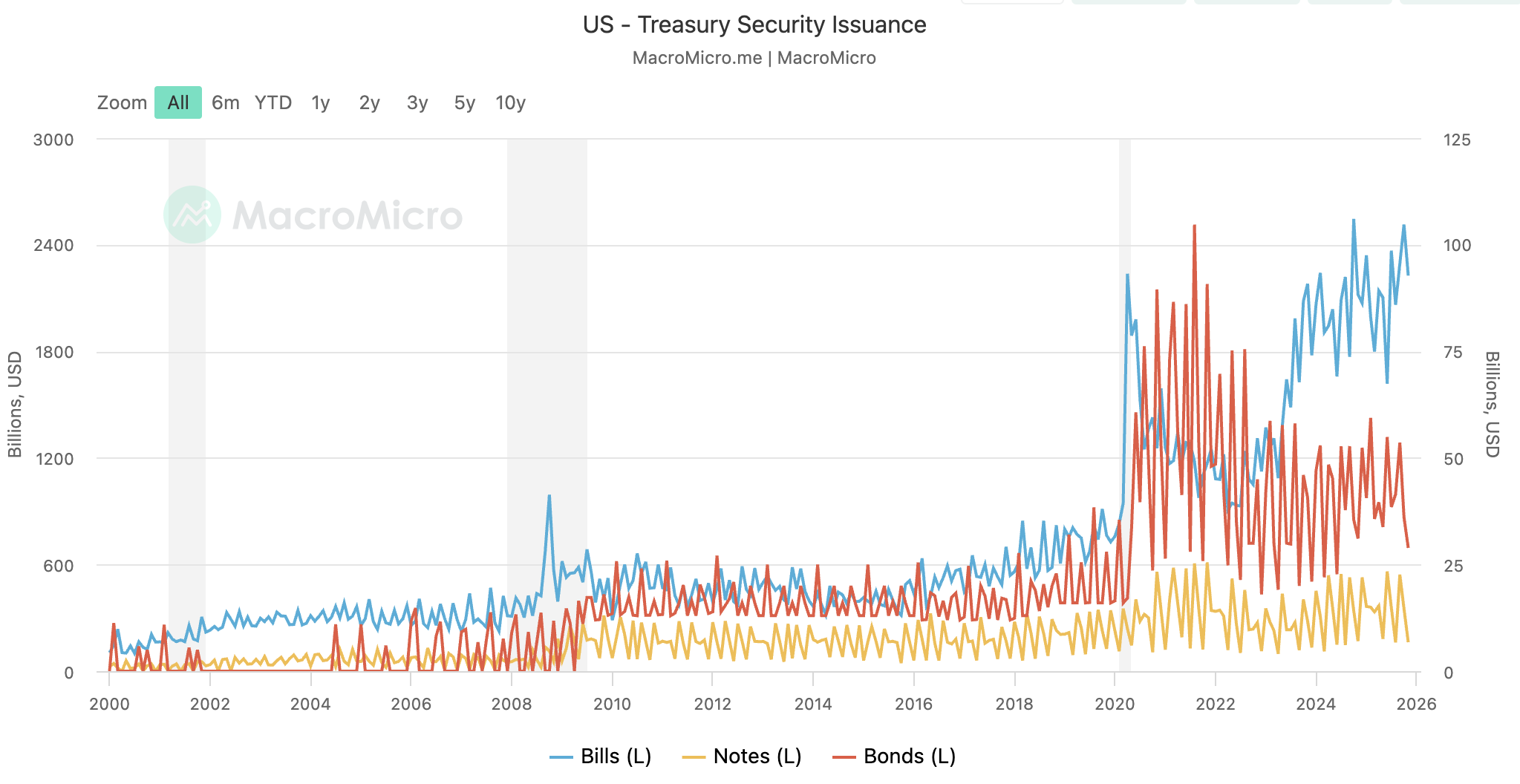
US Treasury issuance by maturity. Source: MacroMicro

Hayes said policies like RMP expand fiat liquidity and, in his view, favor scarce assets such as Bitcoin, gold and silver.

I love QE because it means money printing, and thankfully I own financial assets like gold, gold/silver mining stocks, and Bitcoin that rise faster than the pace of fiat money creation.

At the same time, he warned that people without assets are harmed, as money creation erodes purchasing power, weakens wages relative to prices and shifts wealth toward asset holders.

“Unfortunately, in the here and now for most of humanity, money printing destroys their dignity as productive humans,” he wrote. “When the government intentionally debases the currency, it destroys the link between energy inputs and economic outputs.”

Related: Bitcoin rebounds on Japan rate hike as Arthur Hayes sees dollar at 200 yen

Polymarket points to pause after December rate cut

On Dec. 10, the Federal Open Market Committee (FOMC) cut interest rates by 25 basis points and announced purchases of short-term Treasury securities, a move Fed Chair Jerome Powell said was “solely for the purpose of maintaining an ample supply of reserves” and separate from the stance of monetary policy.

The Fed said the purchases would initially total about $40 billion in the first month and could remain elevated for several months to ease near-term pressures in money markets, particularly around seasonal fluctuations such as tax payments.

Despite the interest rate cut and the announcement of short-term Treasury purchases, analysts said mixed signals from Powell were likely to dampen a sustained Bitcoin rally until the rate-cutting cycle resumes in 2026.

The price of Bitcoin was about $92,695 on Dec. 10, according to Yahoo Finance data. It is was trading around $87,300 at time of writing.

At the time of writing, Polymarket traders were overwhelmingly pricing in no change to Fed policy in January, with the probability of rates staying unchanged at about 77%, while odds of another 25 basis point cut sit near 21% and larger moves are viewed as highly unlikely.
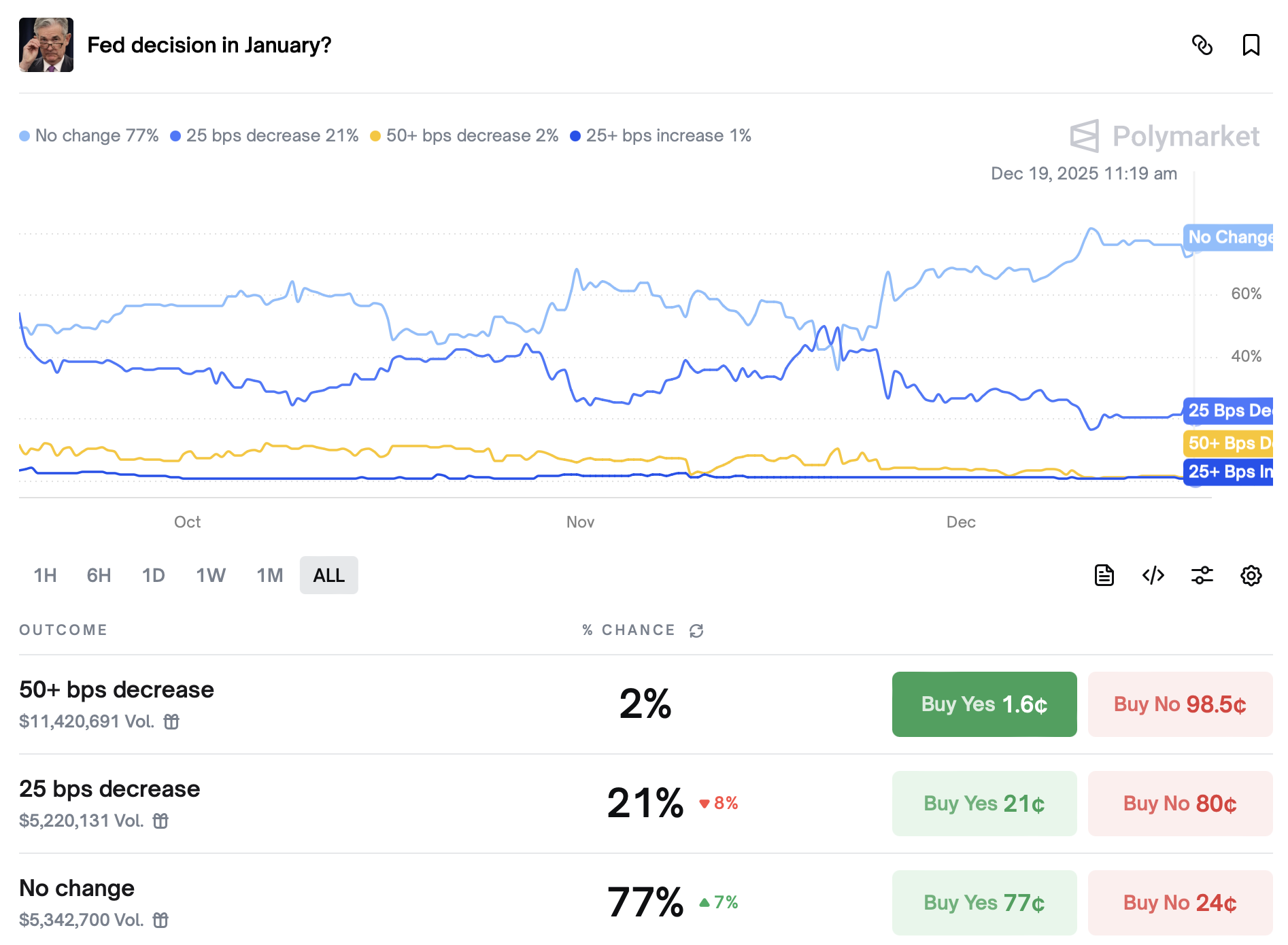
Odds of Fed rate cut in Jan. Source: Polymarket

Powell’s term is set to expire in May 2026. US President Donald Trump, who has publicly pushed for the next Fed chair to pursue aggressive interest rate cuts, is preparing to interview finalists to succeed him, with National Economic Council Director Kevin Hassett widely viewed as the frontrunner.

Magazine: Big questions: Would Bitcoin survive a 10-year power outage?

Domande pertinenti

QWhat is Arthur Hayes' main argument regarding the Federal Reserve's new RMP program?

AArthur Hayes argues that the Fed's Reserve Management Purchases (RMP) program is effectively a rebranded form of quantitative easing (QE) that allows the Fed to finance government spending while avoiding the political stigma associated with QE.

QAccording to Hayes, what is the inflationary impact of the RMP program?

AHayes states that the RMP is 'highly inflationary from both a financial and real goods/services perspective' because it expands fiat liquidity.

QWhich assets does Hayes believe benefit from policies like RMP and QE?

AHayes believes that scarce assets such as Bitcoin, gold, and silver mining stocks benefit from these policies, as they tend to rise faster than the pace of fiat money creation.

QWhat was the Fed's stated reason for initiating the purchases of short-term Treasury securities?

AFed Chair Jerome Powell stated that the purchases were 'solely for the purpose of maintaining an ample supply of reserves' and were a technical liquidity operation, separate from the stance of monetary policy.

QWhat is the market's expectation for the Fed's January policy meeting, according to Polymarket data?

AAccording to Polymarket, traders are pricing in a 77% probability of no change to interest rates in January, with only a 21% chance of another 25 basis point cut.

Letture associate

Five Counterparty Risk Architectures: A Settlement-Layer Methodology for Classifying TradFi Models in Crypto Exchanges

**Summary:** This companion piece reframes the five TradFi-on-crypto exchange architectures, previously classified by "architectural fingerprint," through the lens of counterparty risk. The core question is: whose balance sheet bears the loss first in a stress scenario, and has it historically done so? Each of the five models corresponds to a distinct risk holder with its own documented failure modes. * **Model 1 (Stablecoin-Settled CEX Perpetuals):** Risk is held by the stablecoin issuer (e.g., reserve composition, bank connectivity) and the CEX's own book. History includes Tether's banking disconnections (2017) and reserve misrepresentations (CFTC 2021 Order). * **Model 2 (CFD Brokers):** Risk resides on the broker's balance sheet (B-book model). Regulatory differences (e.g., ESMA's mandatory negative balance protection vs. Mauritius FSC's lack thereof) define loss allocation rules, as seen in the 2015 SNB event (Alpari UK insolvency). * **Model 3 (Off-Chain Custody & Transfer Agent Chain):** Risk lies with the off-chain custodian/platform. User asset recovery depends on Terms of Use and corporate structure, exemplified by the Celsius bankruptcy ruling (2023) where Earn Account assets were deemed property of the estate. * **Model 4 (DEX Perpetual Protocols):** No single balance sheet bears risk. Loss absorption relies on a protocol's insurance fund and Auto-Deleveraging (ADL) mechanism, as demonstrated in the GMX V1 (2022) and dYdX v3 YFI (2023) incidents. * **Model 5 (Regulated CCP - DCM-DCO-FCM):** The most institutionalized model concentrates risk in the Central Counterparty (CCP). However, history shows CCPs can employ non-standard tools under extreme stress, such as mass trade cancellation (LME Nickel, 2022) or enabling negative price settlements (CME WTI, 2020). The report argues that regulatory choices and counterparty risk structures are co-extensive, not in an upstream-downstream relationship. It concludes with five separate observation checklists (not predictions) for monitoring the structural vulnerabilities of each risk model.

marsbit15 min fa

Five Counterparty Risk Architectures: A Settlement-Layer Methodology for Classifying TradFi Models in Crypto Exchanges

marsbit15 min fa

Trading

Spot
Futures
活动图片





