Argentina court orders nationwide block of Polymarket over gambling

cointelegraphPubblicato 2026-03-17Pubblicato ultima volta 2026-03-17

Introduzione

An Argentine court has ordered a nationwide block of the crypto-based prediction market platform Polymarket, citing unauthorized gambling operations. The ruling, issued by a Buenos Aires court on March 11, instructed the national communications regulator ENACOM to restrict access to the platform and its variants across the country. The investigation was initiated following a complaint by the Buenos Aires City Lottery (LOTBA), which raised concerns over insufficient identity and age verification, potentially allowing minors to gamble. The court also directed Apple and Google to remove Polymarket’s mobile apps in Argentina. This action follows earlier scrutiny of the platform, particularly regarding its inflation prediction markets, which closely mirrored official data and sparked insider trading concerns. Similar restrictions have been implemented in other countries, including Colombia in Latin America.

A court in Argentina has ordered a nationwide block of major crypto-based prediction market platform Polymarket over unauthorized gambling.

Argentina’s national communications and media regulator, Ente Nacional de Comunicaciones (ENACOM), received a court order to block access to Polymarket website and its variants across the country, according to a ruling dated March 11.

The order was issued by the Buenos Aires Court of First Instance in Criminal, Contravention and Minor Offenses No. 31, which is investigating Polymarket under Argentina’s Criminal Code for allegedly offering gambling services without authorization.

The judge asked ENACOM to carry out the measure either directly or through internet service providers (ISPs) and to promptly inform the court or the specialized gambling prosecutor’s office if technical or other obstacles prevent full compliance.

Buenos Aires regulator initiated the case

According to local media reports, the case was brought by the Buenos Aires City Lottery (LOTBA), the state-owned company that regulates gambling activities in the city.

After receiving a complaint from LOTBA about Polymarket’s alleged operation without authorization, prosecutor Juan Rozas, in charge of the City’s Specialized Gaming Prosecutor’s Office (FEJA), opened the investigation that led to the court order.

Authorities argued that Polymarket allowed users to place bets without sufficient identity and age verification, raising concerns that minors could access the platform.

“In practice, this meant that anyone — including children and adolescents — could access and start betting without any control,” the authorities reportedly said.

Inflation bets deepen scrutiny

In addition to instructing ENACOM to block access to Polymarket, the court reportedly ordered Google and Apple to remove and restrict the platform’s mobile applications on Android and iOS throughout Argentina, including for existing users.

Social media reports indicate users are discussing workarounds such as VPNs, while observers note that the order comes from a Buenos Aires city court rather than the national government.
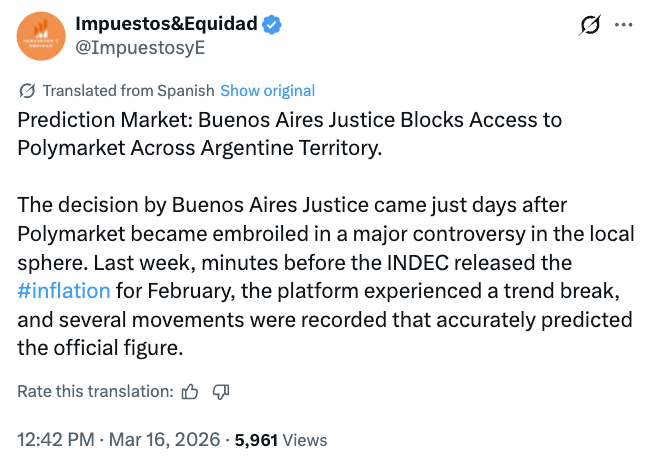
Source: ImpuestosyE (translated by Grok)

The action adds to earlier Polymarket’s scrutiny after its inflation-related prediction markets closely mirrored official data from Argentina’s statistics agency, reigniting controversy over potential insider trading, according to local reports.

Polymarket did not immediately respond to a request for comment from Cointelegraph.

Related: CFTC chair backs blockchain-based prediction markets as ‘truth machines’

Argentina’s action is the latest example of moves against prediction markets globally, with countries including the Netherlands, Hungary, Portugal and Ukraine taking similar steps to restrict access.

In Latin America, Colombia was among the first to take action, with its gambling regulator reportedly warning about Polymarket’s unauthorized operations in September 2025.

Magazine: How crypto laws changed in 2025 — and how they’ll change in 2026

Domande pertinenti

QWhy did the Argentina court order a nationwide block of Polymarket?

AThe court ordered the block because Polymarket was allegedly offering unauthorized gambling services, violating Argentina's Criminal Code.

QWhich regulatory body in Argentina is responsible for implementing the block on Polymarket?

AEnte Nacional de Comunicaciones (ENACOM), the national communications and media regulator, is responsible for implementing the block.

QWhat concerns did authorities raise about Polymarket's operations that led to the investigation?

AAuthorities were concerned that Polymarket allowed users to bet without proper identity and age verification, potentially enabling minors to access the platform.

QBesides blocking the website, what additional actions did the court order against Polymarket?

AThe court also ordered Google and Apple to remove and restrict Polymarket's mobile applications on Android and iOS throughout Argentina.

QWhich other countries have taken similar actions to restrict prediction markets like Polymarket?

ACountries including the Netherlands, Hungary, Portugal, Ukraine, and Colombia have taken similar steps to restrict access to such prediction markets.

Letture associate

Bitcoin Withdrawals Continue: 8 Years of Storage in a Coldcard Cold Wallet Ended in Zero

Coldcard Hardware Wallet Hacked: Losses Mount Due to Vulnerable Seed Generation A critical vulnerability in Coldcard hardware wallets has led to a continued wave of fund thefts. According to Galaxy Research, the total stolen has reached 1,367.05 BTC (approx. $88.6 million) from 4,585 addresses, a significant increase from the initial 594.5 BTC reported on July 30, 2026. Most of the stolen funds remain on the attackers' addresses. The issue is not with the current firmware, which Coinkite has updated, but with seed phrases generated on vulnerable devices between March 2021 and the release of fixed firmware versions. Due to a programmer error, devices switched from using a hardware random number generator to the software-based Yasmarang generator, which was initialized with publicly accessible data like the chip's serial number. This made the seed phrases predictable through offline brute-force attacks, meaning wallets remain at risk until funds are moved to a new wallet generated with the patched firmware. Affected devices include Mk2/Mk3 with firmware 4.0.1–4.1.9 (and up to 5.0.3), Mk4/Mk5 up to version 5.6.0, and Q models up to 1.5.0Q. The only exceptions are seeds created with a high-entropy method like at least 50 independent dice rolls or a strong unique BIP-39 passphrase. All other owners must generate a new seed on the fixed firmware and transfer their assets. A case highlighting the human impact involves a 39-year-old long-term investor who lost 2 BTC (approx. $130,000) in minutes. He had accumulated the Bitcoin over eight years through physical labor, viewing it as a financial lifeline and a retirement plan in a country suffering from hyperinflation. His story underscores that even conservative "buy and hold in cold storage" strategies can be compromised by such underlying technical flaws. From a technical perspective, this incident echoes historical failures where weak random number generators undermined cryptographic security, challenging the assumption that offline storage is automatically foolproof.

cryptonews.ru1 h fa

Bitcoin Withdrawals Continue: 8 Years of Storage in a Coldcard Cold Wallet Ended in Zero

cryptonews.ru1 h fa

Trading

Spot
活动图片





