Are Dogecoin ETFs Dead On Arrival? Dwindling Volume Suggests Investors Are Not Interest – Details

bitcoinistPubblicato 2025-12-11Pubblicato ultima volta 2025-12-11

Introduzione

Dogecoin ETFs have experienced consistently low demand and dwindling trading volumes since their launch in late November, indicating a lack of institutional interest. Data from SoSoValue shows daily volumes have declined significantly, with only three days reaching seven-figure trades out of twelve. Total net assets for these funds stand at just $6.01 million, far below Grayscale’s Chainlink ETF, which has $77.71 million in assets. Analysts had predicted lower interest for meme coins like DOGE compared to major cryptos, and this is reflected as even newer Solana and XRP ETFs are performing better. DOGE’s status as a meme coin with limited utility is seen as a key reason for its poor ETF uptake. The token’s price also fell over 6% to $0.138 at the time of writing.

The Dogecoin ETFs have continued to record low demand since they launched last month, indicating the lack of interest from institutional investors in the meme coin. Notably, DOGE has also seen the lowest demand through these ETFs among the top coins by market cap.

Dogecoin ETFs Record Dwindling Volume And Inflows

SoSoValue data shows that the Dogecoin ETFs have continued to see their daily volume and inflows decline since they launched last month. On December 10, the Grayscale and Bitwise DOGE ETFs recorded a trading volume of $125,100. Meanwhile, these funds as a group saw a total net inflow of $171,920 on the day.

Further data from SoSo Value shows that the Dogecoin ETFs trading volume has been on a decline since December 2, when they recorded a daily trading volume of $1.09 million. These funds have recorded only three 7-figure trading volume days out of 12 trading days since November 24, when Grayscale’s Dogecoin fund launched.
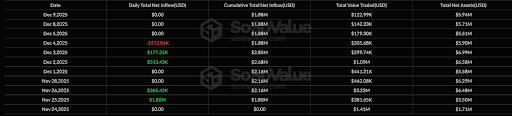
Source: Chart from SoSoValue on X

This is relatively low and signifies little demand for the DOGE ETFs among institutional investors. For context, Grayscale’s Chainlink ETF, the only LINK fund at the moment, has outperformed the Dogecoin ETFs despite launching at the start of this month. Grayscale’s LINK ETF has a total net asset of $77.71 million, while the DOGE ETFs have total net assets of $6.01 million.

The net flows also highlight the underperformance of these Dogecoin ETFs. Since launching, Bitwise’s DOGE fund has recorded a net outflow of $972,840. Meanwhile, Grayscale’s fund has taken in just over $3 million. The funds, as a group, have recorded net inflows on five of 12 trading days.

Possible Reason For The Underperformance

Bloomberg analyst Eric Balchunas had warned before now that crypto ETFs like the Dogecoin ETFs would record fewer assets given their distance from Bitcoin in terms of market cap. “’The further away you get from BTC, the less asset there will be,’ he said. Notably, DOGE funds have the lowest net assets among the top 10 cryptos by market cap with ETF wrappers.

The Solana and XRP ETFs, which also just launched last month, have outperformed the Dogecoin ETFs, although there are more funds offering SOL and XRP. Meanwhile, Balachunas’ theory hasn’t applied to the LINK ETF, as it has outperformed DOGE funds despite Chainlink having a lower market cap than Dogecoin.

Furthermore, the Hedera and Litecoin ETFs also boast larger net assets than the Dogecoin ETFs, indicating that institutional investors are simply not bullish on DOGE, possibly due to its meme coin status and lack of utility. DOGE is, so far, the only meme coin with an ETF wrapper.

At the time of writing, the DOGE price is trading at around $0.138, down over 6% in the last 24 hours, according to data from CoinMarketCap.


DOGE trading at $0.13 on the 1D chart | Source: DOGEUSDT on Tradingview.com

Letture associate

Bitcoin Mining Farms Are Becoming AI Factories

Bitcoin mines are transforming into AI factories. This shift is driven by the convergence of three key assets from the previous crypto cycle: infrastructure, talent, and capital. Crypto mining companies like Crusoe, CoreWeave, and Bitdeer are repurposing their core competency—securing power, land, and grid connections in remote locations—to build data centers for AI clients. These firms are signing multi-billion dollar, long-term contracts with companies like Anthropic, AWS, and Microsoft, as AI's demand for reliable, high-capacity compute surpasses the profitability of Bitcoin mining. Simultaneously, crypto entrepreneurs and engineers are applying their skills to new AI ventures. Examples include OpenSea's co-founder launching OpenRouter (an AI model aggregator), and former Coinbase engineers building Fal.ai (a generative media infrastructure platform). Their experience in building scalable, global software networks translates effectively to the AI space. Furthermore, capital accumulated during the crypto boom is now fueling AI. Figures like Jed McCaleb (co-founder of Ripple) funded Voltage Park, a large-scale GPU cloud provider. Notably, some crypto investments, like FTX's early bets on Anthropic and Cursor, have generated astronomical paper returns, demonstrating how high-risk crypto capital flowed into AI before it became mainstream. The transition is not just about repurposing hardware, but about redirecting critical resources—power infrastructure, distributed systems expertise, and venture funding—to the next technological frontier: artificial intelligence.

链捕手18 min fa

Bitcoin Mining Farms Are Becoming AI Factories

链捕手18 min fa

Morpho Launches Fixed-Rate Product Midnight: Lenders and Borrowers Set Their Own Rates, Ending the Era of Interest Rate Models

Morpho Launches Fixed-Rate Product Midnight: Lenders and Borrowers Set Their Own Rates, Ending the Era of Algorithmic Interest Models On-chain lending has grown to $60 billion but remains minuscule compared to traditional finance's $200 trillion annual credit volume. Morpho identifies the lack of fixed rates and maturity dates as key bottlenecks. Institutions need predictability, not the passive floating rates set by algorithmic models. Midnight allows lenders and borrowers to directly quote rates, set terms, and become price makers, not takers. Fixed-rate lending is now viable due to cheaper, faster blockchains and the entry of institutions demanding control and certainty over returns, costs, and duration. Morpho Blue previously gave users control over risk; Midnight adds control over interest rates. Past attempts at on-chain fixed-rate lending failed primarily because they were built on top of floating-rate pools (creating unpredictability) or lacked sufficient active participants. Midnight avoids these pitfalls as a standalone primitive with fixed rates at its core, built upon Morpho Blue's existing large and active user base. Midnight offers distinct value: institutions gain predictable term structures and full control; fintech companies can offer tailored fixed-rate products; lenders/borrowers achieve predictability and efficiency; and curators can now differentiate by configuring both risk and interest rates. Morpho Midnight is not a replacement for Morpho Blue. The Morpho network will now feature two complementary market structures: floating-rate/open-term (Blue) for flexibility and fixed-rate/fixed-term (Midnight) for predictability. Liquidity can flow between them. The launch will be gradual, prioritizing security. Initially, it will support direct lending on Base network with one trading pair (cbBTC/USDC) and limited maturity dates. Advanced features like auto-rollovers will be introduced later.

marsbit19 min fa

Morpho Launches Fixed-Rate Product Midnight: Lenders and Borrowers Set Their Own Rates, Ending the Era of Interest Rate Models

marsbit19 min fa

Trading

Spot
活动图片




