Aptos introduces post-quantum signatures before they’re urgently needed

cointelegraphPubblicato 2025-12-18Pubblicato ultima volta 2025-12-18

Introduzione

Aptos is advancing a proposal to introduce post-quantum digital signatures as an optional security upgrade, addressing growing concerns that future quantum computers could eventually break current cryptographic systems. The Aptos Improvement Proposal AIP-137 would integrate the SLH-DSA (FIPS 205) signature scheme at the account level, making Aptos one of the first major blockchains to natively support quantum-resistant accounts. Existing accounts would remain unchanged, and adoption would be opt-in. This move reflects broader industry attention to quantum risks, with other networks like Solana also testing quantum-resistant solutions. While some in the crypto space, including Bitcoin pioneers, view the quantum threat as distant or overhyped, Aptos and others are taking proactive steps to prepare for a post-quantum era.

Blockchain network Aptos is moving toward a post-quantum signature option, reflecting growing concern that advances in quantum computing are no longer purely theoretical and could eventually affect how blockchain networks secure accounts and transactions.

On Thursday, Aptos outlined a proposal to introduce post-quantum signatures, addressing the network’s reliance on digital signatures for ownership, transaction authorization and overall security.

While existing cryptographic schemes remain secure against classical computers, researchers warn that sufficiently powerful quantum machines could one day forge them, potentially compromising account security retroactively.

“Quantum computing is not a distant spectre anymore,” Aptos Labs wrote in a post on X, pointing to early discussions around quantum scaling by IBM and growing regulatory momentum, including the publication of post-quantum cryptography standards by the US National Institute of Standards and Technology (NIST).

“This matters for networks like Aptos because Cryptographically Relevant Quantum Computers (CRQCs) can make today’s signature schemes forgeable, possibly breaking security models,” the post said.

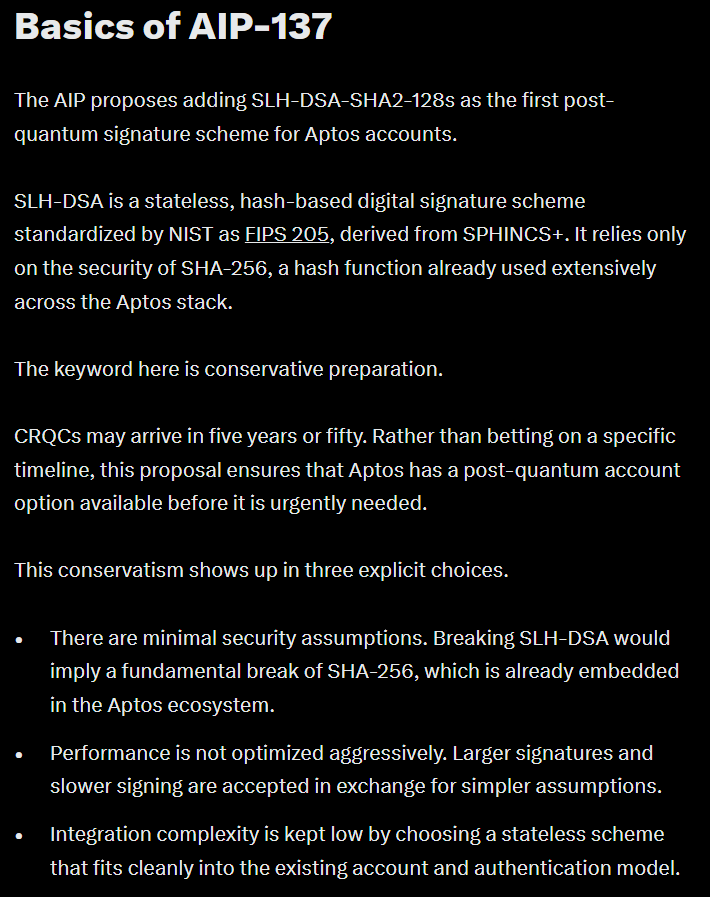
In response, developers have proposed AIP-137, an Aptos Improvement Proposal authored by cryptographers at Aptos Labs, which would add support for a post-quantum signature scheme at the account level.
Source: Aptos Labs

If approved through governance, AIP-137 would introduce SLH-DSA, a hash-based digital signature scheme standardized as FIPS 205, as an optional account signature type. The change would make Aptos one of the earliest production blockchains to natively support post-quantum accounts.

However, existing accounts would remain unaffected. Post-quantum accounts would be opt-in only, allowing users to adopt selectively.

Aptos is one of the larger layer-1 proof-of-stake blockchains, designed primarily to support decentralized applications. Earlier this year, its head of ecosystem, Ash Pampati, told Cointelegraph that consumer-focused applications were gaining traction on the network, particularly those blending elements of Web2 and Web3.

As Cointelegraph previously reported, Aptos has also emerged as a venue for tokenized real-world assets, with asset managers including Franklin Templeton and BlackRock deploying products on the network.

Related: Google announces quantum advantage, 13,000 times faster than supercomputers

The race against quantum

While many in the crypto industry argue that quantum threats to blockchains, particularly Bitcoin, remain years away, networks are increasingly taking preparatory steps, with Aptos far from alone in doing so.

Earlier this month, Solana tested quantum-resistant transactions on a dedicated testnet, an experiment aimed at evaluating how post-quantum signature schemes could be integrated into its transaction model without disrupting existing accounts.

Within the Bitcoin community, a smaller but vocal group of developers, researchers and fund managers has also begun pushing for faster progress on quantum-resistant cryptography.

Some have rallied around BIP-360, a proposed Bitcoin Improvement Proposal that would introduce quantum-resistant signature options. However, the idea remains in its early stages and is subject to debate.
Source: Adam Back

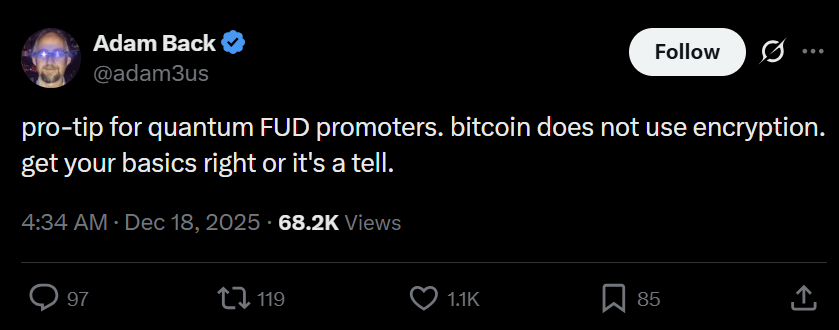
Others, including early Bitcoin figure Adam Back, have dismissed near-term quantum concerns as a form of fear, uncertainty and doubt, or FUD, arguing that Bitcoin does not rely on encryption for its core security model. Instead, Bitcoin uses digital signature schemes and cryptographic hash functions, which are not imminently threatened by practical quantum computers.

Related: Are quantum computers stealing Bitcoin? Inside Josh Mandell’s claim and the pushback


Crypto di tendenza

Domande pertinenti

QWhat is the main reason Aptos is introducing post-quantum signatures?

AAptos is introducing post-quantum signatures due to growing concern that advances in quantum computing could eventually compromise the network's security by making today's digital signature schemes forgeable.

QWhat specific proposal has Aptos Labs put forward for post-quantum signatures?

AAptos Labs has proposed AIP-137, which would add support for the SLH-DSA (FIPS 205) hash-based digital signature scheme as an optional account signature type.

QWill existing Aptos accounts be automatically upgraded to post-quantum security?

ANo, existing accounts will remain unaffected. The post-quantum account option will be opt-in only, allowing users to adopt it selectively.

QBesides Aptos, which other blockchain network has recently tested quantum-resistant technology?

ASolana tested quantum-resistant transactions on a dedicated testnet earlier this month to evaluate integration of post-quantum signature schemes.

QWhat is the name of the proposed Bitcoin Improvement Proposal for quantum resistance mentioned in the article?

AThe proposed Bitcoin Improvement Proposal for quantum-resistant signature options is BIP-360.

Letture associate

Unitree's IPO Frenzy: The Real Mystery is How It Will Spend the 42 Billion Raised

Unitree, a Chinese robotics company, is set for a public listing after its IPO registration was approved by regulators. The company, which started with quadruped robots and has expanded into humanoids, plans to raise approximately 4.2 billion yuan through its offering. The article traces Unitree's rapid growth from its founding in 2016 to its current status. It highlights key milestones like the 2021 CCTV Spring Festival Gala performance, the 2023 launch of its affordable Go2 robot dog and the H1 humanoid robot, and a series of subsequent product launches. By 2025, the company reported revenue of 1.71 billion yuan, profitability, and sales exceeding 5,500 humanoid robots. As the first publicly-listed humanoid robot company on China's STAR Market, Unitree's main challenges are sustaining growth and deploying its newly raised capital effectively. The humanoid robot sector in China is crowded, with over 140 companies. Competitors include UBTech (focusing on industrial and consumer markets), Fourier, and international players like Tesla Optimus and 1X NEO. The article outlines three critical challenges for Unitree: establishing a strong second product line beyond its quadruped robots, maintaining its price advantage while ensuring quality, and successfully advancing its embodied AI capabilities through partnerships like the one with NVIDIA for the H2 Plus platform. Unitree's likely strategy involves a "developer tools + industry benchmarks" approach: using low-cost models like the R1 and G1 to build developer adoption and volume, leveraging high-end platforms for AI training, and securing pilot projects in sectors like logistics and manufacturing to build case studies. The company's future success hinges on converting its current momentum in shipments and pilot programs into sustainable, large-scale commercial contracts as the broader market evolves.

marsbit1 h fa

Unitree's IPO Frenzy: The Real Mystery is How It Will Spend the 42 Billion Raised

marsbit1 h fa

Examining the Open USD Partner Lineup: Follow Who's Joining to See Where the Money Flows

**Title: Deciphering the Open USD Partner Roster: Following the Money** The launch of Open USD is notable less for the stablecoin itself and more for its expansive list of over 140 founding partners, which reads like a "who's who" of global finance and tech. This coalition, including asset managers like BlackRock, card networks Visa and Mastercard, banks (BNY Mellon, Standard Chartered, etc.), tech giants (Google, IBM), merchants (Shopify), and crypto firms (Coinbase, Ripple, Aave, MetaMask), signals a strategic shift. The diverse membership reveals that stablecoins are increasingly viewed not as products to compete over, but as shared infrastructure too critical to be left to any single entity. Each partner category has distinct motives. Asset managers like BlackRock seek to manage the large, sticky cash reserves, a lucrative fee-generating opportunity. Merchants like Shopify aim for lower-cost settlement and potential yield on balances. Banks join defensively to retain custody and settlement roles, fearing deposit outflows to stablecoins. Tech companies bet on programmable money for future machine-to-machine commerce. Crypto firms gain mainstream legitimacy and distribution channels. Remarkably, the consortium includes direct competitors (Visa vs. Mastercard, Coinbase vs. Ripple), indicating that the fear of exclusion from this emerging financial layer outweighs competitive rivalries. However, this shared governance could also lead to slow decision-making. The roster's composition is the real message: it represents a collective bet that a widely accepted, consortium-owned stablecoin is preferable to proprietary versions or having none at all. For incumbents like Circle and Tether, this alliance poses a significant threat, as potential clients have collectively chosen to build their own alternative. The absence of major U.S. retail banks (busy with their own tokenized deposit networks) is equally telling. In essence, the partner list maps where the industry believes value and risk will flow in a tokenized dollar future, marking stablecoin's evolution from a product to a utility.

Foresight News1 h fa

Examining the Open USD Partner Lineup: Follow Who's Joining to See Where the Money Flows

Foresight News1 h fa

Trading

Spot

Articoli Popolari

Come comprare O

Benvenuto in HTX.com! Abbiamo reso l'acquisto di O1 exchange (O) semplice e conveniente. Segui la nostra guida passo passo per intraprendere il tuo viaggio nel mondo delle criptovalute.Step 1: Crea il tuo Account HTXUsa la tua email o numero di telefono per registrarti il tuo account gratuito su HTX. Vivi un'esperienza facile e sblocca tutte le funzionalità,Crea il mio accountStep 2: Vai in Acquista crypto e seleziona il tuo metodo di pagamentoCarta di credito/debito: utilizza la tua Visa o Mastercard per acquistare immediatamente O1 exchangeO.Bilancio: Usa i fondi dal bilancio del tuo account HTX per fare trading senza problemi.Terze parti: abbiamo aggiunto metodi di pagamento molto utilizzati come Google Pay e Apple Pay per maggiore comodità.P2P: Fai trading direttamente con altri utenti HTX.Over-the-Counter (OTC): Offriamo servizi su misura e tassi di cambio competitivi per i trader.Step 3: Conserva O1 exchange (O)Dopo aver acquistato O1 exchange (O), conserva nel tuo account HTX. In alternativa, puoi inviare tramite trasferimento blockchain o scambiare per altre criptovalute.Step 4: Scambia O1 exchange (O)Scambia facilmente O1 exchange (O) nel mercato spot di HTX. Accedi al tuo account, seleziona la tua coppia di trading, esegui le tue operazioni e monitora in tempo reale. Offriamo un'esperienza user-friendly sia per chi ha appena iniziato che per i trader più esperti.

63 Totale visualizzazioniPubblicato il 2026.06.19Aggiornato il 2026.06.29

Come comprare O

Come comprare PROS

Benvenuto in HTX.com! Abbiamo reso l'acquisto di Pharos (PROS) semplice e conveniente. Segui la nostra guida passo passo per intraprendere il tuo viaggio nel mondo delle criptovalute.Step 1: Crea il tuo Account HTXUsa la tua email o numero di telefono per registrarti il tuo account gratuito su HTX. Vivi un'esperienza facile e sblocca tutte le funzionalità,Crea il mio accountStep 2: Vai in Acquista crypto e seleziona il tuo metodo di pagamentoCarta di credito/debito: utilizza la tua Visa o Mastercard per acquistare immediatamente PharosPROS.Bilancio: Usa i fondi dal bilancio del tuo account HTX per fare trading senza problemi.Terze parti: abbiamo aggiunto metodi di pagamento molto utilizzati come Google Pay e Apple Pay per maggiore comodità.P2P: Fai trading direttamente con altri utenti HTX.Over-the-Counter (OTC): Offriamo servizi su misura e tassi di cambio competitivi per i trader.Step 3: Conserva Pharos (PROS)Dopo aver acquistato Pharos (PROS), conserva nel tuo account HTX. In alternativa, puoi inviare tramite trasferimento blockchain o scambiare per altre criptovalute.Step 4: Scambia Pharos (PROS)Scambia facilmente Pharos (PROS) nel mercato spot di HTX. Accedi al tuo account, seleziona la tua coppia di trading, esegui le tue operazioni e monitora in tempo reale. Offriamo un'esperienza user-friendly sia per chi ha appena iniziato che per i trader più esperti.

62 Totale visualizzazioniPubblicato il 2026.06.22Aggiornato il 2026.06.29

Come comprare PROS

Cosa è VERONA

I. Introduzione al Progetto VERONA è una blockchain costruita per tutti, ovunque attraverso l'astrazione della catena. Utilizzando il suo livello di astrazione generalizzato, VERONA si distingue integrando funzionalità blockchain complesse, come conti, firme e interoperabilità, direttamente a livello di protocollo. Questo approccio consente di interagire con le applicazioni blockchain senza la necessità di comprendere le tecnologie sottostanti.1) Informazioni di Base Nome:VERONA(VERONA)III. Link Correlati Link al sito ufficiale:https://xion.burnt.com/ Whitepaper:https://xion.burnt.com/whitepaper.pdf Esploratori:https://explorer.burnt.com/ Social Media: https://x.com/burnt_xion Nota: L'introduzione al progetto proviene dai materiali pubblicati o forniti dal team ufficiale del progetto, che è solo a scopo di riferimento e non costituisce consulenza per investimenti. HTX non si assume responsabilità per eventuali perdite dirette o indirette risultanti.

86 Totale visualizzazioniPubblicato il 2026.06.22Aggiornato il 2026.06.22

Cosa è VERONA

Discussioni

Benvenuto nella Community HTX. Qui puoi rimanere informato sugli ultimi sviluppi della piattaforma e accedere ad approfondimenti esperti sul mercato. Le opinioni degli utenti sul prezzo di A A sono presentate come di seguito.

活动图片