Anthropic Removes Claude Code from Pro Plan, Developer Community Erupts, OpenAI Seizes the Opportunity to Strike

marsbitPubblicato 2026-04-22Pubblicato ultima volta 2026-04-22

Introduzione

Anthropic has removed its coding agent, Claude Code, from the $20/month Pro plan, triggering strong backlash from the developer community. The change was reflected in updated pricing pages and documentation, which now state that Claude Code is only available to Max plan subscribers, starting at $100/month. Anthropic’s growth lead, Amol Avasare, described the move as a "small-scale test" affecting only 2% of new users, but the broad updates to public documentation contradicted this claim. He later acknowledged that rising computational costs due to increased usage made the previous pricing structure unsustainable. Developers expressed frustration on platforms like Hacker News, Reddit, and GitHub, with some calling it a reason to switch to local or open-source models like Llama or Mistral. In response, OpenAI quickly emphasized that its competing product, Codex, remains available in both free and $20/month Plus plans, and reaffirmed its commitment to transparent communication with users. Google’s Gemini CLI remains free, adding further competitive pressure. The incident highlights growing tension between AI service affordability and the high compute costs of advanced coding assistants.

Author: Claude, Deep Tide TechFlow

Deep Tide Guide: On April 21, Anthropic quietly removed its programming agent Claude Code from the $20/month Pro plan, with related pricing pages and help documents updated simultaneously. Although Growth Lead Amol Avasare claimed this was only a "small-scale test" targeting about 2% of new users, the site-wide documentation has been completely rewritten to state "Max plan only," sparking a massive backlash in the developer community. OpenAI promptly publicly stated that Codex will remain in the free and Plus plans, while the local model camp called this incident "the best time to switch to self-hosting."
Anthropic is testing developers' price tolerance limits, at the possible cost of user trust.

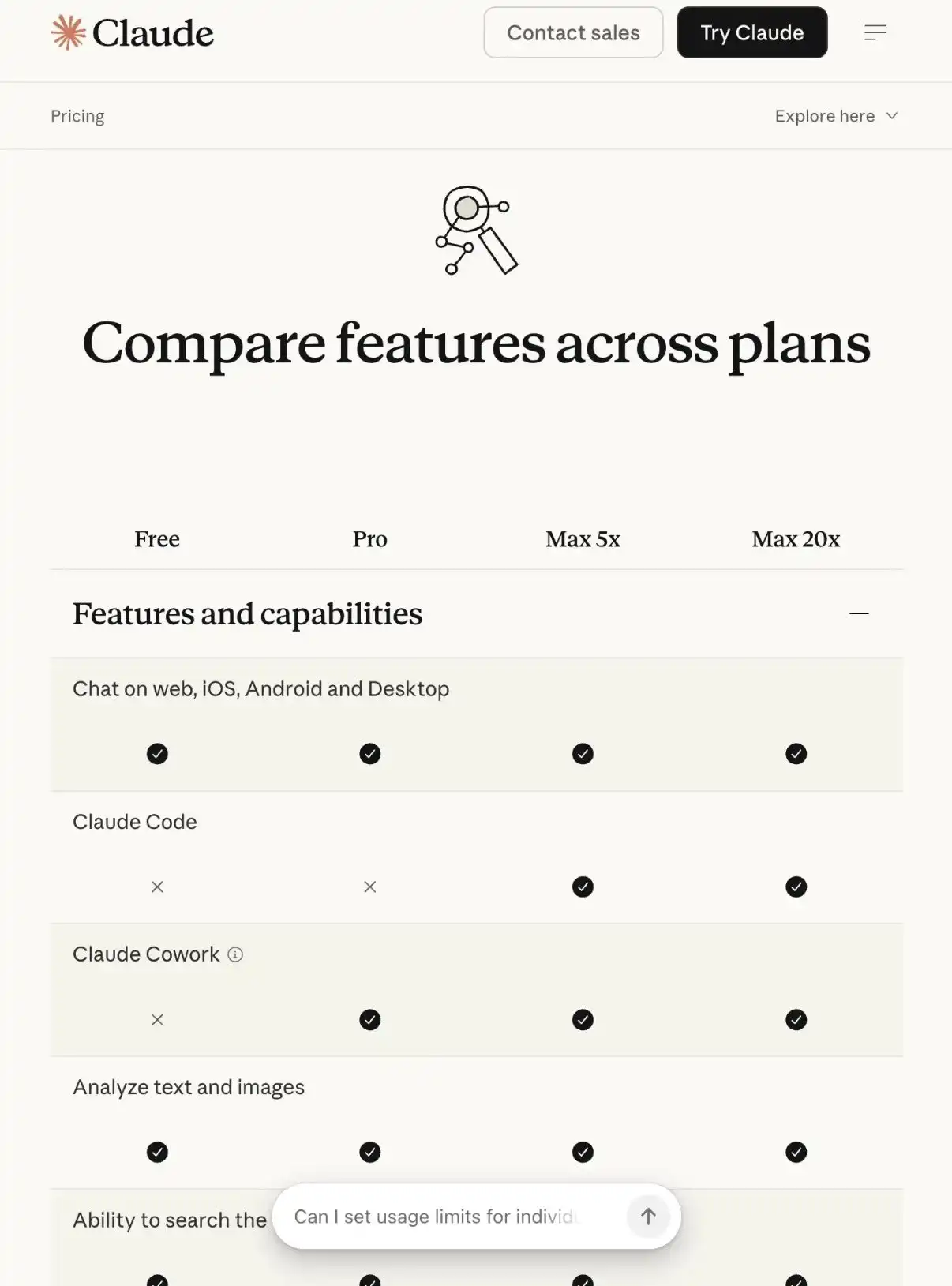
On April 21, some developers noticed significant changes on Anthropic's official pricing page: Claude Code was marked as unavailable (with an "X") in the feature comparison table for the Pro plan ($20/month), whereas the day before the page still stated that the Pro plan "includes Claude Code." Almost simultaneously, the wording in Anthropic's help documentation quietly changed from "Use Claude Code with your Pro or Max plan" to "Use Claude Code with your Max plan."

AI industry observer Ed Zitron first sounded the alarm on the Bluesky platform, and the news quickly sparked discussions on Hacker News, Reddit r/LocalLLaMA, and X platform.

Official Statement Calls it a "Small-Scale Test," but Documentation is Fully Rewritten

Facing the developer community's intense reaction, Anthropic Growth Lead Amol Avasare responded that day on the X platform, stating this was only a small-scale test targeting about 2% of newly registered users, and existing Pro and Max subscribers would not be affected.

However, multiple media outlets pointed out that Avasare's statement contradicted the actual situation: the feature comparison matrix on the pricing page had been updated site-wide, and the help documentation had also been modified simultaneously. These changes were visible to all visitors and did not resemble a灰度 test for 2% of users. According to The Register, as of publication time, an Anthropic spokesperson had not responded further to this contradiction.

In subsequent tweets, Avasare explained the logic behind the adjustment: when the Max plan was launched a year ago, Claude Code was not bundled with it, Cowork did not exist, and asynchronous agents running for hours were not yet the norm. Since then, Claude Code usage has surged significantly post-Opus 4, and user usage patterns have fundamentally changed. He admitted, "Usage per subscriber has increased substantially, and our current plan structure was not designed for this."

This statement actually revealed a key point: providing Claude Code access for a $20 monthly fee has become unsustainable in terms of computing costs. According to industry analysis, each Claude Code programming session consumes far more tokens than regular chat, and the computational cost of long programming sessions could be several times the subscription fee.

From $20 to $100, Developers Pushed to a Decision Point

If this change is ultimately implemented permanently, Pro users who wish to continue using Claude Code would need to upgrade to the Max 5x plan starting at $100/month, or the Max 20x plan at $200/month. The price has increased fivefold.

Developers reacted quickly and strongly. A GitHub issue titled "Breaking Change: Claude Code CLI Removed from Pro Plan Without Notice" appeared within hours.

A related post on Hacker News received over 100 upvotes and more than 40 comments in less than an hour. One user's experience was representative: he started with the $20 Pro plan in January, upgraded to $200 due to frequently hitting usage limits, downgraded to $100 due to quality drops in Claude Opus 4.6, and recently downgraded back to $20 because he was satisfied with OpenAI Codex's performance on GPT-5.4. "I went from the most enthusiastic recommender to my current state," he wrote.

The reaction on the Reddit r/LocalLLaMA community was more direct. A post titled "Anthropic removes Claude Code from Pro plan, users call it 'the best time to switch to local models'" received extensive discussion, focusing on the progress made by open-source models like Meta's Llama series, Mistral, and DeepSeek in programming capabilities over the past year, as well as the maturity of local deployment tools like Ollama and LM Studio.

OpenAI Quickly Strikes, Codex Remains in Free and Plus Plans

Competitors did not miss this window.

From OpenAI's side, an employee responsible for Codex-related work posted on the X platform: "I don't know what they're doing over there, but Codex will continue to be available in the free and Plus ($20) plans. We have the compute and efficient models to support it. For important changes, we communicate with the community in advance."
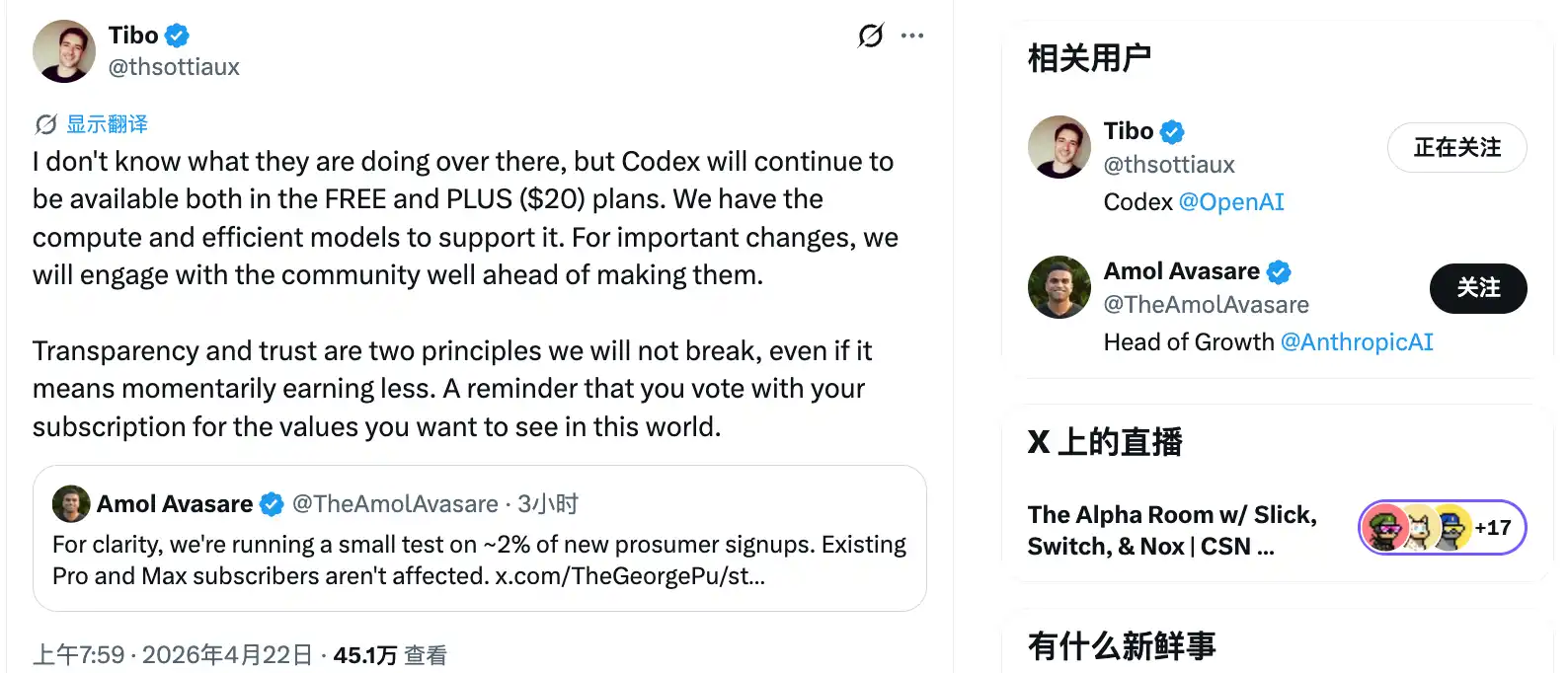
The timing and wording of this statement were highly targeted.

OpenAI's Codex, as the main competitor to Claude Code, is currently offered in the ChatGPT Plus ($20/month) plan with a usage limit of 30 to 150 messages every 5 hours, and also has basic access in the free plan. Additionally, weeks ago, OpenAI released a Codex plugin specifically designed for Claude Code users, allowing developers to directly call Codex for code review or task delegation within the Claude Code workflow.

Google is also active; Gemini CLI is currently completely free. According to The New Stack, Anthropic has recently been under pressure regarding computing supply. Not only did it remove Pro access to Claude Code, but it also previously cut off third-party client OpenClaw's access to Claude via subscription accounts. Platform stability issues and frequent outages have also provided opportunities for competitors.


Domande pertinenti

QWhat change did Anthropic make to its Pro plan regarding Claude Code, and when was it noticed?

AAnthropic removed Claude Code from its $20/month Pro plan on April 21, as noticed by developers who saw the pricing page updated to show Claude Code as unavailable for Pro users, whereas it was previously included.

QHow did Anthropic's growth head, Amol Avasare, explain the removal of Claude Code from the Pro plan?

AAmol Avasare claimed it was a 'small-scale test' affecting only about 2% of new sign-ups, stating that existing Pro and Max subscribers would not be impacted, and attributed the change to significantly increased usage and computational costs.

QWhat was the reaction from the developer community to Anthropic's change?

AThe developer community reacted strongly, with immediate backlash on platforms like Hacker News, Reddit, and X. Many expressed frustration, with some considering switching to local models or alternatives, and a GitHub issue was quickly created to highlight the abrupt change.

QHow did OpenAI respond to Anthropic's removal of Claude Code from the Pro plan?

AOpenAI swiftly responded by affirming that its Codex would remain available in both free and Plus ($20/month) plans, emphasizing their ability to support it with sufficient compute and efficient models, and criticizing Anthropic's lack of prior communication.

QWhat are the pricing implications for Pro users if they want to continue using Claude Code after this change?

AIf the change becomes permanent, Pro users would need to upgrade to the Max plan, which starts at $100/month for the 5x version or $200/month for the 20x version, effectively increasing the cost fivefold or more to access Claude Code.

Letture associate

No Sales Team, $20 Million in Revenue: How Did AI Employee Viktor Win Over 30,000 Companies?

The AI employee Viktor, developed by a team with DeepMind background, has achieved $20 million in annual revenue without a traditional sales team, serving over 30,000 companies. Its core innovation lies in positioning itself as a "Tier 3 AI Coworker" capable of "end-to-end execution and delivery of results," moving beyond the "draft and wait for human completion" model of typical AI assistants. Users can simply mention Viktor in Slack or Microsoft Teams using natural language commands, and it autonomously performs tasks like pulling sales data from a CRM, generating reports, or even cross-tool operations like creating board meeting PPTs by aggregating data from six different sources. Key to its growth is a pure Product-Led Growth (PLG) model, eliminating complex implementation cycles and per-seat licensing. Instead, it charges based on task credits or consumption, lowering the trial barrier with a $100 free credit offer and no credit card required. This enabled viral, bottom-up adoption within organizations. Viktor's interaction paradigm removes the barrier of prompt engineering, allowing non-technical employees to delegate complex workflows seamlessly. It also features proactive, automated task execution (e.g., overnight bookkeeping, scheduled reports) based on triggers, effectively embedding AI as an automated "process layer" within business operations. However, its expansion into Microsoft Teams—a platform with 320 million users—highlights challenges. Large enterprises require stringent IT compliance, security reviews (e.g., SOC 2), and governance, potentially hindering the frictionless, user-driven adoption that succeeded in Slack. Additionally, the "black box" nature of its autonomous decision-making raises concerns about operational risks, data integrity, and the need for robust audit logs and permission controls. Balancing efficiency gains with security and trust remains a critical hurdle for Viktor and similar AI agents aiming to become core enterprise infrastructure.

marsbit22 min fa

No Sales Team, $20 Million in Revenue: How Did AI Employee Viktor Win Over 30,000 Companies?

marsbit22 min fa

Manus Buyback Plan Emerges: Chinese Investors Plan to Repurchase Equity with $2 Billion, Path to Hong Kong IPO Becomes Clearer

According to a report by The Information, early Chinese investors of Manus, including Tencent, Sequoia Capital China, and ZhenFund, are planning to repurchase the company from Meta for $2 billion—the same price Meta paid in its acquisition last December. This move is a direct response to the Chinese government's prohibition of the foreign acquisition in April. As part of the repurchase plan, Manus is considering establishing a Sino-foreign joint venture within China. This structure is seen as a way to ensure regulatory compliance for its Chinese investors and to pave the way for a future IPO in Hong Kong. Notably, U.S. investor Benchmark will not participate in the buyback, which will concentrate ownership even more among Chinese capital. Since its acquisition by Meta, Manus's business has grown rapidly, with its annualized revenue run rate reportedly increasing four-to-fivefold to $400-$500 million in roughly six months. This strong growth underpins the investors' willingness to repurchase at the original price. Financially, the forced unwinding of the deal may benefit the early investors, allowing them to regain equity at a cost far below the company's current implied valuation, with the added prospect of an independent future listing. However, specific terms of the repurchase, including funding proportions and the joint venture's equity structure, are still under negotiation. This "repurchase-joint venture-Hong Kong IPO" approach could serve as a reference model for other Chinese AI startups navigating cross-border M&A regulations.

marsbit49 min fa

Manus Buyback Plan Emerges: Chinese Investors Plan to Repurchase Equity with $2 Billion, Path to Hong Kong IPO Becomes Clearer

marsbit49 min fa

STRC Loses Peg by 11%, Can Strategy's Perpetual Motion Machine Keep Running?

The article discusses the significant and concerning depegging of MicroStrategy's (MSTR) preferred stock, STRC. Designed to trade near its $100 target par value, STRC has recently fallen sharply, reaching a low of $83.26 and closing at $88.59, representing an over 11% discount. STRC is a core component of MicroStrategy's financial strategy. As a perpetual preferred stock, it allows the company to raise capital through an "at-the-market" (ATM) issuance program without diluting common shareholders (MSTR). This capital is primarily used to purchase Bitcoin, creating a "capital flywheel": issuing STRC → raising cash → buying BTC → increasing net assets → supporting STRC's value. The flywheel's operation depends on STRC maintaining its $100 price. To enforce this, MicroStrategy employs a dynamic dividend mechanism, recently raising the rate to 11.5% and increasing payout frequency. However, this has failed to halt the depegging, indicating market concerns extend beyond yield. Analysts cite two main reasons. First, technical factors like forced liquidations from leveraged arbitrage trades may have exacerbated the sell-off. Second, and more fundamentally, is waning confidence in MicroStrategy's financial resilience. A JPMorgan report highlighted the company's limited cash relative to its ~$1.7 billion annual dividend obligation, raising liquidity concerns. While MicroStrategy counters that its massive Bitcoin holdings provide decades of coverage, this argument relies on the potential need to sell BTC—a departure from its long-standing "never sell" narrative. The company's recent sale of a small amount of Bitcoin for "testing," despite being framed as minor, has intensified these fears. The persistent depegging threatens to cripple MicroStrategy's primary funding channel. If STRC remains discounted, the company's ability to fund further Bitcoin purchases weakens. Should cash reserves dwindle while financing is constrained, the market may increasingly price in the risk of MicroStrategy becoming a forced seller of Bitcoin to meet obligations. This shift from a major marginal buyer to a potential seller could pose significant downside risk to the broader Bitcoin market.

链捕手58 min fa

STRC Loses Peg by 11%, Can Strategy's Perpetual Motion Machine Keep Running?

链捕手58 min fa

Trading

Spot
Futures
活动图片