Anthropic Removes Claude Code from Pro Plan, Developer Community Erupts, OpenAI Seizes the Opportunity to Strike

marsbitPubblicato 2026-04-22Pubblicato ultima volta 2026-04-22

Introduzione

Anthropic has removed its coding agent, Claude Code, from the $20/month Pro plan, triggering strong backlash from the developer community. The change was reflected in updated pricing pages and documentation, which now state that Claude Code is only available to Max plan subscribers, starting at $100/month. Anthropic’s growth lead, Amol Avasare, described the move as a "small-scale test" affecting only 2% of new users, but the broad updates to public documentation contradicted this claim. He later acknowledged that rising computational costs due to increased usage made the previous pricing structure unsustainable. Developers expressed frustration on platforms like Hacker News, Reddit, and GitHub, with some calling it a reason to switch to local or open-source models like Llama or Mistral. In response, OpenAI quickly emphasized that its competing product, Codex, remains available in both free and $20/month Plus plans, and reaffirmed its commitment to transparent communication with users. Google’s Gemini CLI remains free, adding further competitive pressure. The incident highlights growing tension between AI service affordability and the high compute costs of advanced coding assistants.

Author: Claude, Deep Tide TechFlow

Deep Tide Guide: On April 21, Anthropic quietly removed its programming agent Claude Code from the $20/month Pro plan, with related pricing pages and help documents updated simultaneously. Although Growth Lead Amol Avasare claimed this was only a "small-scale test" targeting about 2% of new users, the site-wide documentation has been completely rewritten to state "Max plan only," sparking a massive backlash in the developer community. OpenAI promptly publicly stated that Codex will remain in the free and Plus plans, while the local model camp called this incident "the best time to switch to self-hosting."
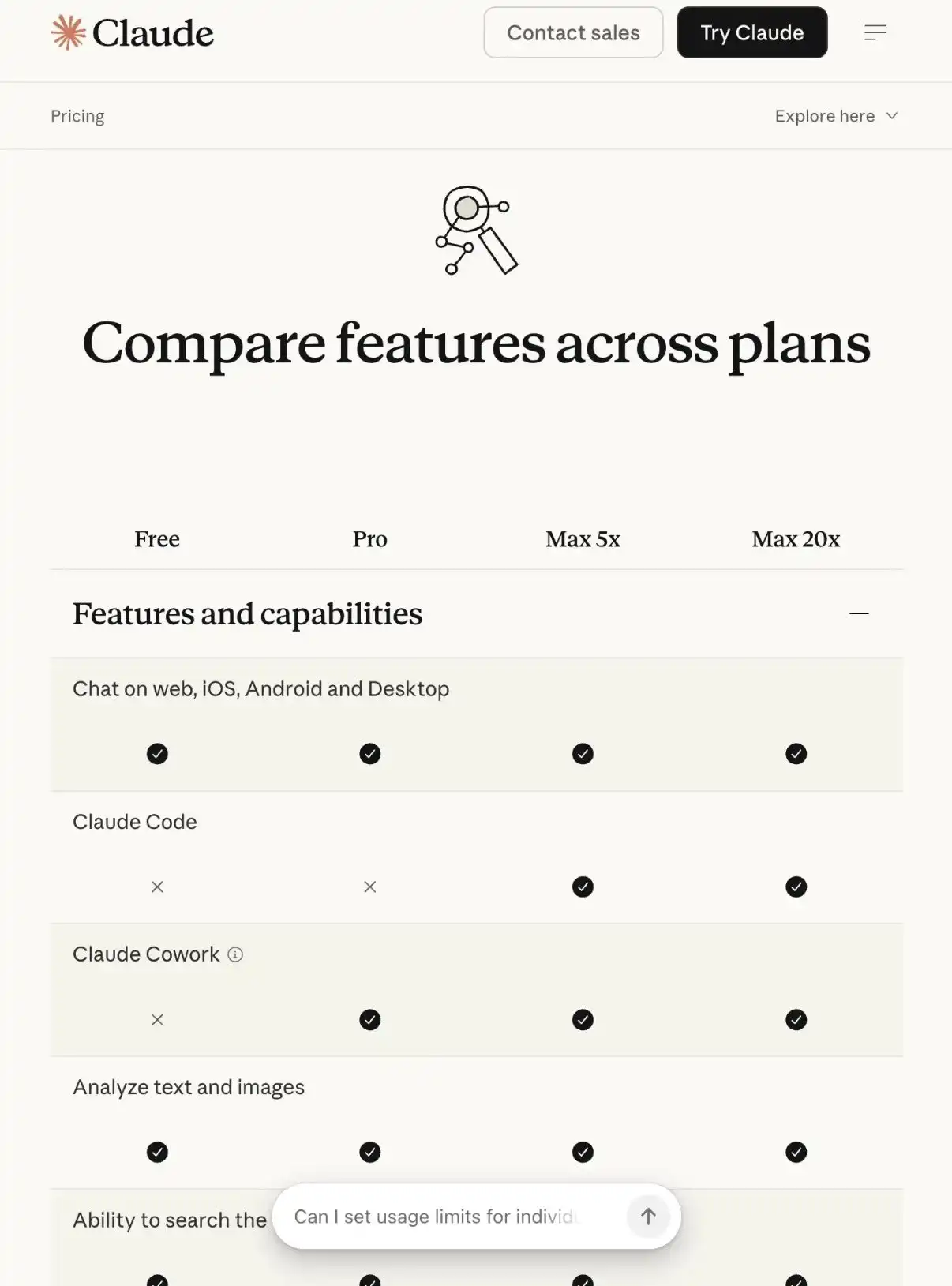
Anthropic is testing developers' price tolerance limits, at the possible cost of user trust.

On April 21, some developers noticed significant changes on Anthropic's official pricing page: Claude Code was marked as unavailable (with an "X") in the feature comparison table for the Pro plan ($20/month), whereas the day before the page still stated that the Pro plan "includes Claude Code." Almost simultaneously, the wording in Anthropic's help documentation quietly changed from "Use Claude Code with your Pro or Max plan" to "Use Claude Code with your Max plan."

AI industry observer Ed Zitron first sounded the alarm on the Bluesky platform, and the news quickly sparked discussions on Hacker News, Reddit r/LocalLLaMA, and X platform.

Official Statement Calls it a "Small-Scale Test," but Documentation is Fully Rewritten

Facing the developer community's intense reaction, Anthropic Growth Lead Amol Avasare responded that day on the X platform, stating this was only a small-scale test targeting about 2% of newly registered users, and existing Pro and Max subscribers would not be affected.

However, multiple media outlets pointed out that Avasare's statement contradicted the actual situation: the feature comparison matrix on the pricing page had been updated site-wide, and the help documentation had also been modified simultaneously. These changes were visible to all visitors and did not resemble a灰度 test for 2% of users. According to The Register, as of publication time, an Anthropic spokesperson had not responded further to this contradiction.

In subsequent tweets, Avasare explained the logic behind the adjustment: when the Max plan was launched a year ago, Claude Code was not bundled with it, Cowork did not exist, and asynchronous agents running for hours were not yet the norm. Since then, Claude Code usage has surged significantly post-Opus 4, and user usage patterns have fundamentally changed. He admitted, "Usage per subscriber has increased substantially, and our current plan structure was not designed for this."

This statement actually revealed a key point: providing Claude Code access for a $20 monthly fee has become unsustainable in terms of computing costs. According to industry analysis, each Claude Code programming session consumes far more tokens than regular chat, and the computational cost of long programming sessions could be several times the subscription fee.

From $20 to $100, Developers Pushed to a Decision Point

If this change is ultimately implemented permanently, Pro users who wish to continue using Claude Code would need to upgrade to the Max 5x plan starting at $100/month, or the Max 20x plan at $200/month. The price has increased fivefold.

Developers reacted quickly and strongly. A GitHub issue titled "Breaking Change: Claude Code CLI Removed from Pro Plan Without Notice" appeared within hours.

A related post on Hacker News received over 100 upvotes and more than 40 comments in less than an hour. One user's experience was representative: he started with the $20 Pro plan in January, upgraded to $200 due to frequently hitting usage limits, downgraded to $100 due to quality drops in Claude Opus 4.6, and recently downgraded back to $20 because he was satisfied with OpenAI Codex's performance on GPT-5.4. "I went from the most enthusiastic recommender to my current state," he wrote.

The reaction on the Reddit r/LocalLLaMA community was more direct. A post titled "Anthropic removes Claude Code from Pro plan, users call it 'the best time to switch to local models'" received extensive discussion, focusing on the progress made by open-source models like Meta's Llama series, Mistral, and DeepSeek in programming capabilities over the past year, as well as the maturity of local deployment tools like Ollama and LM Studio.

OpenAI Quickly Strikes, Codex Remains in Free and Plus Plans

Competitors did not miss this window.

From OpenAI's side, an employee responsible for Codex-related work posted on the X platform: "I don't know what they're doing over there, but Codex will continue to be available in the free and Plus ($20) plans. We have the compute and efficient models to support it. For important changes, we communicate with the community in advance."

The timing and wording of this statement were highly targeted.

OpenAI's Codex, as the main competitor to Claude Code, is currently offered in the ChatGPT Plus ($20/month) plan with a usage limit of 30 to 150 messages every 5 hours, and also has basic access in the free plan. Additionally, weeks ago, OpenAI released a Codex plugin specifically designed for Claude Code users, allowing developers to directly call Codex for code review or task delegation within the Claude Code workflow.

Google is also active; Gemini CLI is currently completely free. According to The New Stack, Anthropic has recently been under pressure regarding computing supply. Not only did it remove Pro access to Claude Code, but it also previously cut off third-party client OpenClaw's access to Claude via subscription accounts. Platform stability issues and frequent outages have also provided opportunities for competitors.


Domande pertinenti

QWhat change did Anthropic make to its Pro plan regarding Claude Code, and when was it noticed?

AAnthropic removed Claude Code from its $20/month Pro plan on April 21, as noticed by developers who saw the pricing page updated to show Claude Code as unavailable for Pro users, whereas it was previously included.

QHow did Anthropic's growth head, Amol Avasare, explain the removal of Claude Code from the Pro plan?

AAmol Avasare claimed it was a 'small-scale test' affecting only about 2% of new sign-ups, stating that existing Pro and Max subscribers would not be impacted, and attributed the change to significantly increased usage and computational costs.

QWhat was the reaction from the developer community to Anthropic's change?

AThe developer community reacted strongly, with immediate backlash on platforms like Hacker News, Reddit, and X. Many expressed frustration, with some considering switching to local models or alternatives, and a GitHub issue was quickly created to highlight the abrupt change.

QHow did OpenAI respond to Anthropic's removal of Claude Code from the Pro plan?

AOpenAI swiftly responded by affirming that its Codex would remain available in both free and Plus ($20/month) plans, emphasizing their ability to support it with sufficient compute and efficient models, and criticizing Anthropic's lack of prior communication.

QWhat are the pricing implications for Pro users if they want to continue using Claude Code after this change?

AIf the change becomes permanent, Pro users would need to upgrade to the Max plan, which starts at $100/month for the 5x version or $200/month for the 20x version, effectively increasing the cost fivefold or more to access Claude Code.

Letture associate

In Jinjiang, Fujian, a Storage Super Unicorn Lies Quiet

In Fujian's Jinjiang, a city known for sportswear, lies a quiet semiconductor giant: Fujian Jinhua Integrated Circuit Co. (JHICC). Once a promising domestic DRAM manufacturer alongside Yangtze Memory and ChangXin Memory Technologies (CXMT), its journey was derailed in 2018 when the U.S. placed it on an Entity List and filed criminal charges for alleged trade secret theft. This halted production for years. A turning point came in February 2024 when a U.S. federal court found JHICC not guilty. However, it had lost crucial time. While CXMT soared to become a top-valued A-share company in 2024, JHICC, with an estimated valuation of 80 billion RMB, was just restarting. Its current output is primarily customized DDR4 chips, not the advanced DDR5/HBM demanded for AI, but it still benefits from the broader memory chip upcycle. JHICC's story is tied to Chen Zhengkun, a veteran engineer who left Micron to lead the venture. Founded in 2016 with state-backed funding, JHICC partnered with Taiwan's UMC to develop DRAM technology. Rapid progress was cut short by the U.S. actions, which Micron initiated, partly due to its heavy reliance on the Chinese market. Post-sanctions, Chen's team worked to rebuild the production line with reduced reliance on U.S. technology. According to its records, JHICC achieved small-scale production and revenue growth under immense pressure. It now focuses on the stable "niche" DRAM market (e.g., TVs, routers) with a monthly capacity of ~40,000 wafers, aiming for 60,000 by 2026. It holds over 1,000 patents but remains on the Entity List. For Jinjiang, investing in JHICC was a bold industrial leap. The local government provided unwavering financial and logistical support during the crisis, helping the company survive. JHICC has become the anchor for a growing local semiconductor cluster. Though its scale lags behind domestic peers, JHICC's persistence symbolizes a hard-won foothold in a global market long dominated by Samsung, SK Hynix, and Micron. Having missed one boom, it seeks a place in the new AI-driven memory supercycle.

marsbit37 min fa

In Jinjiang, Fujian, a Storage Super Unicorn Lies Quiet

marsbit37 min fa

Must-Watch Events Next Week|CLARITY Act Could Face Senate Vote; SpaceX, Circle to Report Earnings (8.3-8.9)

**Summary: Key Events and Developments to Watch (August 3-9)** The upcoming week is marked by significant financial disclosures, key legislative deadlines, and notable product updates. **Major Financial Events:** Several companies are scheduled to release their Q2 2026 earnings. American Bitcoin (ABTC) will report on August 3, followed by SpaceX and Hut 8 Mining Corp. on August 4, and Circle on August 5. Notably, a significant portion of SpaceX shares (up to 12% of total shares) will be unlocked on August 6 following their earnings release. **Key Legislative Deadline:** The U.S. Senate faces an August 7 deadline to secure 60 votes for the CLARITY Act, a bipartisan bill aiming to establish a federal regulatory framework for cryptocurrencies. The Senate may hold a full vote on the bill during the week. **Economic Data:** The U.S. July Non-Farm Payrolls report will be released on August 7, providing crucial labor market data. **Technology & Product Updates:** * **Shutdowns:** DeFi portfolio tracker Zapper and wallet app Ctrl Wallet will cease operations on August 3. * **Upgrades:** LayerZero will deprecate its v1 relayers on August 3. XRP Ledger's new version 3.3.0, featuring five new functions, is expected next week. * **AI:** Elon Musk announced that the advanced Grok 4.6 AI model is set for release around August 7. * **Bitcoin:** The BIP-110 forced signaling for a potential Bitcoin network change is scheduled to begin around August 8. **Other Notable Events:** Chinese robotics firm Unitree Tech has set its preliminary price inquiry for its IPO for August 5. South Korean exchange Upbit will delist AQT and AERGO tokens on August 3.

marsbit2 h fa

Must-Watch Events Next Week|CLARITY Act Could Face Senate Vote; SpaceX, Circle to Report Earnings (8.3-8.9)

marsbit2 h fa

Trading

Spot
活动图片




