Anthropic Issues DMCA Takedown Notices, Massively Removes 8,100 Source Code Repositories

marsbitPubblicato 2026-04-01Pubblicato ultima volta 2026-04-01

Introduzione

AI giant Anthropic has issued multiple DMCA takedown notices to GitHub in response to a major source code leak. The company is targeting illegally hosted repositories containing the code for Claude Code. As a result, GitHub has removed the main repository along with over 8,100 forked repositories, marking one of the largest code copyright clean-up operations in the AI industry. Contrary to initial reports of employee error, an internal investigation revealed the leak was caused by a bug in an internal packaging tool. This bug mistakenly included sensitive files and full TypeScript source code, which should have remained private, into a production build. While this finding shifts blame from employee misconduct, it highlights a critical security flaw in Anthropic's automated workflow. Despite the takedown, the code had already been downloaded by thousands of developers within 48 hours and widely shared on platforms like Telegram, cloud storage, and private Git servers, making complete eradication nearly impossible. The leaked code, which includes implementation logic and internal model fine-tuning instructions, continues to be actively analyzed by developers.

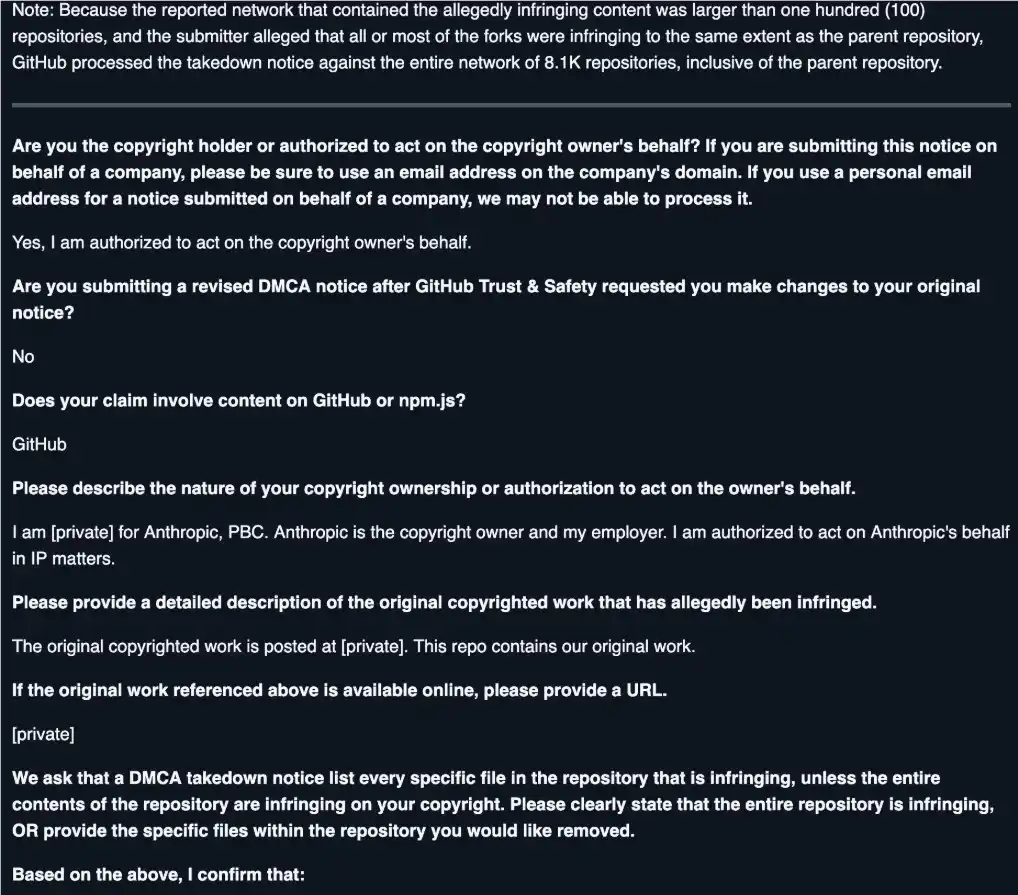
In response to the recent source code leak incident, AI giant Anthropic has officially launched a legal counterattack. According to the latest news, the company has submitted multiple DMCA (Digital Millennium Copyright Act) takedown notices to GitHub, demanding the removal of all illegally hosted Claude Code source code repositories on the platform.

As a result, GitHub adopted a "wholesale" approach, not only deleting the reported main repository but also simultaneously taking down over 8,100 related forked repositories. This marks one of the largest code copyright cleanup operations in the AI industry in recent years.
Leak Cause Reversed: Not "Human Error," but a Tool BUG

Public opinion previously widely believed the leak was due to employee operational error, but the latest investigation report reveals that the real culprit may be an underlying BUG in a certain packaging tool used internally by Anthropic.

This BUG caused the system to mistakenly include sensitive files and complete TypeScript source code, which should have remained private, when building the production environment package. The exposure of this technical detail somewhat alleviates external doubts about the professional competence of Anthropic employees but also reveals serious security vulnerabilities in their automated workflow.

Although GitHub cooperated by taking down 8,100 repositories, it is nearly impossible to completely erase this data, as the source code has been downloaded, cloned, and disseminated by tens of thousands of developers worldwide over the past 48 hours, spreading to Telegram, cloud storage, and private Git platforms.

Currently, a large number of developers within the community are conducting "archaeological" research on this code. The leaked source code not only reveals the implementation logic of Claude Code but also contains a wealth of internal instructions regarding model behavior fine-tuning.


Domande pertinenti

QWhat legal action did Anthropic take in response to the source code leak?

AAnthropic submitted multiple DMCA (Digital Millennium Copyright Act) takedown notices to GitHub to remove illegally hosted Claude Code source code repositories.

QHow many repositories were affected by GitHub's takedown in response to Anthropic's DMCA notices?

AGitHub took down over 8,100 related fork repositories in addition to the main reported repository.

QWhat was the actual cause of the source code leak, according to the latest investigation?

AThe leak was caused by a bug in an internal packaging tool used by Anthropic, which mistakenly included sensitive files and full TypeScript source code that should have remained private when building the production environment package.

QWhy is it nearly impossible to completely remove the leaked source code from circulation?

AIt is nearly impossible because the source code was downloaded, cloned, and spread by tens of thousands of developers worldwide within 48 hours, and it has been disseminated to platforms like Telegram, cloud storage, and private Git platforms.

QWhat does the leaked source code reveal about Claude Code?

AThe leaked source code reveals the implementation logic of Claude Code and contains a large number of internal instructions related to model behavior fine-tuning.

Letture associate

SemiAnalysis on the Epic Plunge: It's Not Over Yet

SemiAnalysis Weekly discusses the recent sharp correction in the semiconductor market after a historic first half. Analysts Doug O'Loughlin and Dylan note that despite healthy fundamentals, markets like South Korea's KOSPI have plunged 40%, wiping out leveraged retail investors. A core debate focuses on AI demand versus supply constraints. Dylan cites SemiAnalysis's internal use of AI coding agents, leading to a 100x increase in AI spending, as evidence of powerful demand. Doug agrees demand is strong but questions its exact magnitude, calling it a "trillion-dollar question." His primary concern is physical and financial bottlenecks: a shortage of 100,000 electricians in the US, massive $450B in corporate debt issuance by hyperscalers (funded by a shrinking pension pool), and labor/scale limits in regions like Taiwan, where TSMC constitutes 20% of GDP. The conversation covers market dynamics, including the typical semiconductor cycle where over-ordering leads to crashes, China's growing memory capacity, and the potential for older chips like the H100 to lose value as models scale. Politically, AI is seen as a likely scapegoat in upcoming elections, though not a top-tier voter priority. The analysts conclude that while the long-term potential is significant, the scaling path is narrowing. The challenge is matching exponential compute demands with real-world constraints on capital, labor, and permits, risking scenarios where massive investment outpaces near-term revenue generation.

marsbit52 min fa

SemiAnalysis on the Epic Plunge: It's Not Over Yet

marsbit52 min fa

After Robinhood's Aggressive Entry, Why is PUMP Defying the Trend and Rising?

Amid a prolonged crypto bear market that has strained many projects, Pump.fun stands out by maintaining strong profitability. Despite a major token unlock in mid-July that was expected to cause selling pressure, its native token PUMP has risen nearly 48% over the past month. Analysis shows only a small portion of unlocked tokens were sold, with 92% of investor allocations still held. A buyback-and-burn mechanism has also supported the price, though daily回购 funds have declined by 77.5% from their peak, partly due to a change in tokenomics and lower platform revenue. Pump.fun remains a top revenue generator in crypto, with annualized revenue of around $450 million, ranking just behind giants like Tether and Circle. However, its daily revenue is down about 69% from its all-time high, reflecting dependence on meme coin market cycles. The platform also faces a class-action lawsuit alleging market manipulation and securities violations. New competition has emerged with Robinhood Chain's launchpad, which recently saw higher weekly volume and active addresses than Pump.fun. While Pump.fun's metrics haven't declined yet, it has responded with a new token launch mechanism called BOOST to improve liquidity. This has increased platform activity but raised community concerns about potential exploitation for short-term pumps. Ultimately, Pump.fun's success remains tightly linked to meme coin speculation and broader market sentiment.

marsbit52 min fa

After Robinhood's Aggressive Entry, Why is PUMP Defying the Trend and Rising?

marsbit52 min fa

Trading

Spot
活动图片