Anthropic and OpenAI Have Single-Handedly Severed the Logic of Pre-IPO Stock Tokenization

marsbitPubblicato 2026-05-12Pubblicato ultima volta 2026-05-12

Introduzione

The pre-IPO stock token market is experiencing significant turmoil following strong statements from AI giants Anthropic and OpenAI. Both companies have updated their official policies, declaring that any transfer of their company shares—including sales, transfers, or assignments of share interests—without prior board approval is "invalid" and will not be recognized in their corporate records. This means buyers in such unauthorized transactions would not be recognized as shareholders and would have no shareholder rights. A major point of contention is the use of Special Purpose Vehicles (SPVs), which are legal entities commonly used by pre-IPO token platforms to pool investor funds and indirectly acquire shares from employees or early investors. The companies explicitly state they do not permit SPVs to acquire their shares, and any such transfer violates their restrictions. They warn that third parties selling shares through SPVs, direct sales, forward contracts, or stock tokens are likely engaged in fraud or are offering worthless investments due to these transfer limits. This stance directly threatens the core model of many pre-IPO token platforms, which rely on SPV structures. The announcement revealed additional risks within this model, such as complex "SPV-within-SPV" layering that obscures legal transparency, increases management fees, and creates a chain reaction risk of invalidation. Following the news, tokens like ANTHROPIC and OPENAI on platforms like PreStocks fel...

Original | Odaily Planet Daily (@OdailyChina)

Author | Azuma (@azuma_eth)

The pre-IPO stock token market has just experienced a severe shockwave. The epicenter of this earthquake comes from two statements issued by AI giants Anthropic and OpenAI.

Anthropic and OpenAI Successively State They "Do Not Recognize" Unauthorized Transfers

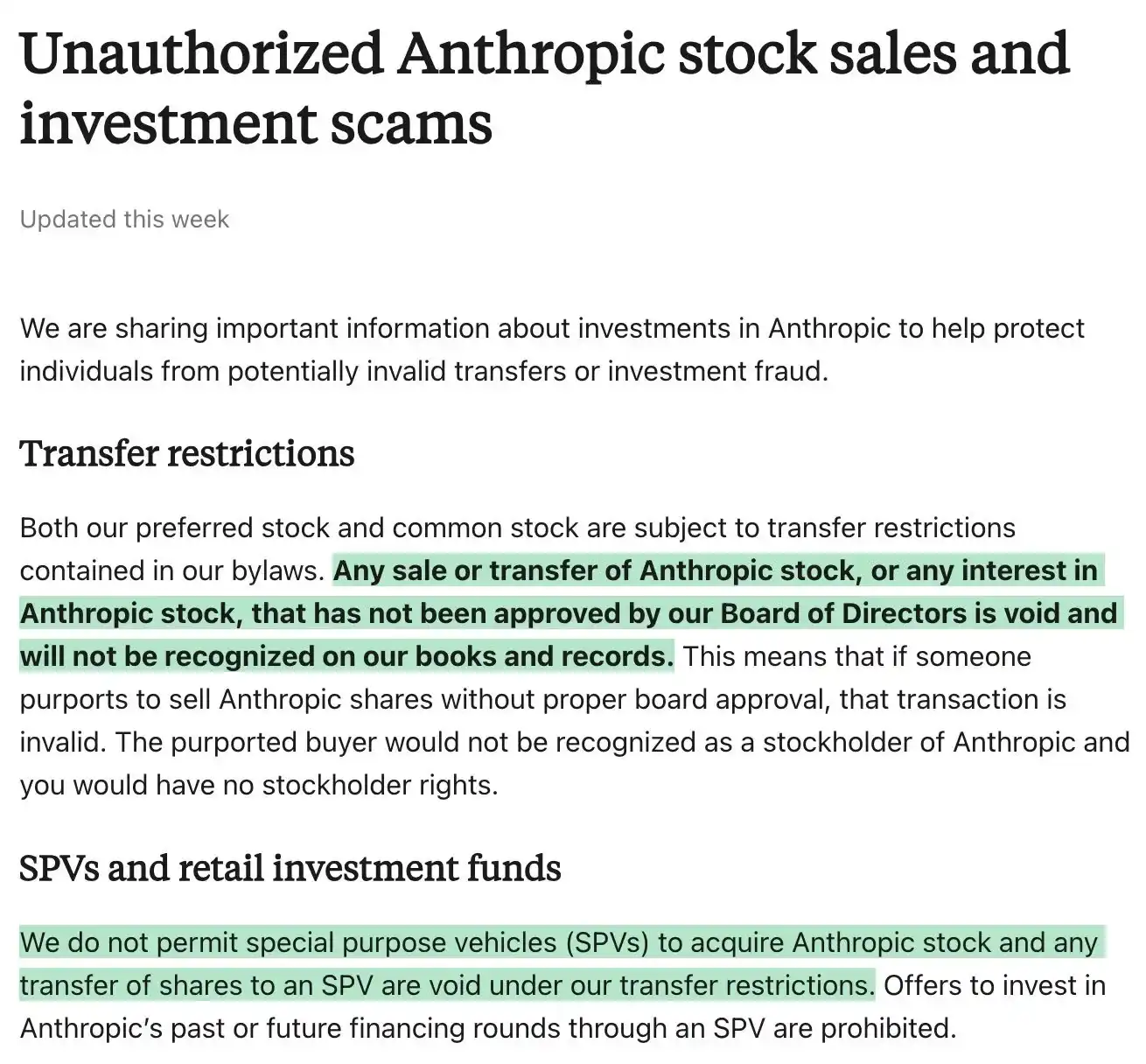
Today, Anthropic updated an official statement it released in February titled "On Unauthorized Anthropic Stock Sales and Investment Scams."

In the article, Anthropic explicitly stated: "Any sale or transfer of Anthropic stock, or disposition of an interest in Anthropic stock, that has not been approved by our board of directors, is invalid (note the use of 'invalid') and will not be recognized on the company's books and records. This means that if anyone sells Anthropic stock without board approval, the transaction will be deemed invalid. The purported buyer will not be recognized as an Anthropic shareholder and will not enjoy any shareholder rights."
Shortly after Anthropic updated its statement, OpenAI also followed up with an announcement stating: "All equity interests are subject to transfer restrictions. No shares may be transferred directly or indirectly without the written consent of the company. Any sale without consent is not only unauthorized but also invalid."
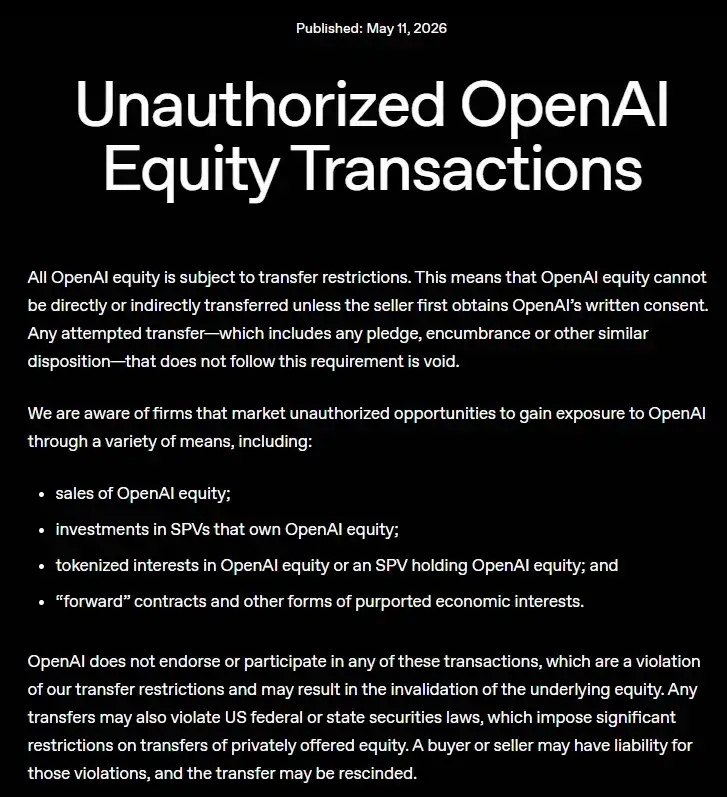
In their announcements, both Anthropic and OpenAI explained that the companies' preferred and common stock are subject to transfer restrictions stipulated in their charters, meaning all stock transfers require board approval.

Anthropic also emphasized, "The company also does not permit the acquisition of Anthropic shares by 'Special Purpose Vehicles' (SPVs). Any transfer of shares to an SPV violates the company's transfer restrictions... Some investment funds may claim to offer indirect access to Anthropic shares, but these funds are likely attempting to circumvent transfer restrictions. Therefore, any third party claiming to sell Anthropic shares to the public — whether through direct sales, forward contracts, stock tokens, or other mechanisms — may be involved in fraud or offering worthless investments due to Anthropic's transfer restrictions."
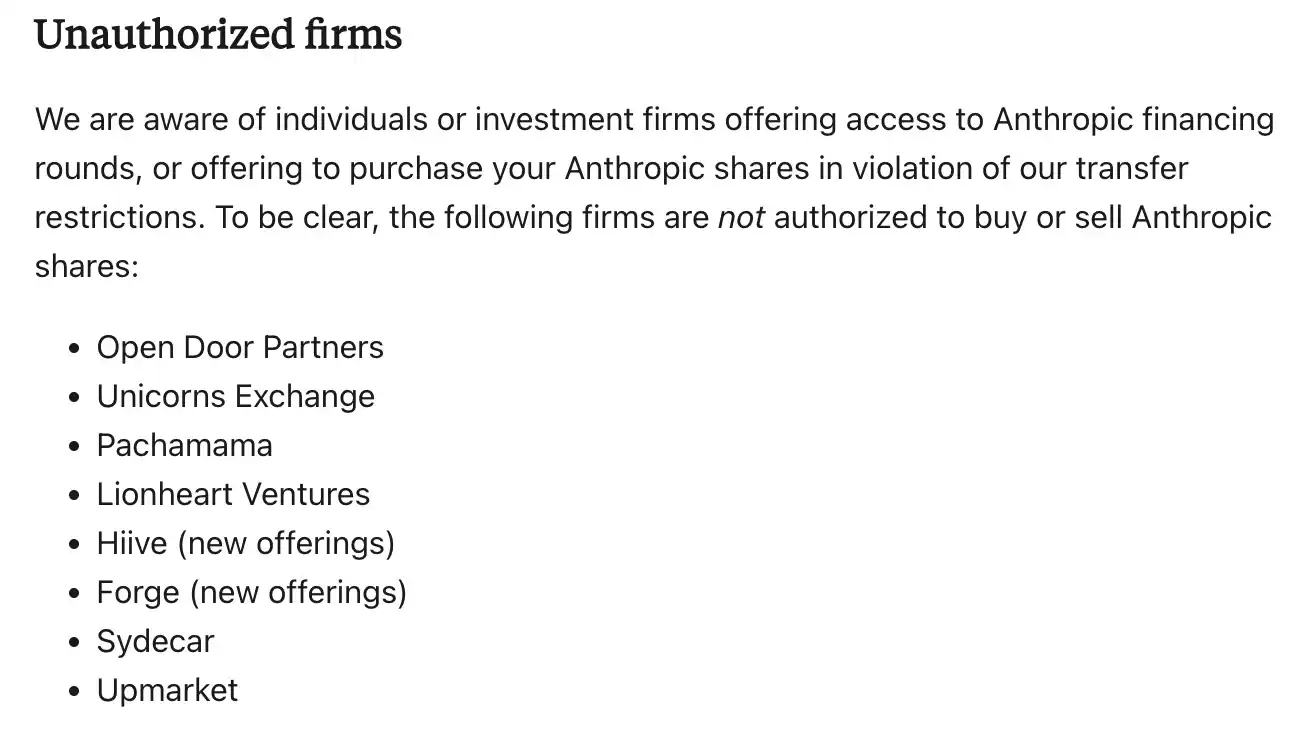
  • Odaily Note: The image shows unauthorized equity transfer platforms named by Anthropic.

What is an SPV?

To understand why this update has had such a massive impact on the pre-IPO stock token market, one must first understand what an SPV is.

In traditional pre-IPO stock trading, directly transferring original shares is extremely difficult, restricted not only by company charters but also involving complex legal procedures. In this context, SPVs emerged.

An SPV is a legal entity established specifically for a particular transaction or investment purpose. It can be understood as a 'shell company dedicated to holding a specific asset.' Multiple investors can indirectly hold shares in a company or a certain asset by contributing capital to the same SPV, achieving goals such as centralized ownership, lowered entry barriers, and optimized legal and tax structures. SPVs are particularly common in popular pre-IPO stock trading. Since many high-profile companies are often unwilling to directly introduce numerous small shareholders, institutions typically first set up an SPV, which then uniformly invests in the target company.

For example, so-called "early participation in Anthropic or OpenAI share subscriptions" in the market essentially involves investors first contributing capital to an SPV, which then purchases the unlisted equity of Anthropic or OpenAI.

Currently, most pre-IPO stock token platforms (such as Prestock) adopt the SPV structure.

  • The platform or its partners will register an SPV in a certain jurisdiction. The sole purpose of this SPV is to buy original Anthropic shares in the secondary market (usually from employees or early investors).
  • The platform will then issue derivative tokens on-chain (e.g., ANTHROPIC or OPENAI), which are legally defined in agreements as "claims to the economic benefits of that SPV."
  • Theoretically, these tokens are 1:1 pegged to the original shares. For every token issued, the underlying SPV should hold a corresponding share of stock.

The problem now is that Anthropic and OpenAI have now explicitly stated they 'do not recognize unauthorized stock transfers.' This means if an SPV transfers stock without board approval (which is highly unlikely to be granted), the stock held by that SPV may be considered invalid in the eyes of Anthropic and OpenAI. If the stock held by the SPV is invalid, then the "economic benefits" referenced by the on-chain tokens become worthless.

The Risk of SPV "Nesting"

A significant reason for Anthropic and OpenAI's strong opposition to SPVs is the growing risk of over-financialization as their pre-IPO stock tokens continue to be hotly traded (Anthropic's pre-IPO valuation once soared to $1.4 trillion, far exceeding its last funding round valuation).

Among these risks, the "nesting" of SPVs is most concerning — many investors buying pre-IPO stock tokens believe they are purchasing company shares, but are actually only buying claims to the economic benefits of an SPV. More exaggeratedly, many SPVs do not directly hold Anthropic's original shares but are instead nested two or three SPV layers down.

This "nesting" structure is, in fact, very dangerous.

  • Legal Transparency Issues: With each additional layer, the authenticity of the underlying assets becomes more blurred. Investors find it difficult to confirm whether the bottom-most SPV has actually obtained the company's board transfer approval.
  • Management Fee Exploitation: Each layer of SPV charges management fees, performance fees, and dividends. After layer-by-layer skimming, investors' actual returns are severely diluted.
  • Zeroing Risk: If the equity transfer at any layer is deemed "invalid" by Anthropic, the entire value chain could instantly collapse.

Whether for reputational reasons or investor protection, Anthropic and OpenAI clearly do not want to see this situation.

Pre-IPO Stock Tokens Plummet, Contracts Remain Relatively Stable

Once the announcements from Anthropic and OpenAI spread, the market immediately reacted.

ANTHROPIC on PreStocks plunged sharply, falling below $1,000 at its lowest, temporarily reported at $1,082 as of 12:00, down 20.62% for the day; OPENAI was temporarily reported at $1,440, down 26.82% for the day.
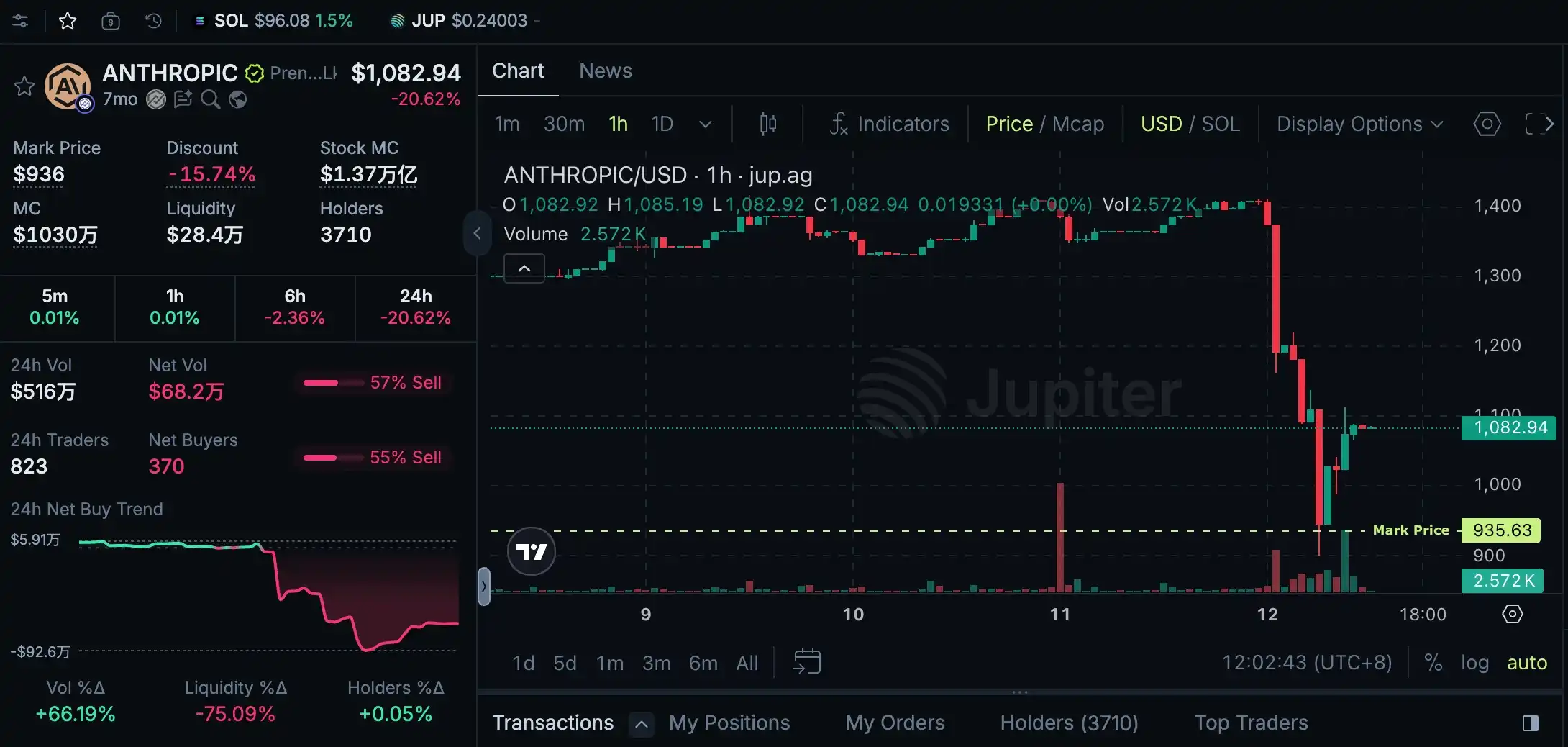
Investor panic is easily understood. Since Anthropic and OpenAI explicitly stated they do not recognize unauthorized shareholdings, the "rights" behind these tokens face the probability of becoming "worthless paper." Holders may confront significant claim validation risks and legal litigation costs.

Interestingly, while pre-IPO stock tokens came under pressure, another type of pre-IPO stock trading product performed relatively stably — pre-IPO contracts that rely entirely on market-driven bilateral betting. The reason for this is that such products do not hold any real stock; Anthropic and OpenAI's restrictions have no effect on them. They are essentially "bilateral betting pools" on future IPO prices, relying on price competition between buyers and sellers.

Predictions for Future Direction

In response to Anthropic and OpenAI's "non-recognition" statements, two distinctly different voices have emerged in the industry.

Some believe the logic of pre-IPO tokenized stock trading is dead. If headliners like Anthropic and OpenAI are leading the charge to ban SPVs, other giants may follow suit. With equity backing being questioned, the value of so-called pre-IPO stock tokens is in doubt.

However, others, including Rivet founder Nick Abouzeid, believe this is not a cause for alarm. Trading pre-IPO stock tokens through unofficial channels was always a gamble; buyers should have had the awareness from day one that the "company might not recognize" the shares. What you lack is direct investment opportunity; obtaining that opportunity through other channels always carries certain risks.

In summary, at a time when premiums for pre-IPO stock tokens have continued to expand and market sentiment has grown increasingly feverish, Anthropic and OpenAI's statements undoubtedly pour cold water on the entire sector.

Over the past few months, more and more investors have begun viewing pre-IPO stock tokens as a 'low-barrier channel to participate in the growth of top AI companies.' Valuations for some AI-concept pre-IPO stock tokens have significantly detached from reality, with even crazy speculation far exceeding the valuations of the last funding rounds. Against this backdrop, the public "debunking" by Anthropic and OpenAI, in a way, is also about redrawing the boundaries for this wildly growing new market.

For speculators, this is a lesson in risk; but for the long-term development of the industry, the market may also need such a moment of "de-bubbling."


Domande pertinenti

QAccording to the article, what did Anthropic and OpenAI announce regarding unauthorized stock transfers?

ABoth Anthropic and OpenAI announced that any sale or transfer of their company stock without board approval is unauthorized and invalid. They will not recognize such transactions on their books, meaning buyers of such shares will not be considered shareholders and will have no shareholder rights.

QWhat is an SPV, and how was it typically used in the pre-IPO stock token market as described?

AAn SPV (Special Purpose Vehicle) is a legal entity created for a specific transaction or investment. In the pre-IPO token market, platforms would use an SPV to purchase company stock (e.g., from employees). They would then issue tokens on a blockchain, which represented a claim on the economic benefits of that SPV, theoretically 1:1 with the underlying shares.

QWhy does the article consider the multi-layered 'nesting' of SPVs particularly risky?

AMulti-layered 'nesting' of SPVs is risky because it obscures the transparency of the underlying asset, makes it hard to verify if the transfer was authorized, involves multiple layers of fees that dilute investor returns, and creates a chain where if any one transfer is deemed invalid by the company, the entire value chain can collapse.

QHow did the market react to the announcements from Anthropic and OpenAI, particularly concerning different types of pre-IPO products?

AThe market reacted negatively to pre-IPO stock tokens based on SPV structures. For example, ANTHROPIC and OPENAI tokens on PreStocks saw significant price drops (over 20%). However, pre-IPO contracts, which are purely speculative bilateral bets on future IPO prices and do not hold actual stock, remained relatively stable as they were unaffected by the companies' transfer restrictions.

QWhat are the two contrasting viewpoints presented in the article regarding the future of the pre-IPO stock token market after these announcements?

AOne viewpoint is that the logic behind pre-IPO token trading is dead, as other major companies might follow Anthropic and OpenAI's lead, undermining the value of tokens without recognized underlying equity. The other viewpoint, from figures like Nick Abouzeid, is that this was always a known risk when buying through unofficial channels, and investors should have been aware that the company might not recognize such holdings from the start.

Letture associate

How to Do Research Well: Deliberately Practice the Real Skills That Matter

No one truly teaches you how to do research. You're often given a desk, a pre-selected problem, and vague instructions to "create something new." Consequently, many people reverse-engineer the job based on visible outputs—papers, posts, announcements—learning only how to *appear* like a researcher rather than how to *become* one. True research capability is built from stacking small, trainable skills, nearly all of which can be developed through deliberate practice. **Pick Your Own Problem:** Most researchers absorb problems from advisors or trends, lacking the underlying reasoning. Choosing a problem you genuinely care about, as John Schulman advises, leads to original work. Develop "taste" like a muscle: predict experiment outcomes, guess paper results from methods, and track which findings remain important over time. **Upgrade Your Inputs:** Relying on shared reading lists (arXiv hot lists, filtered group chats) leads to unoriginal conclusions. Undervalued old literature often holds crucial insights (e.g., MoE, LSTM, backpropagation). Richard Sutton's "The Bitter Lesson" or Claude Shannon's 1952 talk on creative thinking are more predictive than lengthy modern surveys. Breadth matters as much as depth: draw from neuroscience, mechanism design, hardware knowledge, and honest statistics. Read papers directly, especially appendices and limitations sections. **Write Everything Down:** As Paul Graham noted, writing exposes flaws in seemingly mature ideas. Writing is the cheapest defense against self-deception. Following Feynman's principle, Darwin programmatically wrote down facts contradicting his theory to combat memory bias. Maintain a detailed log of hypotheses, setups, predictions, results, and updated understandings. Reviewing past logs fosters essential humility.

marsbit1 h fa

How to Do Research Well: Deliberately Practice the Real Skills That Matter

marsbit1 h fa

Following US Ban on Fable 5, Zhipu AI's Stock Soars 47%

On June 15th, shares of Zhipu AI surged dramatically on the Hong Kong stock market, peaking at a 47.6% gain before closing 32.82% higher. This sharp increase was directly triggered by two recent industry events. On June 12th, Anthropic announced it was suspending global access to its latest flagship models, Claude Fable 5 and Claude Mythos 5, to comply with a U.S. government export control order. The next day, Zhipu AI announced it would open access to its latest open-source flagship model, GLM-5.2, under the permissive MIT license. The Anthropic incident highlighted a critical issue beyond raw model capability: the risk of sudden, unpredictable loss of access to advanced AI models, especially for developers and enterprises deeply integrated with them. This has shifted industry and market focus toward factors like stability, sustainable access, and controllability. Zhipu's move, promoting "frontier intelligence for all," positions its openly available model as a reliable and accessible alternative. The GLM-5.2 model emphasizes "Long Horizon Task" capabilities with a 1M context window, targeting complex, multi-step coding and engineering workflows where maintaining context is crucial. Analysts note this event exposes the risk of dependency on closed-source models subject to single jurisdictional controls, potentially accelerating a shift toward domestic base models and localized deployments. The market's reaction signals a new valuation dimension in AI: providers who can offer stable, long-term, and sustainably accessible AI capabilities are gaining strategic importance.

marsbit1 h fa

Following US Ban on Fable 5, Zhipu AI's Stock Soars 47%

marsbit1 h fa

Fully Entering the AI Era: Alipay Bets on Conversation, WeChat Holds Fast to Social

In May 2026, Alipay announced over 300 million AI payment transactions. Shortly after, WeChat opened its mini-programs for AI integration, sparking controversy by requiring developer source code access. This highlights their diverging approaches to AI integration. Alipay is testing "Project Treasure," an optional AI-native interface replacing traditional app grids with a conversational window. Users can command complex tasks (e.g., "book a ride and order coffee") handled end-to-end by AI. This shift follows an abandoned standalone AI app, focusing instead on enhancing its existing user base. For unmodified mini-programs, Alipay's AI uses "screen-reading" to simulate user interactions, bypassing the need for developer overhaul. It also introduced "Token Pay" for micro-transactions and "AI Wallets" for autonomous agent spending. WeChat, prioritizing its core social function, is taking an embedded approach. Its AI agent will operate within existing contexts like group chats and official accounts, assisting without a separate interface. To enable this, WeChat offers developers two paths: granting source code access for direct AI control ("Automatic Mode") or manually encapsulating services into standardized "Skills." Both place significant burden on developers. Key differences emerge in handling legacy services: WeChat demands developer cooperation (code or labor), while Alipay's screen-reading offers immediate, if potentially less stable, compatibility. Alipay's 3 billion AI transactions demonstrate user acceptance of AI-driven commercial actions. The divergent strategies may reshape mini-program ecosystems—Alipay passively "AI-fying" services, WeChat potentially favoring resource-rich developers—and set competing technical standards. Ultimately, the competition centers on where users entrust the command to "help me get things done."

marsbit1 h fa

Fully Entering the AI Era: Alipay Bets on Conversation, WeChat Holds Fast to Social

marsbit1 h fa

Trading

Spot
Futures
活动图片




