Another Big Scandal in the Crypto World? AI Doomsday Theory... What Are KOLs Talking About?

比推Pubblicato 2026-02-24Pubblicato ultima volta 2026-02-24

Introduzione

Based on the provided content, here is an English summary: The article discusses trending topics among crypto KOLs on social media platform X. The main points include: 1. **Crypto "Strict Father" Action:** Speculation about an imminent major regulatory crackdown on insider trading, with a list of targets allegedly locked in and set to be revealed on the 26th. Multiple embedded images suggest this is a major point of discussion. 2. **Bit Mining Company Sells Bitcoin:** The mining company Bitdeer, with a market cap of $1.9 billion, has drawn controversy for selling off its entire Bitcoin holdings. 3. **AI and Financial Crisis Debate:** A significant online debate questions whether AI will trigger a financial crisis by 2028. The discussion includes concerns about AI's current unreliability for critical tasks, its high cost compared to human labor, and its potential to cause massive unemployment and economic disruption. Opinions vary on the likelihood of an extreme crisis versus a scenario of long-term economic stagnation and inequality. Links are provided to read the full discussions. 4. **Private Equity Mogul Comments on Justin Sun:** Well-known Chinese private equity investor Dan Bin made comments about Tron founder Justin Sun. Replies to this note Sun's controversial reputation but acknowledge the foresight of his past investment ideas, and praise Dan Bin for adapting to new market trends like AI. The article is a roundup of community discussions and explicitly states ...

Dear readers, Wishing you great success as you start work~

What have the KOLs in the crypto circle been talking about in the past 24 hours?

Note: The following content is compiled from the X platform and represents personal opinions. It does not represent the stance of this platform and should not be considered investment advice.

Crypto "Strict Father" is about to take action: Insider trading list locked in, to be revealed on the 26th!


Mining company Bitdeer with a market cap of $1.9 billion liquidates Bitcoin, sparking controversy


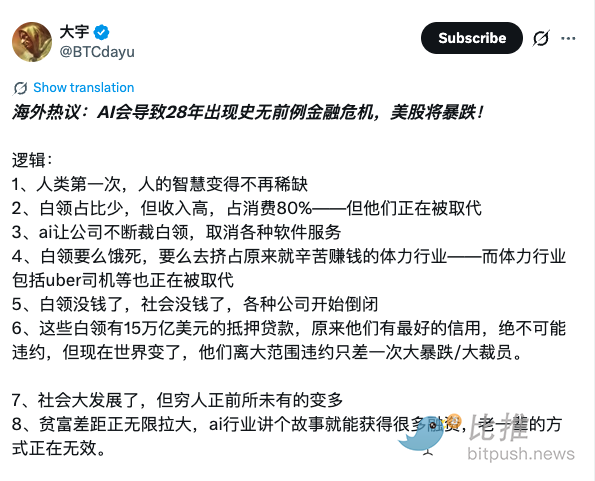
Hot topic overseas: Will AI trigger a financial crisis in 2028?

Click to read the full article:

https://www.bitpush.news/articles/7613842;

https://www.bitpush.news/articles/7613859


Popular replies:

The first point about SaaS dying by mid-2026 is unreliable. Currently, AI accuracy is only 95% to 99%, and this is an inherent characteristic of GenAI. Which company is willing to bear this inaccuracy in mission-critical business? Would you dare use software generated by Vibe Code for tax filing? Would you dare use software generated by Vibe Code for building construction?;

For now, humans are cheaper than tokens. Try running a few tasks with lobsters; even simple ones like checking flight tickets are more expensive than humans;

First inflation, then deflation, but there is still a long period in between, depending on when AI productivity is realized and the race of capital expenditure;

AI will definitely bring huge unemployment and distribution crises, and may even trigger a severe recession. However, the most extreme scenario of an "unprecedented financial crisis + a sharp drop in US stocks" has a low probability of occurring in 2028 (20–30%?). What is more likely is "Japan-style long-term stagnation + class solidification + coexistence of inflation and asset bubbles;";

Since AI can raise a large amount of money just by telling a story, why don't these people switch to the AI industry?;

Private equity big shot Dan Bin comments on Brother Sun

Popular replies:

You can doubt Brother Sun's character, but you can't doubt the foresight of his investment philosophy. I remember listening to Brother Sun's podcast on喜马拉雅 in 2018, and many of the things he talked about have now come true;

Dan Bin is quite famous. His shift to investing in AI shows that he is also keeping up with new market trends;

Learning from the younger generation, I admire Dan Bin's breadth of vision and open-mindedness;


Twitter:https://twitter.com/BitpushNewsCN

Bitpush TG discussion group:https://t.me/BitPushCommunity

Bitpush TG subscription: https://t.me/bitpush

Original article link:https://www.bitpush.news/articles/7613895

Domande pertinenti

QWhat major cryptocurrency mining company sold off all its Bitcoin holdings, causing controversy?

ABitdeer, a mining company with a market capitalization of $1.9 billion, sold off all its Bitcoin holdings, sparking debate.

QAccording to the article, what potential global crisis is AI predicted to trigger by 2028?

AAI is predicted to potentially trigger an unprecedented financial crisis and a stock market crash by 2028, according to discussions among KOLs.

QWhat is the date mentioned for the revelation of a list related to insider trading in the crypto circle?

AThe list related to insider trading is scheduled to be unveiled on the 26th.

QWhich well-known private equity investor commented on 'Brother Sun' (Sun Yuchen) in the article?

ADan Bin, a prominent private equity investor, commented on 'Brother Sun' (Sun Yuchen).

QWhat is a key criticism mentioned in the popular replies regarding the current use of Generative AI (GenAI) in business?

AA key criticism is that GenAI's current accuracy is only 95-99%, and this inherent unreliability makes companies unwilling to use it for mission-critical tasks, as people are currently cheaper than AI tokens for many operations.

Letture associate

Can Generative Models Finally Be Trained End-to-End? The Core Is a For Loop

This article introduces a novel training paradigm for generative models called Explorative Modeling (XM), which enables true end-to-end training. Traditionally, powerful generative models like autoregressive and diffusion models are not trained end-to-end. They are trained to predict a single small step but require iterative multi-step sampling for inference. This "exposure bias" leads to error accumulation and limits performance. The core challenge XM addresses is "mode blurring." In generative tasks, a single input (e.g., "generate a dog") corresponds to many valid outputs (multiple modes). Standard training objectives like reconstruction loss force the model to average these modes, producing unrealistic, blurry outputs. To avoid this, existing models break generation into many small, almost deterministic steps, sacrificing end-to-end training. XM tackles this by restructuring the training loop itself. Its key insight is to amplify "generative expressivity." For each training input, instead of generating one sample, the model generates K candidate outputs. Only the candidate closest to the real data is used for computing the loss and updating the model via backpropagation. This simple "best-of-K" mechanism is implemented as a short for-loop. By exploring multiple possibilities, the model learns to distribute its guesses across different modes rather than collapsing to their uninformative average. The paper demonstrates that "exploration" acts as a new, powerful scaling axis. Gains from XM increase with model size, data scale, and compute. Experiments show improvements in FID scores for image generation and significant efficiency gains, sometimes outperforming larger models without exploration. When pushed to the limit, XM enables fully single-step, end-to-end generative models. In robotics tasks, an "Explorative Policy" matched the performance of a 100-step Diffusion Policy with a single forward pass, drastically improving inference speed. While the best-of-K concept is not entirely new, the authors' contribution lies in formally understanding it as a direct method to boost generative expressivity without fragmenting the generation process. This work suggests that as models scale, enhancing exploration during training may become crucial for overcoming fundamental performance bottlenecks.

marsbit10 min fa

Can Generative Models Finally Be Trained End-to-End? The Core Is a For Loop

marsbit10 min fa

Annual Salary of Millions Competing for Electricians, Meta Rushes to Open Its Own Technical School

The AI boom is facing an unexpected bottleneck: a severe shortage of skilled construction workers and electricians. As tech giants like Meta, OpenAI, and Alphabet race to build massive data centers—such as OpenAI's $16 billion "Stargate" project—they are hitting a critical labor wall. The U.S. needs an estimated 130,000 more electricians, 240,000 construction workers, and 150,000 supervisors by 2030 for AI infrastructure alone, but tens of thousands of electrician jobs go unfilled each year. While AI companies offer high premiums, with electricians earning up to $280,000 annually, worker scarcity still causes massive losses—delays on a single project can cost $14.2 million per month. The complexity of building AI data centers, which require immense power (equivalent to powering hundreds of thousands of homes), sophisticated electrical systems, and advanced liquid cooling solutions, demands highly skilled technicians who are in short supply. To combat this, companies are investing heavily in training. Meta has committed $115 million to a free training school offering tuition, housing, and stipends, targeting 5,000 new workers. OpenAI is partnering with unions to secure skilled labor. These efforts are paying off, with a significant rise in Gen Z interest in trade schools over college. However, the power demands are staggering. AI data centers are driving a rapid surge in electricity consumption, projected to account for up to 12% of U.S. power use by 2028 and raising costs for consumers. Furthermore, the construction boom is project-based, leading to a potential future glut of trained workers once building peaks, which could depress wages industry-wide. The race for AI supremacy now depends as much on skilled hands as on advanced chips.

marsbit1 h fa

Annual Salary of Millions Competing for Electricians, Meta Rushes to Open Its Own Technical School

marsbit1 h fa

Trading

Spot
活动图片