Android Flaw Leaves 30 Million Crypto Wallets Open To Attack: Microsoft Analysts

bitcoinistPubblicato 2026-04-11Pubblicato ultima volta 2026-04-11

Introduzione

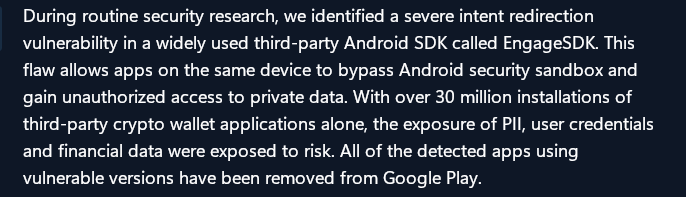
Microsoft analysts revealed a critical security flaw in the EngageLab SDK (v4.5.4), leaving over 30 million Android crypto wallets vulnerable to attack. The "intent redirection" vulnerability allowed a malicious app to bypass Android's sandbox and gain read/write access to a wallet's private data, including seed phrases and keys, without any user interaction. A patch (SDK 5.2.1) was released in mid-2025. Users who haven't updated their apps since then are advised to not only update but also move their funds to new wallets with fresh seed phrases, as any unpatched wallet is considered compromised. The flaw also affected over 50 million apps in total.

A patch has been available for nearly a year, but millions of Android users may still be running vulnerable crypto wallet apps — leaving their funds and private keys exposed to a known security flaw.

Microsoft’s Defender Security Research Team went public last week with details of a vulnerability it first caught in April 2025. The flaw lived inside a widely used software component called the EngageLab SDK, version 4.5.4.

Because that SDK is baked into thousands of Android apps, a single malicious app could trigger a chain reaction that reached far beyond itself.

How The Attack Works

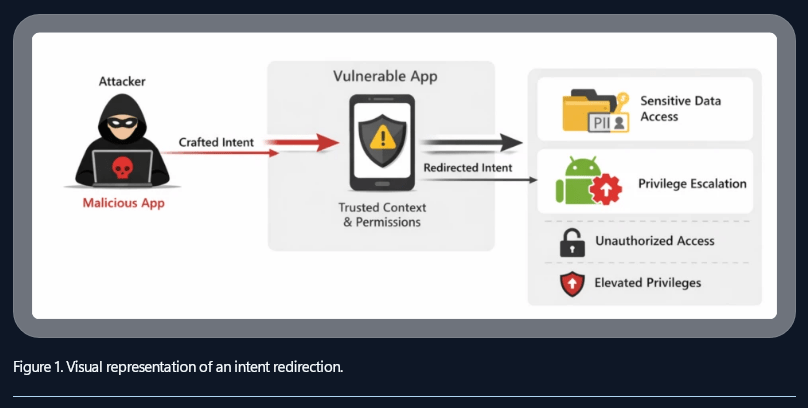
The method is called “intent redirection.” An attacker’s app sends a specially crafted message to any app running the flawed SDK version. Once that message lands, the targeted app is tricked into handing over read and write access to its own data — including stored seed phrases and wallet addresses.
Source: Microsoft

Android’s built-in sandbox system, which normally keeps apps from seeing each other’s data, was bypassed entirely. According to Microsoft, the attack affected more than 50 million apps across the Android ecosystem, with roughly 30 million of those being crypto wallets.

The vulnerability did not require the user to do anything wrong. No suspicious links. No phishing pages. Just having the wrong apps installed at the same time was enough.
Source: Microsoft

Response From Microsoft And Google

Microsoft moved quickly after its discovery. By May 2025, the company had brought Google and the Android Security Team into the response. EngageLab released a fixed version — SDK 5.2.1 — shortly after.

Reports indicate that both Microsoft and Google have since directed users on how to verify whether their wallet apps have been updated through Google Play Protect.

BTCUSD trading at $72,906 on the 24-hour chart: TradingView

Officials also pointed to a broader concern: apps installed as APK files from outside the Play Store are at higher risk, since they bypass the security checks that Google applies to apps listed in its official marketplace.

What Users Should Do Now

For most users who update their apps regularly, the risk has likely passed. But for anyone who has not updated since mid-2025, the recommended action goes beyond a simple app refresh.

Security teams are advising those users to move their funds into entirely new wallets, generated with fresh seed phrases. Any wallet that was active and unpatched during the exposure window should be treated as potentially compromised.

The disclosure comes alongside a separate Android chip vulnerability flagged the previous month and a new US Treasury initiative that pairs government agencies with crypto firms to share cybersecurity threat information — a sign that mobile security in the crypto space is drawing attention at the highest levels.

Featured image from Bleeping Computer, chart from TradingView

Domande pertinenti

QWhat is the name of the vulnerable software component and which version was affected?

AThe vulnerable software component is the EngageLab SDK, specifically version 4.5.4.

QWhat is the attack method called and how does it work?

AThe attack method is called 'intent redirection.' A malicious app sends a specially crafted message to an app running the flawed SDK, tricking it into granting read and write access to its own data, including seed phrases and wallet addresses.

QHow many crypto wallet apps were estimated to be affected by this vulnerability?

ARoughly 30 million crypto wallet apps were estimated to be affected.

QWhat is the primary action recommended for users who had an unpatched wallet app?

AUsers are advised to move their funds into entirely new wallets generated with fresh seed phrases, as the old wallet should be treated as potentially compromised.

QWhich two major companies collaborated on the response to this vulnerability after its discovery?

AMicrosoft and Google (specifically the Android Security Team) collaborated on the response.

Letture associate

"Water Scarcity": The Hidden Fatal Flaw of AI Infrastructure

“Water Scarcity: The Hidden Vulnerability of AI Infrastructure” In June 2026, SpaceX revised its IPO prospectus to highlight a core resource constraint alongside power and processors: water. This move signals a pivotal shift where water scarcity has transformed from an operational cost to a major, uncontrollable investment risk, directly threatening AI data center expansion. The scale of the problem is immense. U.S. data centers consumed an estimated 17 billion gallons of water for direct cooling in 2023, with indirect water use for power generation exceeding 211 billion gallons. Giants like Google alone use billions of gallons annually, with single sites consuming volumes equivalent to a medium-sized city. This water is largely “consumptive,” evaporated into the atmosphere and lost. This massive demand is colliding with scarcity. Tech companies are building “water tigers” in arid regions, sparking community protests in places like Mexico and Arizona, where data centers can legally use millions of gallons daily—enough for tens of thousands of residents. These conflicts are not about illegality, but about a mismatch between historic water allocation frameworks and new, colossal demand. The consequences are real. Community opposition, largely centered on water, has reportedly stalled or canceled $64 billion in U.S. data center projects over two years. Simultaneously, investors are pressuring companies for greater water footprint transparency, viewing it as a financial risk, not just an ESG metric. Technological solutions like air or liquid cooling involve trade-offs between water and electricity use, with final choices dictated by local constraints. The irony is stark: while industry leaders envision AI as a utility “like water,” its physical infrastructure is straining real-world water supplies. The race for AI supremacy may ultimately be governed not by the fastest chip, but by the slowest water meter.

marsbit7 min fa

"Water Scarcity": The Hidden Fatal Flaw of AI Infrastructure

marsbit7 min fa

Global Card Issuance Enters a Compliance-Driven Era: WasabiCard is Building the Next-Generation Payment Infrastructure

Global card issuance is entering a compliance-driven era, with WasabiCard building next-generation payment infrastructure. The platform asserts that as stablecoins increasingly enter cross-border payments, corporate settlements, and global commerce, the industry is shifting focus from "availability" and "growth-driven" models to long-term, compliant operation under global frameworks. Competition will center on sustainable compliance and global infrastructure capabilities. Stablecoins are evolving from on-chain assets into key payment tools in global business, with card issuance acting as critical infrastructure connecting digital assets to traditional payment networks like Visa and Mastercard. This expansion has revealed structural issues, including cross-regional issuance, BIN resource management, and insufficient AML and risk controls. In response, the industry is moving away from reliance on "grey efficiency" towards prioritizing compliance, risk management, and long-term operational stability. WasabiCard outlines its strategy: collaborating with licensed principals and local partners for localized operations, building robust KYC/AML systems, strictly separating commercial and consumer BIN usage, and enhancing global issuance, payment, and cross-border fund flow infrastructure. The goal is to build stable, scalable payment infrastructure amid evolving global regulations, shifting industry competition from scale to infrastructure capability. As stablecoins integrate further with global commerce, payment infrastructure will become a fundamental, embedded component of internet business. WasabiCard will continue to develop capabilities in global card issuance, stablecoin payments, cross-border fund flows, and API-driven financial workflows.

marsbit17 min fa

Global Card Issuance Enters a Compliance-Driven Era: WasabiCard is Building the Next-Generation Payment Infrastructure

marsbit17 min fa

Zhou Hang: How Much Is SpaceX Really Worth?

**Zhou Hang: How Much is SpaceX Really Worth?** SpaceX, arguably one of the greatest industrial companies of the past 50 years, is reportedly targeting a staggering $1.75 trillion valuation in its potential IPO. However, the author argues this figure is inflated by approximately $1.25 trillion when assessed through standard financial metrics. The analysis begins by acknowledging SpaceX's undeniable success: drastically reducing launch costs, achieving near-monopoly in commercial launches, and building the strategic Starlink network. Its achievement surpasses even Tesla's, given it disrupted a state-monopolized industry. Despite this greatness, a $1.75 trillion valuation places SpaceX above the combined market cap of Boeing, Lockheed Martin, Northrop Grumman, RTX, and General Dynamics. Projecting optimistic 2030 revenues of $50-80 billion and applying generous tech-sector multiples yields a "reasonable" valuation range of $500 billion to $1.2 trillion. The $1.25 trillion gap is attributed to three non-financial premiums: 1. **Long-term vision premium** for future Starship-enabled markets (e.g., space-based computing). 2. **Sovereign asset/strategic premium**, as SpaceX is deeply integrated into U.S. national security. 3. **Retail narrative/Musk cult premium**, driven by a heroic story and personal following. Post-IPO, three scenarios are outlined: valuation solidifying (25% probability), sideways volatility as narrative outpaces reality (50%), or a re-rating down to $800B-$1.2T if execution falters or Musk-related risks emerge (25%). The probability-weighted expected value is $1.3-1.5 trillion, suggesting negative expected returns for those buying at the IPO price. The conclusion advises investors to separate the company's excellence from its stock price. Buying at the IPO likely prices in excessive optimism. A more prudent strategy would be to wait for key milestones (e.g., Starship V3 stability) or a significant price correction before investing, or to treat an early purchase as a long-term, high-conviction hold with limited position size, not a short-term bet.

链捕手21 min fa

Zhou Hang: How Much Is SpaceX Really Worth?

链捕手21 min fa

Trading

Spot
Futures
活动图片





