Andrew Kang: Abandon Short-Termism, Embrace Exponential Growth

marsbitPubblicato 2026-02-12Pubblicato ultima volta 2026-02-12

Introduzione

Andrew Kang, founder of Mechanism Capital, argues that we are at a profoundly unique asymmetric moment in history, requiring a shift away from short-term thinking toward a long-term, exponential growth mindset. Having witnessed multiple market cycles, many investors become overly cautious during rapid price increases. However, Kang emphasizes that concerns about bubbles or attempts at market timing are misguided in the current environment. We are nearing a technological "singularity," driven by breakthroughs in AI, robotics, energy, and other innovative fields. In the coming decade, advancements such as billions of AI agents, humanoid robots, space data centers, multi-planetary colonization, and revolutionary medical therapies will compress more progress into twenty years than all of prior human history combined. Companies leveraging AI are already experiencing order-of-magnitude improvements in productivity. For instance, Anthropic now has Claude writing 100% of its product code. Traditional valuation models fail to capture the potential scale of growth, which could represent a 20-sigma event in terms of economic expansion. Wealth creation will accelerate dramatically. Those without exposure to these transformative trends risk being left behind as asset prices surge vertically. While short-term volatility is inevitable, Kang advises embracing long-term risk exposure rather than attempting to trade short-term fluctuations. The value of the embedded "call option" on the sin...

Original author: Andrew Kang, Founder of Mechanism Capital

Compiled by: Ken, Chaincatcher

For those who have experienced at least one full market cycle, you develop an instinct to be wary of price increases that far exceed historical growth rates. Witnessing the dot-com bubble, the 2008 global financial crisis, and the rise and fall of cryptocurrencies triggers pattern recognition alarms in your brain. You hesitate to enter the market because prices are too high, and you want to sell your holdings for fear of being at a peak.

But it is important to recognize that we are in one of the most profound and unique asymmetric moments in history. The only move now is to lengthen your time horizon and completely abandon short-termism.

Excessive worry about bubbles is foolish. Trying to time the market is also foolish. Short-term fluctuations and pullbacks will always occur, but given how close we are to the "singularity," these fluctuations are merely noise. Artificial intelligence, robotics, energy, and innovation are about to experience runaway explosive growth.

Within the next decade, we will have billions (or more) of AI agent workforces, humanoid robots, space data centers, multi-planetary colonization, and significantly improved medical therapies; we will fundamentally change the speed and output of technological breakthroughs in all fields. The technological progress and economic growth we compress into the next twenty years will exceed the sum total of all human civilization history.

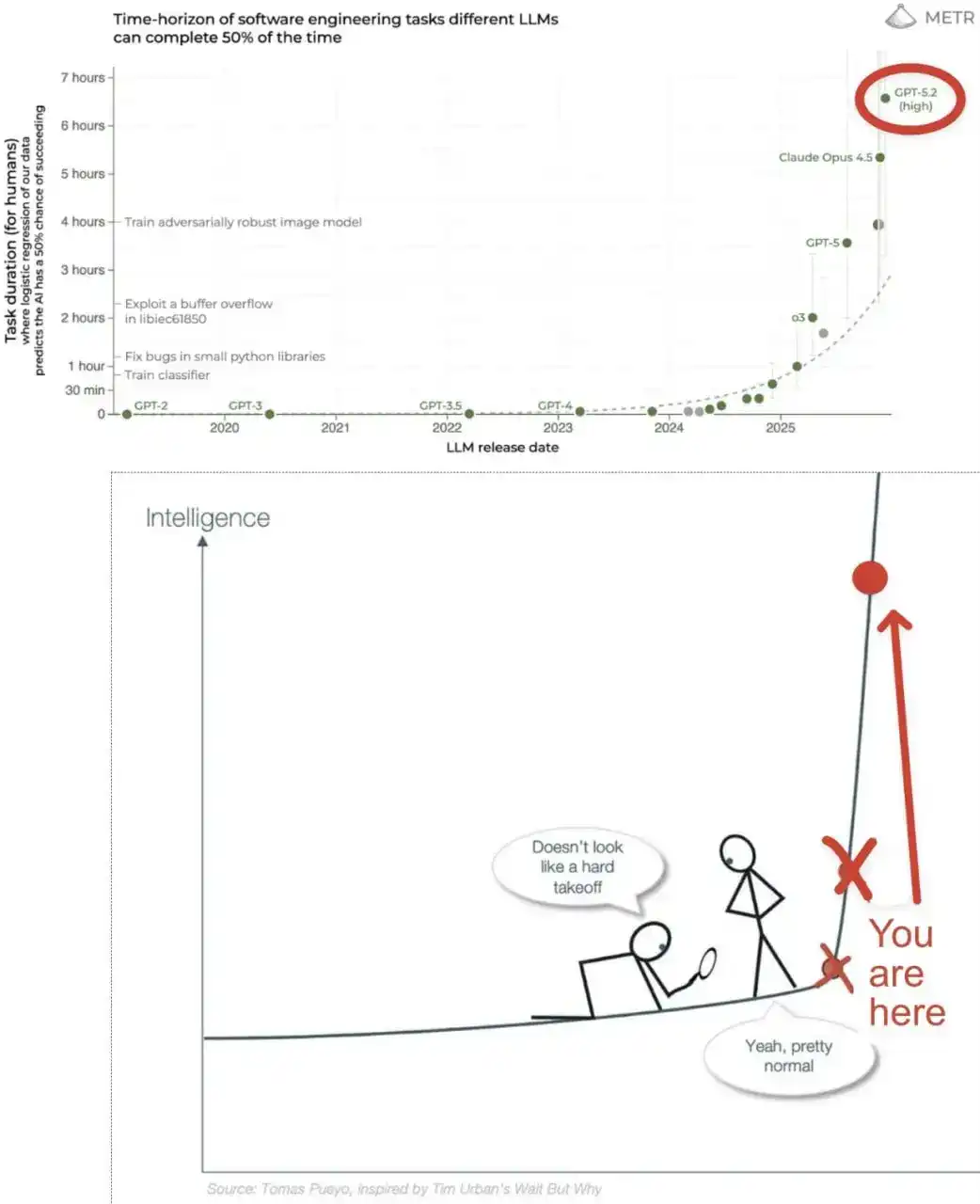
We are already in an extremely steep phase of the J-curve, but this is hard to perceive when we zoom in to the micro level of daily or weekly views. Anthropic now has 100% of its product code written by Claude. Product managers have a virtual team of software engineers so efficient it feels like they can bend time. Companies that effectively utilize AI are seeing product iteration speed improvements not in single digits, not double digits, but triple digits.

Moreover, the capabilities of these tools are still evolving at an accelerating pace. Whether we officially achieve Artificial Superintelligence (ASI) in 2027 or 2029 doesn't really matter. It will happen. By the time it's officially announced, the assets you want to own will have already multiplied in value countless times.

It is highly likely that the actual economic growth over the next 3-10 years will be on the order of 20 standard deviations (20-sigma) in any historical distribution model. This growth, once considered nearly impossible, will be driven by unprecedented second and third-order changes. Traditional valuation models are incapable of pricing these transformations. The potential upside is so vast that traditional present value calculations struggle to capture them.

The rate of wealth appreciation will be staggering, similar to how cryptocurrencies initially created numerous billionaires and millionaires in a short period, but this time the magnitude will be far more extreme. If you have no exposure, it will be difficult to pull the trigger and buy into such vertically rising asset prices; but unlike previous bubbles, the creation of real economic value will better keep pace with the vertical rise in asset prices. Over the past three years, those operating in the market with the cognition of an "exponential horizon" have reaped significant rewards. If you haven't adopted this mindset yet, it's not too late.

While it's important to always be mindful of downside risks, this is the largest upside risk in world history. Learn to bear risk over longer time horizons. Now is not the time for swing trading. For the vast majority of people, long-term investing typically outperforms short-term trading, but the gap in expected value between "trading" and "investing" will be wider than ever before. Ask yourself, what is the value of the call option embedded in the singularity?
Domande pertinenti

QAccording to Andrew Kang, why is it important to abandon short-termism in the current market environment?

ABecause we are at one of the most profound and unique asymmetric moments in history, with unprecedented exponential growth in AI, robotics, energy, and innovation. Short-term volatility is just noise compared to the long-term potential.

QWhat does Andrew Kang predict will happen in the next decade regarding technological progress?

AHe predicts we will have billions of AI agent workforces, humanoid robots, space data centers, multi-planetary colonization, and vastly improved medical therapies, compressing more technological progress and economic growth than the entire history of human civilization.

QHow does Andrew Kang describe the current stage of the J-curve in technological advancement?

AHe describes it as an extremely steep phase of the J-curve, where companies effectively using AI are seeing triple-digit percentage improvements in product iteration speed, though this is hard to notice on a daily or weekly scale.

QWhat does Kang suggest about the relationship between asset prices and the announcement of Artificial Superintelligence (ASI)?

AHe suggests that by the time ASI is officially announced, the prices of assets you would want to own will have already increased exponentially, making early exposure crucial.

QHow does Andrew Kang compare the future wealth creation to the early days of cryptocurrency?

AHe says the speed of wealth creation will be staggering, similar to how cryptocurrency quickly created billionaires and millionaires, but the scale will be far more extreme, with real economic value creation better keeping up with vertical asset price rises.

Letture associate

North Korean Hackers Loot $500 Million in a Single Month, Becoming the Top Threat to Crypto Security

North Korean hackers, particularly the notorious Lazarus Group and its subgroup TraderTraitor, have stolen over $500 million from cryptocurrency DeFi platforms in less than three weeks, bringing their total theft for the year to over $700 million. Recent major attacks on Drift Protocol and KelpDAO, resulting in losses of approximately $286 million and $290 million respectively, highlight a strategic shift: instead of targeting core smart contracts, attackers are now exploiting vulnerabilities in peripheral infrastructure. For instance, the KelpDAO attack involved compromising downstream RPC infrastructure used by LayerZero's decentralized validation network (DVN), allowing manipulation without breaching core cryptography. This sophisticated approach mirrors advanced corporate cyber-espionage. Additionally, North Korea has systematically infiltrated the global crypto workforce, with an estimated 100 operatives using fake identities to gain employment at blockchain companies, enabling long-term access to sensitive systems and facilitating large-scale thefts. According to Chainalysis, North Korean-linked hackers stole a record $2 billion in 2025, accounting for 60% of all global crypto theft that year. Their total historical crypto theft has reached $6.75 billion. Post-theft, they employ specialized money laundering methods, heavily relying on Chinese OTC brokers and cross-chain mixing services rather than standard decentralized exchanges. Security experts, while acknowledging the increased sophistication, emphasize that many attacks still exploit fundamental weaknesses like poor access controls and centralized operational risks. Strengthening private key management, limiting privileged access, and enhancing coordination among exchanges, analysts, and law enforcement immediately after an attack are critical to improving defense and fund recovery chances. The industry's challenge now extends beyond secure smart contracts to safeguarding operational security at the infrastructure level.

marsbit1 h fa

North Korean Hackers Loot $500 Million in a Single Month, Becoming the Top Threat to Crypto Security

marsbit1 h fa

Circle CEO's Seoul Visit: No Korean Won Stablecoin Issuance, But Met All Major Korean Banks

Circle CEO Jeremy Allaire's recent activities in Seoul indicate a strategic shift for the company, moving away from issuing a Korean won-backed stablecoin and instead focusing on embedding itself as a key infrastructure provider within Korea’s financial and crypto ecosystem. Despite Korea accounting for nearly 30% of global crypto trading volume—with a market characterized by high retail participation and altcoin dominance—Circle has chosen not to compete for the role of stablecoin issuer. Instead, Allaire met with major Korean banks (including Shinhan, KB, and Woori), financial groups, leading exchanges (Upbit, Bithumb, Coinone), and tech firms like Kakao. This approach reflects a broader industry transition: the core of stablecoin competition is shifting from issuance rights to systemic positioning. With Korean regulators still debating whether banks or tech companies should issue stablecoins, Circle is avoiding regulatory uncertainty by strengthening its role as a service and technology partner. The company is deepening integration with trading platforms, building connections, and promoting stablecoin infrastructure. This positions Circle to benefit regardless of which entity eventually issues a won stablecoin. Allaire also noted the potential for a Chinese yuan stablecoin in the next 3–5 years, underscoring a regional trend of stablecoins becoming more regulated and integrated with traditional finance. Ultimately, Circle’s strategy highlights that future influence in the stablecoin market will belong not necessarily to the issuers, but to the foundational infrastructure layers that enable cross-system transactions.

marsbit1 h fa

Circle CEO's Seoul Visit: No Korean Won Stablecoin Issuance, But Met All Major Korean Banks

marsbit1 h fa

Trading

Spot
Futures
活动图片