Analyzing RENDER’s 11% surge: Is the momentum sustainable?

ambcryptoPubblicato 2026-04-03Pubblicato ultima volta 2026-04-03

Introduzione

Render (RENDER) surged 11.23% to $1.91, reaching a three-week high, with trading volume rising 48% to $81.5 million. Derivatives data showed strong bullish sentiment, as Open Interest increased by 21% to $60 million and the Long/Short Ratio rose to 1.28, indicating dominant long positions. However, spot netflow turned positive at $460k, suggesting increased selling pressure as profit-taking resumed. Technical indicators like the RSI at 64 and positive DMI signal strong upward momentum, but if profit-taking intensifies, RENDER could retrace to the $1.6 support level. Breaking the $2 resistance is possible if bullish conditions persist.

Render [RENDER] continued with its bullish streak, breaking out of the recent downtrend and summiting a three-week high of $1.92.

As of this writing, RENDER traded at $1.91, up 11.23% on the daily charts, adding to its 6% weekly gains. Over the same period, the altcoin’s volume rose 48% to $81.5 million, reflecting increased market participation.

RENDER speculators take hold of the market

While the market continued to suffer from reduced liquidity, RENDER has shown solid strength, consistent with active market participation.

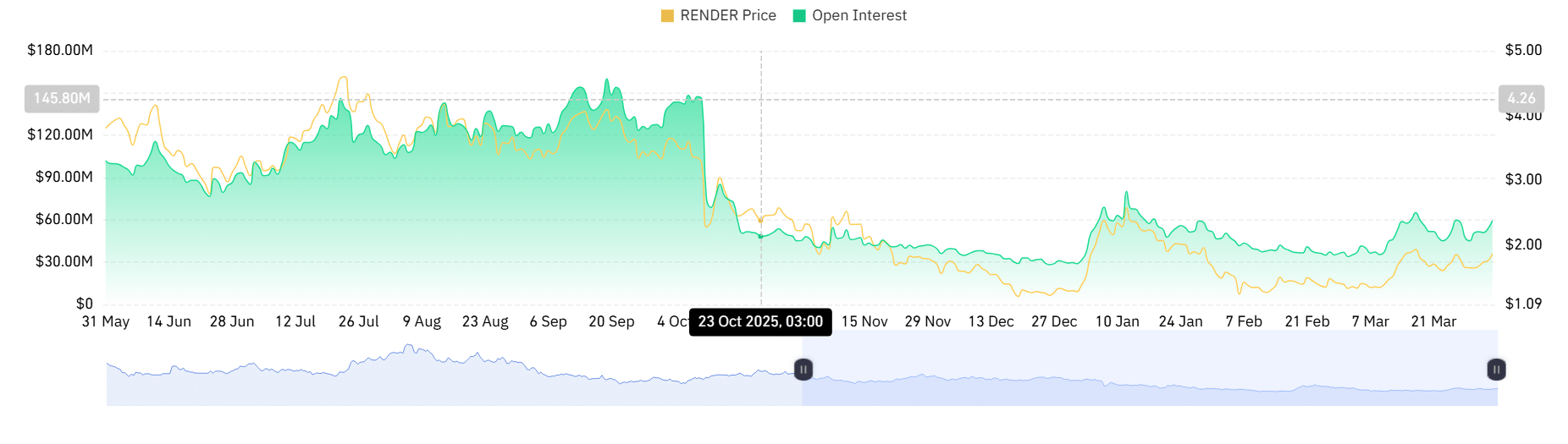
On the derivatives side in particular, RENDER has experienced sustained demand for Futures positions. CoinGlass data showed that altcoin Open Interest rose 21% to $60 million, while derivatives volume climbed 35% to $128 million.
Source: CoinGlass

Such a jump in OI and Volume showed increased Futures market participation and steady capital inflows. In fact, over $9 million flowed into the futures positions over the past eight hours as of the 3rd of April.

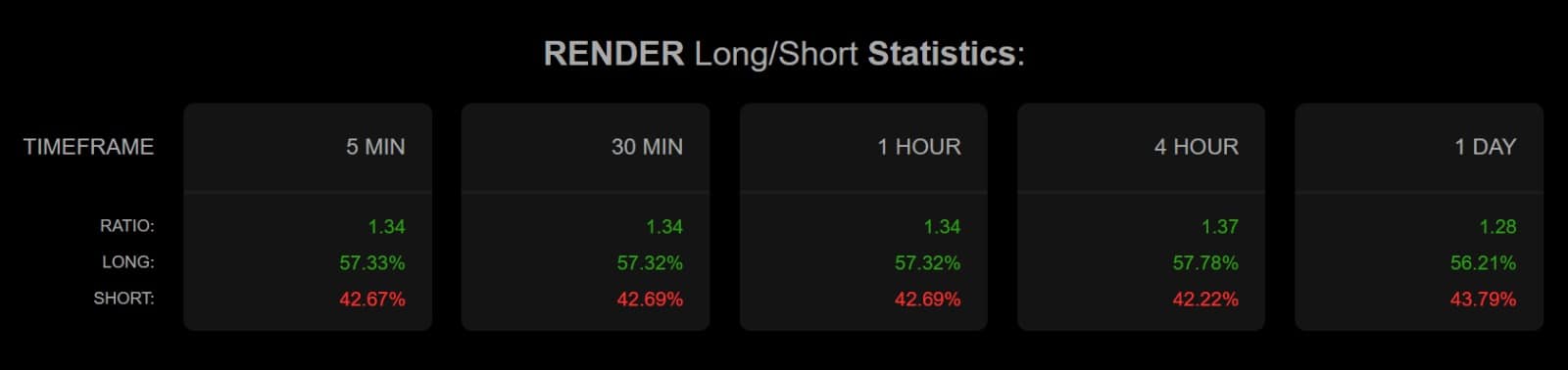
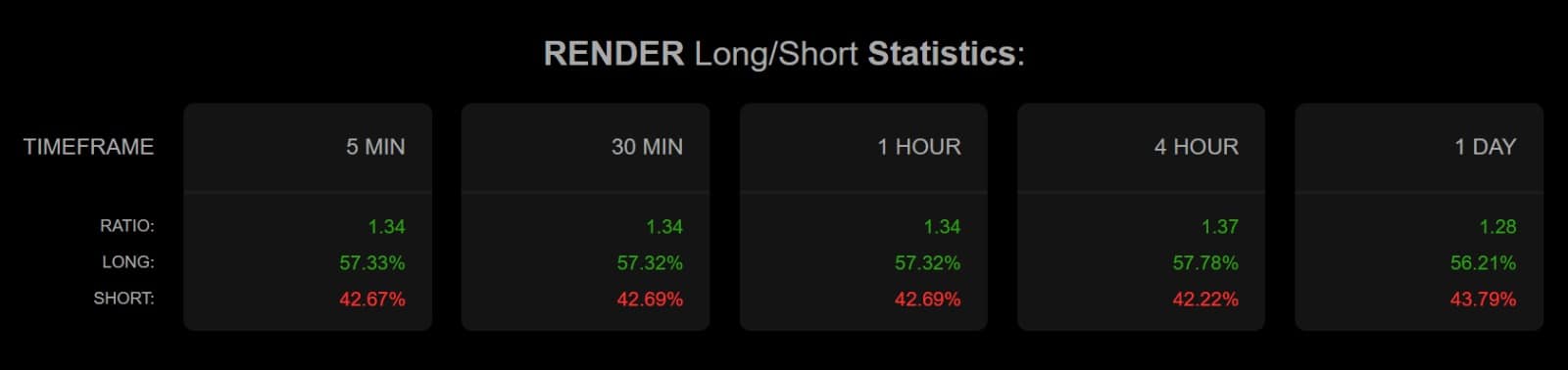
Meanwhile, the altcoin’s Long/Short Ratio rose to 1.28, signaling a higher demand for long positions. As such, longs accounted for 56%, while shorts accounted for 43% of the total Futures positions.
Source: Coinalyze

When longs dominate, it suggests that most participants were bullish and aggressively positioned for more gains.

Profit takers return to the market

With RENDER reaching a three-week high, holders who have been underwater rushed to cash out.

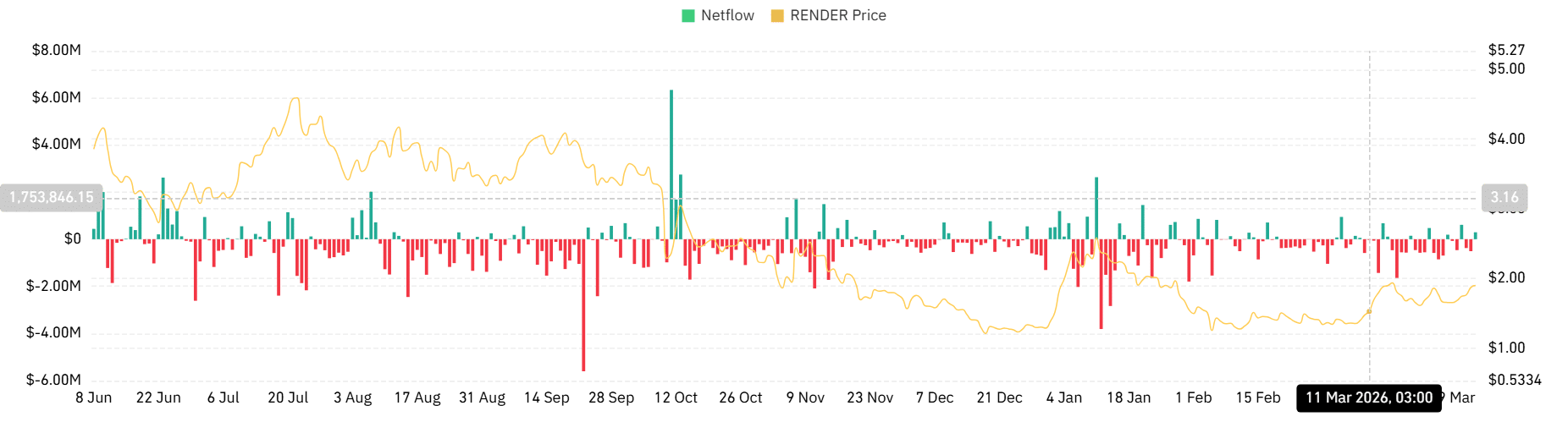
Looking at exchange activity, Spot Netflow turned positive after being negative for two consecutive days. At press time, Netflow was $460k, a significant reversal from -$507 the previous day.
Source: CoinGlass

A positive netflow implied that the market saw more sellers than buyers. Such a shift in market behavior has historically weakened the market and led to pullbacks. Thus, extended profit realization could threaten recent gains and cause another slip.

Can the upside momentum hold?

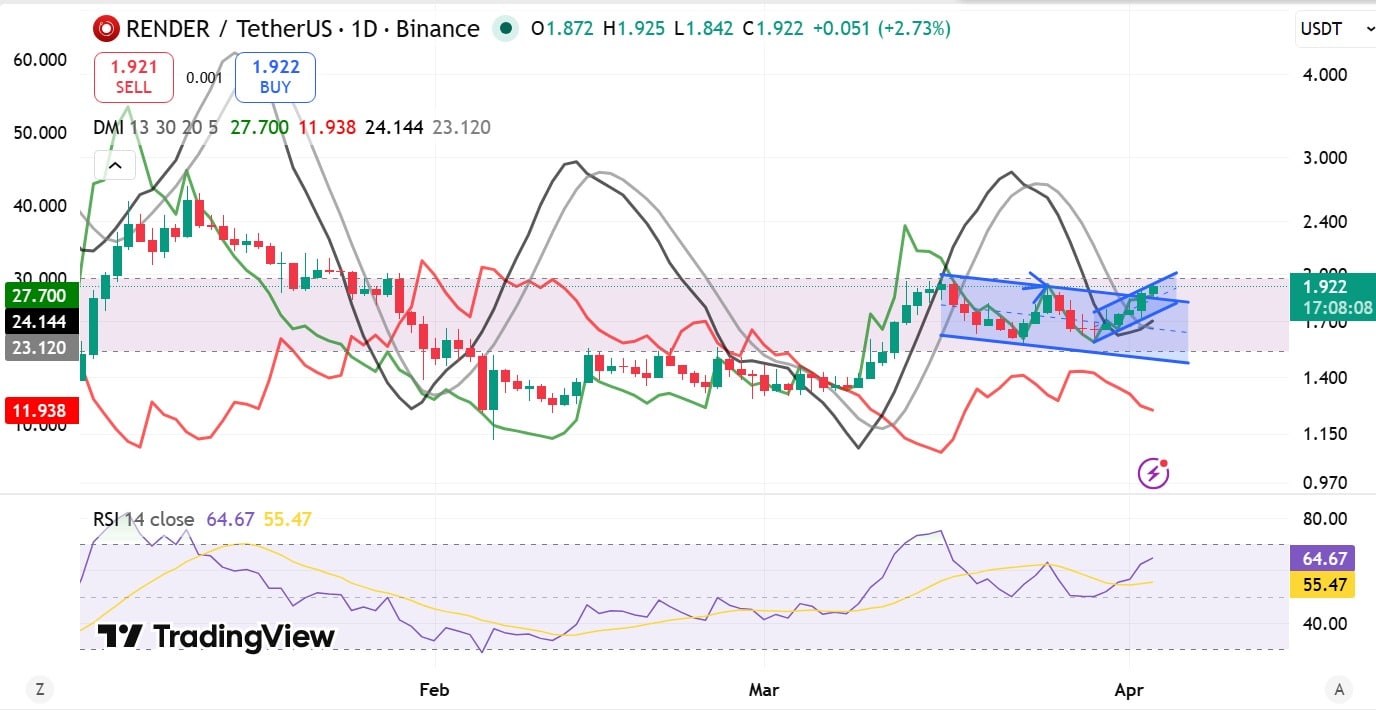
RENDER has recorded a sustained week-long bullish momentum since it held the $1.6 support level. Buyers continually stepped in and defended higher price levels.

The altcoin’s Relative Strength Index (RSI) rose to 64, signaling strong upside momentum and buyer control of the market.

At the same time, the positive index of the Directional Movement Index (DMI) climbed to 27 while the negative index fell to 11. The rise in these two momentum indicators indicated strong upside momentum and confirmed the trend’s strength.
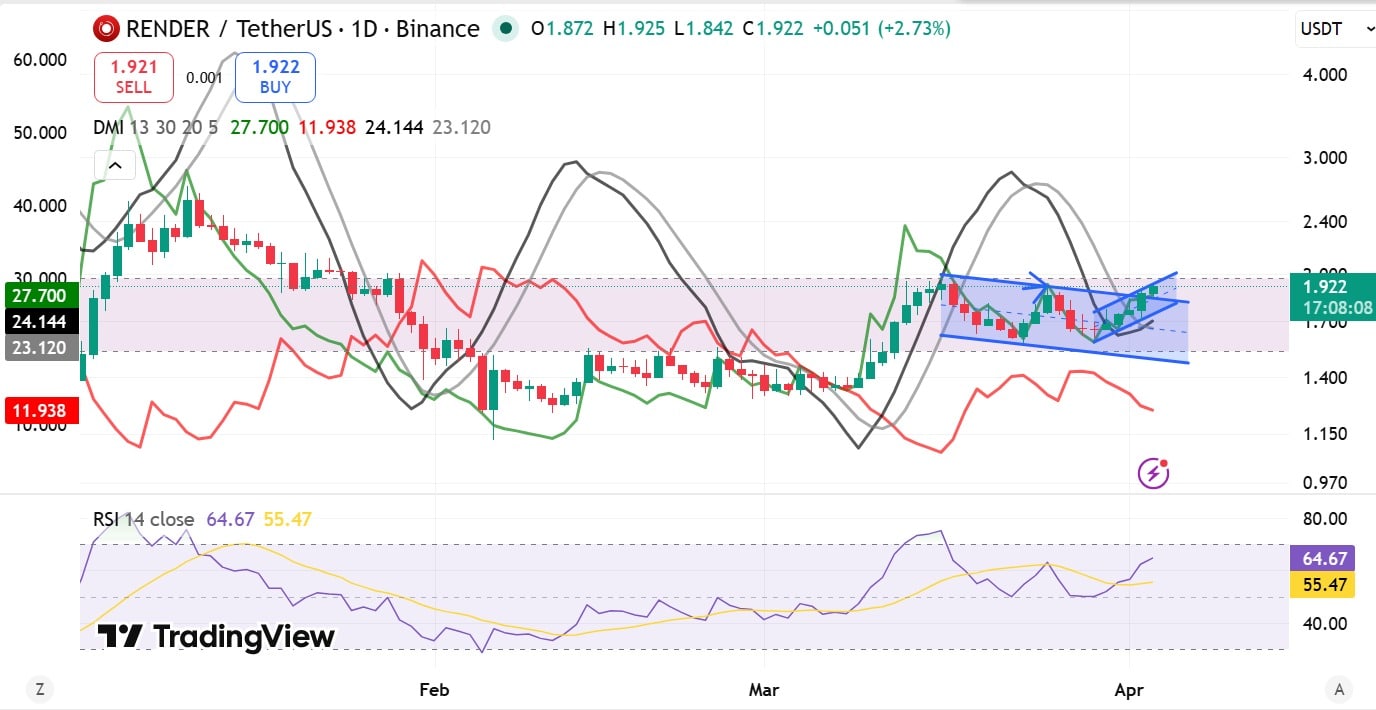
Source: Tradingview

Therefore, the two signals indicate a potential continuation of the market demand trend. While profit takers remain active, their positioning is still not strong enough.

If the prevailing market conditions hold, RENDER could flip its immediate resistance at $2. However, if profit-taking accelerates and overwhelms demand, the altcoin could retrace to $1.6.


Final Summary

  • RENDER surges 11%, touching a three-week high of $1.92 amid sustained demand.
  • RENDER has shown strong upside momentum amid sustained short-term demand, but profit-takers’ return risks capping market gains.


Crypto di tendenza

Domande pertinenti

QWhat was the price of RENDER and its percentage gain as mentioned in the article?

ARENDER traded at $1.91, up 11.23% on the daily charts.

QWhat does the Long/Short Ratio of 1.28 for RENDER indicate about market sentiment?

AA Long/Short Ratio of 1.28 signals a higher demand for long positions, with longs accounting for 56% of total Futures positions, indicating that most participants were bullish and positioned for more gains.

QWhat does a positive Spot Netflow value imply for the RENDER market?

AA positive Spot Netflow value of $460k implies that there were more sellers than buyers, which historically weakens the market and can lead to pullbacks due to profit realization.

QWhat key support level did RENDER hold to maintain its week-long bullish momentum?

ARENDER held the $1.6 support level, which allowed buyers to continually step in and defend higher price levels, sustaining the bullish momentum.

QAccording to the article, what are the two potential price scenarios for RENDER depending on market conditions?

AIf prevailing market conditions hold, RENDER could flip its immediate resistance at $2. However, if profit-taking accelerates and overwhelms demand, it could retrace to $1.6.

Letture associate

Analyzing the Impact of AI on Economic Growth and Productivity

**Title: Analyzing AI's Impact on Economic Growth and Productivity** This article examines three contrasting views on AI's influence on economic growth and productivity. **The Optimistic View** posits that AI, especially through automating R&D ("recursive self-improvement"), could dramatically accelerate growth, even triggering a technological "singularity" with explosive, potentially infinite, economic expansion. **The Moderate/Mainstream View** acknowledges AI's productivity benefits but emphasizes significant real-world constraints that could limit its impact. These include: limited cost savings per task, structural ceilings on which jobs and industries are "exposed" to AI, adoption bottlenecks (e.g., compute, energy, regulatory hurdles), and the "weak link" effect where non-automatable tasks cap overall gains. Consequently, the realized AI dividend may be far lower than optimistic projections, with estimates typically ranging from 0.1% to 1.3% annual productivity growth. **The Pessimistic View** stems from two strands. The first aligns with the moderate view but applies extremely conservative assumptions about task exposure and efficiency gains, yielding minimal projected impact. The second introduces a demand-side critique: if AI primarily replaces rather than augments labor, it could depress labor's share of income, weaken consumer demand, and create a "demand trap" that ultimately stifles growth, unless offset by redistribution policies. **The authors' assessment** is nuanced: * **Short-term (1-2 years):** AI will support growth primarily through investment spending, not significant productivity gains. * **Medium-term (3-5 years):** Three potential paths emerge based on AI demand and bottleneck severity: 1. **"Optimistic Path":** High demand, few bottlenecks. Rapid productivity gains but risk of major job displacement and social conflict without redistribution. 2. **"Moderate Path" (most likely):** High demand but significant, surmountable bottlenecks. Leads to moderate productivity gains, financial market volatility (K-shaped returns), and sectoral job losses. 3. **"Pessimistic Path":** Low demand or severe bottlenecks. Minimal productivity and growth impact, triggering financial market corrections but allowing a smoother societal transition with less labor disruption. * **Long-term:** AI holds potential for a major productivity revolution and prosperity. The conclusion stresses that no path is smooth. Technologically "optimistic" outcomes could be socially detrimental, while "pessimistic" technological diffusion might be more socially stable. Policymakers must monitor developments and prepare balanced responses to manage economic, financial, and social sustainability.

marsbit5 min fa

Analyzing the Impact of AI on Economic Growth and Productivity

marsbit5 min fa

The New Cold War is a Tech Stock War

The New Cold War is a Tech Stock War The article argues that the contemporary geopolitical and economic rivalry between the US and China represents a "New Cold War," but one fundamentally fought through technology and financial markets, not physical barriers or conventional trade. Historically, US dominance was secured through financial systems. The Soviet Union, reliant on the rigid "Transferable Ruble," was ultimately undermined by its dependency on the US dollar for oil trade. Later, Japan's semiconductor challenge was countered not just by tariffs (e.g., Plaza Accord, 301 investigations) but by binding it to US Treasury bonds. China presents a more complex, "embedded" challenger. While it holds vast dollar reserves and US debt like Japan, its industrial base is stronger and more diversified than the Soviet Union's. Surviving the initial 2018 trade war phase, the conflict has evolved into a "tech-financial war." The core battlefield is now the stock market. US tech stocks (AI, semiconductors) are treated as sovereign assets, buoyed by bipartisan national will. China is pushing to strengthen its own financial markets to convert industrial strength into financial power and fund its tech ambitions. Companies like ChangXin (semiconductors), Moonshot AI, and DJI compete not just for market share but as financial proxies for their respective systems. The new paradigm is moving from globally efficient monopolies (Apple, Google) towards companies that achieve monopolistic profits within their respective geopolitical spheres. This competition over "pricing power" and financial valuation in segmented markets defines the current era, making the stock market the primary arena for this tech-centric struggle.

marsbit14 min fa

The New Cold War is a Tech Stock War

marsbit14 min fa

RWA Weekly: Ten European Financial Institutions Establish Tokenized Asset Cooperative; Ondo Launches New Execution Network Ondo Network

RWA Weekly: European Banks Form Tokenized Asset Cooperative; Ondo Launches New Execution Network Ondo Network Covering July 24-31, 2026, the RWA sector saw a steady on-chain total value locked (TVL) of $36.8 billion, with holder count hitting a record high. However, stablecoin transfer volumes fell sharply (~30%), indicating low on-chain settlement demand. Key regulatory moves include South Korea advancing stablecoin legislation and a push to scrap crypto taxes, Kenya lowering capital requirements for stablecoin issuers, and Zimbabwe approving seven projects for its crypto sandbox. In project developments, BIS-led Project Agorá successfully tested cross-border payments with tokenized funds across six currencies. Ten major European financial institutions formed the RL1 blockchain cooperative to build tokenized asset infrastructure. Other notable updates: Aviva launched a tokenized dollar liquidity fund on XRPL, POSCO International tokenized commercial invoices on Injective, and a Brazilian farmer used tokenized cattle as collateral for a loan. Additional progress includes BNY Mellon migrating its core transfer agent operations to blockchain, Securitize gaining SEC investment advisor registration, and Tether’s compliant stablecoin USA₮ launching on Celo. Ondo Finance introduced Ondo Network, a new execution layer focused on speed and privacy, moving away from its initial chain plans. An analysis highlights that despite the growing scale of on-chain RWAs (~$32B), approximately 90% remain underutilized in DeFi, pointing to a critical challenge in unlocking liquidity and fostering real-world application beyond mere issuance.

marsbit14 min fa

RWA Weekly: Ten European Financial Institutions Establish Tokenized Asset Cooperative; Ondo Launches New Execution Network Ondo Network

marsbit14 min fa

South Korean Stock Market Sees Sharp Rebound After Forceful De-leveraging, SK Hynix Rises 30%

On July 31, South Korean stocks staged a historic rebound. The benchmark KOSPI index surged 18.27%, with chipmaker SK Hynix hitting a 30% gain limit. This followed a brutal, near-40% decline in the KOSPI over the previous month, driven largely by a deleveraging spiral involving leveraged ETFs. Analysts attributed the sharp sell-off to structural liquidity issues rather than deteriorating corporate fundamentals. The rally was triggered by a confluence of positive catalysts. Firstly, strong earnings from U.S. cloud giants Microsoft and Amazon alleviated fears of an "AI bubble burst," boosting global tech sentiment. Secondly, SK Group Chairman Chey Tae-won made a rare personal purchase of SK Hynix shares, seen as a strong vote of confidence. Thirdly, the South Korean government announced a 20 trillion won ($139 billion) AI investment fund. In response to the market turmoil, South Korean regulators are tightening controls on leveraged ETFs, admitting oversight shortcomings. Measures include raising minimum cash保证金 requirements for散户 investors and suspending new product launches. While the rebound signals eased liquidity pressure, analysts note deep structural issues remain. The market's future stability is seen as dependent on global tech capital expenditure trends and memory chip price cycles, with some viewing the surge as a technical correction rather than a definitive trend reversal.

marsbit35 min fa

South Korean Stock Market Sees Sharp Rebound After Forceful De-leveraging, SK Hynix Rises 30%

marsbit35 min fa

Trading

Spot

Articoli Popolari

Come comprare RENDER

Benvenuto in HTX.com! Abbiamo reso l'acquisto di RenderToken (RENDER) semplice e conveniente. Segui la nostra guida passo passo per intraprendere il tuo viaggio nel mondo delle criptovalute.Step 1: Crea il tuo Account HTXUsa la tua email o numero di telefono per registrarti il tuo account gratuito su HTX. Vivi un'esperienza facile e sblocca tutte le funzionalità,Crea il mio accountStep 2: Vai in Acquista crypto e seleziona il tuo metodo di pagamentoCarta di credito/debito: utilizza la tua Visa o Mastercard per acquistare immediatamente RenderTokenRENDER.Bilancio: Usa i fondi dal bilancio del tuo account HTX per fare trading senza problemi.Terze parti: abbiamo aggiunto metodi di pagamento molto utilizzati come Google Pay e Apple Pay per maggiore comodità.P2P: Fai trading direttamente con altri utenti HTX.Over-the-Counter (OTC): Offriamo servizi su misura e tassi di cambio competitivi per i trader.Step 3: Conserva RenderToken (RENDER)Dopo aver acquistato RenderToken (RENDER), conserva nel tuo account HTX. In alternativa, puoi inviare tramite trasferimento blockchain o scambiare per altre criptovalute.Step 4: Scambia RenderToken (RENDER)Scambia facilmente RenderToken (RENDER) nel mercato spot di HTX. Accedi al tuo account, seleziona la tua coppia di trading, esegui le tue operazioni e monitora in tempo reale. Offriamo un'esperienza user-friendly sia per chi ha appena iniziato che per i trader più esperti.

238 Totale visualizzazioniPubblicato il 2024.12.11Aggiornato il 2026.06.02

Come comprare RENDER

Discussioni

Benvenuto nella Community HTX. Qui puoi rimanere informato sugli ultimi sviluppi della piattaforma e accedere ad approfondimenti esperti sul mercato. Le opinioni degli utenti sul prezzo di RENDER RENDER sono presentate come di seguito.

活动图片