Analyst Predicts The ‘Biggest Altcoin Season Ever’, Reveals The Real Drivers

bitcoinistPubblicato 2026-05-28Pubblicato ultima volta 2026-05-28

Introduzione

Crypto analyst Fergani predicts the biggest altcoin season ever will occur within the next six months, driven by AI. He cites the Others/BTC chart, indicating altcoins have strong support and are poised for significant gains against Bitcoin. While some AI coins like TAO and NEAR have rallied recently, the overall altcoin season index remains low at 31, far from the 75 threshold indicating a true season. Another analyst, Ryker, forecasts the season will start in June and last about six months, similar to past cycles, leading to major pumps for various altcoins. Despite current market sluggishness, exchange volume for altcoins is increasing, suggesting some investors are quietly accumulating.

Crypto analyst Fergani has predicted that the biggest altcoin season will happen this year. The analyst also revealed the catalyst that will drive this bullish momentum for altcoins, as he noted that this could be the latest real run for these crypto assets.

Analyst Predicts This Year Will Be The Biggest Altcoin Season Ever

In an X post, Fergani stated that this year will be the biggest altcoin season ever and suggested it would happen within the next six months. He cited the Others/BTC chart, which shows that these altcoins have formed a strong support at their current levels and are ready to record significant gains against Bitcoin.

The analyst also alluded to AI as what will drive the altcoin season, although he didn’t explain why or how that would happen. He added that this might be the last real altcoin run before the game changes forever. It is worth noting that some AI coins, such as TAO, NEAR, and VVV, have recorded significant gains over the past few weeks.
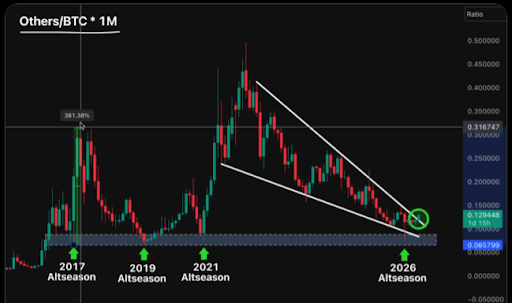
Source: Chart from Fergani on X

Crypto analyst CW recently pointed out that exchange volume for altcoins, excluding the top 5 cryptos by market cap, is increasing and that trading is increasingly concentrated in altcoins amid this sluggish situation. He added that some investors are quietly accumulating altcoins, while some people are negative about the altcoin season.

Despite the recent gains in some altcoins, it is worth noting that it is still far from being altcoin season. BlockchainCenter data shows that the altcoin season index is currently at 31, signaling that it is still Bitcoin season. The index needs to reach 75 for it to be altcoin season. Over the last 90 days, only 15 of the top 50 coins by market cap have outperformed BTC. For it to be altcoin season, 75% of these coins need to have outperformed the leading crypto over this period.

Altcoin Season To Start In June

Crypto analyst Ryker predicted that the next altcoin season will take place from June to January 2027. This came as he noted that the season usually lasts about six months and occurs when all altcoins are undervalued. The analyst cited the 2017 and 2021 bull cycles, when the market pumped strongly, leading many coins like XRP, ETH, SOL, and LUNA to see 10x gains.

Ryker noted that it has been up to 4 years since the last altcoin season and advised market participants not to miss the one about to begin and last for 6 months. He also alluded to the OTHERS/BTC chart, which showed that these altcoins are about to break out against Bitcoin. In another X post, the analyst noted that the gains recorded by coins such as ZEC, HYPE, NEAR, and ONDO are just the beginning of altcoin season and that it will lead to pumps for other coins.

Total market cap excluding BTC at $966.99 BILLION on the 1D chart | Source: TOTAL2 on Tradingview.com

Domande pertinenti

QWhat does crypto analyst Fergani predict about the upcoming altcoin season?

AFergani predicts that this year will see the biggest altcoin season ever, and he suggests it will happen within the next six months.

QAccording to the article, what is one key factor that will drive this altcoin season?

AFergani alludes to Artificial Intelligence (AI) as a key driver for the upcoming altcoin season, noting that some AI coins have already seen significant gains.

QWhat data point does Fergani cite to support his bullish prediction for altcoins?

AHe cites the Others/BTC chart, which shows that altcoins have formed a strong support at current levels and are ready to record significant gains against Bitcoin.

QWhat does the BlockchainCenter altcoin season index currently indicate, and what is the threshold for an 'altcoin season'?

AThe index is currently at 31, which signals it is still Bitcoin season. For it to be considered an altcoin season, the index needs to reach 75.

QWhen does crypto analyst Ryker predict the next altcoin season will take place, and how long does he expect it to last?

ARyker predicts the next altcoin season will take place from June to January 2027, and he expects it to last about six months.

Letture associate

The Truth About Global Payments, Exposed by Airwallex

Airwallex's founder, Jack Zhang, outlines the three primary paths in the global payments industry and explains why the company chooses the most demanding one: building its own global financial infrastructure. The article begins by highlighting a common industry problem: payment platforms appear homogenized on the surface, offering similar features like global acquiring and multi-currency accounts. However, their underlying capabilities differ vastly. Customers truly care about payment stability, compliance robustness, and reliable market entry support. Zhang identifies three strategic paths: 1. **Bypassing Traditional Systems (Web3/Crypto):** This path promises efficiency via stablecoins and blockchain settlement but struggles with mainstream adoption, significant regulatory friction, and a lack of competitive edge against established players, often leaving it with niche or non-compliant markets. 2. **Packaging Existing Infrastructure:** The most common route, where companies layer a modern interface over legacy banking and partner networks. While enabling fast expansion, it fails to solve core issues like dependency on correspondent banks and intermediary risk, merely postponing the need for solid foundations. 3. **Building Own Global Infrastructure:** The path chosen by Airwallex, Ant International, and others. It involves obtaining local licenses, establishing direct regulatory relationships, building local teams, and controlling the full technology stack. This "heavy" approach is slow and capital-intensive but aims to internalize complexity, providing customers with a "lighter" experience. The core argument is that for business clients, the highest cost isn't transaction fees but hidden risks like frozen accounts, payment delays, and regulatory shocks. By investing heavily in its own infrastructure, Airwallex seeks to absorb these complexities, offering customers greater stability, cost savings (beyond fees), and long-term certainty. This foundational investment, though initially slow, enables compound growth, as evidenced by Airwallex's accelerated revenue scaling. In conclusion, while shortcuts enable faster growth, mastering the most difficult aspects—owning the underlying infrastructure—creates durable value for customers and sustainable advantage for the payment provider.

marsbit4 h fa

The Truth About Global Payments, Exposed by Airwallex

marsbit4 h fa

The Truth About Global Payments, Revealed by Airwallex

The article discusses Airwallex's approach to global payments, highlighting the key challenges and different strategic paths in the industry. It begins by addressing common user questions about platform reliability, cryptocurrency payments, and the necessity of Airwallex's "heavy" infrastructure model. The core argument is that while many payment platforms appear similar on the surface—offering features like global acquiring and multi-currency accounts—their underlying capabilities differ drastically. The piece identifies three primary paths for global payment providers: 1. **Bypassing Traditional Infrastructure (Web3/Crypto):** This path promises efficiency through stablecoins and on-chain settlements but faces significant regulatory hurdles and offers little advantage over established players for mainstream use, often serving only niche or non-compliant markets. 2. **Aggregating/Packaging Existing Infrastructure:** The most common route, where companies layer a better user experience over legacy banking and partner networks. While fast to market, this approach does not solve fundamental issues like dependency on intermediaries, correspondent banking risks, and compliance fragility. 3. **Building Proprietary Global Infrastructure:** The path chosen by Airwallex and similar firms. This involves obtaining local licenses, building direct regulatory relationships, establishing local teams, and controlling the compliance and technology stack. This is the most difficult and capital-intensive route but aims to internalize complexity. Airwallex's strategy of "heavy" investment in its own infrastructure is framed not as inefficiency, but as a long-term bet to provide clients with greater stability, cost savings beyond fees, and certainty. The platform's "heaviness" absorbs risk and operational complexity, aiming to deliver a "lighter" experience for business customers. The article concludes that in global payments, while shortcuts enable faster growth, mastering the most difficult aspects—the underlying infrastructure—is what creates durable value for clients and sustainable competitive advantage.

链捕手4 h fa

The Truth About Global Payments, Revealed by Airwallex

链捕手4 h fa

Trading

Spot
Futures
活动图片