An App Made for 1000 RMB Now Valued at 10 Million

marsbitPubblicato 2026-01-12Pubblicato ultima volta 2026-01-12

Introduzione

Three post-95s developers spent 1,000 RMB and less than a month to create an app called “Died Yet?” — now valued at 10 million RMB. The app allows users to check in daily to confirm they are alive. If a user misses two consecutive check-ins, the system automatically sends an email to their emergency contact. Launched on January 8, it quickly topped Apple’s paid app chart at 8 RMB per download. Paying users grew 200-fold in days. A capital offer followed: the founders are considering selling 10% equity for 1 million RMB, implying a 10 million RMB valuation. The app taps into a real anxiety: China has over 120 million people living alone, a number expected to reach 200 million by 2030. The app’s viral name, “Died Yet?”, originated from an online meme and was key to its success. A copycat app, “Alive Yet?”, emerged within 24 hours, but the founders argue the concept—not the tech—is the core value. The piece contrasts this with crypto valuations, citing Fuel Network—a project once valued at $1 billion with minimal users, now down 99%—to highlight different valuation models: one driven by real users and payments, the other by narrative and tokenomics. The author concludes that “Died Yet?” offers more tangible value than most speculative assets.

Written by: Curry, Shenchao TechFlow

Three post-95s spent 1000 RMB and took less than a month to create an App.

Now it's valued at 10 million. A ten-thousand-fold increase.

This App is called "Is He Dead", and its function is ridiculously simple: open it every day and check in to prove you're still alive. If you don't check in for two consecutive days, the system automatically sends an email to your emergency contact.

That's it?

Yeah, that's it.

On January 8th, it topped the Apple paid charts, costing 8 RMB to download. Founder Mr. Guo said that the number of paying users has increased 200-fold in the past few days and is still rising.

Capital came knocking. Mr. Guo said he plans to sell 10% of the shares for 1 million RMB. Doing the math, that's a valuation of 10 million.
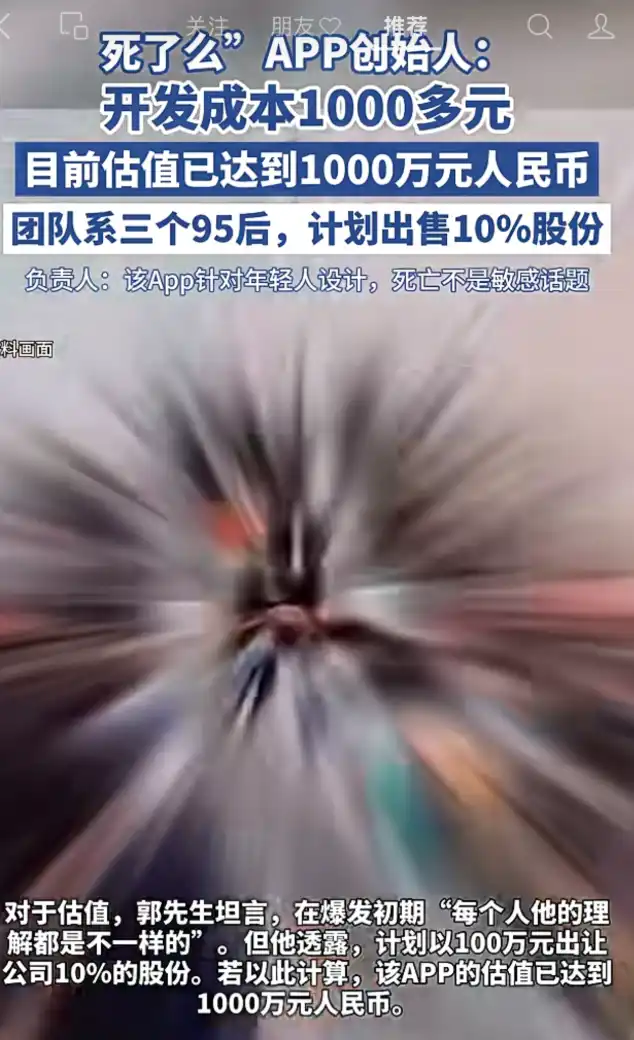
The name "Is He Dead" comes from a viral internet meme a few years ago.

Someone asked on a social platform: What App does everyone need and will definitely download?

A highly upvoted answer: Is He Dead.

Mr. Guo and his team saw this discussion and thought it had potential. They went to trademark the name and found that surprisingly, no one had registered it.

So they made it.

Why did something so simple become popular?

China's solo-living population exceeded 120 million in 2024. By 2030, it's projected to be 150 to 200 million. These people live in rental apartments in cities like Beijing, Shanghai, Guangzhou, and Shenzhen, sharing a common, very real anxiety:

If something happens to me at home one day, how long will it take for someone to find out? So, 8 RMB buys the confirmation that "someone knows I'm still alive."

Less than 24 hours after "Is He Dead" went viral, a copycat appeared.

An App called "Is He Alive" was listed on the Apple App Store, with exactly the same function, free to download.
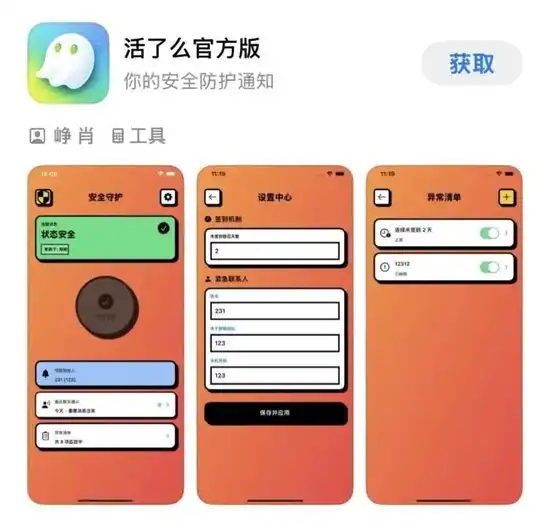
In response, Mr. Guo was very calm: The advantage of this product is not its technical barrier, but its discovery of user needs.

Translation: You can copy the function, but you can't copy my name.

Indeed. The three words "Is He Dead" are the most valuable part of this product. If it had been called "Solo Living Safety Guard," it would probably still be gathering dust in a corner of the App Store.

Looking back, an APP with no technical barrier, costing 1000 RMB, valued at 10 million, is that expensive?

Well, you might want to look at the valuation methods once used in the crypto industry?

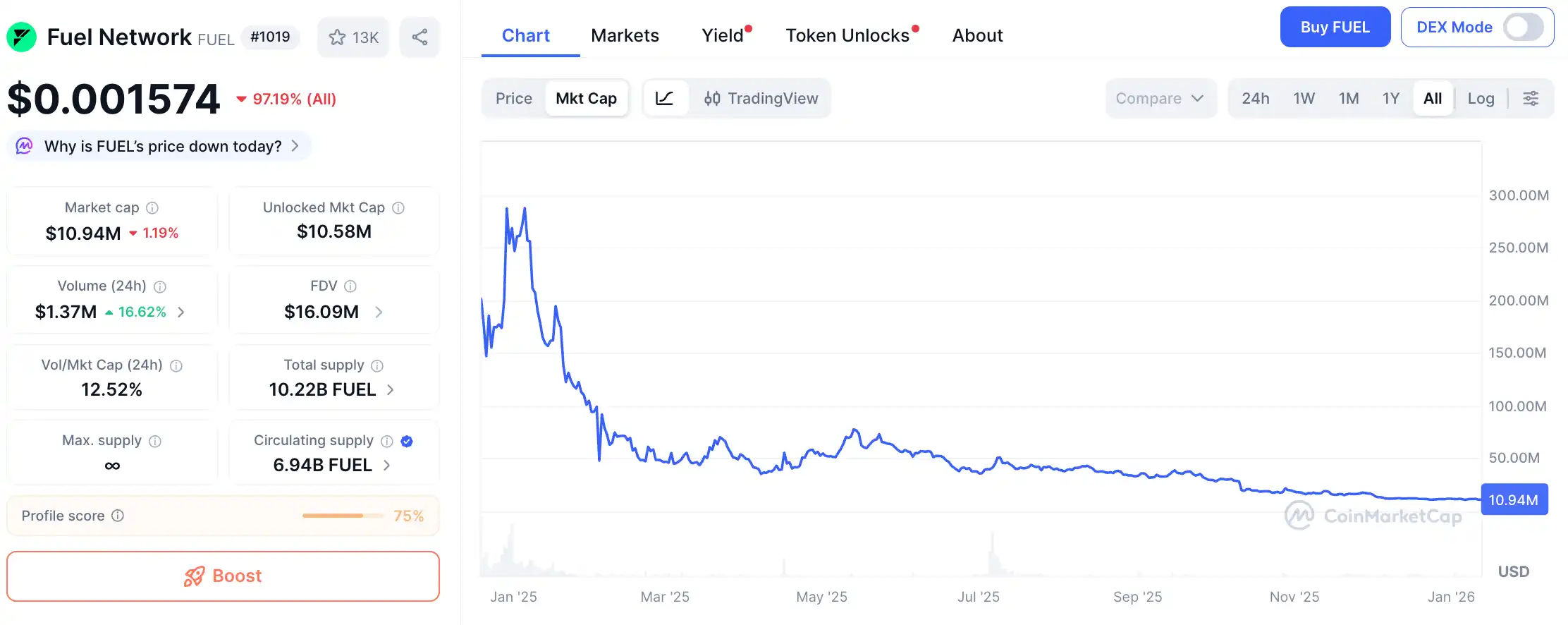
In 2025, there was a crypto project called Fuel Network, working on a "modular blockchain execution layer." VCs gave it a valuation of 1 billion USD, roughly over 7 billion RMB.

700 times the valuation of "Is He Dead".

What does Fuel Network have?

A whitepaper, a roadmap, endorsements from a bunch of Tier1 institutions, videos of the founders speaking at major conferences.

But not many people actually using it.

What is Fuel Network's market cap now? Around 16 million USD. Down about 99% from its peak.
I'm not saying all crypto projects are scams.

I'm saying:

In the crypto world, a project can have no users, no revenue, no one actually using it, and still get a valuation of 1 billion USD.

In the world of "Is He Dead", you need people to actually pay 8 RMB to download it for it to count.

One gives a valuation first and then looks for users. The other has users first and then discusses valuation.

Which is more reasonable? I don't know.

What's more absurd is that the logic of "Is He Dead" is almost heresy in the crypto world.

You tell everyone: We have real users, real payments, solving a real need.

People will definitely ask: What's the narrative? The token economic model? What's the FDV?

You say: No token, just selling the App, 8 RMB each.

Everyone: Then why would I invest in you?

This isn't a joke. The crypto industry's valuation system operates like this.

Users aren't important, revenue isn't important; what's important is whether the story is sexy enough, whether the token can list on major exchanges, and whether the unlock schedule is long enough for early investors to have time to dump.

If "Is He Dead" issued a token, created a "Solo Living Chain", and painted a big picture of the "global loneliness economy", its valuation might really increase tenfold.

But then, it might not have real users anymore.

Perhaps the reason "Is He Dead" became popular is precisely because it serves people who have this anxiety but don't actually need it that badly.

The people who truly need it probably can't use it.

This is actually quite similar to the crypto industry:

Those who truly need "financial inclusion" are often the ones who can least use DeFi.

In the end, whether 10 million is expensive depends on what ruler you use.

Using the internet ruler: one month of development, a team of three, no funding, no burning cash, reaching number one on the paid charts, 10 million is not expensive.

Using the crypto ruler: no token, no narrative, no FDV, only 10 million? That's too cheap. How about issuing a token?

I think the most ironic point is the divide between Web2 and Web3:

In one world, "having users" is a prerequisite for valuation. In another world, "having users" is an accident of valuation.

After writing this, I actually downloaded "Is He Dead" and checked in.

8 RMB for peace of mind.

At least it's more reliable than most of the shitcoins I've bought.

Domande pertinenti

QWhat is the name of the app developed by three post-95s with an initial cost of 1000 RMB, and what is its core function?

AThe app is called '死了么' (translated as 'Is It Dead'). Its core function is to allow users to sign in daily to prove they are alive. If a user fails to sign in for two consecutive days, the system automatically sends an email to their emergency contact.

QHow much did the app '死了么' cost to download, and what was its performance on the Apple paid charts?

AThe app cost 8 RMB to download. It reached number one on the Apple paid charts on January 8th.

QWhat is the estimated valuation of the '死了么' app, and how was this valuation determined?

AThe app has an estimated valuation of 10 million RMB. This was determined as the founder, Mr. Guo, plans to sell 10% of the company's shares for 1 million RMB.

QAccording to the article, what is the valuation approach in the crypto industry contrasted with that of the '死了么' app?

AIn the crypto industry, projects can receive high valuations based on narratives, token economic models, and backing from institutions, even without real users or revenue. In contrast, the '死了么' app's valuation is based on actual user downloads and payments, emphasizing real user demand.

QWhat ironic point does the article make about the target audience of the '死了么' app and its similarity to the crypto industry?

AThe article points out that the app likely serves people who have the anxiety of being found in case of an emergency but don't truly need it, while those who genuinely need it might not use it. This is similar to the crypto industry, where those who truly need 'financial inclusion' are often the least able to use DeFi.

Letture associate

Bank of Japan Signals Interest Rate Hike Despite Keeping Them at 1%

The Bank of Japan (BOJ) kept its benchmark interest rate at 1% on July 31, as widely expected, following a June hike to a 31-year high. The decision passed with an 8-1 vote, with board member Hajime Takata again dissenting in favor of a hike to 1.25%. Despite holding rates steady, the BOJ signaled a hawkish tilt, warning that underlying inflation is likely to accelerate and exceed 2% from the latter half of the fiscal year. While it slightly lowered its core inflation forecast for FY2026, officials expressed stronger confidence that an overshoot will occur later, driven by yen weakness, corporate pricing behavior, and lingering energy shock effects. Markets were focused on the BOJ's forward guidance. Analysts noted the central bank appeared to balance short-term caution with a long-term warning of tighter policy. Governor Kazuo Ueda faces the challenge of reconciling a government reluctant to tighten further with bond markets already pricing in additional hikes, with the timing of the next move debated. Adding complexity, the BOJ reportedly intervened in currency markets hours before the rate decision, buying yen to support the currency which had fallen to 40-year lows against the dollar. Yen weakness stems from the wide U.S.-Japan interest rate gap, high fuel prices, and market skepticism about the pace of BOJ policy normalization. The yield on Japan's 10-year government bonds fell to 2.8%, indicating investor expectations for future monetary tightening.

cryptonews.ru6 min fa

Bank of Japan Signals Interest Rate Hike Despite Keeping Them at 1%

cryptonews.ru6 min fa

Why Are Leveraged ETFs like 7709 Inherently Negative EV Products?

This article argues that the SK H力士 2x Leveraged ETF (7709) is fundamentally a negative expected value (EV) product, rather than simply a "double SK H力士" investment. Its core issue stems from its daily rebalancing mechanism to maintain a 2x leverage target. After a price move, the fund must buy more after a rise or sell after a fall to readjust its leverage, creating a systematic pattern of buying high and selling low. This introduces a "delay loss": it always reacts to past price changes, missing potential gains from adjusting earlier during an uptrend and suffering greater losses from adjusting later during a downtrend. While more frequent intraday rebalancing would improve returns in strong, smooth trending markets by reinvesting profits or cutting losses sooner, it also dramatically increases volatility drag (frictional losses) during choppy, oscillating markets due to more frequent high-buy/low-sell trades. The author draws a parallel to an option seller who delta hedges (short gamma), which involves similar "buy high, sell low" dynamic hedging. However, unlike an option seller who receives upfront premium (IV and theta) as compensation for this risk, the leveraged ETF investor receives no such compensation. Instead, they bear all the path-dependent volatility decay, plus additional costs like swap/derivatives financing, management fees, and trading slippage. Thus, the product's return profile can be framed as: 2x directional return minus realized variance drag minus financing costs minus derivatives costs minus management fees minus transaction costs. For the investor to profit, SK H力士's price must not only rise significantly but do so in a strong, sustained, and smooth trend to overcome these inherent structural costs. High volatility and frequent price reversals are particularly damaging. The article also notes that while the ETF has no explicit liquidation line like perpetual futures, avoiding a sudden "blow-up," its net asset value can still decay towards zero over time through this combination of volatility drag and fees. For experienced traders, directly managing leverage via perpetual contracts may offer more control and potentially lower costs than this packaged, mechanistic product.

marsbit13 min fa

Why Are Leveraged ETFs like 7709 Inherently Negative EV Products?

marsbit13 min fa

'Backstabbing' or 'Win-Win'? How Likely Is TradeXYZ to Break Away from Hyperliquid and Go Solo?

The article discusses the growing debate over whether TradeXYZ, which dominates Hyperliquid's HIP-3 market with over 90% of its volume, might break away to build its own independent trading platform. This possibility is fueled by TradeXYZ's immense market influence and the common industry trend of successful projects seeking more control and profit capture. Key arguments for a potential split include TradeXYZ's overwhelming contribution to Hyperliquid's metrics and the financial incentive to retain all transaction fees, as it currently splits them 50/50 with Hyperliquid. The piece draws parallels to other cases, like Anthropic's "Claude Code" competing with its former partner Cursor, suggesting "betrayal" can occur when business leverage shifts. However, strong counterarguments suggest a split is unlikely or would be detrimental. TradeXYZ relies on Hyperliquid's high-performance infrastructure and its platform as a primary user acquisition channel. Building a comparable system would be challenging. Furthermore, the founders of both projects share a history of trust and mutual admiration. The analysis concludes that a separation would likely be a lose-lose scenario: Hyperliquid would lose a major growth narrative and trading volume, while TradeXYZ would face technical hurdles, user migration issues, and reputational damage, potentially allowing competitors to seize market share. The most rational path is seen as continued collaboration, with TradeXYZ potentially negotiating better terms while leveraging Hyperliquid's established strengths.

marsbit23 min fa

'Backstabbing' or 'Win-Win'? How Likely Is TradeXYZ to Break Away from Hyperliquid and Go Solo?

marsbit23 min fa

Trading

Spot
活动图片