Original | Odaily Planet Daily(@OdailyChina)
Author | Azuma(@azuma_eth)
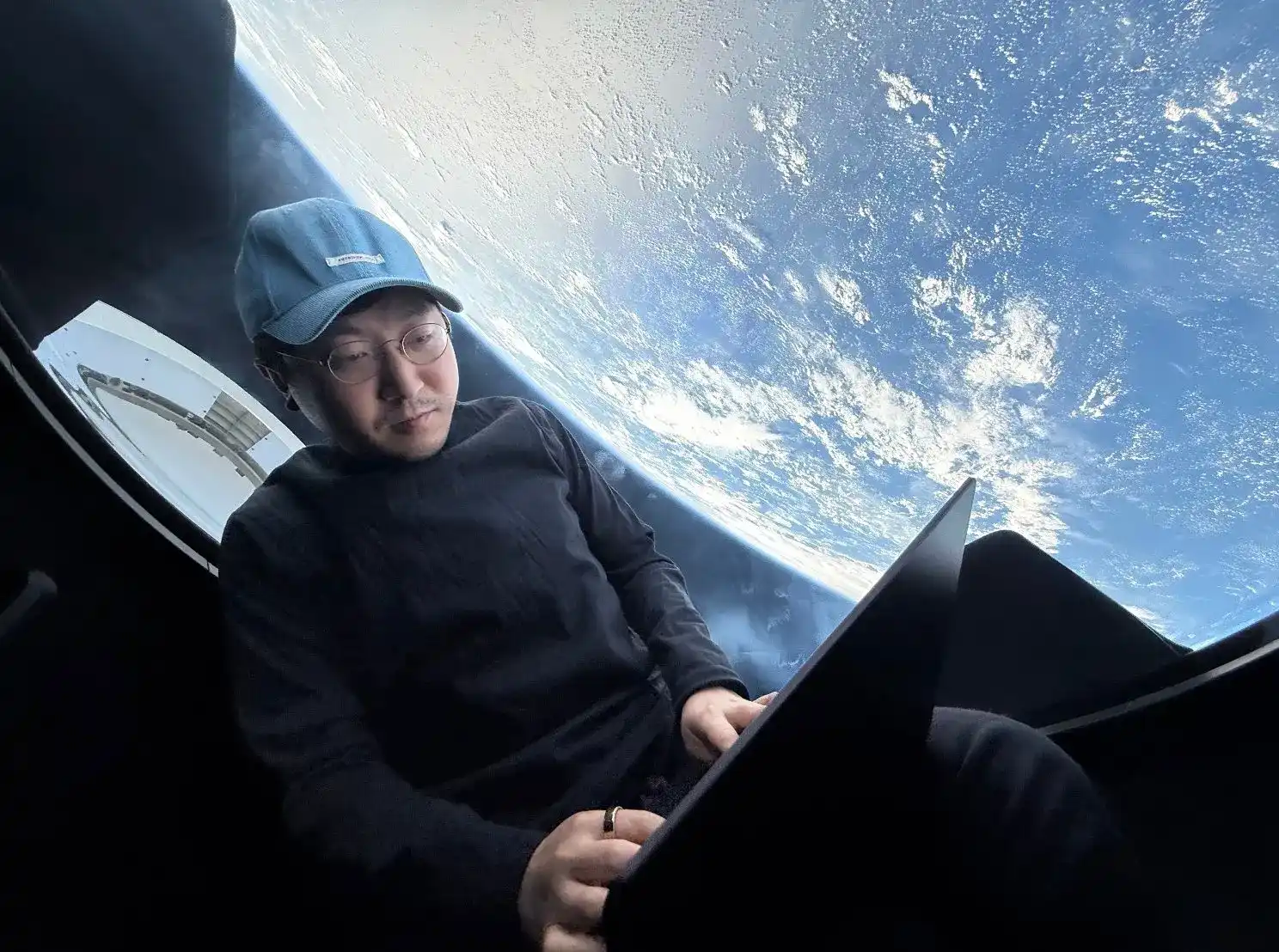
Humanity is finally embarking on its journey to Mars, and the protagonist of this mission destined to be recorded in human history is a Tianjin native.
In the early morning of May 22nd Beijing time, the soon-to-IPO SpaceX dropped a major official announcement — F2Pool co-founder, Fram2 mission commander Wang Chun will board the Starship to execute the first batch of manned interplanetary Mars aviation missions! The mission is planned to be a two-year deep space flight, exiting the Earth-Moon system, skimming past Mars (without landing), and finally returning to Earth.
Prior to this mission, Wang Chun will also join Dennis Tito and Akiko Tito in participating in Starship's first commercial manned circumlunar flight mission. This mission is expected to last one week and will perform a flyby approximately 200 kilometers from the lunar surface.
The Travel Fanatic from Tianjin
On March 31, 2025, just before the Fram2 mission launch, Wang Chun gave an exclusive interview to the aerospace professional media "Spaceflight Now," revealing many previously unknown stories about his upbringing.
Wang Chun was born in Tianjin, China, in 1982 and was raised by his grandparents. He had hardly ever left his hometown until he went to university in 2000.
However, from a very young age, Wang Chun developed a strong interest in travel, often fantasizing about traveling the world: "In 1987, when I was 5 years old, my grandfather brought back a world map he found while taking a walk. That map instantly became my favorite toy and ignited my curiosity. What really caught my eye was the vast blank area at the bottom of the map — the polar regions. From that moment, I was deeply fascinated by the mystery and excitement of these distant, unknown places."
After leaving university, Wang Chun first worked for a Norwegian software company in Beijing. From then on, his travel mileage truly skyrocketed — to save money, he often slept on a French colleague's sofa or directly in the office, commuting back home about 120 kilometers away on weekends.
Wang Chun mentioned: "Even with a full-time job, in the year 2007 alone, I traveled 75,900 kilometers by train on weekends. In total, in 2007, I spent a full two months in train carriages, heading straight to the train station after work every Friday and not returning to the company until Monday morning."
Over the next four years, Wang Chun further expanded his travel map. By train, he traveled to every province in China.
In 2010, Wang Chun began his first trip abroad — to Nepal and then India. That trip took him to the southernmost tip of the Indian subcontinent. He boarded what was then India's longest-running non-stop train — the 16317 "Himsagar Express," riding from Kanyakumari all the way to Kashmir and continuing his journey in the country.
The trip ultimately cost him about $1,000, which was all the savings he had at the time.
"During those years, I was obsessed with infrastructure and transportation, especially railways. I meticulously recorded every train journey, down to the minute or even second, and posted these records on online forums and message boards. Someone once nicknamed me 'The Thousand-High-Speed-Rail Hero,' because I was counting my high-speed rail rides, aiming for the goal of 1,000 rides."
Wang Chun revealed that as of March 20, 2025, he had taken 854 high-speed rail rides, but his number of commercial airline flights was already extremely close to 1,000.
Wealth, Ability, and Resource Accumulation, Stemming from Cryptocurrency
Apart from travel, Wang Chun also showed a very strong interest in various emerging technologies.
At age 7, Wang Chun first heard about computers, but it wasn't until he graduated from primary school at age 13 that he got his first personal computer, a 486SX running MS-DOS 5.0.
Wang Chun mentioned: "Besides playing games, I also used it to write many interesting programs. One of the earliest was a gravity simulator that could visually demonstrate the motion of planets in the solar system... In school, I participated in various programming competitions, including the International Olympiad in Informatics (IOI) and ACM-ICPC (International Collegiate Programming Contest). Due to my excellent performance in these competitions, I was directly admitted to university without taking the national college entrance exam."
In 2011, Wang Chun first heard about Bitcoin through the tech website Solidot. On May 28th of that year, he bought his first Bitcoin at a unit price of $8.7.
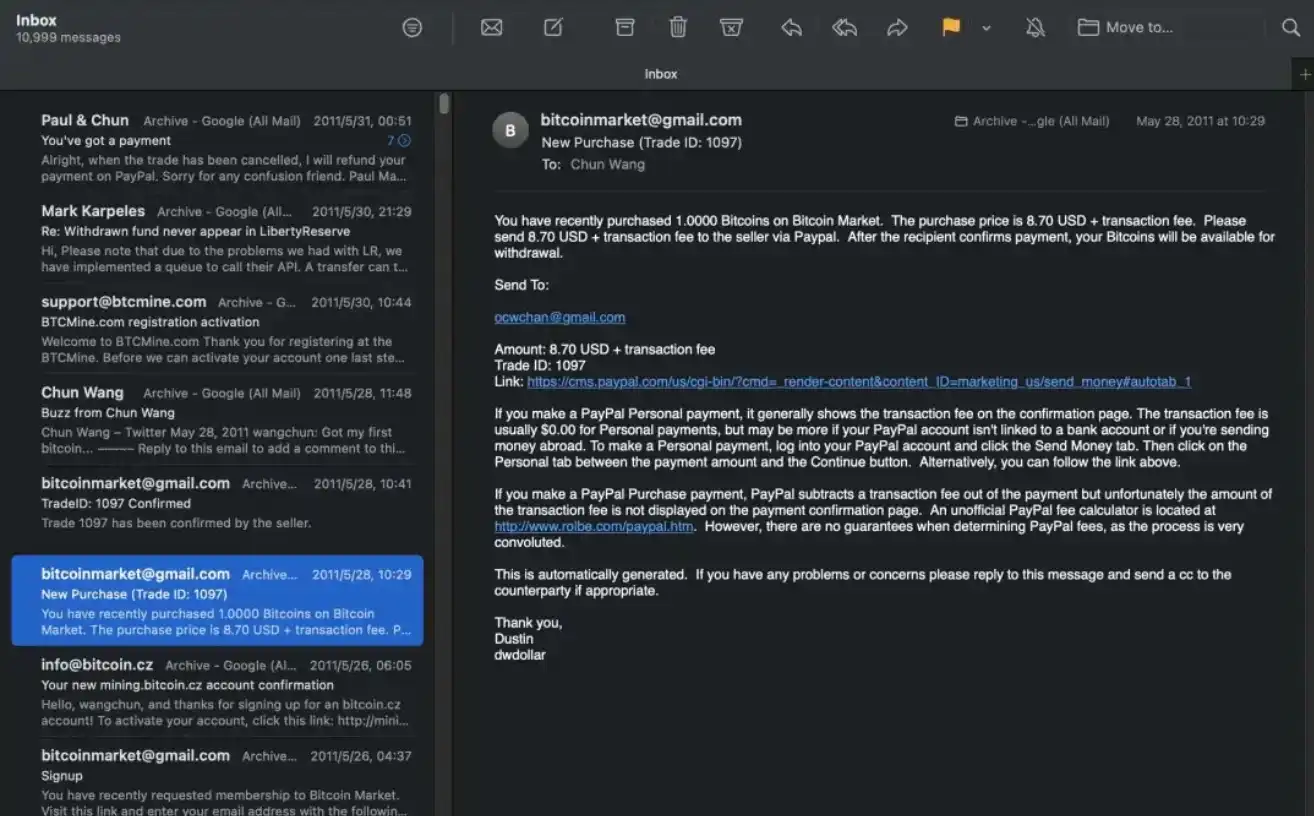
Simultaneously, as a tech enthusiast, Wang Chun began trying to assemble mining rigs himself to mine Bitcoin.
The initial story wasn't particularly smooth. Wang Chun first collaborated with Wu Gang, the later founder of Bixin, renting a few residential rooms and building a relatively rudimentary mining farm with dozens of rigs. The startup capital was even borrowed from his father... Even so, Wang Chun managed to obtain 7,700 Bitcoins through mining over two years, of which 4,000 were spent on electricity bills, 660 were traded for an iPhone (which was later stolen in the Saint Petersburg subway), and the remaining Bitcoins were sold by him in early 2023 at a price of $17 each...
The turning point occurred in 2013. In April of that year, he co-founded F2Pool (known in the cryptocurrency community as "Fish Pool") in Wenzhou with Mao Shixing, nicknamed "Shenyu." The more introverted Wang Chun was responsible for backend code, while the more outgoing Shenyu handled operations. This was China's first Bitcoin mining pool, later developing into one of the world's largest comprehensive mining pools.
In 2018, Wang Chun founded his second company, Stake.fish, in Thailand, a staking service provider focused on PoS networks, comprehensively deploying node staking services for networks like Ethereum, Cosmos, and Polygon.
The success of F2Pool and Stake.fish, coupled with the surge in cryptocurrency prices, accumulated massive personal wealth for Wang Chun — Wang Chun revealed in 2025 that over the past ten-plus years, F2Pool had mined over 1.3 million Bitcoins.
The Space Dream Chaser
The rapid growth in wealth allowed Wang Chun to fulfill his childhood travel dreams to the polar regions. In December 2021, Wang Chun successfully reached the South Pole; in July 2023, he reached the North Pole.
However, after fulfilling these dreams, Wang Chun realized it still didn't seem enough... His entire life had been on a journey, continuously moving towards the unknown distance.
- 2006: He traveled west to the Kazakhstan border at 82°E;
- 2011: He went to the southernmost tip of India, reaching 8°N south;
- 2012: He took the Trans-Siberian Railway to Europe, reaching 60°N, 30°E in Saint Petersburg;
- 2013: He went to the Kamchatka Peninsula, reaching 160°E east;
- 2016: He visited the United States for the first time;
- December 2021: He successfully reached the South Pole;
- July 2023: He successfully reached the North Pole...
But now, there are no farther destinations on Earth. Where else can one go?
Wang Chun quickly found the answer: "Since SpaceX began recovering Falcon 9 first-stage rockets, the commercial aerospace industry has been advancing at an incredible pace. I once again saw something completely new and exciting unfolding, a feeling exactly like when I first heard about computers or first discovered Bitcoin."
Wang Chun's choice was to fly into space. In 2023, Wang Chun proposed an extremely bold concept to SpaceX — he hoped to privately and fully fund a SpaceX "Crew Dragon" mission, flying an orbit that passes over Earth's North and South Poles.
Wang Chun's idea was that since humans entered space in 1961, as the vast majority of rocket launches have been concentrated near the equator or at mid-latitudes, the International Space Station (ISS) and almost all previous manned spacecraft (except the distant Apollo lunar missions) have been unable to fly over Earth's poles. In other words, Earth's polar ice fields have been a visual and scientific blank spot in the history of low Earth orbit manned spaceflight for 60 years. Therefore, Wang Chun wished to take a previously untraveled polar retrograde orbit (Polar Orbit), with a 90-degree orbital inclination, directly traversing and overlooking Earth's poles.
Wang Chun named the mission "Fram2," paying homage to the legendary polar research vessel "Fram," which carried Norwegian explorers to the Arctic and Antarctic in history.
On April 1, 2025, a Falcon 9 rocket carrying the "Resilience" Crew Dragon lifted off on time from Launch Complex 39A at the Kennedy Space Center in Florida. Wang Chun, as Mission Commander, led the purely civilian, all non-American crew (including a Norwegian filmmaker, a German robotics engineer, and an Australian Arctic explorer) he personally selected, officially embarking on the space journey.
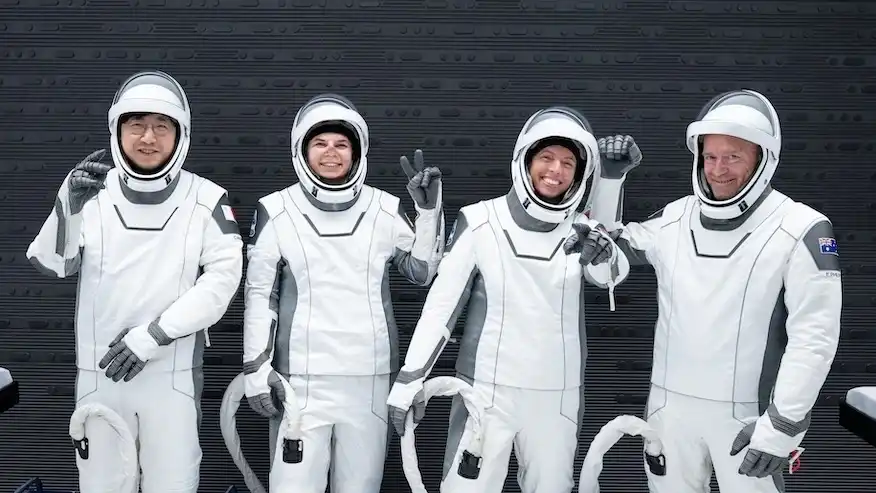
In a 90-degree polar orbit with an apogee of 413 km and a perigee of 202 km, the spacecraft orbited Earth every 93 minutes, taking only 46 minutes to fly from the North Pole to the South Pole. During the three-and-a-half-day mission, Wang Chun and the crew completed a large amount of extremely hardcore scientific research and visual capture — including close observation of the rare high-altitude atmospheric phenomenon STEVE (Strong Thermal Emission Velocity Enhancement) unique to Earth's high latitudes; capturing the first-ever X-ray image in space under microgravity conditions; the first-ever attempt to grow fungal organisms under microgravity conditions...
One noteworthy detail is that Wang Chun's friend, Bao Er Ye, revealed before the mission that Wang Chun had not made any Bitcoin private key backups. He had stated that if anything happened to him during the mission, the Bitcoins he held would be permanently destroyed.
Flying to Mars
Wang Chun's space dream did not end with the successful landing of Fram2; it continues to escalate.
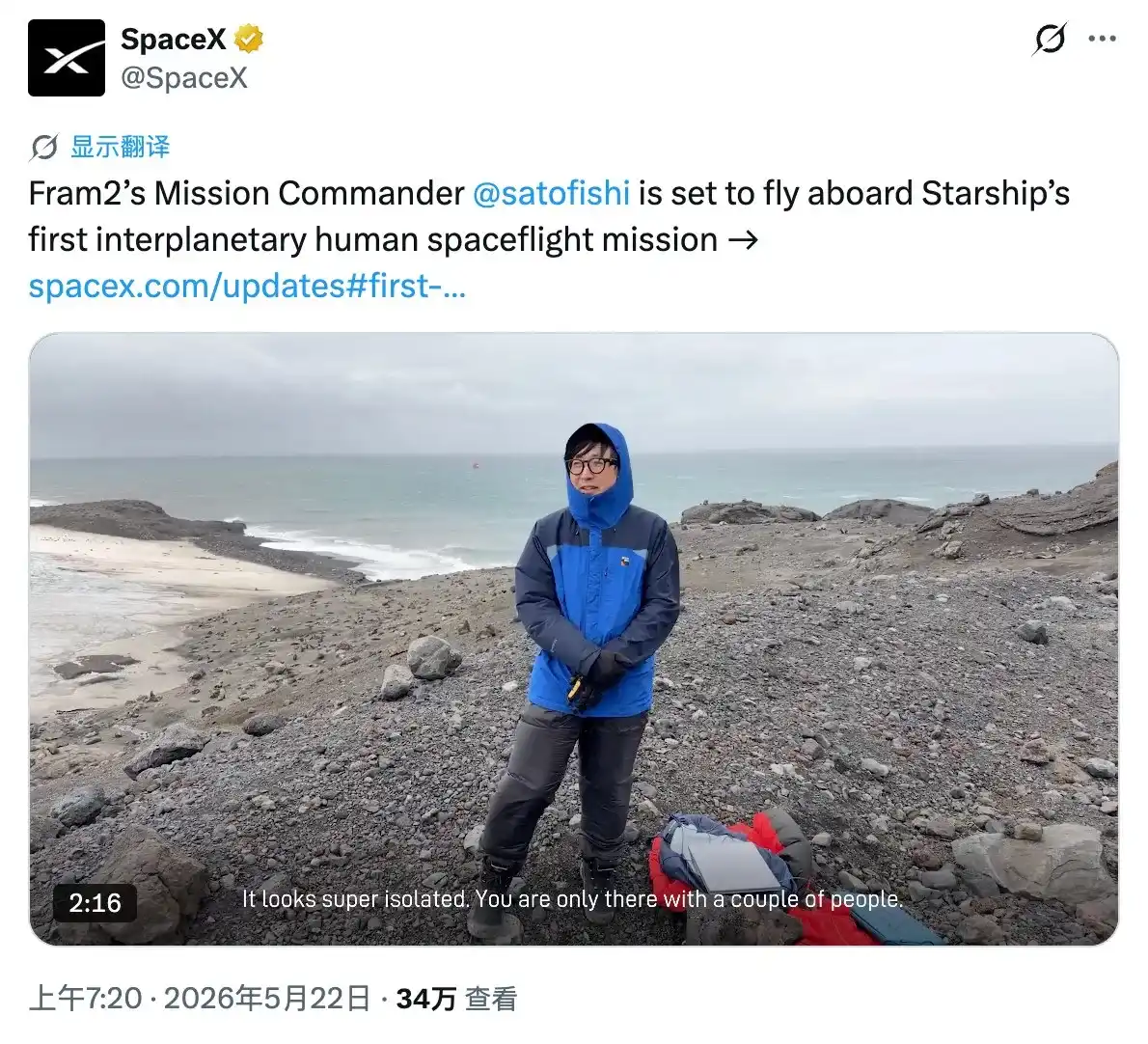
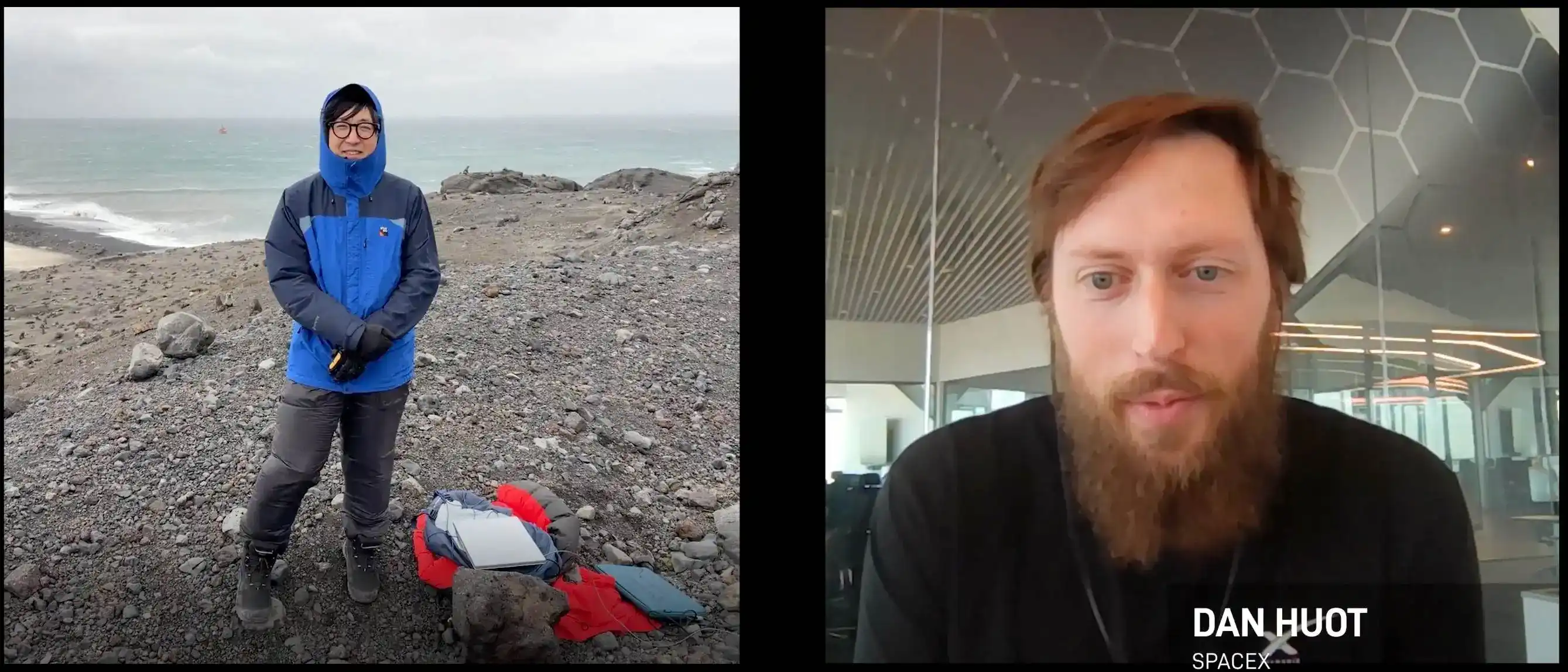
Returning to the story at the beginning, just before SpaceX tested the latest generation Starship launch, SpaceX officially announced in a livestream two follow-up space plans for Wang Chun — a one-week manned circumlunar flight mission, and a full two-year, first-ever manned interplanetary Mars aviation mission in human history.
During SpaceX's live stream with Wang Chun, he was standing in the fierce winds of Bouvet Island at 54°26′S, 3°24′E. The island, located in the South Atlantic Ocean near Antarctica, is an overseas territory of Norway (Norwegian Antarctic Territory) and lies outside the land area frozen by the Antarctic Treaty.
On Wang Chun's personal X homepage, he detailed his travel progress. At the time of writing, the current status is: "60% of the map of 1 celestial body checked in (150 / 249), to be continued..."