Amplify ETFs for stablecoins, tokenization go live for trading

cointelegraphPubblicato 2025-12-24Pubblicato ultima volta 2025-12-24

Introduzione

Amplify has launched two new exchange-traded funds: the Amplify Stablecoin Technology ETF (STBQ) and the Amplify Tokenization Technology ETF (TKNQ), both now trading on NYSE Arca. These ETFs track indexes of companies involved in stablecoin and tokenization infrastructure, including major players like Visa, Circle, Mastercard, PayPal, BlackRock, and JPMorgan. The launch comes amid growing regulatory clarity in the U.S. and Europe, with laws like the GENIUS Act and MiCA positioning stablecoins as compliant digital finance tools. Tokenization and stablecoins have gained significant traction this year as institutions explore digitizing traditional financial services.

Digital asset manager Amplify has launched two exchange-traded funds tracking blockchain projects across stablecoins and tokenization.

The company said on Tuesday that its Amplify Stablecoin Technology ETF (STBQ) and Amplify Tokenization Technology ETF (TKNQ) both went live on the NYSE Arca exchange.

Both funds track a diversified index of companies working on products or infrastructure, along with projects that generate revenue from tokenization and stablecoins.

“These new ETFs expand Amplify’s lineup at a time when the infrastructure behind stablecoins and the growth of tokenization are shaping the next phase of digital finance,” the company said.
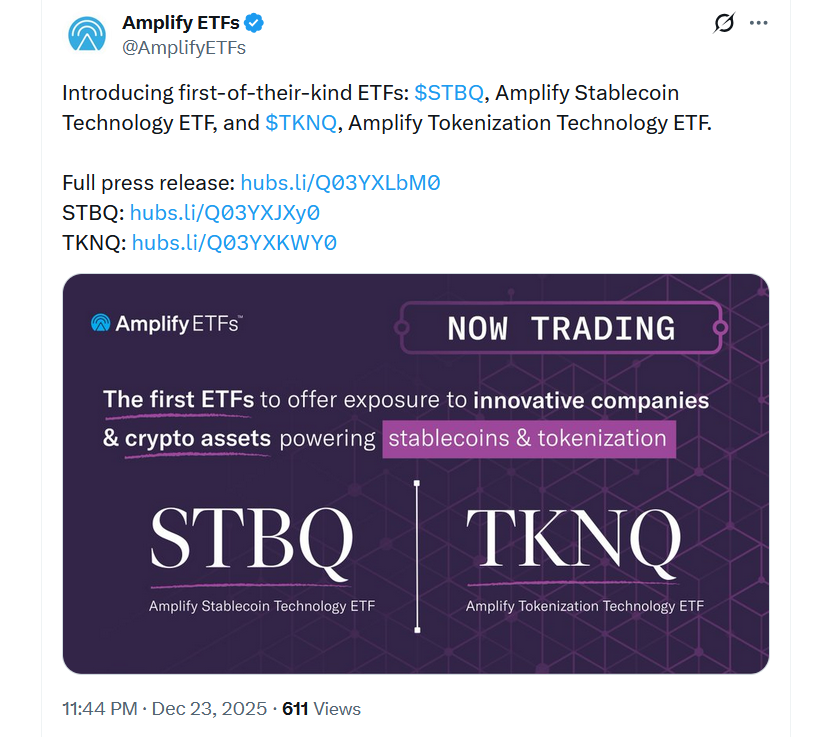
Source: Amplify ETFs

Stablecoins and tokenization have been among the most popular themes in crypto this year, with the US passing laws that have given institutions confidence to launch stablecoins, and regulators opening dialogue on how they should treat assets such as tokenized stocks.

Amplify said its stablecoin-focused ETF tracks shares of companies “generating significant revenue from payments technology, digital asset infrastructure, and trading platforms.”

It holds shares in companies working on stablecoins such as Visa, Circle, Mastercard and PayPal, alongside crypto ETFs from Grayscale, iShares and Bitwise.

The firm pointed to regulatory developments in the US and EU, noting that the “GENIUS Act in the US and MiCA in Europe are positioning stablecoins as the compliant backbone of digital finance.”

Related: Clarity Act delays led to $952M in crypto fund outflows: CoinShares

Meanwhile, the tokenization fund includes exposure to BlackRock, JPMorgan, Figure Technology Solution, Citigroup and the Nasdaq, which all have made tokenization plays over the past few years as they seek opportunities to digitize traditional financial services.

Crypto and blockchain ETFs stormed onto the market in 2025 after the US Securities and Exchange Commission under chair Paul Atkins loosened requirements for crypto ETFs.

Magazine: Big questions: Would Bitcoin survive a 10-year power outage?

Domande pertinenti

QWhat are the names of the two new ETFs launched by Amplify and on which exchange did they go live?

AThe two new ETFs are the Amplify Stablecoin Technology ETF (STBQ) and the Amplify Tokenization Technology ETF (TKNQ). They both went live on the NYSE Arca exchange.

QWhat is the primary focus of the Amplify Stablecoin Technology ETF (STBQ)?

AThe Amplify Stablecoin Technology ETF (STBQ) tracks shares of companies generating significant revenue from payments technology, digital asset infrastructure, and trading platforms related to stablecoins.

QWhich major companies are included in the stablecoin-focused ETF's holdings?

AThe stablecoin-focused ETF holds shares in companies such as Visa, Circle, Mastercard, PayPal, as well as crypto ETFs from Grayscale, iShares, and Bitwise.

QWhat regulatory developments does Amplify cite as supporting the growth of stablecoins?

AAmplify points to the GENIUS Act in the US and the Markets in Crypto-Assets (MiCA) regulation in Europe, which are positioning stablecoins as the compliant backbone of digital finance.

QWhich types of companies does the Amplify Tokenization Technology ETF (TKNQ) provide exposure to?

AThe tokenization fund provides exposure to companies like BlackRock, JPMorgan, Figure Technology Solution, Citigroup, and Nasdaq, which are involved in tokenizing traditional financial services.

Letture associate

Not Speculation but a Necessity: The 4 Unique Values of Prediction Markets

Polymarket's recent $4 billion funding round and soaring valuation of $15 billion highlight the explosive growth of prediction markets, with trading volume reaching $25.7 billion in March 2026—a 10.6% monthly increase. This analysis argues that prediction markets serve critical non-speculative functions, positioning them as essential tools rather than mere gambling platforms. Prediction markets offer four unique values: entertainment consumption, insurance-like protection, risk hedging, and truth discovery. Firstly, they stimulate economic activity by engaging users in event-based betting, similar to the broader sports industry. Secondly, they act as a form of decentralized insurance, allowing users to hedge against specific, well-defined risks (e.g., weather events) transparently and without traditional overhead costs. Thirdly, institutions and individuals use these markets to hedge against geopolitical and commodity price risks, as demonstrated during the U.S.-Iran conflict and the launch of 24/7 commodity markets on platforms like Kalshi. Finally, prediction markets counter media bias by aggregating crowd-sourced information, often achieving 30% higher accuracy than surveys due to users' vested interests. Experts like Bitwise’s Jeff Park and SIG’s Jeff Yass emphasize the markets' role in risk transfer and financial innovation. As these platforms evolve, they are poised to become trillion-dollar markets, offering more reliable, decentralized mechanisms for information pricing and risk management.

marsbit2 h fa

Not Speculation but a Necessity: The 4 Unique Values of Prediction Markets

marsbit2 h fa

Trading

Spot
Futures
活动图片