Amid Stock Market Highs, Bond and Oil Markets Are Still 'Casting Dissenting Votes'

marsbitPubblicato 2026-04-16Pubblicato ultima volta 2026-04-16

Introduzione

The stock market has fully recovered its losses from the U.S.-Iran conflict, with the S&P 500 nearing all-time highs. However, bond and crude oil markets are signaling a different story. While equities are pricing in an optimistic scenario—low inflation, Fed rate cuts, contained costs, and conflict resolution—bond yields and oil prices suggest persistent inflation, limited Fed flexibility, and ongoing geopolitical risk. The 10-year Treasury yield has risen 30 basis points since the conflict began, reflecting inflation concerns rather than growth optimism. WTI crude is up 37%, indicating the market does not anticipate a near-term resolution to Middle East tensions. The 2-year yield, sensitive to Fed policy expectations, has increased 40 bps, challenging the narrative of imminent rate cuts. This divergence suggests the equity rally may be driven more by momentum than fundamentals. If upcoming inflation data exceeds expectations or geopolitical risks persist, stocks may need to correct downward to align with the realities reflected in bonds and oil. The author remains cautious, preferring to wait for clearer signals rather than chase a rally unsupported by key asset classes.

Original Title: The Bond Market Isn't Buying This Rally. Neither Am I.

Original Author: KURT S. ALTRICHTER, CRPS

Original Compilation: Peggy, BlockBeats

Editor's Note: As the stock market quickly recovers its wartime losses and approaches historical highs, a narrative that 'risks have been cleared' is once again taking dominance. However, this article reminds us that if we only look at the equity market, it is easy to misjudge the current real environment.

The signals from bonds and oil are inconsistent: rising interest rates and high oil prices point to sticky inflation, limited policy space for the Federal Reserve, and geopolitical conflicts that have not truly subsided. In contrast, the stock market is simultaneously pricing in low inflation, the restart of interest rate cuts, controllable costs, and conflict resolution—a highly idealized set of premises.

The author believes that this rally is driven more by momentum than fundamentals. Driven by trading behavior of 'fear of missing out,' prices can deviate from reality in the short term but must eventually return to the range determined by macroeconomic variables.

When divergences occur between different asset classes, the real risk often lies not in who is right or wrong, but in how this divergence is resolved. The current issue is not whether the market is optimistic, but whether this optimism has run ahead of the data.

Below is the original text:

"Rule Two: Excessive volatility in one direction often triggers excessive reversals in the opposite direction." — Bob Farrell

The S&P 500 has completely recovered all its losses during the U.S.-Iran conflict. As of yesterday, the index was 1% higher than on February 27 (the day before the first strike on Iran) and is only a step away from its historical high (less than 1%).

In just 10 trading days, the market has completed a full round trip.
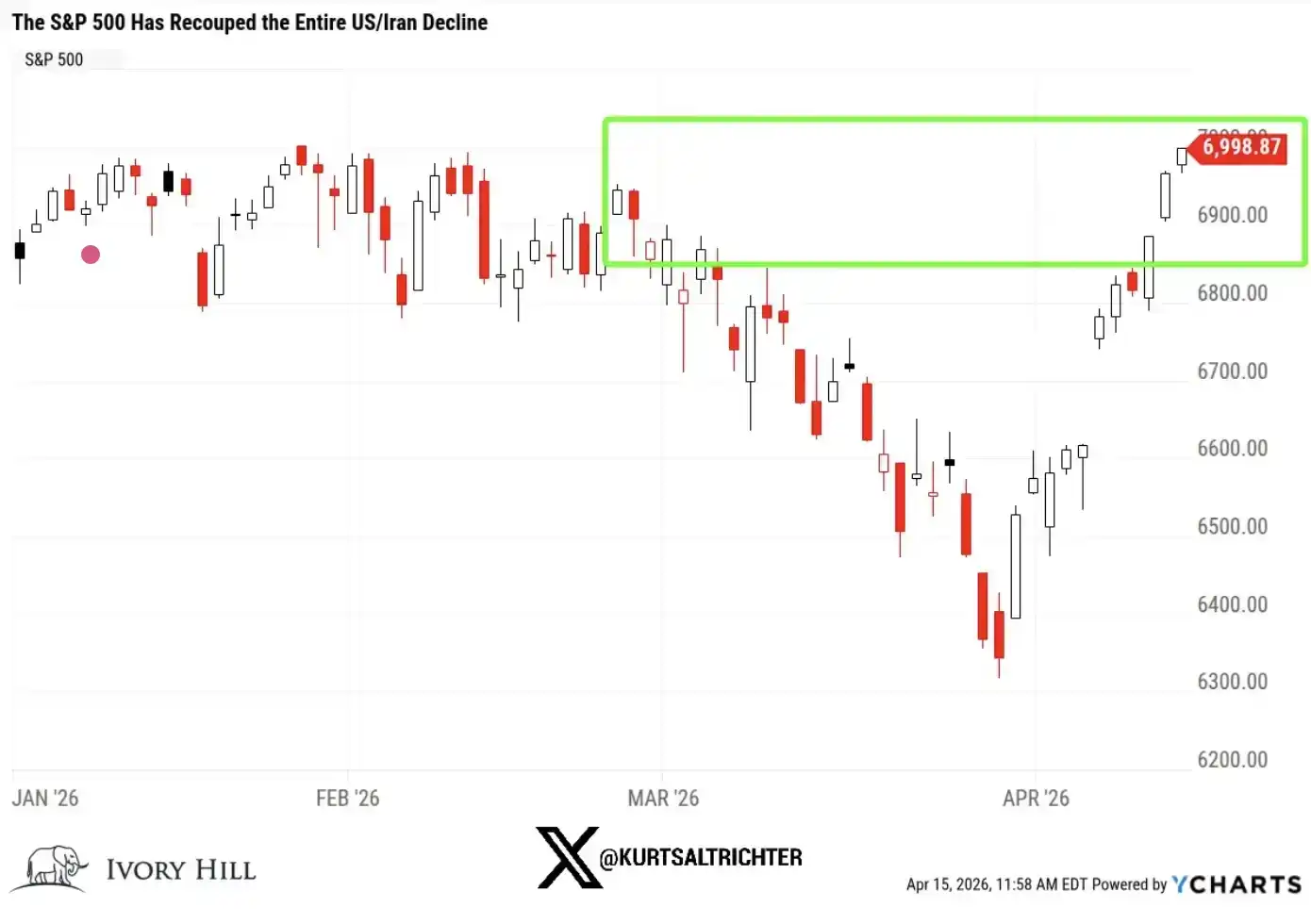
Let me be direct: if you only look at the stock market now, everything seems to be 'back to health.' War breaks out, the market falls, then quickly rebounds, everything returns to normal, and everyone moves on.

But if you broaden your perspective, this is not what is really happening.

The bond market has not confirmed this rally.

The oil market has not confirmed this rally either.

When the two most important global markets are telling a different story from the stock market, this is by no means a signal that can be ignored.

So, what is the stock market pricing in right now?

For the S&P 500 to stand above pre-war levels, the market essentially needs to believe in the following things simultaneously:

Current oil prices are not yet sufficient to substantially suppress consumption.

The Federal Reserve will ignore overheated inflation data and still choose to cut interest rates.

Higher raw material and transportation costs will not erode corporate profit margins.

The Middle East conflict will be sufficiently close to resolution within six months, no longer posing a risk.

Maybe things will indeed develop this way. I'm not saying it's impossible. But this is a rather aggressive set of premises, and the data released by the current bond and oil markets do not support these assumptions.

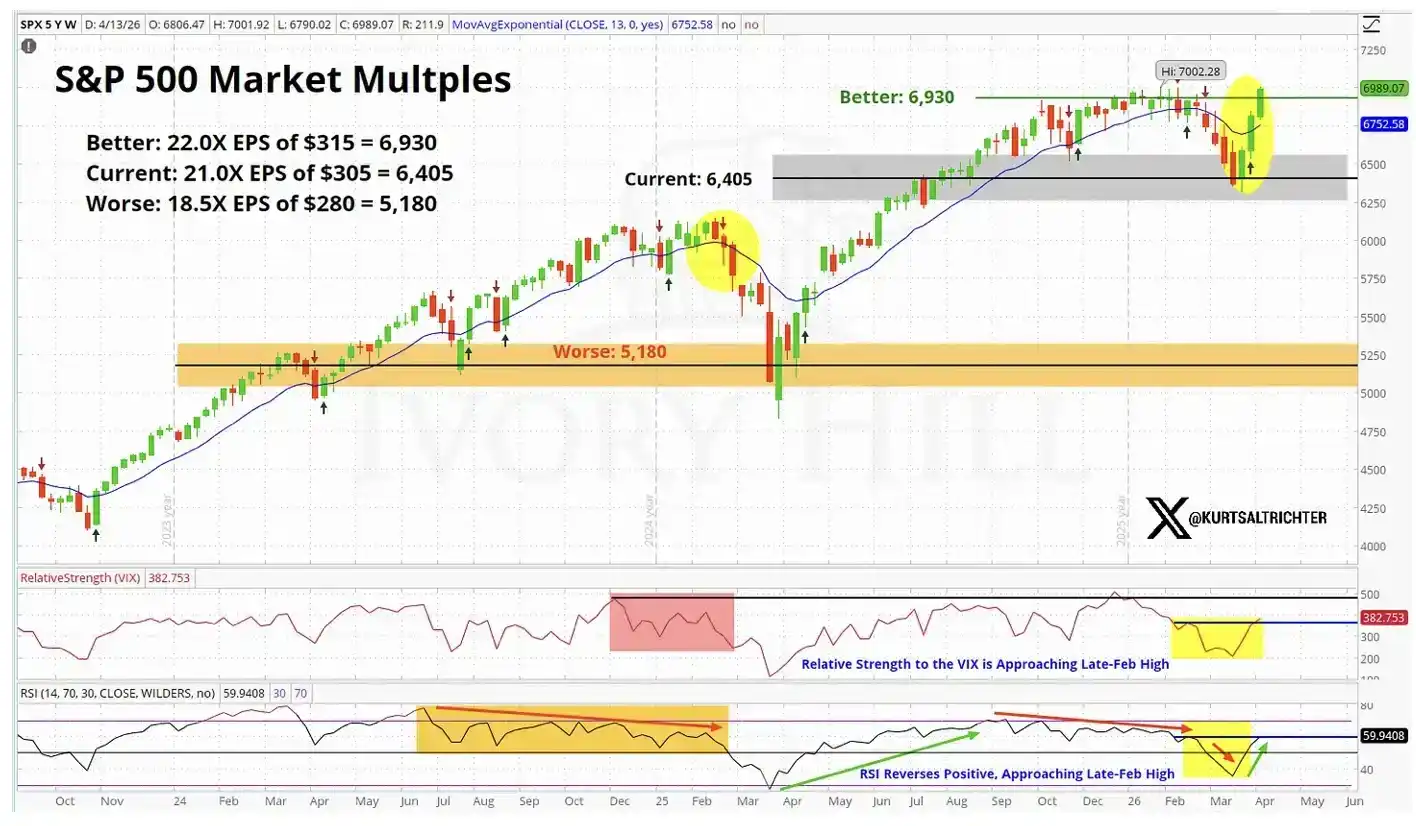
From a fundamental perspective, the stock market's pricing is already close to a 'perfect expectation.'
Let's look at more specific data

On February 27, the day before the war broke out, the closing levels of key indicators were as follows:

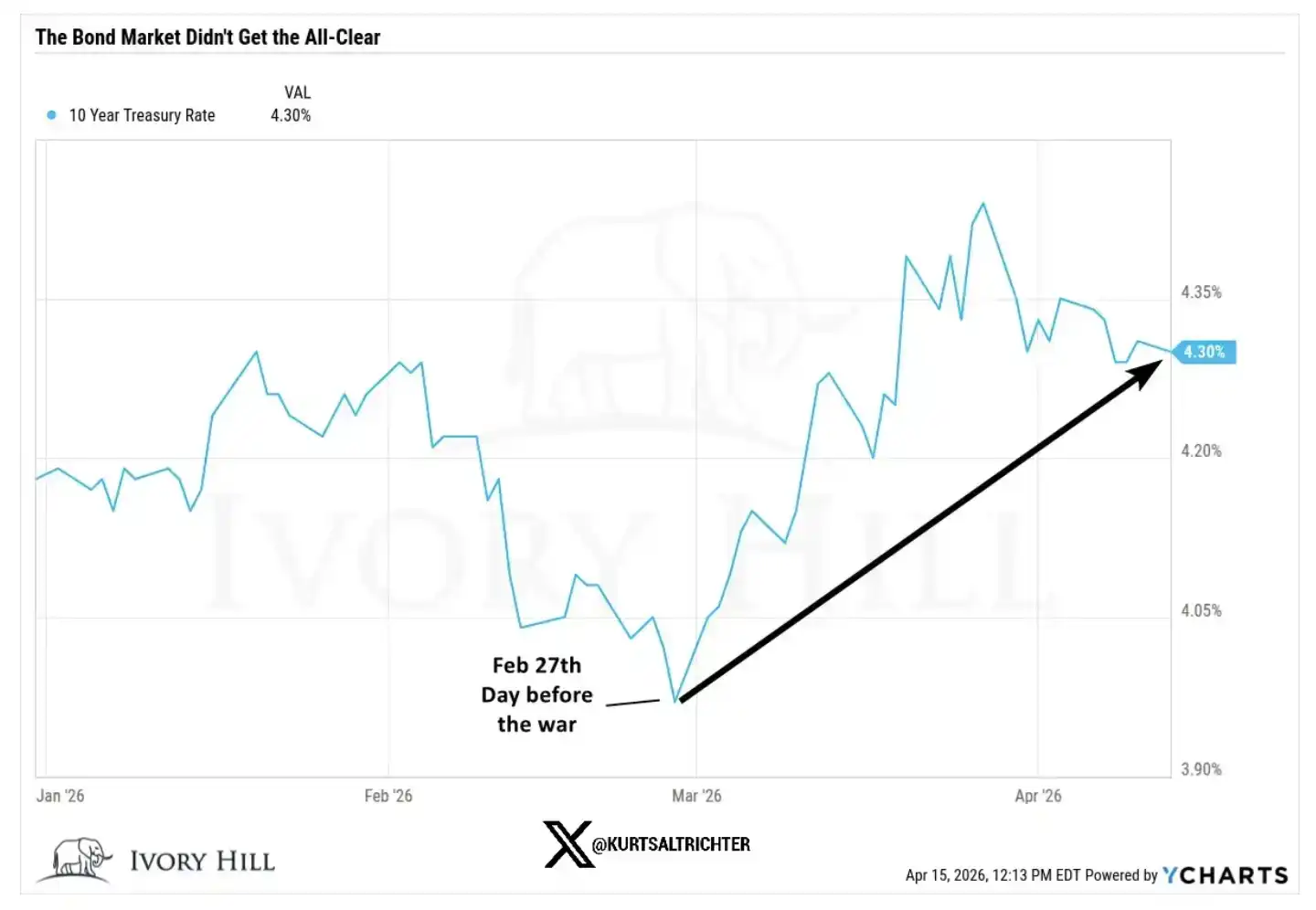
10-year U.S. Treasury yield: 3.95%, while yesterday it closed at 4.25%, up 30 basis points from pre-war levels.

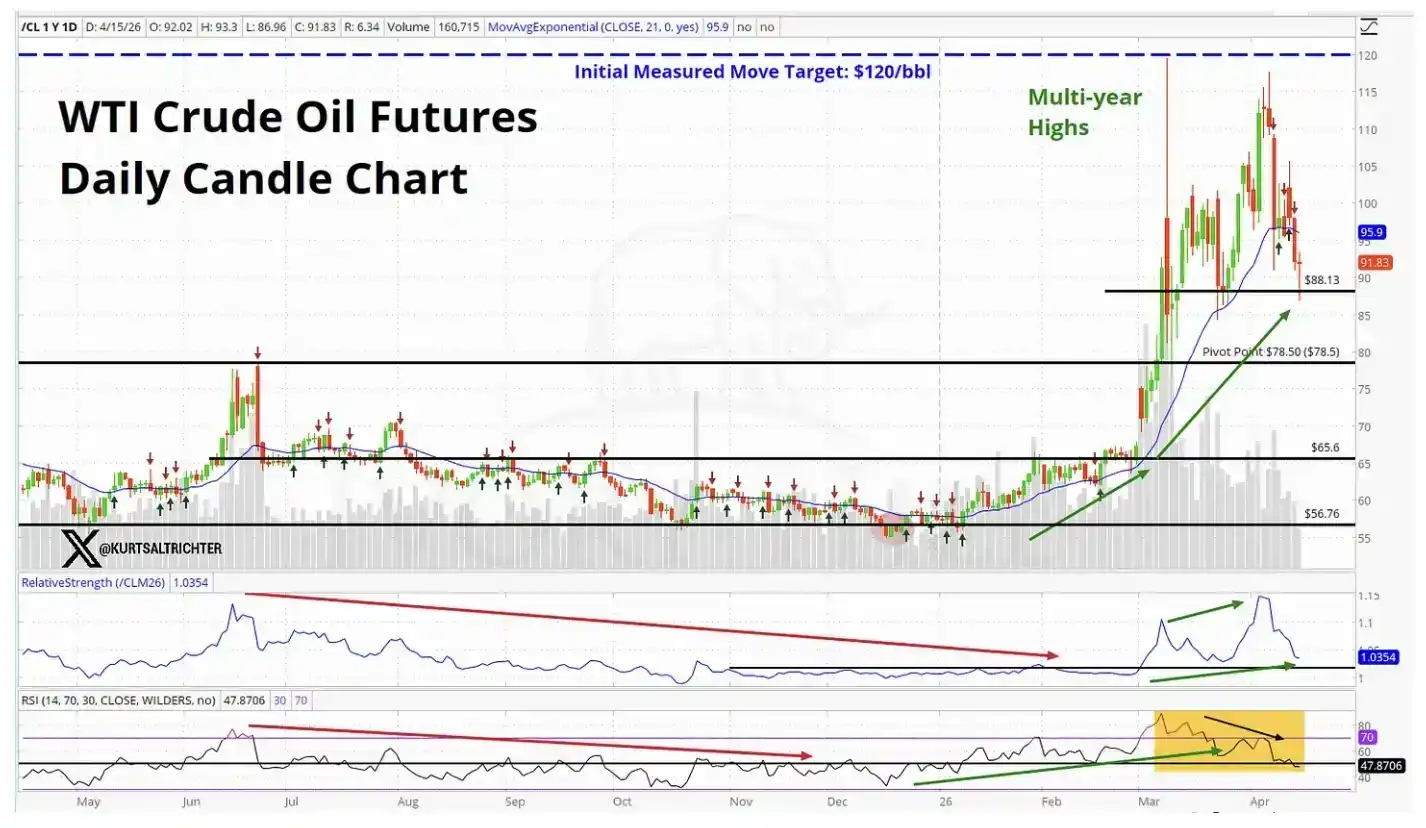
WTI crude oil: $67.02, currently about 37% higher than then.

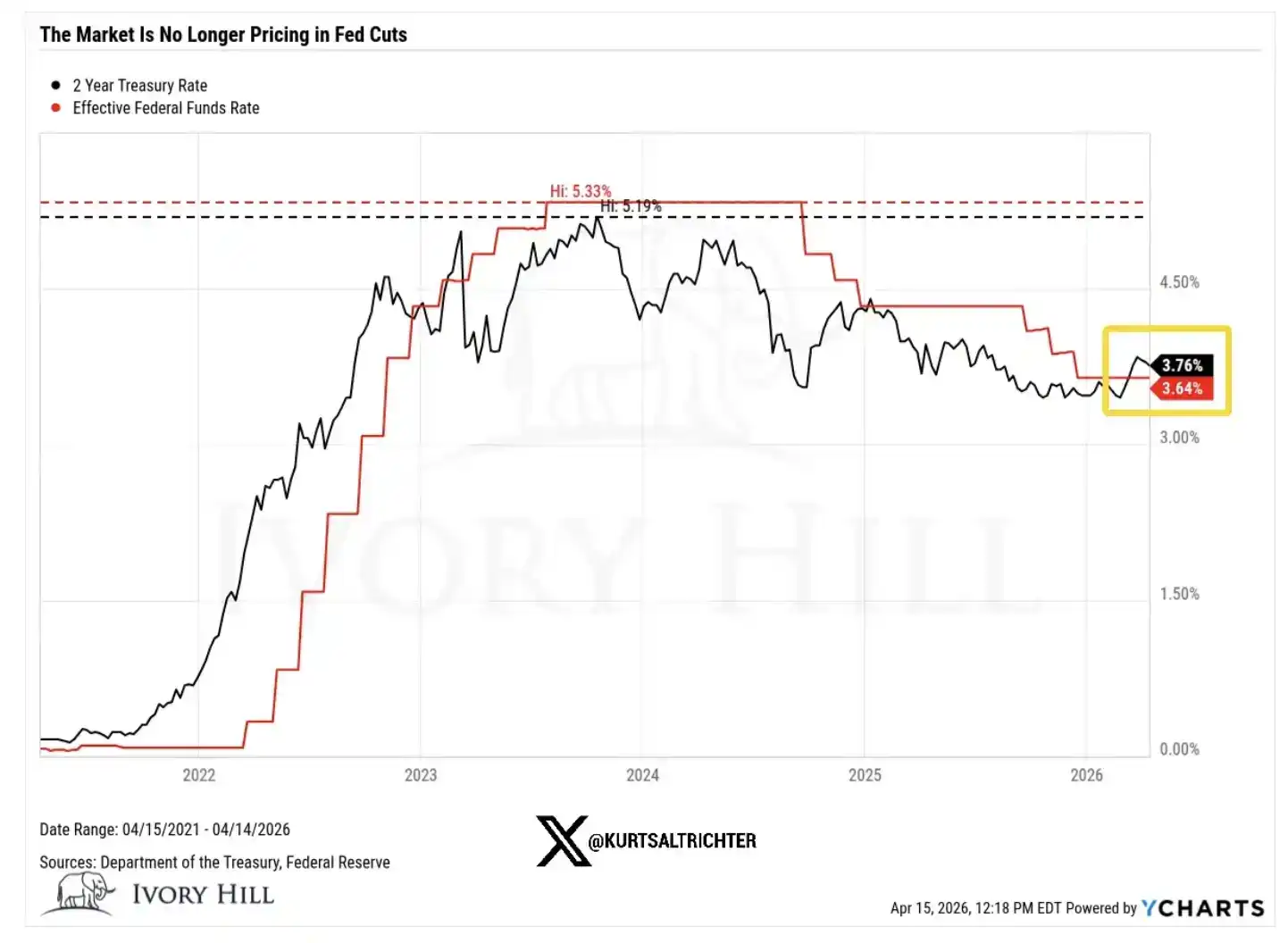
2-year U.S. Treasury yield: 3.38%, yesterday it closed at 3.75%, up nearly 40 basis points from pre-war levels.

Now, let's break down the implications behind these changes one by one.

The 30-basis-point rise in the 10-year yield after the war broke out is not because the bond market is more optimistic about economic growth. Current consumer sentiment is weakening, and confidence remains sluggish. This rise in interest rates is essentially the bond market 'quietly' pricing in inflation.

The signal it sends is clear: higher oil prices are transmitting to the overall price system, and the Federal Reserve's future policy space may not be as accommodative as the stock market assumes.
A 37% rise in oil prices over 6 weeks is not the performance one would expect if the market truly believed that a real, lasting agreement between the U.S. and Iran is imminent.

If traders were truly confident in a stable ceasefire agreement, oil prices should have long fallen back to the $70 range and continued to decline. But that is not the reality. Oil prices remain high, which means the oil market is not pricing in the same 'conflict resolution is imminent' expectation as the stock market.
And the 2-year U.S. Treasury yield is still 40 basis points higher than pre-war levels, which is itself a direct challenge to the narrative that 'the Federal Reserve is about to cut interest rates.'

The 2-year yield is the most sensitive indicator for observing interest rate expectations; it reflects the Federal Reserve's policy path more directly than any other asset. And now, the signal it sends is: the Federal Reserve's room for maneuver is smaller than the market imagines. This affects almost all the valuation logic supporting this stock market rally.
So, who is right?

The stock market might be right, I'm willing to admit that. If a substantive ceasefire agreement really emerges, bond yields could quickly fall back; once supply issues are credibly resolved, oil prices could also drop significantly. This is not the first time the stock market has led, with other markets 'catching up' or following later.

But there is another explanation that I think is currently underestimated.

A large part of this rally is not driven by fundamentals but by momentum. Traders' reluctance to short in an upward trend itself continuously pushes the market higher. Such buying can indeed sustain the trend longer than it should.

But it does not change the underlying logic.

And the underlying reality is: oil prices remain high, interest rates are still rising, and the Federal Reserve's room for interest rate cuts is more limited than what the bulls need.
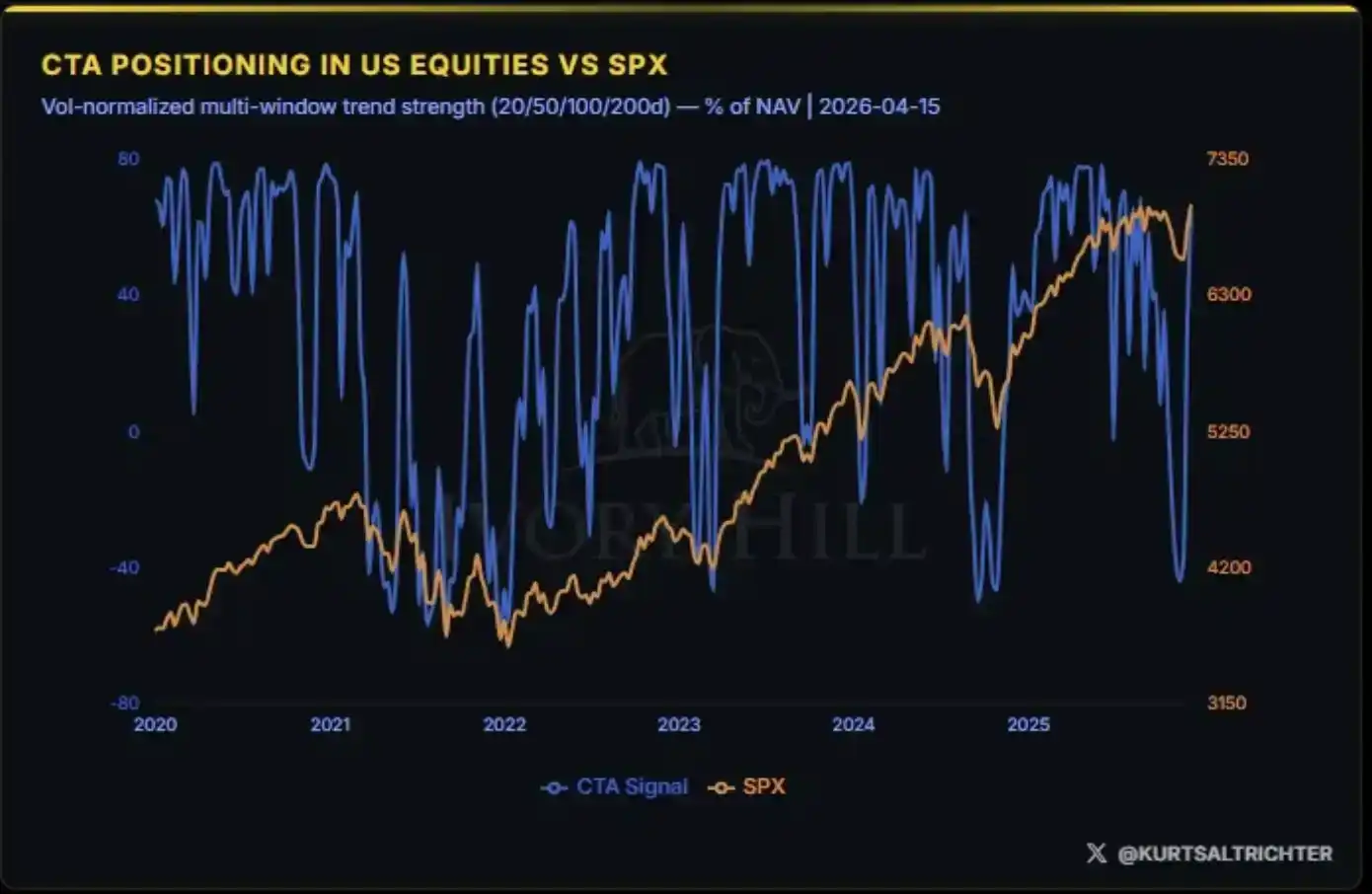
Rallies driven by fundamentals tend to be more sustainable; those driven by momentum are usually more fragile and shorter-lived. When you consider whether to add positions near historical highs, this difference is particularly critical. As the market valuation chart above shows, the current stock market is already pricing in a 'perfect scenario.'

My actual judgment

Over the past 10 days, the situation has indeed improved, I won't deny that. I'm not the type to be bearish for no reason.

But there is still a clear gap between the stock market's pricing and the reality reflected by bonds and oil, and this gap has not narrowed. I am closely watching this.

Currently, the stock market is at the most optimistic end of the range; bonds and oil are closer to the middle, reflecting a world where inflation still exists, the Federal Reserve's policy space is limited, and the conflict is not truly resolved.

This divergence will eventually be resolved, and there are only two paths:

Either a real ceasefire agreement is reached, oil prices fall back to around $70, the Federal Reserve gains clear room to cut rates, ultimately proving the stock market right;

Or none of this happens, and the stock market will fall back, moving closer to the levels currently reflected by bonds and oil.

And for now, bonds and oil show no signs of moving toward the stock market; it seems more like the stock market needs to move down to 'align' with them.

The next inflation data will be released on May 12. If my judgment is correct and CPI is above 3.5%, the narrative of rate cuts in 2026 will basically be over.

If you continue to add positions at this level, you are essentially betting that everything develops in the most ideal direction: the war ends smoothly, without interference from 'Trump's sudden remarks'; inflation remains controllable; the Federal Reserve cuts rates as planned; corporate profits hold steady. These four things must all happen simultaneously. If any one of them deviates significantly, the market's downward adjustment process is likely to be swift and severe.

In comparison, I prefer to remain patient rather than chase a rally that is 'quietly denied' by two key asset classes. If long-term signals point to buying, we will naturally gradually increase positions according to strategy.

And don't forget—the only certainty is that everything will eventually change.

Original link

Domande pertinenti

QWhat are the key signals from the bond and oil markets that contradict the stock market rally?

AThe 10-year Treasury yield has increased by 30 basis points since the pre-war period, indicating bond markets are pricing in persistent inflation rather than economic optimism. The 2-year Treasury yield is up 40 basis points, challenging the narrative of imminent Fed rate cuts. Oil prices have risen 37%, suggesting the market does not believe in a near-term resolution to Middle East conflicts, contrary to equity assumptions.

QAccording to the author, what underlying reality do bond and oil markets reflect compared to equities?

ABond and oil markets reflect a reality where inflation remains sticky, the Fed has limited policy flexibility, and geopolitical conflicts are unresolved. Equities, however, are pricing a 'perfect scenario' of low inflation, Fed rate cuts, controlled costs, and conflict resolution—a highly optimistic set of assumptions.

QWhat two paths could resolve the divergence between equity markets and bond/oil markets?

AEither a genuine ceasefire agreement is reached, causing oil prices to fall and the Fed to gain clear room for rate cuts (validating equities), or these conditions do not materialize, forcing equities to decline and align with the levels reflected in bond and oil markets.

QWhy does the author view the current stock rally as potentially fragile?

AThe rally is driven more by momentum and 'fear of missing out' (FOMO) trading behavior rather than fundamentals. Such momentum-driven gains are often short-lived and vulnerable to abrupt corrections if underlying macroeconomic variables—like inflation data or geopolitical events—disappoint.

QWhat critical data does the author highlight as a potential catalyst for market reassessment?

AThe next CPI data release on May 12th is highlighted. If CPI exceeds 3.5%, it would likely end the narrative of Fed rate cuts in 2026, forcing a reevaluation of equity valuations that rely on accommodative monetary policy.

Letture associate

Breaking: OpenAI Undergoes Major Reorganization, President Brockman Assumes Command

OpenAI has announced a major internal reorganization just months before its anticipated IPO. The company is merging its three flagship product lines—ChatGPT, Codex, and the API platform—into a single, unified product organization. The most significant leadership change involves co-founder and President Greg Brockman moving from a background technical role to take full, permanent control over all product strategy. This follows the indefinite medical leave of AGI Deployment CEO Fidji Simo. Additionally, ChatGPT's longtime lead, Nick Turley, has been reassigned to enterprise products, with former Instagram executive Ashley Alexander taking over consumer offerings. The consolidation, internally framed as a strategic move towards an "Agentic Future," aims to break down internal silos and create a cohesive "Super App." This planned desktop application would integrate ChatGPT's conversational abilities, Codex's coding power, and a rumored internal web browser named "Atlas" to autonomously perform complex user tasks. The reorganization occurs amid significant internal and external pressures. OpenAI has recently seen a wave of high-profile departures, including Sora co-lead Bill Peebles and other senior technical leaders, leading to concerns about a thinning executive bench. Externally, rival Anthropic recently secured funding at a staggering $900 billion valuation, surpassing OpenAI's own. Google's upcoming I/O developer conference also poses a competitive threat. Analysts suggest the dramatic restructure is a pre-IPO move to present a clearer, more focused narrative to Wall Street—streamlining operations and demonstrating decisive leadership under Brockman to counter internal turbulence and intense market competition.

marsbit3 h fa

Breaking: OpenAI Undergoes Major Reorganization, President Brockman Assumes Command

marsbit3 h fa

Two Survival Structures of Market Makers and Arbitrageurs

Market makers and arbitrageurs represent two distinct survival structures in high-frequency trading. Market makers primarily use limit orders (makers) to profit from the bid-ask spread, enjoying high capital efficiency (nominally 100%) but bearing inventory risk. This "inventory risk" arises from passive, fragmented, and discontinuous order fills in the limit order book (LOB). This risk, while a potential cost, can also contribute to excess profit if managed within control boundaries, allowing for mean reversion. Market makers essentially sell "time" (uncertainty over execution timing) to the market for price control and low fees. In contrast, cross-exchange arbitrageurs typically use market orders (takers) to exploit price differences or funding rates, resulting in lower nominal capital efficiency (requiring capital on both exchanges) and higher transaction costs. Their risk exposure stems from asymmetries in exchange rules (e.g., minimum order sizes), execution latency, and infrastructure risks (e.g., ADL, oracle drift). These exposures are active, exogenous gaps that primarily erode profits rather than contribute to them. Arbitrageurs essentially sell "space" (capital sunk across venues) for localized, immediate certainty. Both strategies engage in a trade-off between execution friction and residual risk. Optimal systems allow for temporary, controlled risk exposure rather than enforcing zero exposure at all costs. Their evolution converges towards hybrid models: arbitrageurs may use maker orders to reduce costs, while market makers may use taker orders or hedges for risk management. Ultimately, both use different forms of risk exposure—market makers exposing inventory, arbitrageurs immobilizing capital—to extract marginal, hard-won certainty from the market.

链捕手3 h fa

Two Survival Structures of Market Makers and Arbitrageurs

链捕手3 h fa

Who Will Define the Rules of the AI Era? Anthropic Discusses the 2028 US-China AI Landscape

This article, based on Anthropic's analysis, outlines the intensifying systemic competition between the U.S./allies and China for AI leadership by 2028. It argues that access to advanced computing power ("compute") is the critical bottleneck, where the U.S. currently holds a significant advantage through chip export controls and allied innovation. However, China's AI labs remain competitive by exploiting policy loopholes—via chip smuggling, overseas data center access, and "model distillation" attacks to copy U.S. model capabilities—keeping them close to the frontier. The piece presents two contrasting scenarios for 2028. In the first, decisive U.S. action to tighten compute controls and curb distillation locks in a 12-24 month AI capability lead, cementing democratic influence over global AI norms, security, and economic infrastructure. In the second, policy inaction allows China to achieve near-parity through continued access to U.S. technology, enabling Beijing to promote its AI stack globally and integrate advanced AI into its military and governance systems, altering the strategic balance. Anthropic contends that maintaining a decisive U.S. lead is essential for shaping safe AI development and governance. The core recommendation is for U.S. policymakers to urgently close compute and model access loopholes while promoting global adoption of the U.S. AI technology stack to secure a lasting strategic advantage.

marsbit5 h fa

Who Will Define the Rules of the AI Era? Anthropic Discusses the 2028 US-China AI Landscape

marsbit5 h fa

Trading

Spot
Futures
活动图片





