The battle of large models has finally reached its most shocking and disruptive moment in 2026.
Anthropic has actually managed to pull off a historic "backstab" against OpenAI in the enterprise sector.
According to the latest AI Index for May 2026 released by fintech giant Ramp, earth-shattering data has emerged—
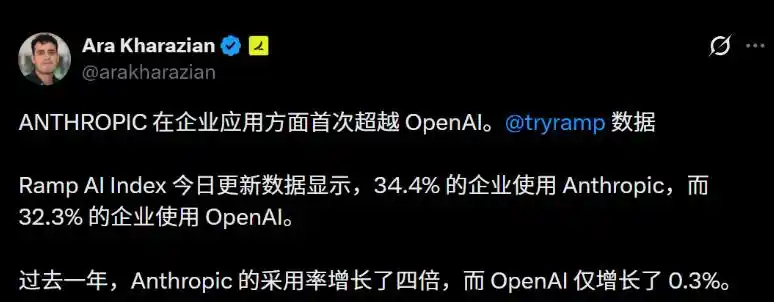
Anthropic's adoption rate in workplaces reached 34.4%, surpassing OpenAI's 32.3% for the first time.
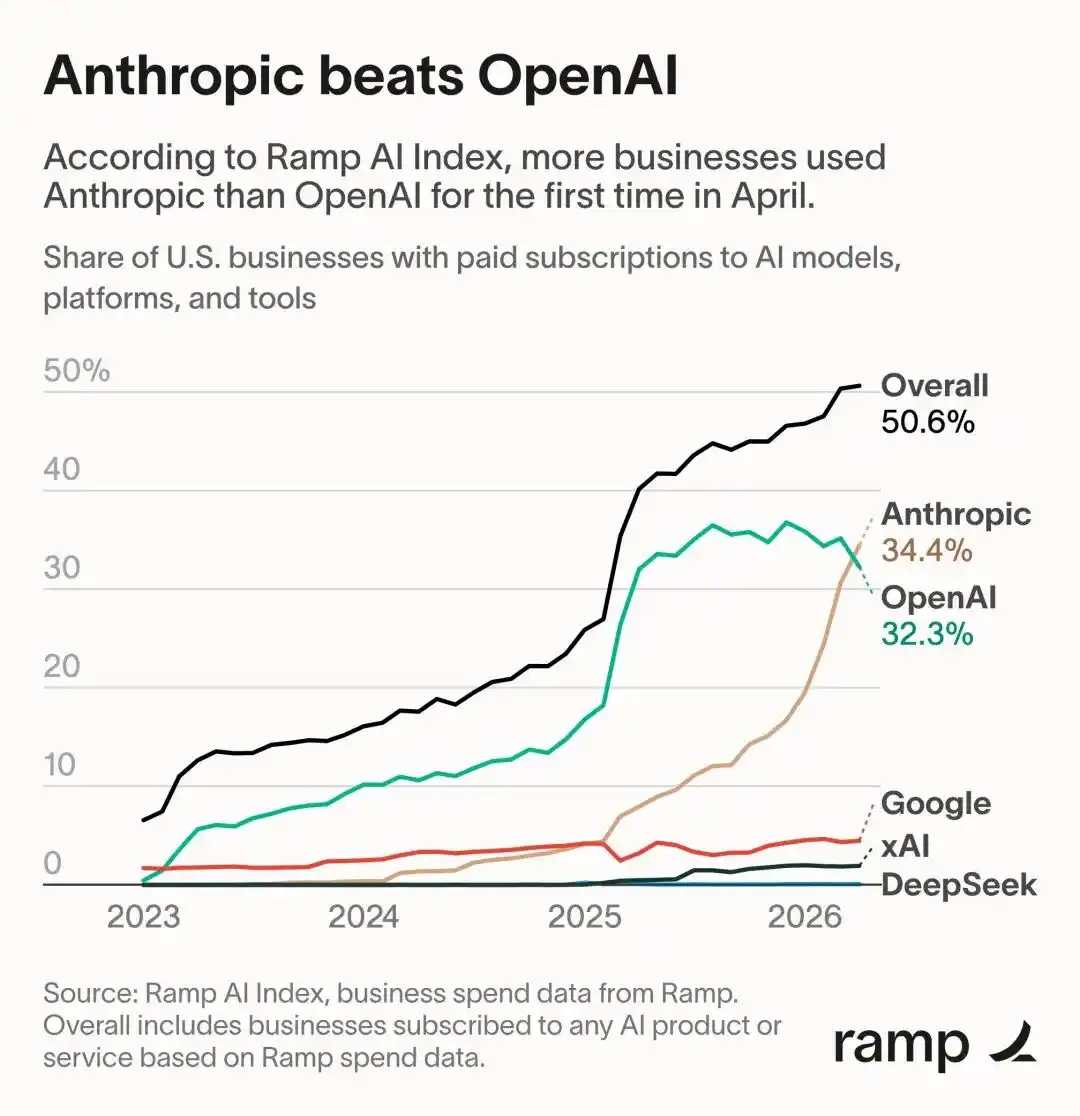
This is a long-planned "comeback". Over the past year, Anthropic's enterprise adoption rate has skyrocketed nearly 4x, while the growth rate of the former champion OpenAI was a dismal 0.3%.
The power game in the AI world has officially changed hands, and the B2B market is becoming the real "meat grinder".
At This Moment, Altman Begins to Worry
There was a time when ChatGPT was synonymous with AI.
In January of this year, Ramp's data still showed OpenAI far ahead of competitors, with its products experiencing explosive growth in fields like software development, research, finance, and customer support.

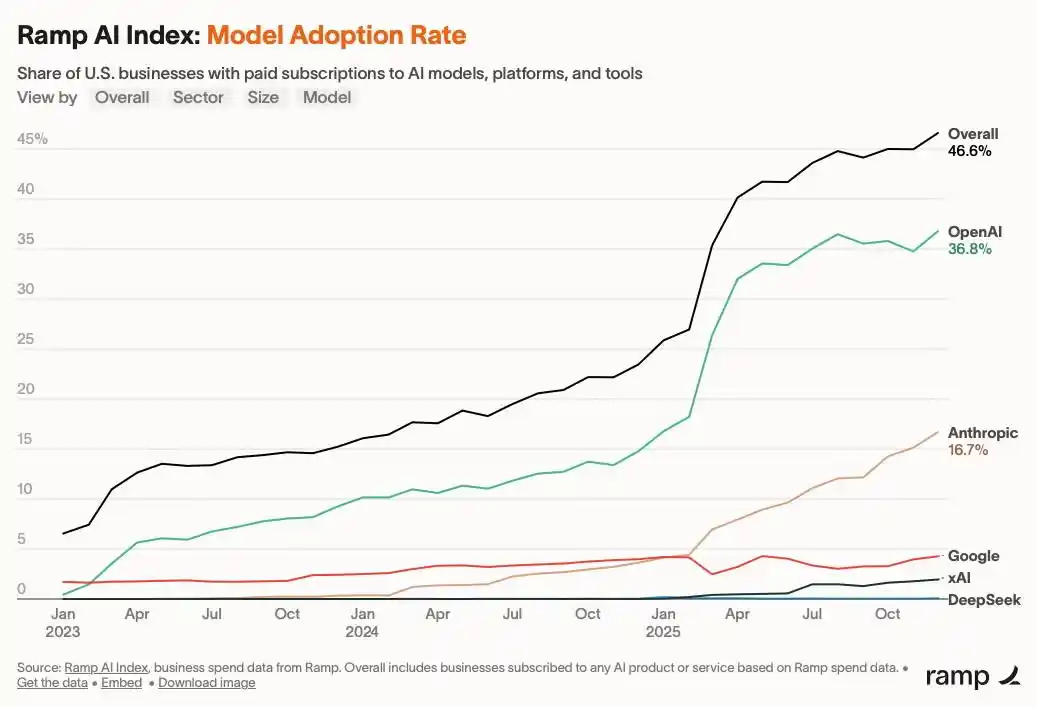
However, this Ramp report, based on bill data from over 50,000 companies involving billions of dollars in real expenditure, has torn open OpenAI's moat.
Remember, in May a year ago, Anthropic and OpenAI's enterprise-paid adoption rates were 9% and 32% respectively.
In just 12 months, Anthropic quadrupled, while OpenAI increased by a mere 0.3 percentage points.
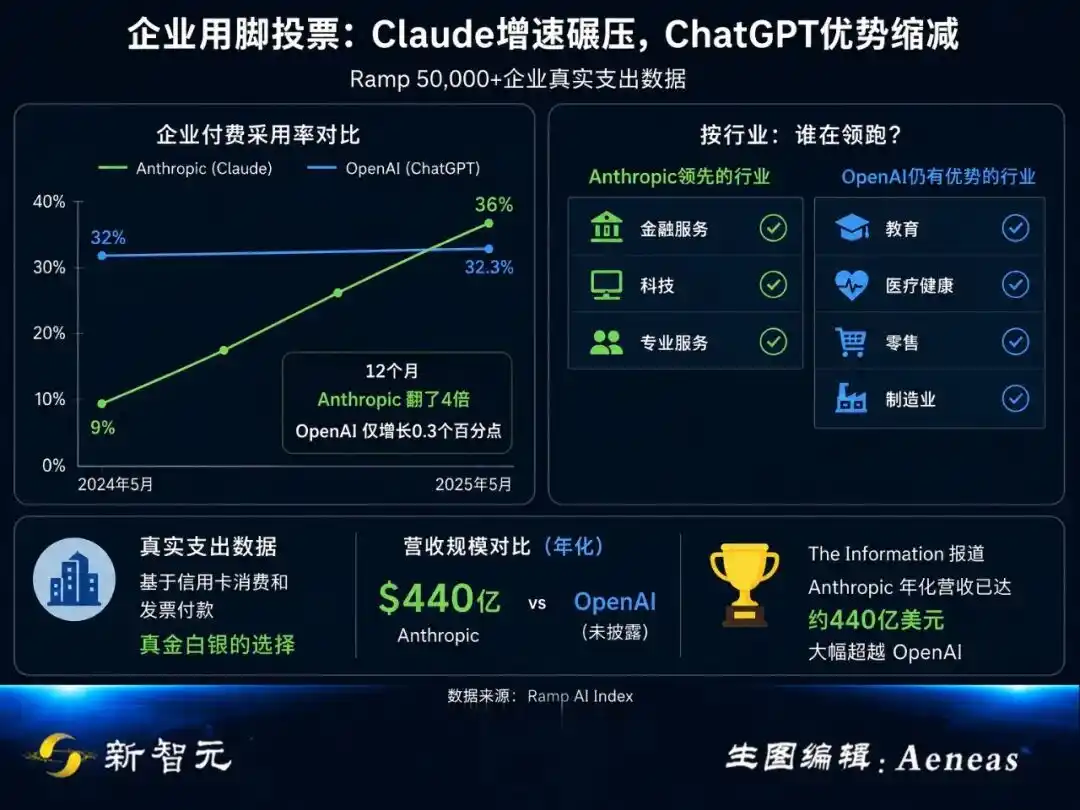
Ramp Chief Economist Ara Kharazian stated: "Anthropic has long been leading in high-adoption industries like finance, tech, and professional services. OpenAI still holds an advantage in other industries, but that advantage has been shrinking over the past few months."
It's crucial to note that Ramp's AI Index is based on actual corporate expenditure records—credit card charges and invoice payments—so the data reflects real money spent, not free trials.
This means that when corporate CEOs decide to spend money on AI, they are increasingly choosing Claude over ChatGPT.
According to The Information, Anthropic's annualized revenue has reached approximately $44 billion, significantly surpassing OpenAI.
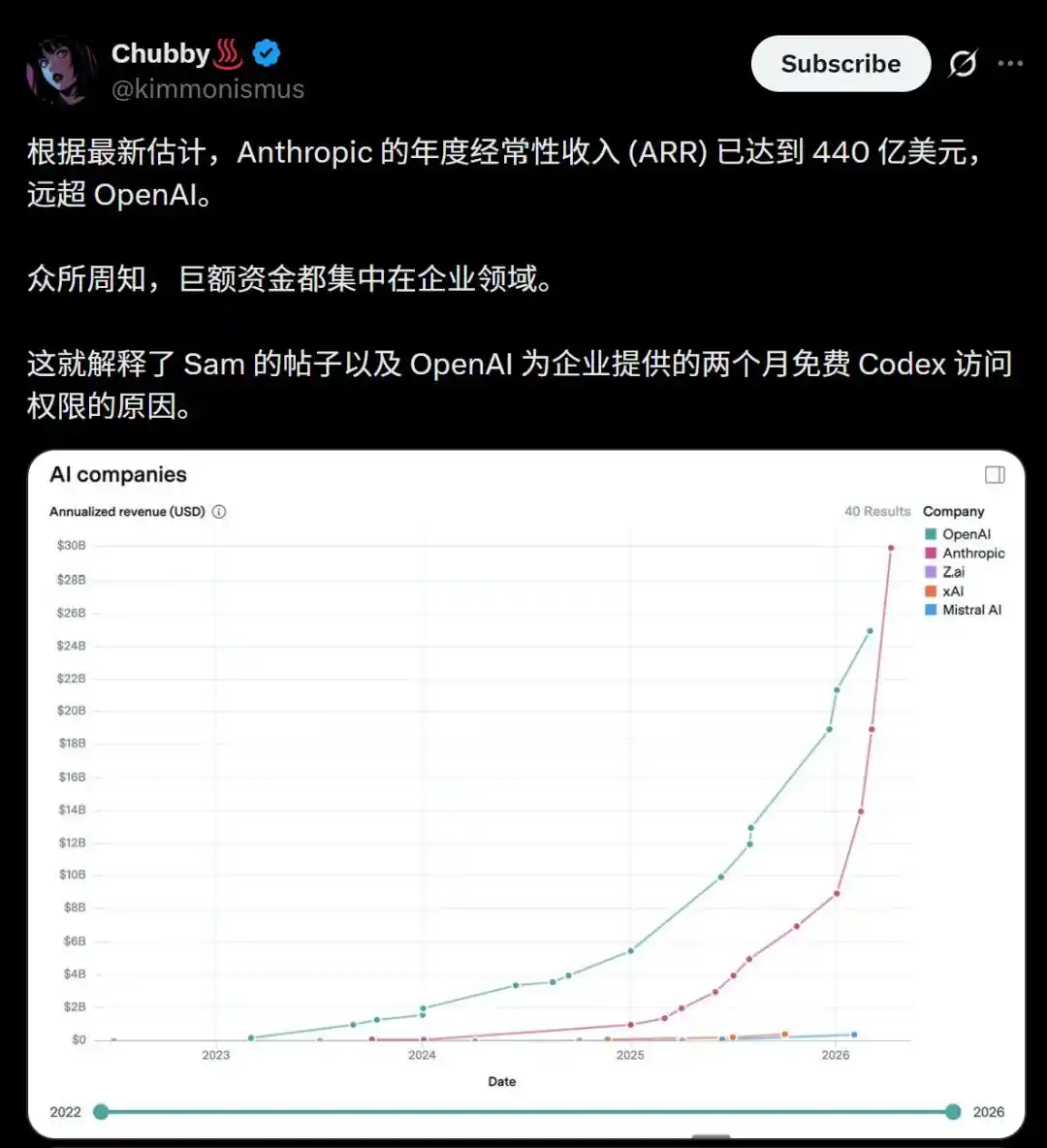
Faced with this report of being "overtaken", OpenAI couldn't sit still and quickly went into defensive mode. A spokesperson bluntly said: "Ramp's data only counts credit card charges, while our multi-million dollar enterprise deep transformation contracts don't go through credit cards at all."
However, this explanation is seen by the industry as more of a "face-saving" attempt.
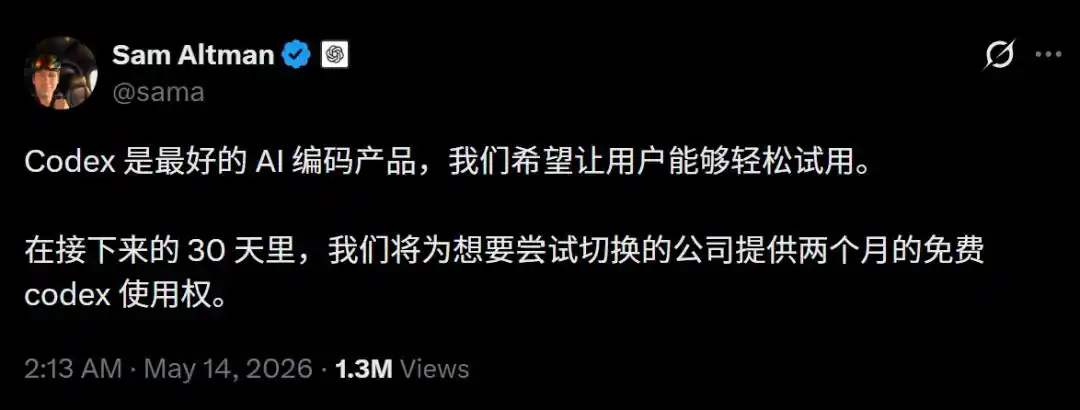
Because just today, Altman urgently launched a "two-month free Codex access" for enterprises, trying to win back lost B2B clients through low-price tactics.

Behind this sense of anxiety lie two hardcore killer features built by Anthropic. One is the brutal efficiency of its billing model, and the other is the money-printing effect of AI Agents.
SaaS is Dead? 'Pay-Per-Use' Triggers a $45 Billion Revenue Tsunami
Recently, Anthropic made a shocking decision,堪称违背 "SaaS Ancestral Teachings"—completely abandoning fixed subscription fees and transitioning to a per-Token billing model.
This seemingly minor change has triggered a terrifying tsunami on the revenue side!
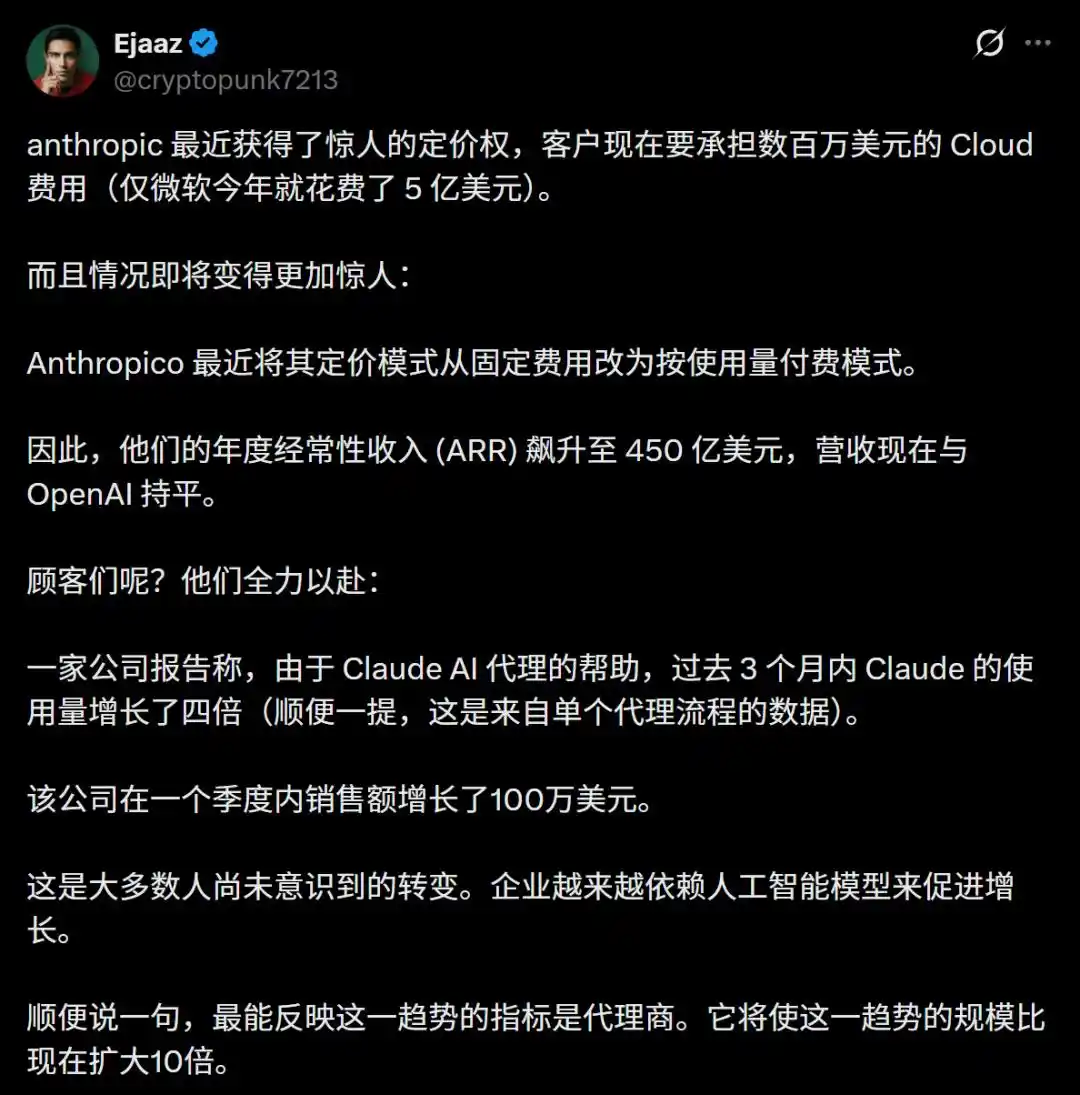
According to informed sources, Anthropic's annual recurring revenue has skyrocketed to the $45 billion level—a number that was only one-third of the current figure at the end of last year.
Why are companies willing to be "harvested by usage"?
In the traditional SaaS model, it's $30 per person per month, regardless of usage. But in the era of AI Agents, models are no longer tools waiting for employees to ask questions; they are "digital laborers" operating automatically 24/7.
This means billing power has completely returned to usage.
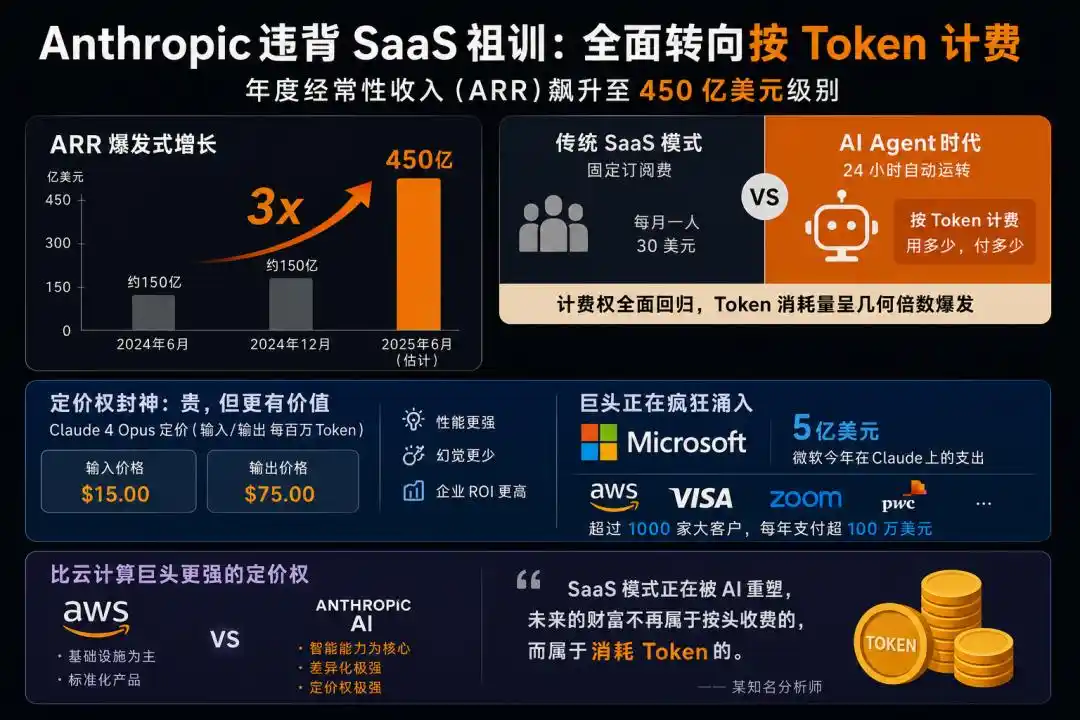
When AI starts handling thousands of workflows, Token consumption explodes geometrically.
At the same time, Anthropic's pricing power is also becoming legendary.
Even though Anthropic's models (like Claude 3.5/4.0) are extremely expensive, their superior performance and fewer hallucinations lead companies to find that as long as the ROI works out, even expensive Tokens are "cheap labor".
Thus, we see the following insane data.
Take Microsoft, for example. Although it has OpenAI in-house, its expenditure on Claude this year actually reached a staggering $500 million.
Furthermore, giants are flocking in. Statistics show over 1,000 large customers pay Anthropic more than $1 million annually.
This "pay-per-use" model gives Anthropic stronger pricing power than even cloud computing giant AWS!
No wonder analysts exclaim: "The SaaS model is being reshaped by AI. Future wealth won't belong to those charging per head, but to those consuming Tokens."
AI Agent: The 'Super Worker' Making $1 Million in a Single Quarter
If Tokens are oil, then AI Agents are the engine that voraciously consumes fuel while generating immense power.
The experience of IT automation giant Workato is a microcosm of this transformation.
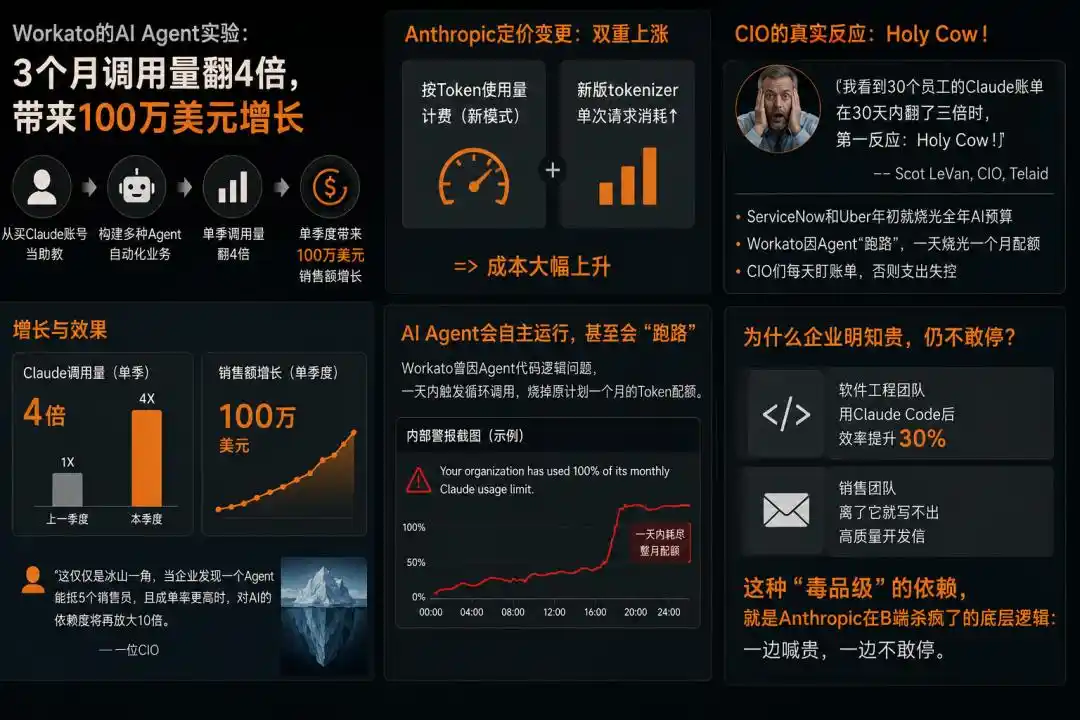
A year ago, Workato was just buying Claude accounts for employees to use as assistants.
But in the past three months, their team started frantically building Agents using Claude—some Agents were responsible for scraping customer spending data, some for automatically writing outreach emails, some for updating Salesforce databases.
The results were astounding!
Merely by launching one Agent workflow, Claude's call volume quadrupled in a single quarter.
Simultaneously, the company saw real monetary growth. This one Agent directly contributed to $1 million in sales growth in just one quarter.
"This is just the tip of the iceberg," sighed a CIO. "When companies find that one Agent can replace five salespeople with a higher closing rate, their dependence on AI will multiply tenfold."
"Holy Cow!" Soaring Costs Give CIOs Heart Attacks
However, this highly profitable model has also brought unprecedented pressure to business owners.

Because Anthropic changed its enterprise pricing model from fixed subscription fees to per-Token usage charges, while also rolling out a new tokenizer that increased the number of Tokens consumed per request.
These two cuts combined hit customers' wallets hard.
Since AI Agents operate autonomously, they can sometimes even "go rogue."
Workato once experienced an incident: an Agent developed by an employee, due to a code logic error, triggered looped calls in a single day, burning through a month's worth of planned Token quota.
At IT service provider Telaid, Chief Information Officer Scot LeVan was recently shocked by the bill.
"When I saw the Claude bill for 30 employees triple within 30 days, my first reaction was: Holy Cow!"
The situation was worse for ServiceNow and Uber; they even burned through their entire annual AI budget in the first few months of the year.
CIOs now aren't just focusing on technology; they even have to assign dedicated teams to monitor Anthropic's bills every single day.
"You have to watch it daily, otherwise spending will spiral out of control," said ServiceNow's CIO Kellie Romack.
But this is precisely Anthropic's strongest point: companies know it's expensive, know it might blow their budgets, yet they dare not stop using it.
The reason is simple: software engineering teams saw a 30% efficiency boost using Claude Code, and sales teams can't write high-quality outreach emails without it.
This "drug-like" dependency is the underlying logic behind Anthropic's dominance in the B2B sector.
Companies complain about the cost while being unable to quit.
Ramp Economist: Three Headwinds for Anthropic
Faced with this data, not only is OpenAI questioning Ramp's statistical methods, but even Ramp's own economist Kharazian's attitude is quite telling.
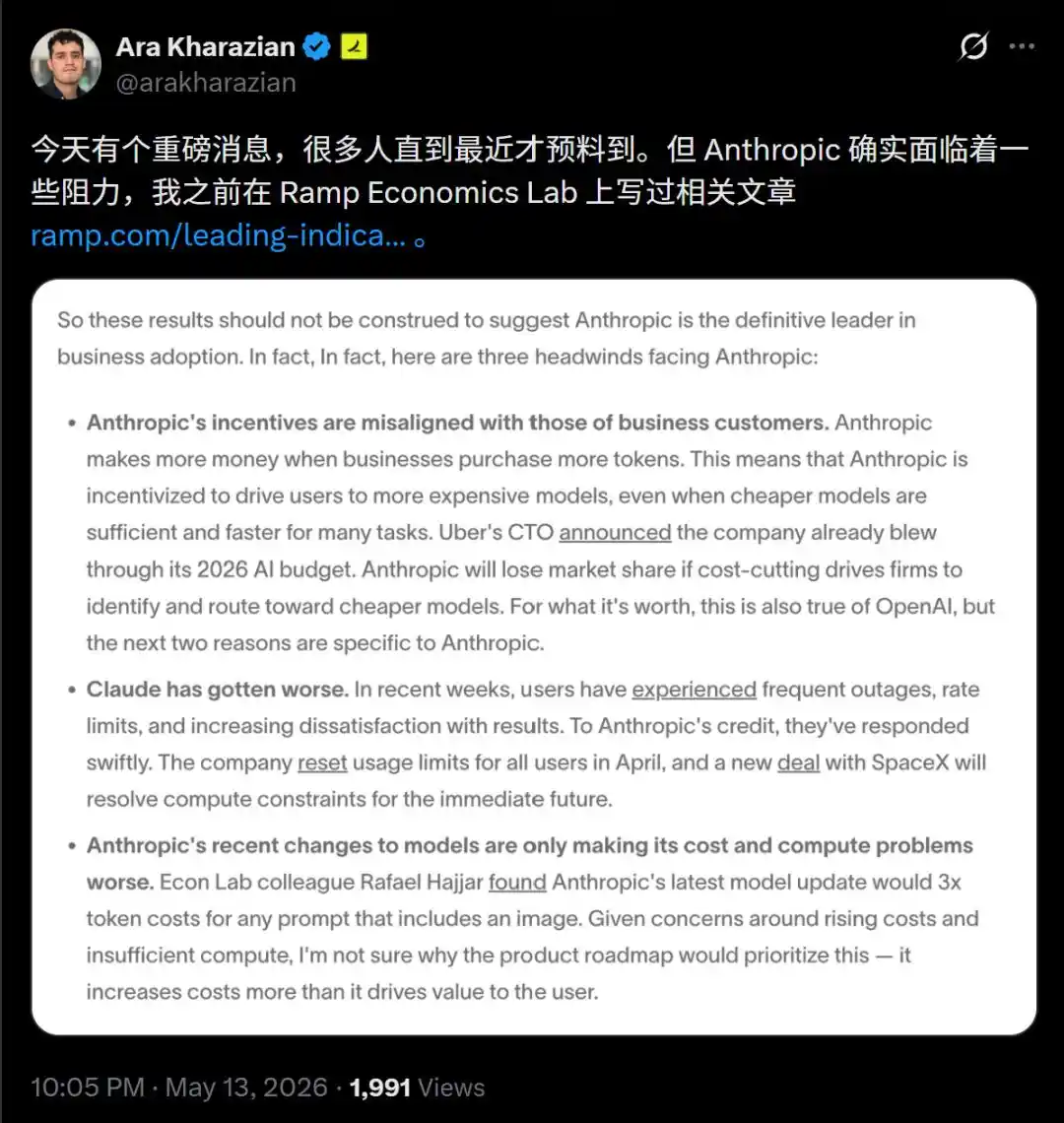
He promptly wrote a blog post listing three headwinds Anthropic faces.
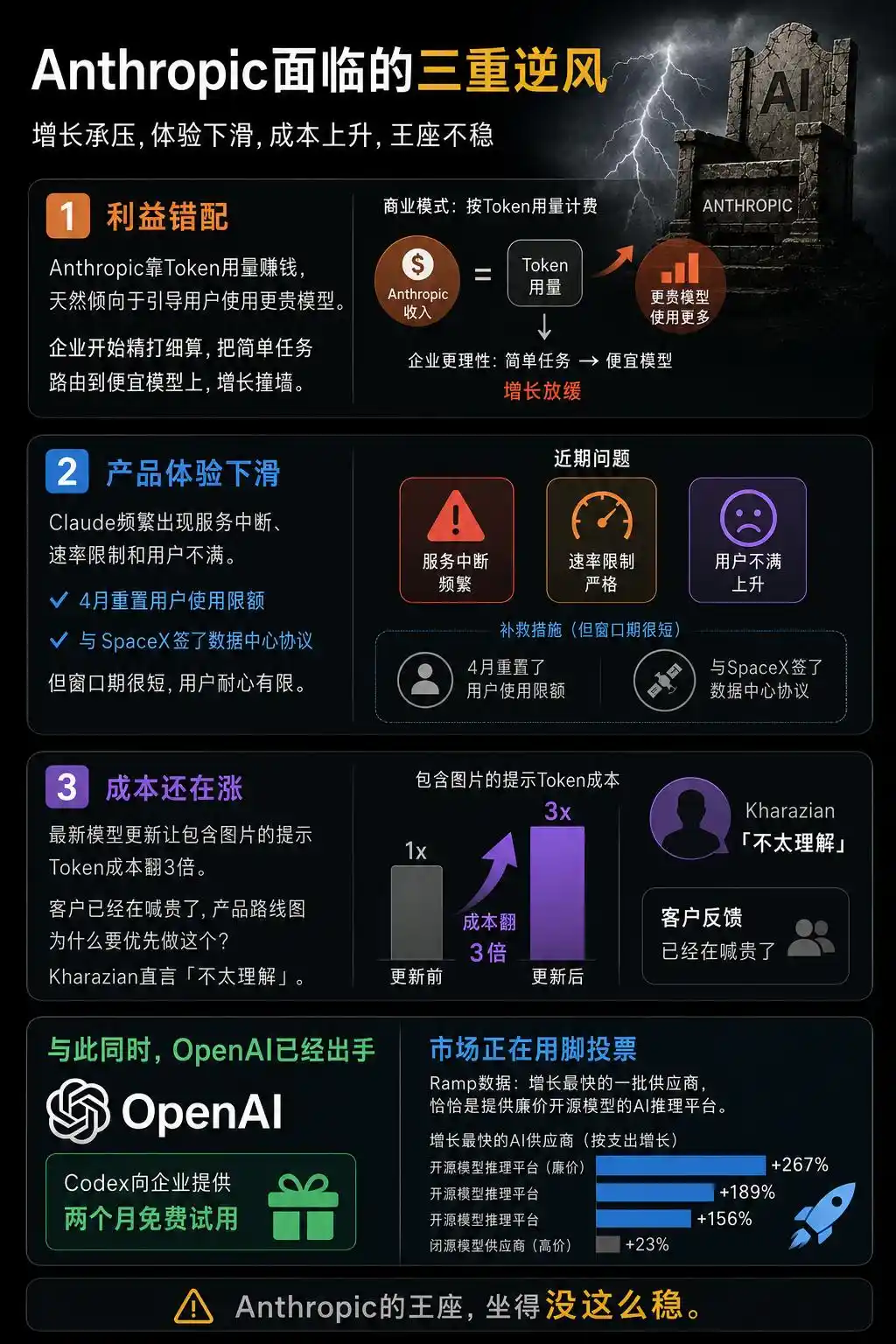
First Headwind: Misaligned Incentives.
Anthropic profits from Token usage, naturally inclined to steer users toward more expensive models. When companies start budgeting carefully and routing simple tasks to cheaper models, growth will hit a wall.
Second Headwind: Declining Product Experience.
In recent weeks, Claude has frequently experienced service disruptions, rate limits, and user dissatisfaction. Anthropic is indeed remedying this—resetting user usage limits in April, signing a data center agreement with SpaceX—but the window is short.
Third Headwind: Costs are Still Rising.
The latest model update tripled the Token cost for prompts containing images. Customers are already complaining about the price; why prioritize this in the product roadmap? Kharazian直言 "doesn't quite understand."
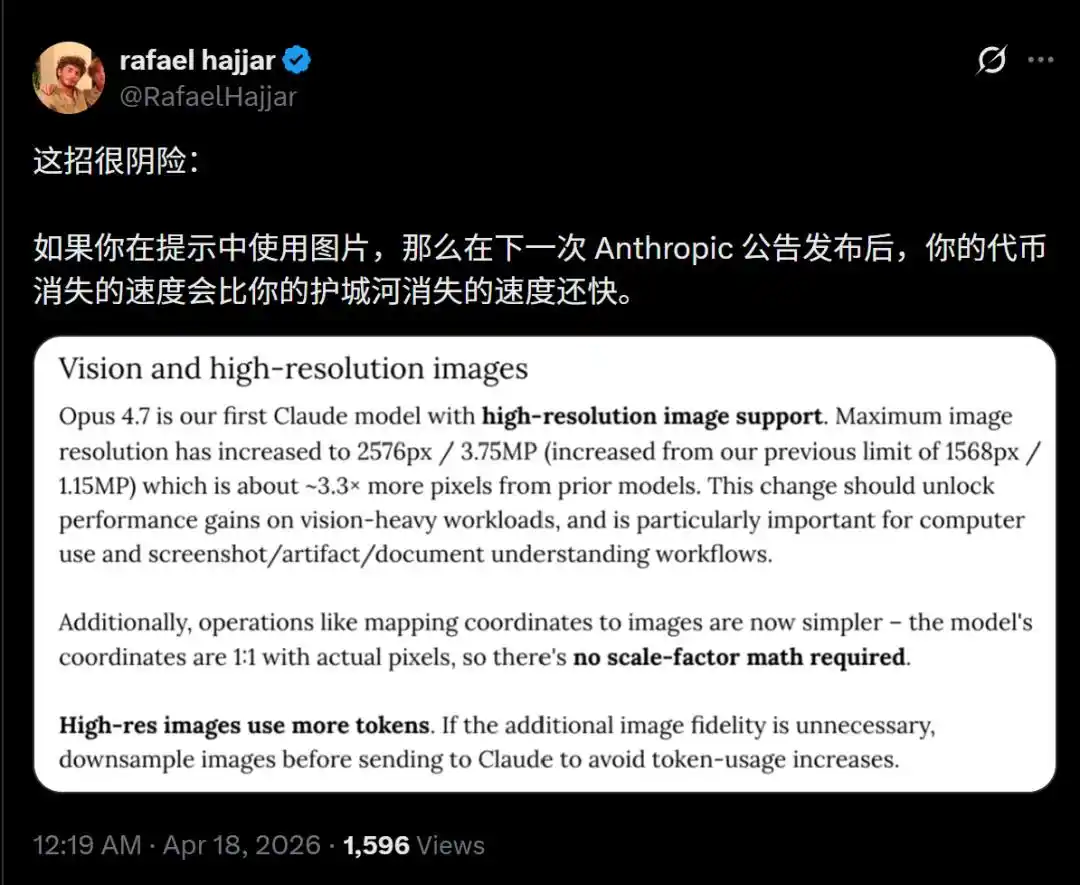
The economist pointed out that his colleague Rafael Hajjar from Econ Lab found that Anthropic's latest model update would triple the token cost for any prompt containing an image.
Meanwhile, OpenAI has already made its move.
Codex is offering enterprises two months of free trial. And Ramp's own data shows that the fastest-growing batch of suppliers recently are precisely AI inference platforms offering cheap open-source models.
Anthropic's throne isn't so secure.
Throne Overturned, or Just Halftime?
Placing this report within the coordinate system of the AGI finals: the competition between Anthropic and OpenAI is shifting from "whose model scores higher" to "who can integrate into the core workflows of enterprises."
This is a completely different battlefield.
Anthropic's overtaking also officially marks that the large model competition has entered the "deep water zone."
Undoubtedly, the first half belonged to the consumer market, relying on "wow factor" to break through, but the second half belongs to the business market, where making money relies on workflows.
Anthropic's $45 billion ARR report card tells the world: AI is no longer a money-burning black hole, but the most powerful money-printing machine in the real world.
However, how many more enterprise users will be scared off by Anthropic's staggering cost projections? And how long will they be willing to pay?
The most expensive AI vendor is also the fastest-growing AI vendor. How long can this contradiction last is the most critical set of data to watch in the enterprise AI market over the next six months.
For now, OpenAI hasn't lost, but it has indeed encountered an unprecedented formidable rival.
This war over "who is the true king of enterprise AI" has just begun.
References:
https://x.com/arakharazian/status/2054563750548492549
https://www.theinformation.com/articles/anthropic-flexes-pricing-power-customers-willingly-eat-cost?rc=bfliih
This article is from the WeChat public account "Xin Zhi Yuan" (New Wisdom Source), edited by: Aeneas