Altcoin market falls from $100B to $26.5B in volume – Can demand recover?

ambcryptoPubblicato 2026-03-21Pubblicato ultima volta 2026-03-21

Introduzione

Altcoin trading volume has sharply declined from peaks above $100 billion to approximately $26.5 billion, indicating a significant contraction in market activity and reduced risk appetite. Binance currently processes nearly 40% of this volume, with other exchanges handling the remainder. The market has entered a capitulation phase, with nearly 40% of altcoins trading near all-time lows, reflecting broad-based deterioration rather than isolated declines. Capital is rotating towards Bitcoin as a safer asset, leading to thinner liquidity and accelerated price declines in altcoins. However, such extreme conditions suggest selling pressure may be nearing exhaustion. Market structure shows stress without full capitulation, with limited liquidations and controlled selling pressure. The Futures-to-Spot ratio on Binance has reached a 1.5-year high, indicating derivatives activity is outpacing spot demand—a sign of fragile market balance. If spot demand fails to recover, the market could face renewed volatility, though current conditions may eventually favor accumulation if liquidity returns to undervalued altcoins.

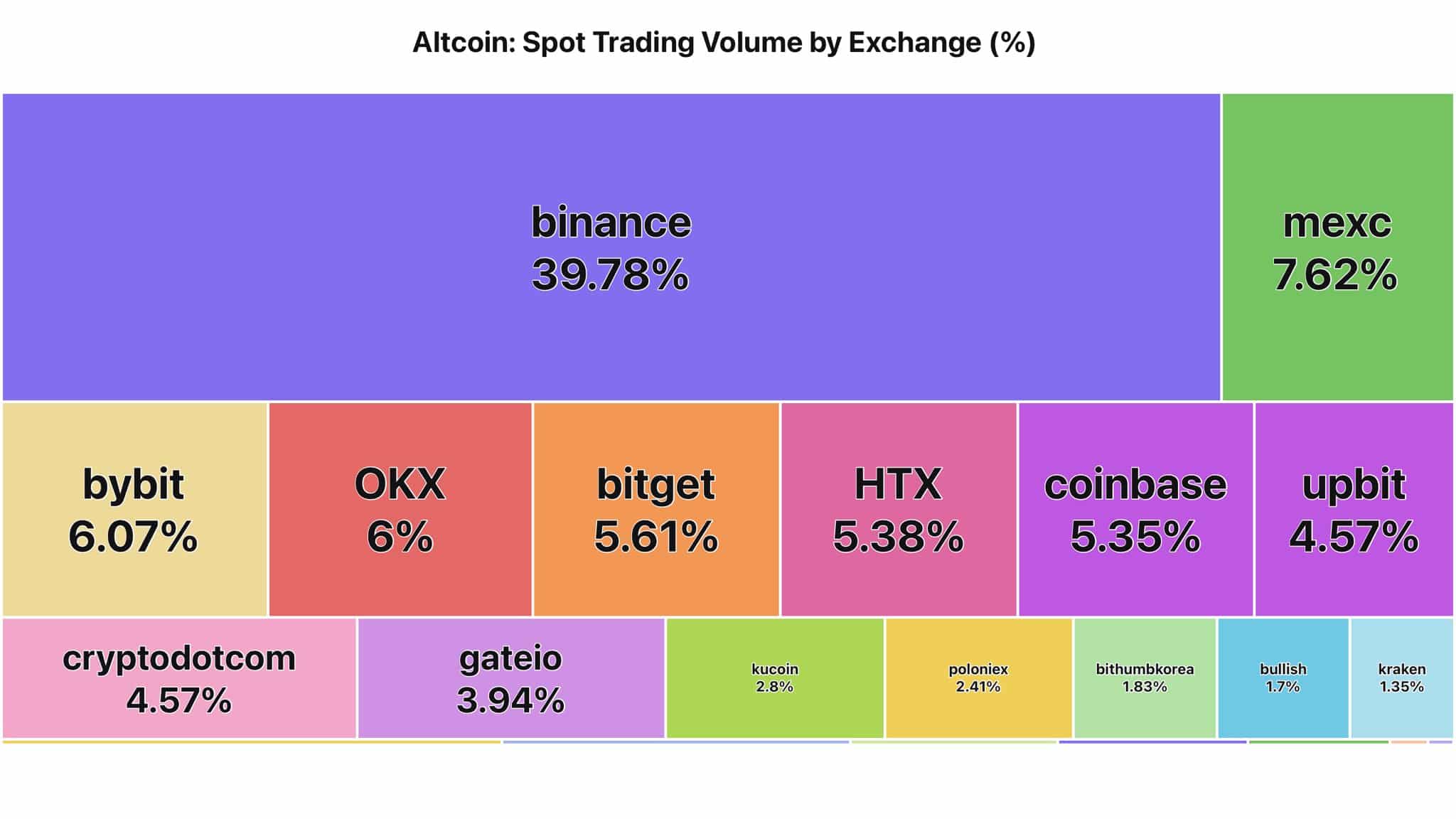
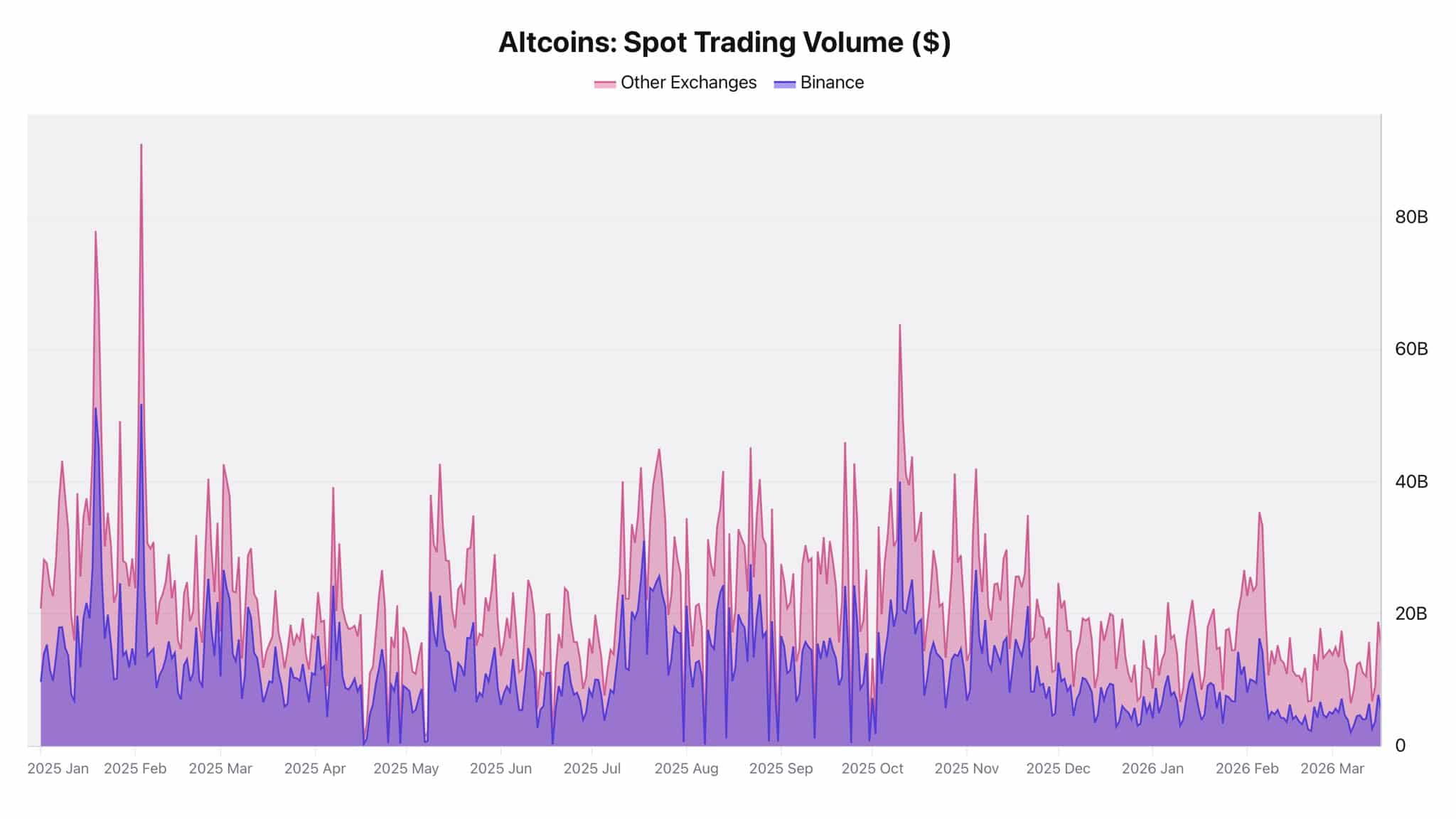
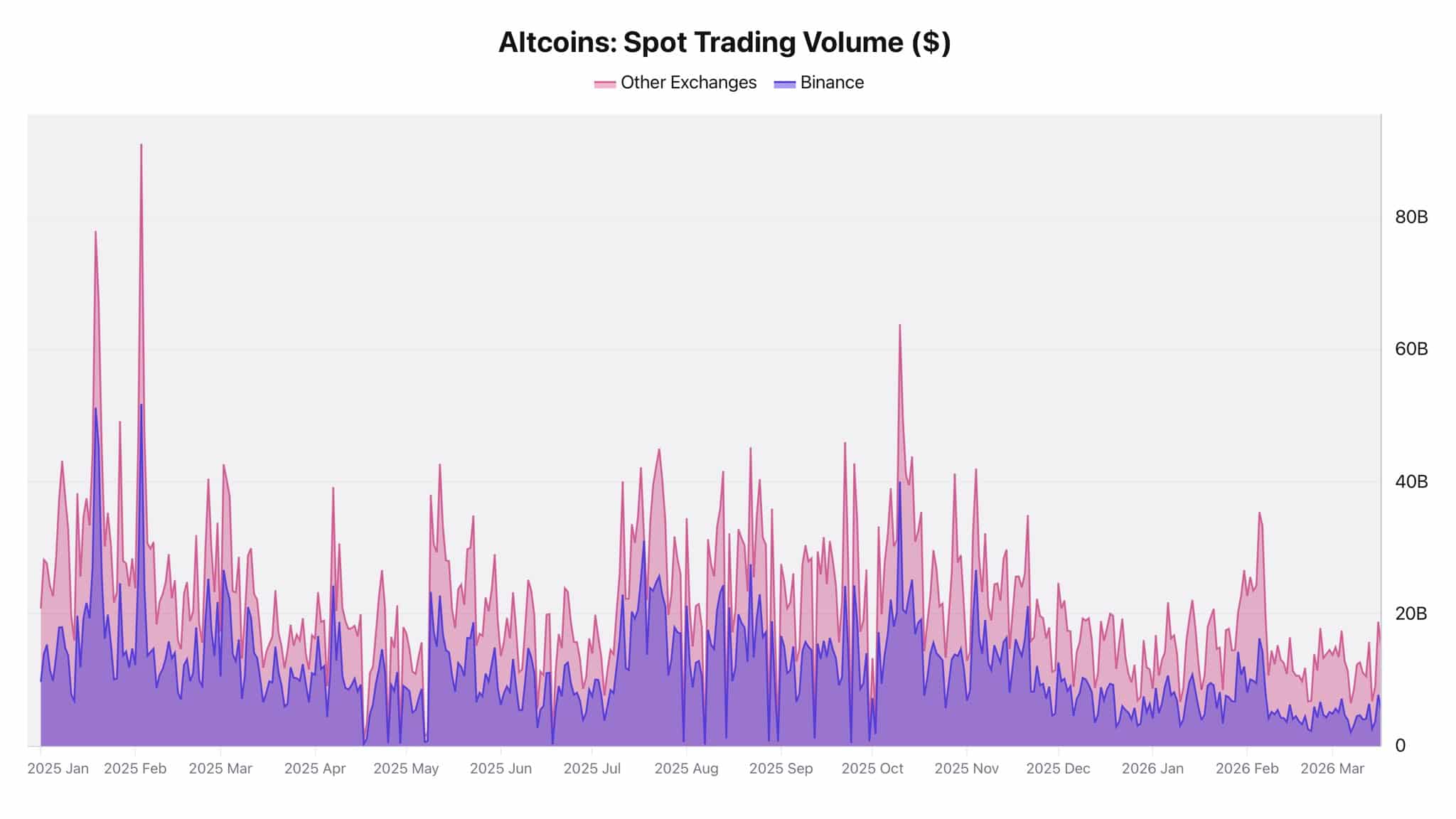
Altcoin trading volume has dropped towards $26.5 billion from peaks above $100 billion, showing a sharp contraction in activity. As this decline unfolded, Binance processed about $7.7 billion. All while other exchanges handled roughly $18.8 billion – Confirming broad-based weakness.
Source: CryptoQuant

In relative terms, Binance holds nearly a 40% share right now, with the same rising as overall participation shrinks. Earlier peaks in February and October 2025 saw volumes surge to $40–50 billion on Binance and up to $91 billion elsewhere, marking periods of strong demand.

As volumes fall across all venues, participation weakens across pairs and trade sizes, pointing to reduced risk appetite.
Source: CryptoQuant

However, this also means capital is stepping back rather than exiting entirely. As engagement compresses, volatility often declines, although such phases can precede renewed positioning once sentiment stabilizes and liquidity begins returning.
Altcoins enter capitulation zone as liquidity rotates to Bitcoin

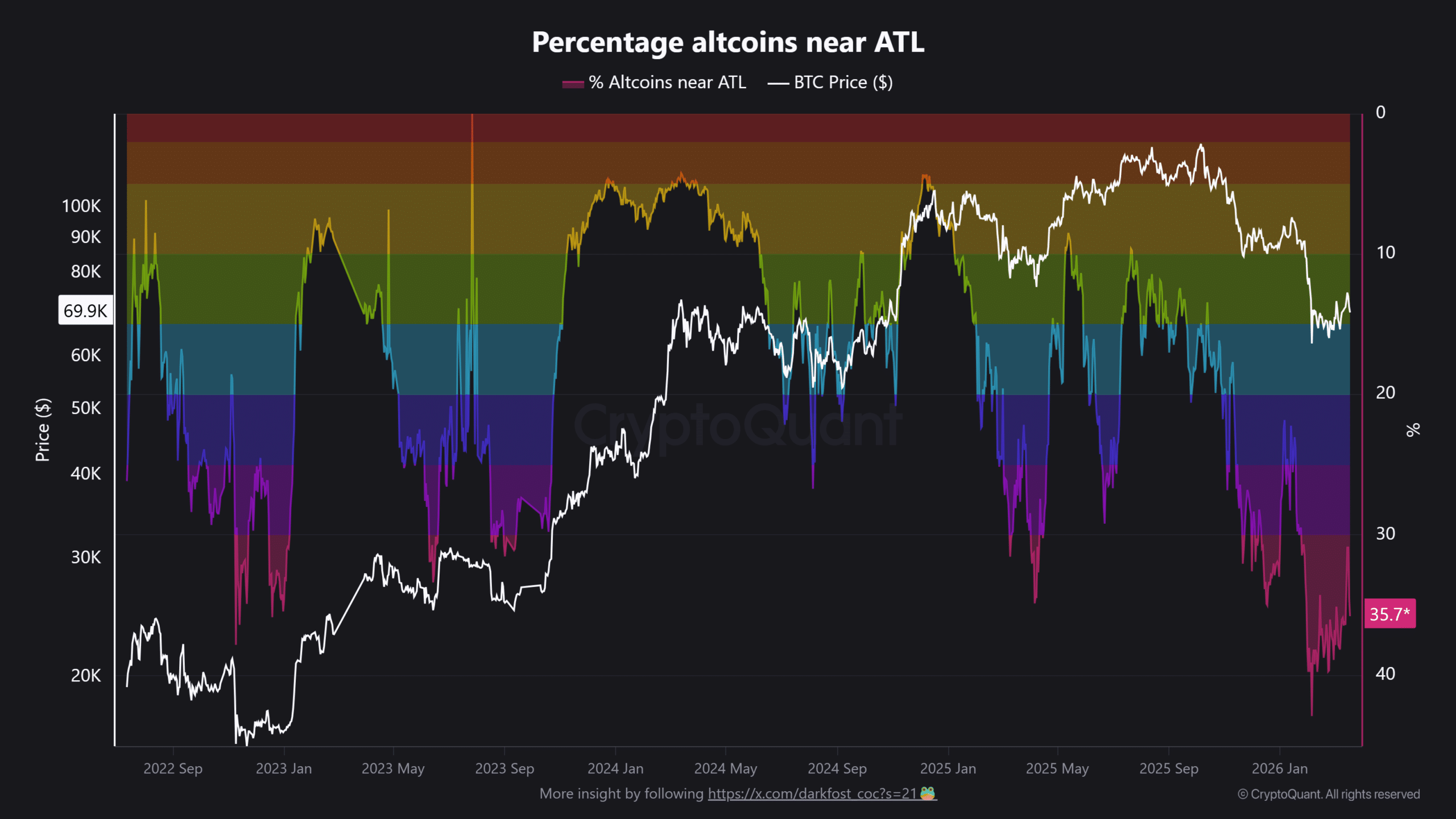
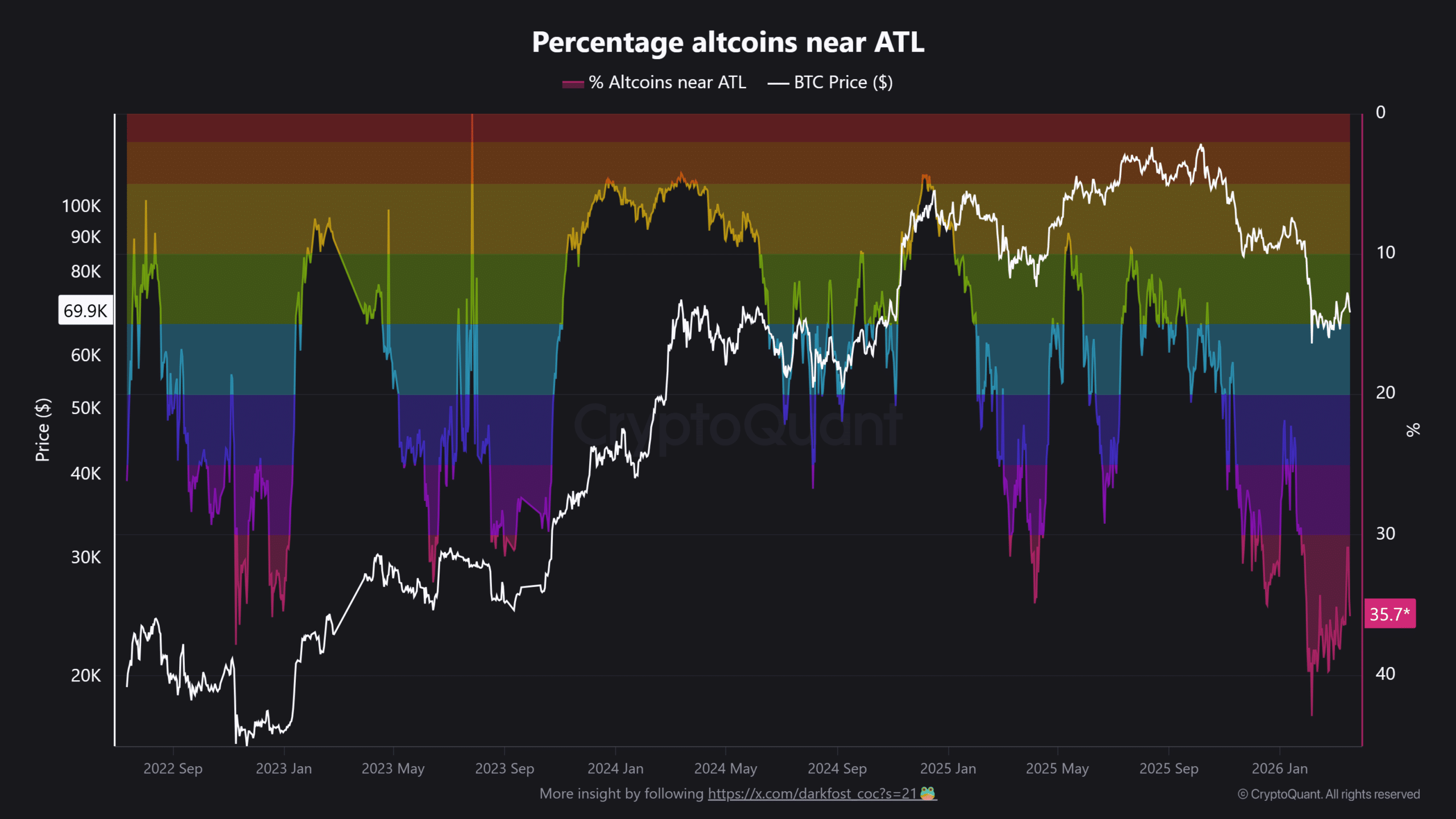
Altcoin weakness deepened as nearly 38–40% of assets traded near all-time lows, pushing the market into clear capitulation territory. As this level rises, it would reflect broad deterioration rather than isolated declines.

Source: CryptoQuant

At the same time, Bitcoin has held on relatively stronger, highlighting a widening divergence between major and risk assets. This shift signals liquidity rotation, where capital moves into Bitcoin for safety while exiting altcoins. As funds leave, altcoins face thinner liquidity and reduced demand, which accelerates price declines.

However, such extreme readings also mean that selling pressure may be nearing exhaustion. Meanwhile, participants reduce risk exposure, favoring preservation over speculation.

Such a structure implies a fragile market, one where downside risks remain. However, conditions may begin to favor accumulation if liquidity gradually returns to undervalued altcoins.

Market holds near capitulation as derivatives outpace spot demand

Finally, market structure revealed stress building without full capitulation, as Bitcoin [BTC] Short-Term Holder SOPR held near 0.98, reflecting realized losses around -12%. Since 2023, similar levels have often preceded deeper resets. And yet, press time selling appeared to be more controlled rather than aggressive.

Source: CryptoQuant

Consequently, liquidations have stayed subdued at $234 million, with $127 million in longs – Indicative of limited forced exits.

However, liquidity quality weakened as Binance’s Futures-to-Spot ratio climbed to a 1.5-year high. Such a shift showed derivatives activity expanding faster than spot demand.This divergence also hinted at a fragile balance, one where markets may either stabilize or face renewed volatility if spot demand fails to strengthen.


Final Summary

  • Altcoin market showed weakening demand as volumes fell to $26.5 billion and nearly 40% traded near lows, reflecting reduced risk appetite.
  • Altcoins now face thinning liquidity and sell-side pressure as capital rotates to Bitcoin [BTC], although conditions may begin favoring accumulation if demand returns.

Domande pertinenti

QWhat has happened to the altcoin trading volume according to the article?

AAltcoin trading volume has sharply contracted, dropping to $26.5 billion from peaks above $100 billion.

QWhich exchange processed the largest share of altcoin trades during this decline?

ABinance processed the largest share, handling about $7.7 billion, which represents nearly 40% of the market.

QWhat does the decline in altcoin volume and the performance of Bitcoin indicate about market behavior?

AIt indicates a liquidity rotation where capital is moving into Bitcoin for safety while exiting altcoins, reflecting reduced risk appetite and a preference for preservation over speculation.

QWhat does the high Futures-to-Spot ratio on Binance suggest about the current market dynamics?

AThe high ratio, which reached a 1.5-year high, suggests that derivatives activity is expanding faster than spot demand, indicating a fragile balance that could lead to renewed volatility if spot demand doesn't strengthen.

QAccording to the article, what might the current market conditions potentially favor in the future?

AThe current conditions may begin to favor accumulation if liquidity gradually returns to undervalued altcoins, as extreme selling pressure could be nearing exhaustion.

Letture associate

Within Strategy's Framework, STRC's Dividend Yield Remains at 12% as Share Price Stays Below Par Value

Michael Saylor, Executive Chairman of Strategy (MSTR), confirmed that the dividend rate for its STRC perpetual preferred shares will remain at 12.00% through August 2026. The rate has increased from 9% at its July 2025 launch to the current high via a "ratchet" mechanism, which permanently raises the rate by 0.5% whenever the share price falls below $95. This mechanism is intended to push the price back toward its $100 par value and support Strategy's "at-the-market" (ATM) program for issuing new shares to fund Bitcoin purchases. However, the mechanism has not worked as intended. STRC shares closed at $89.46 on July 31, remaining about 10-11% below par value despite the record-high dividend. Competition from rival Strive's higher-yielding SATA securities has pressured demand. The persistent discount has forced Strategy to suspend new STRC issuances via its ATM program, limiting this funding channel for Bitcoin acquisitions. STRC's struggles reflect Bitcoin's own volatility, as the preferred shares historically move in tandem. Analysts have warned the ratchet structure carries long-term, one-way risk. A law firm is investigating Strategy's ability to maintain dividend payments if Bitcoin's price stays low. Retail investors own roughly 83% of outstanding STRC shares, a group seen as prone to panic selling during downturns. In response, Strategy has established financial reserves, including a liquidity cushion covering about 26 months of dividend/interest obligations, and a $2 billion share buyback program alongside a Bitcoin monetization framework, though the company emphasized it is not obligated to sell any Bitcoin.

cryptonews.ru40 min fa

Within Strategy's Framework, STRC's Dividend Yield Remains at 12% as Share Price Stays Below Par Value

cryptonews.ru40 min fa

Analyst: Bitcoin's Price Will Drop to $60k in August, Then Rebound to $70k

Financial analyst Andrey Poroshin has provided a new forecast for Bitcoin's price dynamics in August. Poroshin, an analyst at the Bitbanker exchange, expects the cryptocurrency market to experience a downturn this month, with prices retesting the $60,000 level due to a lack of supportive macroeconomic catalysts. He noted that the recent US Federal Reserve decision to hold interest rates did not significantly impact the market, while inflation remains above the 2% target. Poroshin stated that Bitcoin is ending July under pressure from moderate volatility and a lack of new macroeconomic stimuli, leading to continued market caution. According to his base scenario, Bitcoin will drop to a range of $60,000 to $62,000 before recovering to $70,000. He pointed out that even $70,000 remains below the cost of mining in the US, which has prompted some miners to shift towards AI data center operations. Poroshin cited the winding down of BitMEX's operations as a potential catalyst for a price rebound, suggesting the exit of weaker players often coincides with market reversals and reduced short-term selling pressure. He believes Bitcoin is currently less susceptible to geopolitical shocks, such as the Iran-US conflict, and does not expect significant market changes in August related to the pending CLARITY Act. Looking ahead, Poroshin forecasts that September will bring more active price fluctuations driven by potential Fed rate decisions and possible discussions or approval of the CLARITY Act.

cryptonews.ru40 min fa

Analyst: Bitcoin's Price Will Drop to $60k in August, Then Rebound to $70k

cryptonews.ru40 min fa

Trading

Spot
活动图片