All about Revolut moving $1.2B on Polygon and if that makes it faster than SWIFT

ambcryptoPubblicato 2026-03-28Pubblicato ultima volta 2026-03-28

Introduzione

Digital banking giant Revolut has processed over $1.2 billion in stablecoin transfers on the Polygon network, demonstrating blockchain's growing role in mainstream finance. These transactions settled in seconds with total fees under $700, showcasing significant cost and efficiency advantages over traditional systems like SWIFT, which can take days and involve high intermediary fees. Polygon's low transaction costs—up to 426x cheaper than Ethereum—make it an attractive infrastructure for institutional payments. This milestone signals a structural shift toward blockchain-based settlements, with stablecoins enabling near-instant, low-cost, and transparent cross-border transactions.

Across the Internet and socials, there has been a heated debate between traditional finance and blockchain. However, as it stands, most investors and institutions are now accepting blockchain as an equal competitor.

Just recently, digital banking giant Revolut crossed a major milestone, processing over $1.2 billion in stablecoin transfers on the Polygon network. The figure reflects real user activity, not test flows, while highlighting how blockchain rails are quietly entering mainstream finance.

In fact, according to Polygon’s official report, these transactions settled in seconds and cost fractions of a cent, making them significantly cheaper than legacy systems.

Why are institutions choosing Polygon?

The economics behind this shift are hard to ignore. Revolut reportedly processed the entire $1.2 billion volume for less than $700 in total fees, demonstrating the scale advantage of blockchain-based settlements.

Polygon consistently offers the lowest transaction costs among major chains – Up to 426x cheaper than Ethereum and 4x cheaper than Solana in many cases.

For institutions moving large capital, this difference compounds quickly. What would cost millions in traditional infrastructure can now be executed almost instantly at near-zero cost.

Traditional cross-border transfers still lag behind

Despite decades of innovation, traditional cross-border systems remain slow and expensive. Payments routed through correspondent banking networks like SWIFT can take 1–5 business days and involve multiple intermediaries.

Fees are another major drawback. Global remittance costs average around 6.49%, with banks often charging over 14% in some corridors.

On the contrary, Polygon-based transfers eliminate intermediaries, settle in seconds, and offer 1:1 stablecoin conversions with no hidden FX spreads.

A structural shift, not a trend

Revolut’s $1.2 billion milestone is more than a headline. In fact, it’s a proof point. Institutions are no longer experimenting with blockchain; they’re deploying it at scale.

As stablecoin infrastructure matures, networks like Polygon are positioning themselves as the back end for global money movement – Faster, cheaper and increasingly invisible to the end user.

Polygon’s network token is benefiting from network adoption

On the daily chart, POL seemed to be gaining some traction at press time. This, despite the fact that the token’s prices have been consolidating over the last few weeks.

If the network keeps recording these significant gains, the altcoin’s prices could usher in a potential breakout as long as the demand zone at around $0.095 holds.
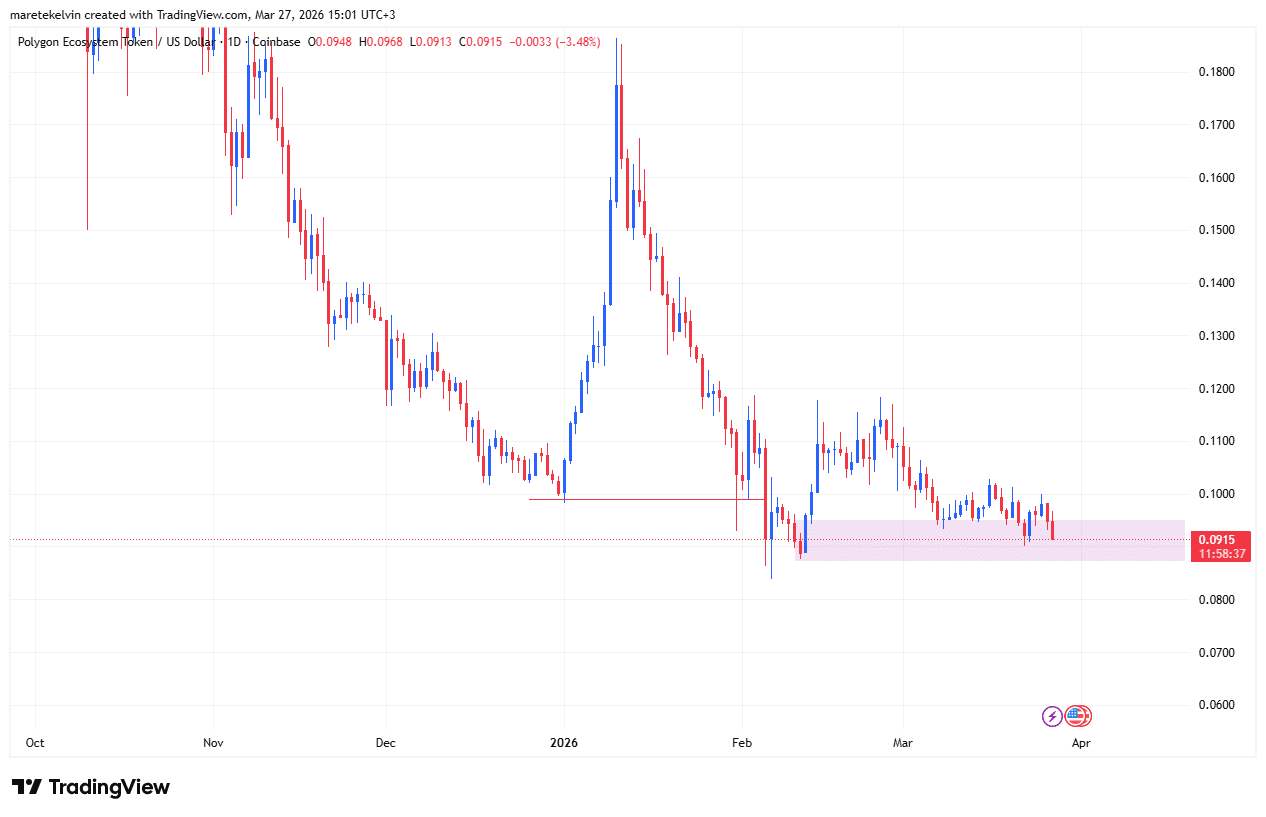
Source: TradingView

Final Summary

  • Blockchain rails like Polygon are proving significantly cheaper and faster than traditional cross-border systems at institutional scale.
  • Revolut’s $1.2B volume signals a structural shift towards stablecoin-powered global payments, rather than a temporary trend.


Domande pertinenti

QWhat major milestone did Revolut achieve on the Polygon network?

ARevolut processed over $1.2 billion in stablecoin transfers on the Polygon network, reflecting real user activity.

QHow do transaction costs on Polygon compare to traditional systems like SWIFT?

APolygon transactions cost fractions of a cent, significantly cheaper than traditional systems. For example, Revolut processed $1.2 billion for less than $700 in total fees, while traditional cross-border transfers average around 6.49% in fees.

QWhat are the advantages of using Polygon for cross-border transfers compared to traditional banking networks?

APolygon-based transfers settle in seconds, eliminate intermediaries, offer 1:1 stablecoin conversions with no hidden FX spreads, and are much cheaper than traditional systems like SWIFT, which can take 1-5 business days and involve multiple intermediaries.

QWhat does Revolut's $1.2 billion volume on Polygon indicate about institutional adoption of blockchain?

AIt signals a structural shift towards stablecoin-powered global payments, showing that institutions are no longer just experimenting with blockchain but are deploying it at scale for faster and cheaper transactions.

QHow has Polygon's network token (POL) been performing according to the article?

AAt the time of writing, POL was gaining some traction despite consolidating over the previous weeks. If network adoption continues, the token's price could potentially break out as long as the demand zone around $0.095 holds.

Letture associate

Codex Goal Mode Usage Guide: How to Make AI Continuously Pursue a Specific Objective

"Codex Goal Mode: How to Make AI Work Continuously Toward a Specific Goal" OpenAI's Codex "goal mode" (/goal) transforms the AI from a reactive code assistant into a proactive execution agent capable of working autonomously for hours or even days to achieve a defined objective. To maximize its effectiveness, follow these key principles: 1. **Define Clear, Verifiable Exit Criteria:** The goal prompt should be a concise, measurable success condition, not a lengthy specification. Use quantifiable metrics like "reduce build time by 30%" or "achieve 100% test parity." 2. **Provide Initial Guidance and Tools:** Direct Codex toward likely problem areas and specify available tools (e.g., browsers, testing environments) to prevent it from exploring unproductive paths. 3. **Enable Progress Measurement:** Equip Codex with ways to track advancement, such as creating comparison tools for visual tasks or evaluation sets, ensuring it can gauge its own progress. 4. **Use a Realistic Execution Environment:** For tasks like performance optimization, provide access to environments that closely mimic production (e.g., similar configs, databases) to yield valid results. 5. **Be Cautious with Visual Goals:** Avoid vague "pixel-perfect" instructions. Instead, supplement visual references with functional checklists or design system specifications to prevent Codex from obsessing over minor details. 6. **Implement Progress Tracking:** For long-running tasks, have Codex commit code to draft PRs, update progress documents, or send Slack updates to maintain visibility into its work. 7. **Review and Consolidate Results:** Once the goal is met, instruct Codex to review its work, clean up ineffective experimental code, and reflect on what strategies succeeded or failed. Ultimately, using goal mode shifts the developer's role from writing prompts to managing a persistent engineering agent—defining objectives, establishing metrics, configuring environments, and conducting final reviews.

marsbit14 min fa

Codex Goal Mode Usage Guide: How to Make AI Continuously Pursue a Specific Objective

marsbit14 min fa

From Ethereum to AI's 'CROPS': What Exactly Is This 'Slow Variable' That Vitalik Has Repeatedly Emphasized?

Recently, Vitalik Buterin has frequently emphasized the concept of "CROPS," first outlined in the Ethereum Foundation's March mandate as core principles guiding its focus: Censorship Resistance, Capture Resistance, Open Source, Privacy, and Security. CROPS represents Ethereum's commitment to providing foundational capabilities for user sovereignty—enabling asset ownership, identity expression, and coordination without reliance on centralized platforms or surrendering ultimate control. This framework is gaining new urgency with the rise of AI, particularly AI agents managing digital assets and automating transactions. While AI offers convenience, it risks centralizing user data, intent, and control if dependent on opaque, centralized services. Vitalik argues for "CROPS AI"—AI that is open, privacy-preserving, secure, and capable of local execution to maintain user agency. He highlights convergence between "CROPS Ethereum access layers" and "CROPS AI," such as using zero-knowledge proofs for private remote LLM calls and Ethereum RPC reads, ensuring users can access services without exposing sensitive information. Ultimately, CROPS is not just an abstract ideal but a practical guide for Ethereum's development and AI integration. It addresses the critical long-term question: as digital systems grow more powerful, how can users retain control over their privacy, assets, and autonomy? In an AI-driven era, these principles may define Ethereum's enduring value—prioritizing verifiable, secure, and user-centric design over short-term optimizations like speed and cost alone.

marsbit18 min fa

From Ethereum to AI's 'CROPS': What Exactly Is This 'Slow Variable' That Vitalik Has Repeatedly Emphasized?

marsbit18 min fa

Trading

Spot
Futures
活动图片




