Summary
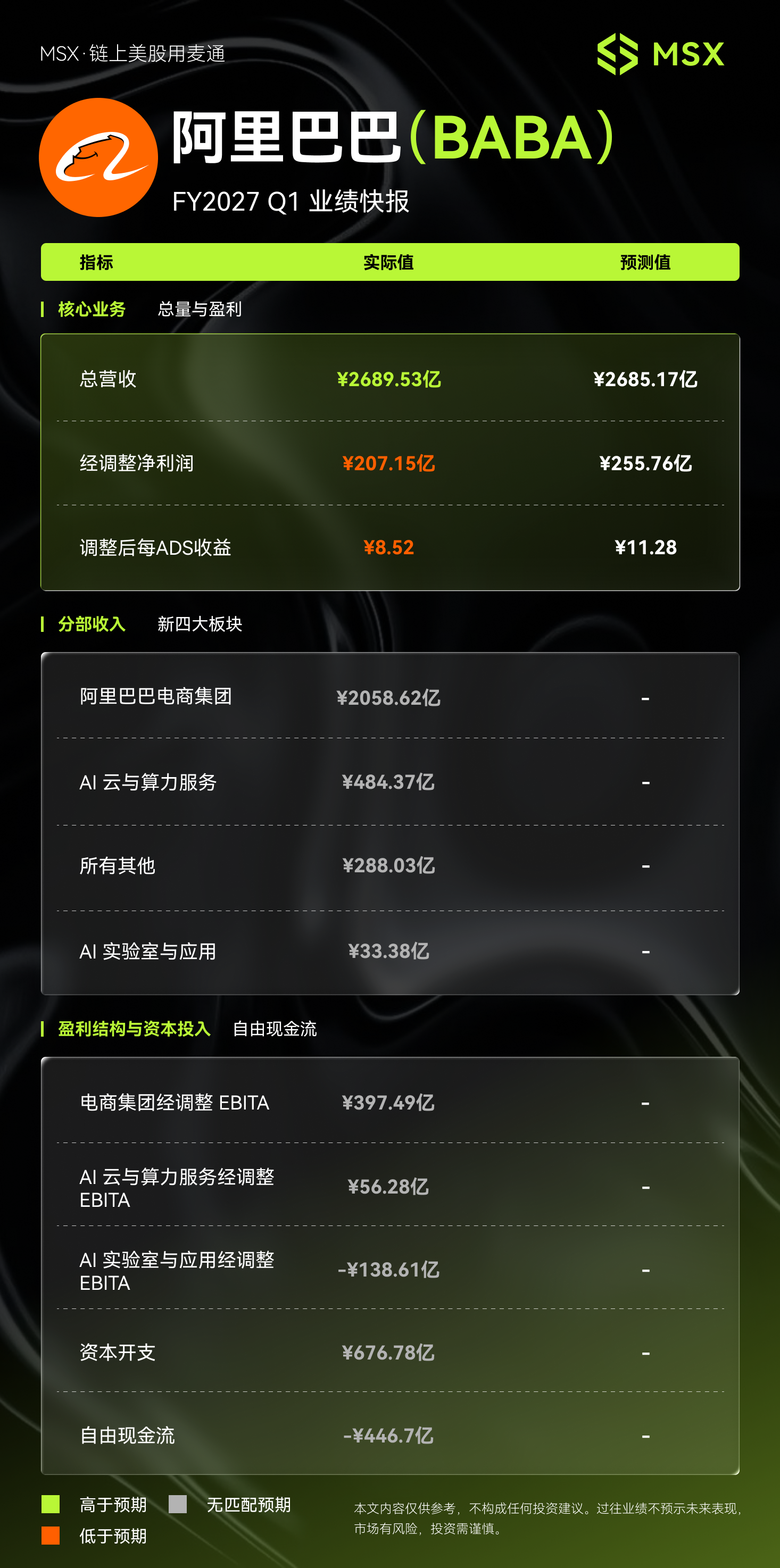
Alibaba's AI and cloud computing services revenue grew 45% year-over-year to 48.4 billion yuan, with AI product revenue maintaining triple-digit growth for the 12th consecutive quarter. Although capital expenditures of 67.68 billion yuan and negative free cash flow depressed short-term profitability, the simultaneous acceleration in customer demand, product revenue, and cloud business scale indicates that Alibaba's AI investments are no longer just expenses but are also starting to generate visible revenue.
If only looking at the approximately 75% drop in net profit, Alibaba's quarterly results would be hard to get excited about. But shifting the focus to the cloud business paints a completely different picture: AI and cloud computing services revenue grew 45% year-over-year to 48.44 billion yuan, becoming the most eye-catching number in the entire earnings report.
The significance of this growth rate is not just "more cloud sales." Alibaba relied on Taobao, Tmall, and other e-commerce businesses for traffic and cash flow for a long time. Now, AI cloud is taking on a new growth mission. It addresses the real needs of enterprises for training models, deploying intelligent agents, calling inference services, and expanding computing power. Its revenue sources are also closer to the growth logic of global tech companies like Microsoft Azure and Google Cloud.
AI Revenue Has Sustained Rapid Growth for 12 Consecutive Quarters
This quarter, Alibaba's AI-related product revenue reached 12.38 billion yuan, marking the 12th consecutive quarter of triple-digit year-over-year growth. Continuity is more important than a single-quarter surge: it indicates that customer AI usage is not a one-time experiment but is gradually transforming into stable computing and model inference demand.
Alibaba is also expanding its product coverage. The Qwen series includes both enterprise-focused model and agent capabilities, as well as lightweight versions that can run on consumer-grade hardware. For enterprise clients, Alibaba can provide a complete solution from chips, computing power, and models to application deployment; for developers, its open-source and open-weight strategy lowers the barrier to experimentation. The more users there are, the easier it is for cloud training, inference, and storage demands to solidify into revenue.
Currently, the Biggest Controversy is the Speed of Investment
Growth does not come without cost. Alibaba's capital expenditures this quarter increased 75% year-over-year to approximately 67.68 billion yuan, with free cash flow showing a net outflow of 44.67 billion yuan. The market initially expressed concern with a drop of nearly 5% at the open: even with strong AI prospects, investing too fast can depress current profits and increase the risk of returns falling short of expectations.
On the other hand, AI infrastructure exhibits clear economies of scale. Once data centers and computing platforms are built, they can serve more enterprises and developers simultaneously. As long as cloud revenue continues its high growth rate, early-stage investments have the opportunity to be diluted by a larger customer base. Citi also noted that with Alibaba's increased disclosure, investors can more clearly see the relationship between AI investments and business progress.
For BABA, the key going forward is not just to continue releasing more powerful models, but to convert model usage into cloud revenue, and to ensure that revenue growth ultimately outpaces cost growth. The 12 consecutive quarters of high AI product growth and this quarter's 45% cloud growth rate at least prove that the first step is already happening. The pressure on short-term profits cannot be ignored, but Alibaba is rewriting the market's valuation approach with an AI business that can be verified by financial numbers.