Algorand: Why THIS signal points to another 10% ALGO drop

ambcryptoPubblicato 2026-04-09Pubblicato ultima volta 2026-04-09

Introduzione

Algorand (ALGO) has declined by 10% in the past day, with technical analysis suggesting further downside. The price was rejected at the upper Bollinger Band, indicating overvaluation, and is now expected to move toward the middle band, implying a potential additional 10% drop. The strengthening downtrend is supported by a rising Average Directional Index (ADX). Futures market activity reinforces the bearish outlook, with over $6.5 million exiting ALGO perpetual contracts and a sharp drop in the Open Interest Weighted Funding Rate, signaling increased short positioning. However, spot investors are accumulating ALGO, with nearly $496,000 in inflows in the past day and $1.98 million over the week, which may cushion further declines or prompt a reversal if sustained.

Algorand [ALGO] recorded a 10% drop over the past day, at press time, as the market adjusted. This move may mark the start of a broader decline, based on technical patterns observed on the chart.

Other factors, particularly activity in the perpetual futures market, are likely to play a major role in adding pressure and extending the current downside.

Bollinger Bands signal further downside

Bollinger Bands, an indicator used to assess whether an asset is overvalued or undervalued while identifying potential support and resistance levels, suggest that further downside may be imminent.

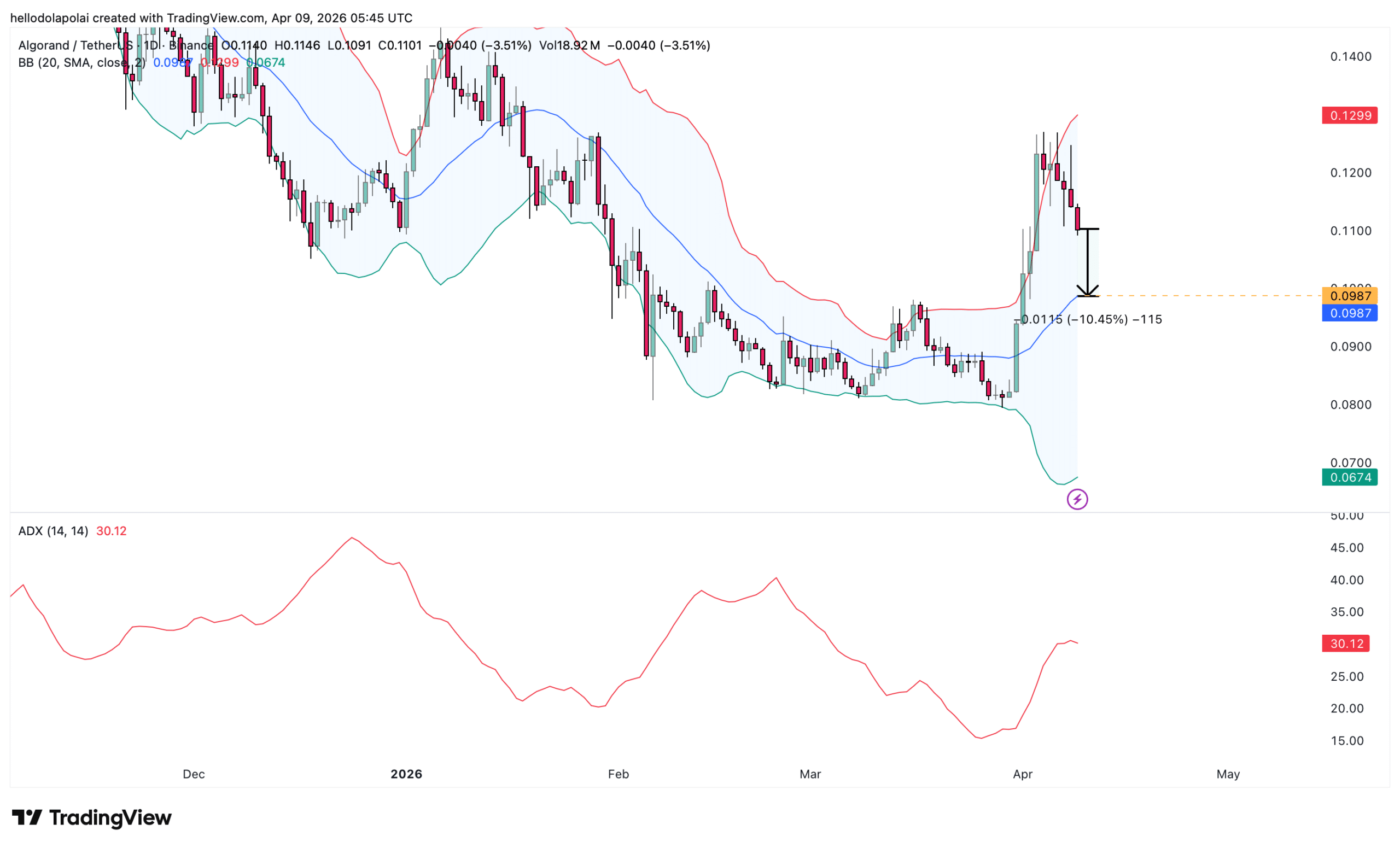
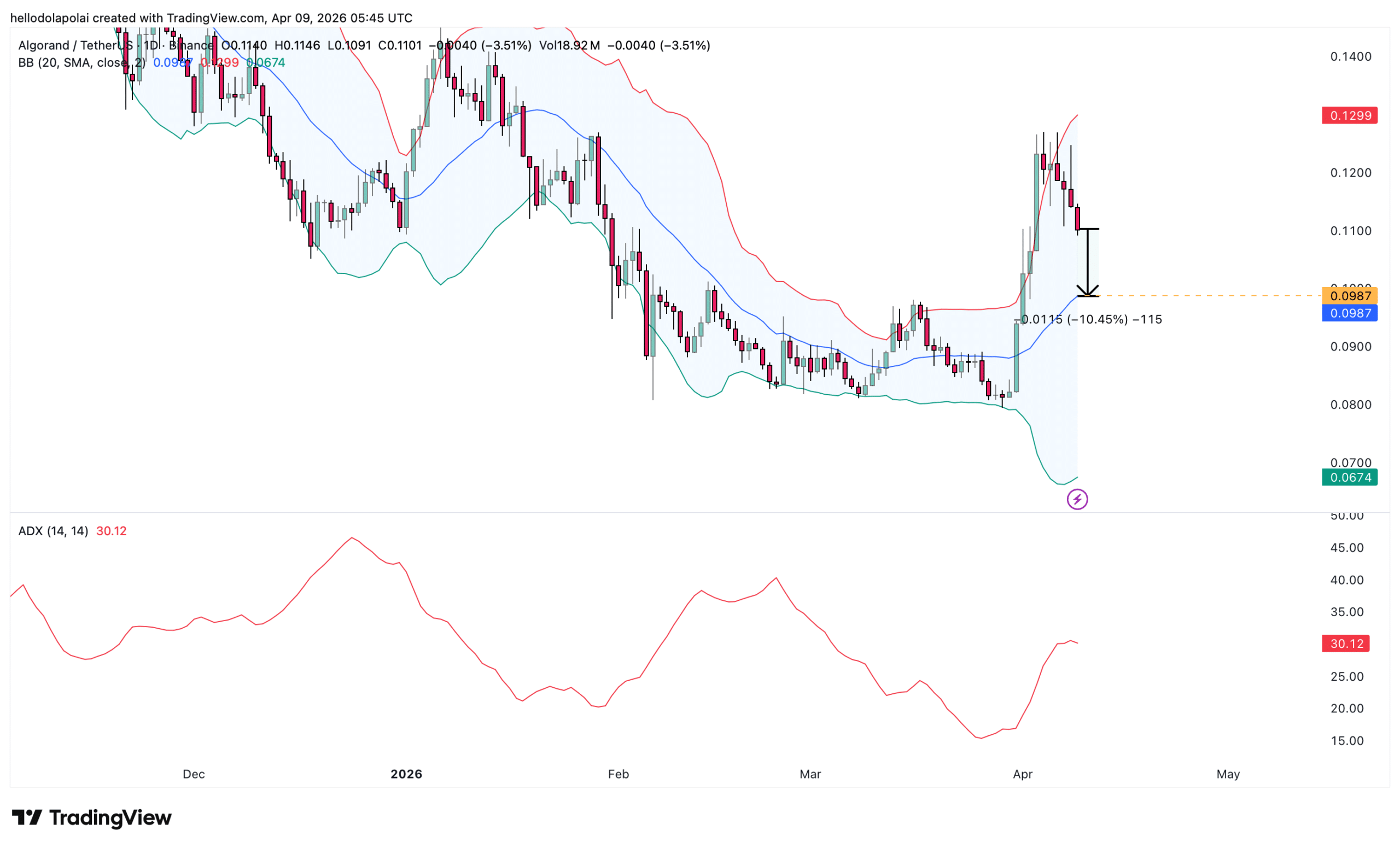
This outlook follows ALGO’s rejection at the upper band (red), which acted as resistance and signaled an overvaluation zone, pushing price lower. Such rejections typically drive price toward the middle band, or neutral zone, marked in blue, as seen on several occasions in the past.
Source: TradingView

Notably, price has yet to approach this middle region. The gap between the current price of $0.677 and the middle band implies a potential additional decline of roughly 10%. The likelihood of continued downside is further supported by the trend-based indicator, the Average Directional Index (ADX), which is trending upward as price moves lower.

ADX measures trend strength. When it rises while price declines, it indicates that the prevailing downtrend is strengthening and may persist.

Futures market adds pressure

Activity in the Futures market has not supported price stability and instead points to an acceleration of the decline.

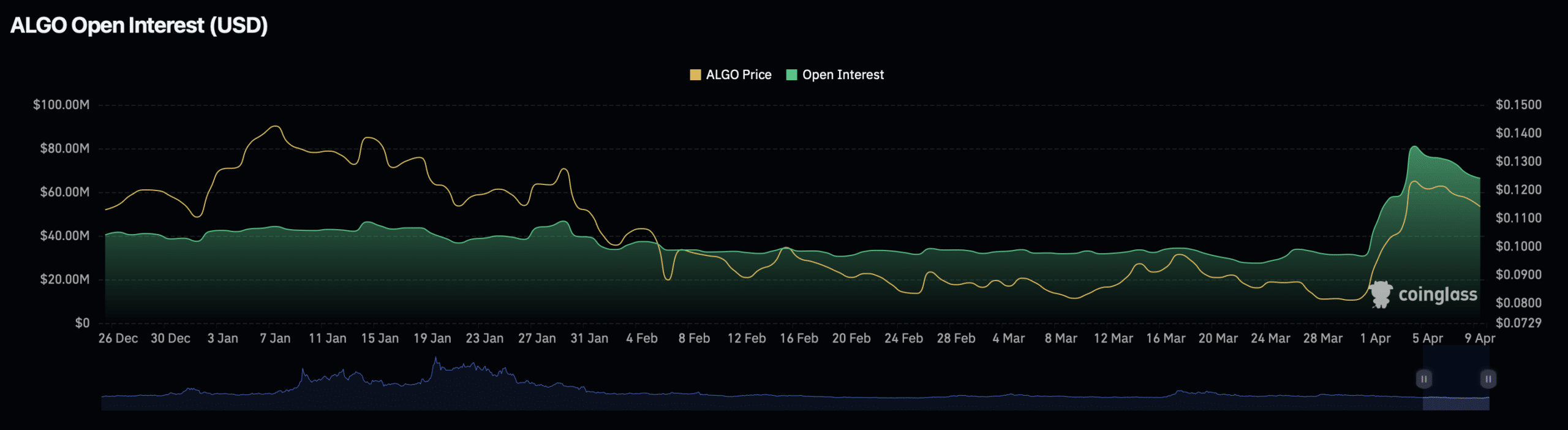
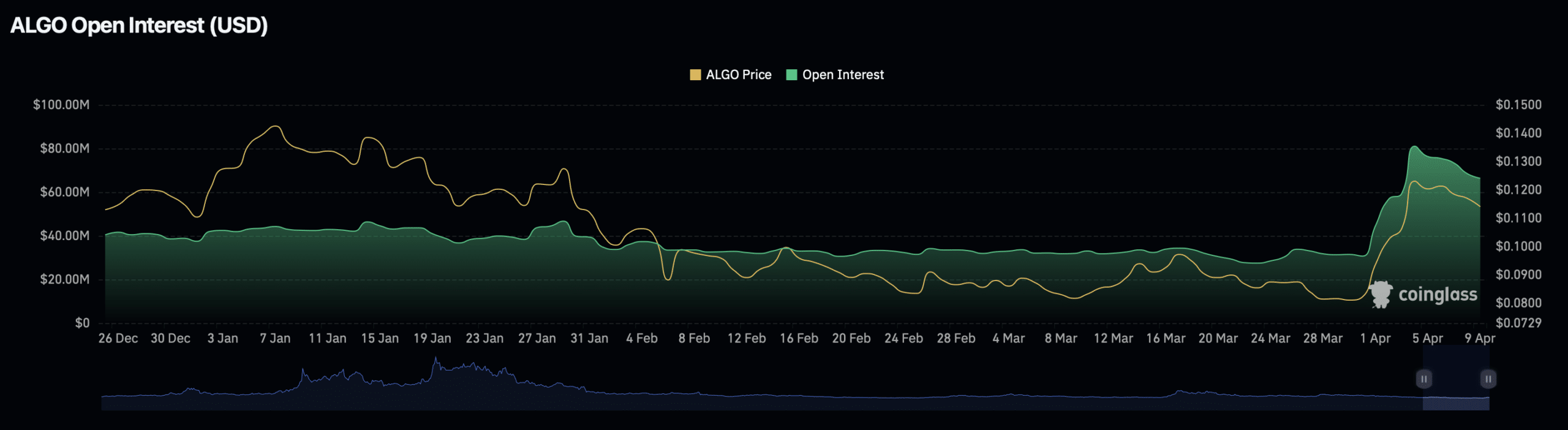
Over the past day, the market has seen a significant capital outflow, with more than $6.5 million exiting ALGO’s perpetual contracts as the broader cycle weakens.
Source: CoinGlass

This outflow aligns with a sharp shift in positioning. At press time, the Open Interest Weighted Funding Rate dropped from 0.0073% to 0.0027% over the past 24 hours, reflecting a decline in long positions. This trend suggests a rise in short positions on ALGO, a typical signal when traders anticipate further downside.

For context, between the 7th and 8th of April, ALGO maintained a bullish outlook. However, short sellers have been proven correct, and the price has fallen over the last 24 hours. Spot investors appear to be the key group mitigating further downside, even as short positions continue to build in the derivatives market.

In the past day alone, the spot market recorded nearly $496,000 in inflows into ALGO despite the price decline, signaling accumulation at lower levels. This forms part of a broader trend. Over the past week, spot investors have consistently accumulated ALGO, with total purchases reaching $1.98 million.
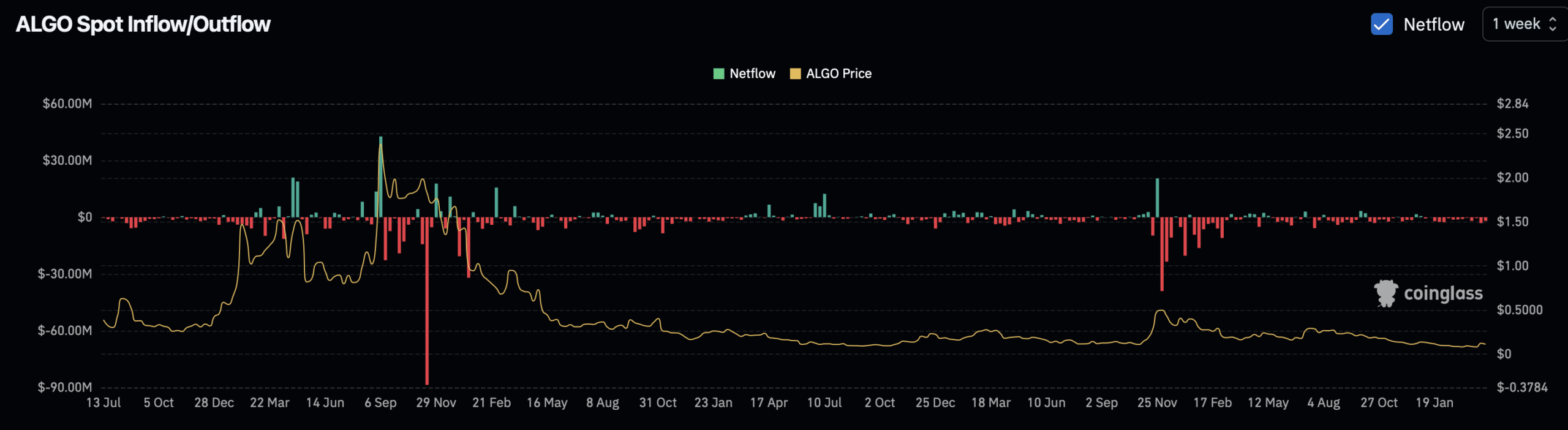
Source: CoinGlass

This places the average daily net inflow as of writing, at approximately $396,000.

Sustained accumulation in the spot market could help cushion ALGO’s downside. If buying pressure remains strong, it may limit losses or even trigger a reversal before the projected decline fully plays out.


Final Summary

  • ALGO may witness an additional 10% decline as indicators point to a move toward fair value.
  • Perpetual traders may intensify the ongoing sell-off, while spot investors appear to view the dip as a discount and continue accumulating ALGO.

Domande pertinenti

QWhat technical indicator suggests that Algorand (ALGO) may experience a further 10% decline in price?

AThe Bollinger Bands indicator suggests a further downside. The price was rejected at the upper band, signaling an overvaluation, and the gap between the current price and the middle band implies a potential additional decline of roughly 10%.

QHow did the activity in the perpetual futures market contribute to the downward pressure on ALGO's price?

AActivity in the perpetual futures market added downward pressure with a significant capital outflow of over $6.5 million from ALGO's contracts. The Open Interest Weighted Funding Rate also dropped, reflecting a decline in long positions and a rise in short positions as traders anticipated further downside.

QWhat does a rising Average Directional Index (ADX) indicate when the price is declining?

AA rising Average Directional Index (ADX) while the price is declining indicates that the prevailing downtrend is strengthening and is likely to persist.

QDespite the price decline, what activity did spot investors engage in regarding ALGO?

ADespite the price decline, spot investors were accumulating ALGO. In the past day alone, the spot market recorded nearly $496,000 in inflows, and over the past week, total purchases reached $1.98 million.

QWhat could potentially limit the losses or trigger a reversal in ALGO's price according to the article?

ASustained accumulation and strong buying pressure from spot investors in the market could help cushion ALGO's downside, potentially limiting losses or even triggering a reversal before the full projected decline plays out.

Letture associate

The Value Distribution of Stablecoins

**Summary: The Value Distribution of Stablecoins** The article argues that stablecoins are evolving from mere trading tools into broader channels for dollar access. It divides the stablecoin ecosystem into four layers to analyze how value is distributed: 1. **Issuance Layer:** Mints stablecoins, holds reserve assets, and captures the spread between reserve yield and user costs (e.g., Tether, Circle). This layer currently earns the largest profit margin. 2. **Infrastructure Layer:** Connects stablecoins to the traditional financial system, handling fiat on/off-ramps, banking integration, compliance (KYC/AML), and asset management (e.g., Bridge, BVNK). This is the "unglamorous" but critical work, building the essential bridges between crypto and real-world finance. 3. **Acquiring/Distribution Layer:** Integrates stablecoins into merchant systems, manages payment flows, and provides enterprise financial software (e.g., Stripe, Coinbase). They act as the access point for businesses. 4. **Application Layer:** The end-users and businesses that ultimately use stablecoins for payments, settlements, or as a store of value. They benefit from convenience but have little pricing power. The core thesis is that while the issuance layer currently dominates profits, the often-overlooked **infrastructure layer holds significant long-term potential**. The real challenge and barrier to mass adoption is not the on-chain transfer of stablecoins (which is simple), but the complex "last mile" integration into existing business workflows, banking systems, and regulatory frameworks across different countries. Companies in this layer are currently in a "land grab" phase, investing heavily to build networks, secure bank partnerships, and establish compliance pathways. While their position is currently pressured by the profitable issuers above and distribution platforms below, the article suggests that if stablecoins become a default financial rail for businesses, the infrastructure providers who have done the hard work of integration will ultimately gain strong pricing power and become entrenched, essential players.

marsbit5 h fa

The Value Distribution of Stablecoins

marsbit5 h fa

The Value Distribution of Stablecoins

The Value Distribution of Stablecoins The article argues that stablecoins are evolving from a mere trading tool into a broad "dollar channel." It analyzes the industry's value chain through four layers: 1. **Issuance Layer (e.g., Tether, Circle):** The top layer that mints stablecoins, holds reserve assets, and captures the thickest interest rate spread. 2. **Infrastructure Layer (e.g., Bridge, BVNK):** Connects stablecoins to the traditional financial system, handling critical but complex "dirty work" like fiat on/off-ramps, banking integration, compliance (KYC/AML), and cross-border settlement. 3. **Acquiring/Distribution Layer (e.g., Stripe, Coinbase):** Embeds stablecoins into merchant systems, manages payment flows, and integrates with enterprise software. 4. **Application Layer:** End-users and businesses that ultimately use stablecoins for payments, settlement, or storing value. The author posits that while the issuance layer currently captures the most profit, the most overlooked and potentially critical layer is infrastructure. The core challenge for stablecoin adoption isn't the on-chain transfer (which is simple), but bridging the gap between blockchain and the real-world financial system. This involves solving practical problems for businesses: fiat conversion, reconciliation, tax handling, and user onboarding. Infrastructure companies are currently in a difficult "land-grab" phase—building networks, securing banking relationships, and achieving compliance country-by-country. They face pressure from both the profitable issuance layer above and distribution platforms below. However, the author suggests this layer is building a crucial moat. Once stablecoins become a default business rail, the infrastructure players who have done the hard work of integration may gain significant, durable value and pricing power.

链捕手5 h fa

The Value Distribution of Stablecoins

链捕手5 h fa

Trading

Spot
Futures

Articoli Popolari

Come comprare ALGO

Benvenuto in HTX.com! Abbiamo reso l'acquisto di Algorand (ALGO) semplice e conveniente. Segui la nostra guida passo passo per intraprendere il tuo viaggio nel mondo delle criptovalute.Step 1: Crea il tuo Account HTXUsa la tua email o numero di telefono per registrarti il tuo account gratuito su HTX. Vivi un'esperienza facile e sblocca tutte le funzionalità,Crea il mio accountStep 2: Vai in Acquista crypto e seleziona il tuo metodo di pagamentoCarta di credito/debito: utilizza la tua Visa o Mastercard per acquistare immediatamente AlgorandALGO.Bilancio: Usa i fondi dal bilancio del tuo account HTX per fare trading senza problemi.Terze parti: abbiamo aggiunto metodi di pagamento molto utilizzati come Google Pay e Apple Pay per maggiore comodità.P2P: Fai trading direttamente con altri utenti HTX.Over-the-Counter (OTC): Offriamo servizi su misura e tassi di cambio competitivi per i trader.Step 3: Conserva Algorand (ALGO)Dopo aver acquistato Algorand (ALGO), conserva nel tuo account HTX. In alternativa, puoi inviare tramite trasferimento blockchain o scambiare per altre criptovalute.Step 4: Scambia Algorand (ALGO)Scambia facilmente Algorand (ALGO) nel mercato spot di HTX. Accedi al tuo account, seleziona la tua coppia di trading, esegui le tue operazioni e monitora in tempo reale. Offriamo un'esperienza user-friendly sia per chi ha appena iniziato che per i trader più esperti.

401 Totale visualizzazioniPubblicato il 2024.12.11Aggiornato il 2026.06.02

Come comprare ALGO

Discussioni

Benvenuto nella Community HTX. Qui puoi rimanere informato sugli ultimi sviluppi della piattaforma e accedere ad approfondimenti esperti sul mercato. Le opinioni degli utenti sul prezzo di ALGO ALGO sono presentate come di seguito.

活动图片