Algorand: Why THIS signal points to another 10% ALGO drop

ambcryptoPubblicato 2026-04-09Pubblicato ultima volta 2026-04-09

Introduzione

Algorand (ALGO) has declined by 10% in the past day, with technical analysis suggesting further downside. The price was rejected at the upper Bollinger Band, indicating overvaluation, and is now expected to move toward the middle band, implying a potential additional 10% drop. The strengthening downtrend is supported by a rising Average Directional Index (ADX). Futures market activity reinforces the bearish outlook, with over $6.5 million exiting ALGO perpetual contracts and a sharp drop in the Open Interest Weighted Funding Rate, signaling increased short positioning. However, spot investors are accumulating ALGO, with nearly $496,000 in inflows in the past day and $1.98 million over the week, which may cushion further declines or prompt a reversal if sustained.

Algorand [ALGO] recorded a 10% drop over the past day, at press time, as the market adjusted. This move may mark the start of a broader decline, based on technical patterns observed on the chart.

Other factors, particularly activity in the perpetual futures market, are likely to play a major role in adding pressure and extending the current downside.

Bollinger Bands signal further downside

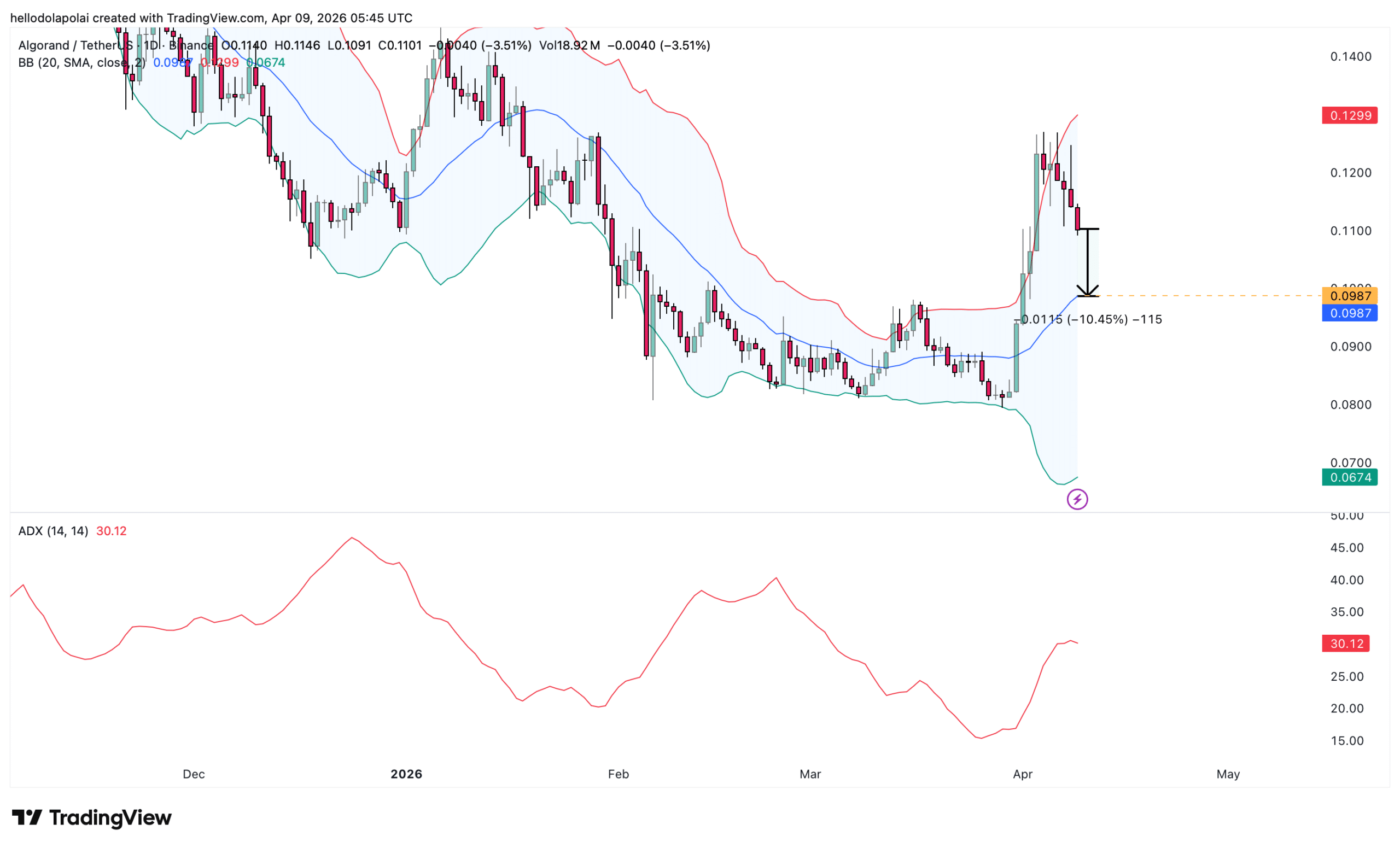
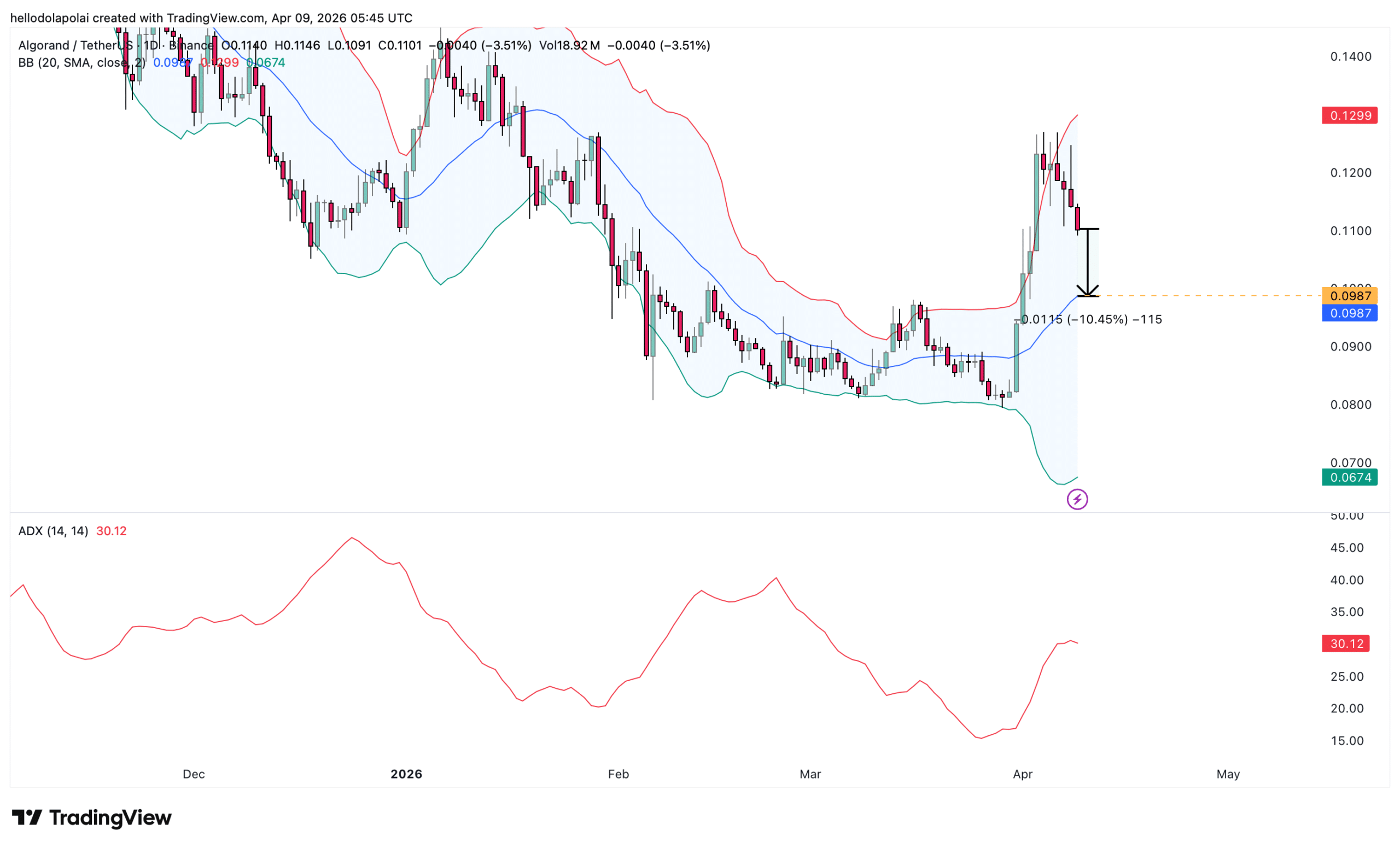
Bollinger Bands, an indicator used to assess whether an asset is overvalued or undervalued while identifying potential support and resistance levels, suggest that further downside may be imminent.

This outlook follows ALGO’s rejection at the upper band (red), which acted as resistance and signaled an overvaluation zone, pushing price lower. Such rejections typically drive price toward the middle band, or neutral zone, marked in blue, as seen on several occasions in the past.
Source: TradingView

Notably, price has yet to approach this middle region. The gap between the current price of $0.677 and the middle band implies a potential additional decline of roughly 10%. The likelihood of continued downside is further supported by the trend-based indicator, the Average Directional Index (ADX), which is trending upward as price moves lower.

ADX measures trend strength. When it rises while price declines, it indicates that the prevailing downtrend is strengthening and may persist.

Futures market adds pressure

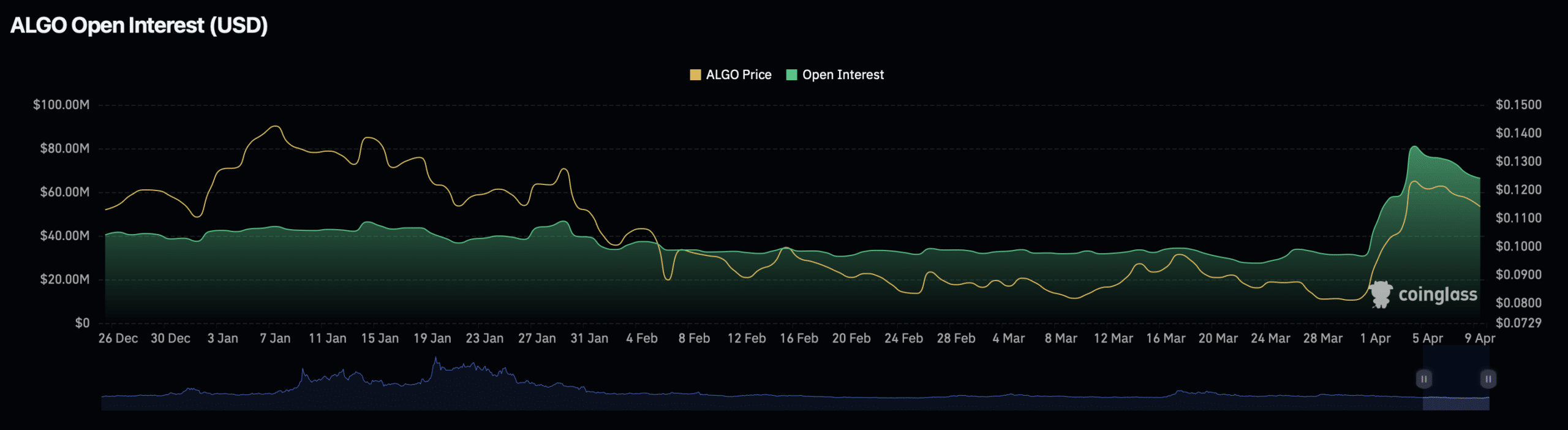
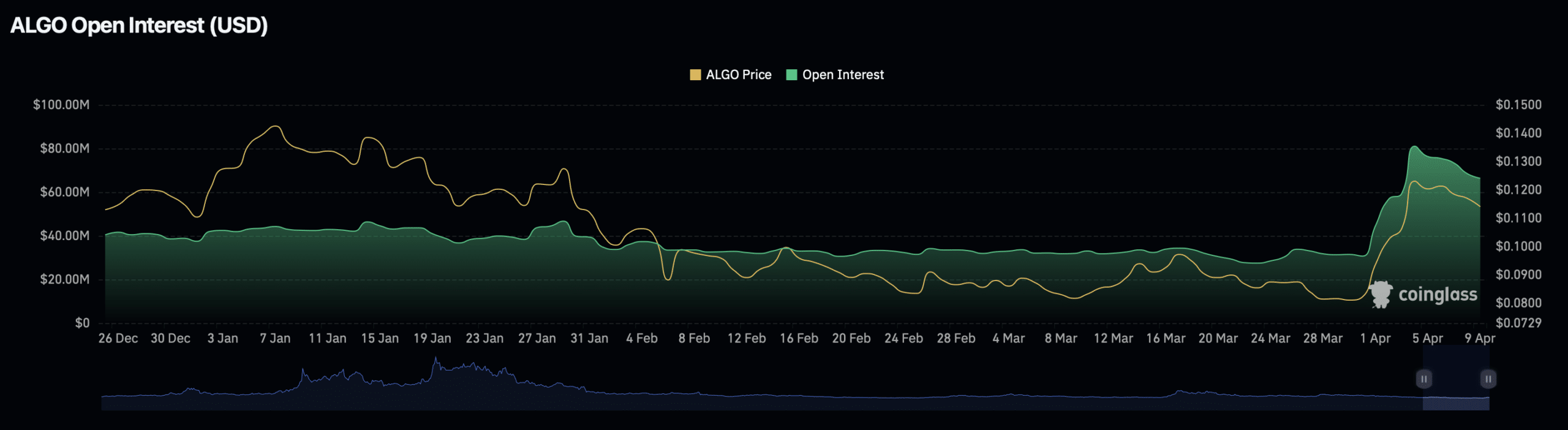
Activity in the Futures market has not supported price stability and instead points to an acceleration of the decline.

Over the past day, the market has seen a significant capital outflow, with more than $6.5 million exiting ALGO’s perpetual contracts as the broader cycle weakens.
Source: CoinGlass

This outflow aligns with a sharp shift in positioning. At press time, the Open Interest Weighted Funding Rate dropped from 0.0073% to 0.0027% over the past 24 hours, reflecting a decline in long positions. This trend suggests a rise in short positions on ALGO, a typical signal when traders anticipate further downside.

For context, between the 7th and 8th of April, ALGO maintained a bullish outlook. However, short sellers have been proven correct, and the price has fallen over the last 24 hours. Spot investors appear to be the key group mitigating further downside, even as short positions continue to build in the derivatives market.

In the past day alone, the spot market recorded nearly $496,000 in inflows into ALGO despite the price decline, signaling accumulation at lower levels. This forms part of a broader trend. Over the past week, spot investors have consistently accumulated ALGO, with total purchases reaching $1.98 million.
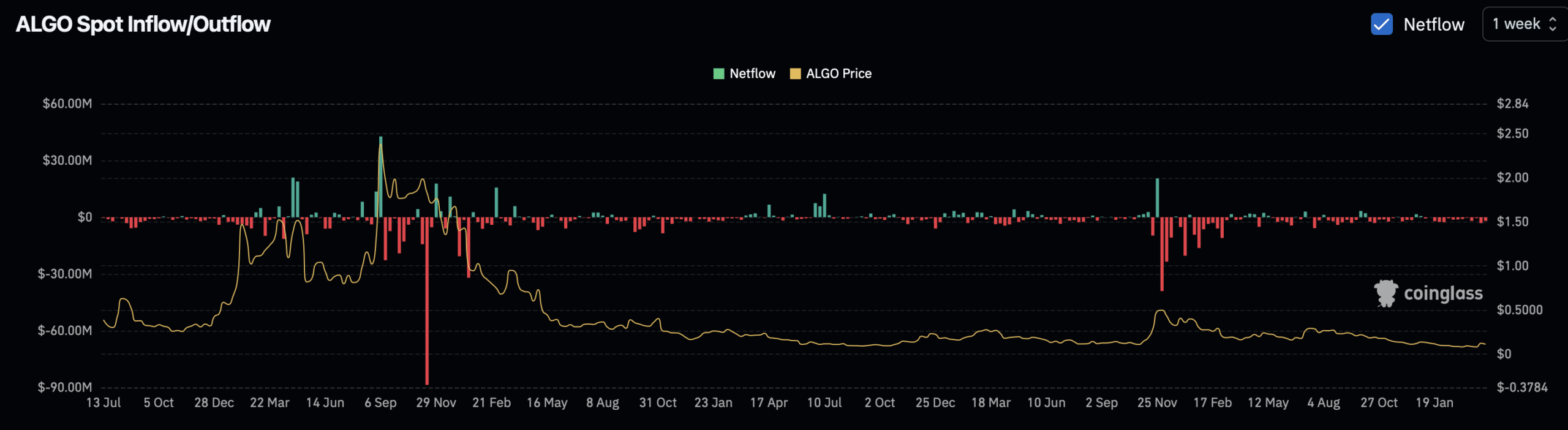
Source: CoinGlass

This places the average daily net inflow as of writing, at approximately $396,000.

Sustained accumulation in the spot market could help cushion ALGO’s downside. If buying pressure remains strong, it may limit losses or even trigger a reversal before the projected decline fully plays out.


Final Summary

  • ALGO may witness an additional 10% decline as indicators point to a move toward fair value.
  • Perpetual traders may intensify the ongoing sell-off, while spot investors appear to view the dip as a discount and continue accumulating ALGO.


Domande pertinenti

QWhat technical indicator suggests that Algorand (ALGO) may experience a further 10% decline in price?

AThe Bollinger Bands indicator suggests a further downside. The price was rejected at the upper band, signaling an overvaluation, and the gap between the current price and the middle band implies a potential additional decline of roughly 10%.

QHow did the activity in the perpetual futures market contribute to the downward pressure on ALGO's price?

AActivity in the perpetual futures market added downward pressure with a significant capital outflow of over $6.5 million from ALGO's contracts. The Open Interest Weighted Funding Rate also dropped, reflecting a decline in long positions and a rise in short positions as traders anticipated further downside.

QWhat does a rising Average Directional Index (ADX) indicate when the price is declining?

AA rising Average Directional Index (ADX) while the price is declining indicates that the prevailing downtrend is strengthening and is likely to persist.

QDespite the price decline, what activity did spot investors engage in regarding ALGO?

ADespite the price decline, spot investors were accumulating ALGO. In the past day alone, the spot market recorded nearly $496,000 in inflows, and over the past week, total purchases reached $1.98 million.

QWhat could potentially limit the losses or trigger a reversal in ALGO's price according to the article?

ASustained accumulation and strong buying pressure from spot investors in the market could help cushion ALGO's downside, potentially limiting losses or even triggering a reversal before the full projected decline plays out.

Letture associate

Silicon Valley 'Startup Guru' Steve Hoffman: Web3 + AI Could Be a Trap

Silicon Valley investor and "Godfather of Startups" Steve Hoffman warns that combining Web3 with AI is likely a trap, not a promising venture. In an interview, Hoffman argues that while AI is a foundational technology touching all industries, Web3 adds complexity, friction, and regulatory risk without solving mainstream consumer or business needs. He advises founders to focus on deep, specialized applications where startups can out-iterate giants, rather than on generic features easily replicated by large tech companies. Hoffman observes that Silicon Valley will lead foundational AI research, while China excels at rapid, large-scale application and commercialization, particularly in robotics. He stresses that AI-driven autonomous agents capable of collaborative, multi-step tasks are 2-4 years away, which will cause significant job displacement. The solution is not to slow AI but to redesign business models around human-AI collaboration and reform social systems like education and retraining. For startups, Hoffman recommends focusing on vertical, expertise-heavy domains to build defensibility. He sees major opportunities in AI fraud detection and cybersecurity. Key founder mindsets include systemic thinking over feature-focus, relentless customer centricity, building adaptive teams, and deeply understanding AI's capabilities and limits. Hoffman is also leading a non-profit initiative to establish university centers aimed at training future leaders in responsible, human-value-aligned AI innovation.

marsbit1 h fa

Silicon Valley 'Startup Guru' Steve Hoffman: Web3 + AI Could Be a Trap

marsbit1 h fa

Token Inefficient, Economy Tokenless

The article "Tokens Aren't Economical, Economics Aren't Tokenized" analyzes a pivotal shift in the AI industry from a technology-driven narrative to one dominated by capital efficiency. It highlights two concurrent trends: a severe capital shortage due to the exorbitant and recurring costs of compute (e.g., OpenAI's high burn rate) and a wave of corporate spin-offs where major tech companies are separating their AI units (like Kuaishou's Kling and Baidu's Kunlunxin). The core argument is that AI's "anti-internet" business model, where user growth increases costs rather than profits, has created a disconnect between high valuations and actual cash flow. Spin-offs address this by allowing AI assets to be valued independently. Within a parent company, they are seen as cost centers, but as standalone entities, they are priced based on their growth potential and scarcity in the primary market, leading to massive valuation premiums (e.g., Kling's estimated value tripling post-spin-off). The industry is at an inflection point, moving from "model worship" to "value realization." The competition is evolving from a pure compute (GPU) race to a broader focus on systemic efficiency and full-stack engineering (involving CPUs and orchestration) to achieve viable commercialization. The year 2026 is framed as a critical moment where the industry must definitively answer how to economically translate AI capability into tangible business value, reshaping the sector's future power structure.

marsbit1 h fa

Token Inefficient, Economy Tokenless

marsbit1 h fa

Crossing the 'Memory Wall': The Wafer-Level Revolution and Computing Power Routes in the AI Inference Era

In 2026, a historic shift occurred in AI as major cloud providers' inference spending surpassed training spending for the first time, signaling a move from "building large models" to "using large models." This shifts the core challenge from computing power to the "memory wall"—the bottleneck of data movement (model weights, activations, KV Cache) between external DRAM and processors, where energy and latency from data transfer far exceed computation itself. Companies like Nvidia face GPU idle time due to bandwidth limits. In contrast, Cerebras Systems adopts a radical "wafer-scale" approach with its Wafer-Scale Engine (WSE). Instead of cutting a silicon wafer into many chips, Cerebras uses almost the entire wafer as one massive chip (WSE-3). This design provides 44GB of on-chip SRAM, delivering memory bandwidth thousands of times higher than traditional HBM (e.g., 21 PB/s vs. Nvidia B200). For LLM inference, weights are streamed layer-by-layer from external MemoryX storage to the chip, avoiding HBM bottlenecks. This results in token generation speeds 1.5–5 times faster than Nvidia's B200 in some models and significant advantages in first-token latency and long-context tasks. Additionally, Cerebras's architecture offers much lower interconnect power consumption (0.15 pJ/bit vs. GPU's ~10 pJ/bit). However, Cerebras faces challenges: SRAM scaling has slowed with advanced nodes, limiting future capacity gains; the chip requires specialized liquid cooling and custom software stacks; and its external I/O bandwidth (150 GB/s) is low compared to NVLink, hindering multi-system scaling for very large models. Competition is intensifying. Major players are pursuing three paths: 1) Developing proprietary inference ASICs (e.g., Google TPU, Microsoft Maia), 2) Leveraging advanced packaging (e.g., TSMC's SoW) to democratize wafer-scale-like integration, potentially eroding Cerebras's process advantage within a few years, and 3) Exploring optical interconnects for ultimate bandwidth. Commercially, Cerebras is transitioning from a hardware vendor to a service provider, facing the immense challenge of building high-power, specialized data centers to meet large contracts (e.g., 250MW/year from 2026–2028). In conclusion, the AI inference era presents a fundamental architectural trade-off. Cerebras opts for extreme physical optimization for low-latency, single-task performance, while Nvidia prioritizes versatility and massive cluster throughput. The path forward remains uncertain, with technology and business models still evolving in the race toward advanced AI.

marsbit1 h fa

Crossing the 'Memory Wall': The Wafer-Level Revolution and Computing Power Routes in the AI Inference Era

marsbit1 h fa

Has Bitcoin's 'Rebound Ended', Officially Entering the Late Bear Market Phase?

**Title: Has Bitcoin's Rebound Ended, Entering the Late Bear Market Phase?** **Summary:** Bitcoin's price has declined by 13% this week, signaling a potential return to late-stage bear market conditions. The price fell to around $67k, positioned between the Realized Price and Realized Cap Weighted Average. For the first time since early 2022, the Short-Term Holder cost basis has dropped below this key average, confirming a hallmark of late-cycle bear markets. Profitability metrics have collapsed sharply. The 7-day average of the Realized Profit/Loss ratio plummeted from a local high of 3.16 to 0.29, mirroring the February panic sell-off. Critically, the 90-day average never breached the threshold of 2, indicating the recent rally to $82k was a bear market bounce, not a structural shift. Realized losses surged to $1.35 billion daily, with $770 million coming from Long-Term Holders selling at a loss. This accelerating redistribution of supply from weak to strong hands is a necessary but ongoing process for a market bottom. The rally stalled almost precisely at the aggregate cost basis (~$83k) of US spot Bitcoin ETF investors, turning that level into strong resistance and leaving the average ETF holder underwater again. Spot market flows have turned decisively negative, showing sellers are dominating order books despite the price drop. While a significant futures long liquidation event cleared over $400 million in leverage, providing a potential reset, sustained spot demand is yet to materialize. Options markets continue to price in higher future volatility (Implied Volatility) than recent price action (Realized Volatility) has shown, with a persistent skew towards put options, indicating ongoing demand for downside protection. In conclusion, multiple metrics point to a fragile market structure. Resistance at the ETF cost basis, accelerating realized losses, dominant spot selling, and cautious options pricing all suggest the bear market trend persists. A sustainable recovery likely requires a resurgence of spot demand, ETF holders returning to profit, and a clear reduction in selling pressure.

marsbit1 h fa

Has Bitcoin's 'Rebound Ended', Officially Entering the Late Bear Market Phase?

marsbit1 h fa

Trading

Spot
Futures

Articoli Popolari

Come comprare ALGO

Benvenuto in HTX.com! Abbiamo reso l'acquisto di Algorand (ALGO) semplice e conveniente. Segui la nostra guida passo passo per intraprendere il tuo viaggio nel mondo delle criptovalute.Step 1: Crea il tuo Account HTXUsa la tua email o numero di telefono per registrarti il tuo account gratuito su HTX. Vivi un'esperienza facile e sblocca tutte le funzionalità,Crea il mio accountStep 2: Vai in Acquista crypto e seleziona il tuo metodo di pagamentoCarta di credito/debito: utilizza la tua Visa o Mastercard per acquistare immediatamente AlgorandALGO.Bilancio: Usa i fondi dal bilancio del tuo account HTX per fare trading senza problemi.Terze parti: abbiamo aggiunto metodi di pagamento molto utilizzati come Google Pay e Apple Pay per maggiore comodità.P2P: Fai trading direttamente con altri utenti HTX.Over-the-Counter (OTC): Offriamo servizi su misura e tassi di cambio competitivi per i trader.Step 3: Conserva Algorand (ALGO)Dopo aver acquistato Algorand (ALGO), conserva nel tuo account HTX. In alternativa, puoi inviare tramite trasferimento blockchain o scambiare per altre criptovalute.Step 4: Scambia Algorand (ALGO)Scambia facilmente Algorand (ALGO) nel mercato spot di HTX. Accedi al tuo account, seleziona la tua coppia di trading, esegui le tue operazioni e monitora in tempo reale. Offriamo un'esperienza user-friendly sia per chi ha appena iniziato che per i trader più esperti.

397 Totale visualizzazioniPubblicato il 2024.12.11Aggiornato il 2026.06.02

Come comprare ALGO

Discussioni

Benvenuto nella Community HTX. Qui puoi rimanere informato sugli ultimi sviluppi della piattaforma e accedere ad approfondimenti esperti sul mercato. Le opinioni degli utenti sul prezzo di ALGO ALGO sono presentate come di seguito.

活动图片











