Alert Across the Internet! Claude Code Source Code Leak Triggers "Secondary Disaster": Hackers Set GitHub Phishing Traps

marsbitPubblicato 2026-04-03Pubblicato ultima volta 2026-04-03

Introduzione

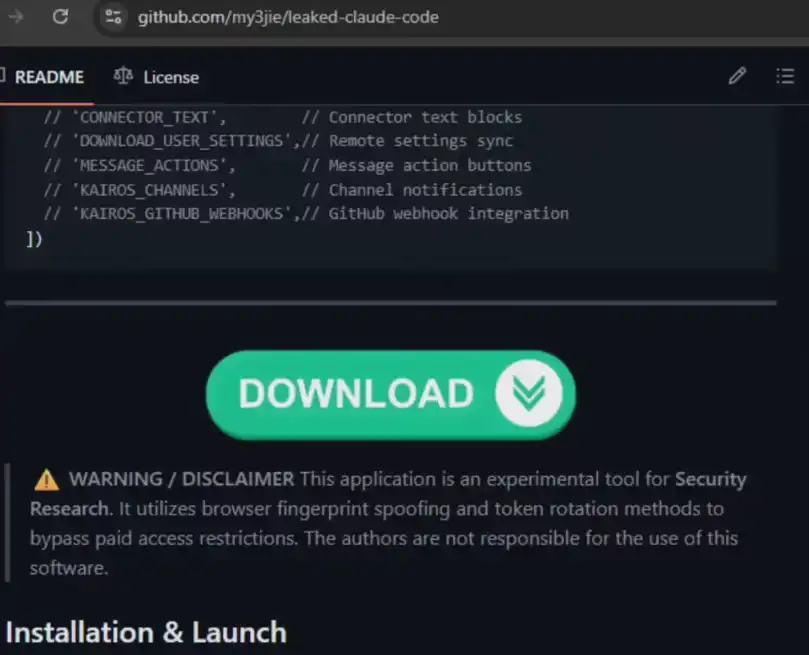
A major security alert is circulating online following the accidental leak of Claude Code's source code by Anthropic. Hackers are exploiting the incident by creating fake GitHub repositories that distribute the information-stealing malware known as **Vidar**. Posing as a user named `idbzoomh`, the threat actor set up multiple repositories claiming to offer "unlocked enterprise features" from the leaked source code. These repositories are optimized for search engines to appear at the top of results for queries like “Claude Code leak,” increasing their reach. If a user downloads and executes the provided files, the Vidar malware is deployed. It is a sophisticated stealer designed to harvest sensitive data such as browser credentials, cryptocurrency wallets, and personal information. The attack also installs **GhostSocks**, a proxy tool that establishes hidden communication channels for remote control and data exfiltration. Security firm Zscaler notes that these malicious repositories update frequently, making it easier to bypass basic security scans. At least two similar repositories have been identified, suggesting the same attacker is testing different distribution methods. This incident highlights the compound risks in the AI era, where initial human error leads to secondary threats like social engineering. Developers are urged to obtain software only through official channels and avoid executing untrusted binaries.

According to an April 2nd report, the Claude Code source code leak incident caused by an Anthropic human error continues to escalate. Currently, hackers have exploited this hot topic to spread information-stealing malware named Vidar via fake repositories on GitHub.

Upgraded Bait: Claiming to "Unlock Enterprise-Level Features"

Monitoring reports from security company Zscaler show that a user named idbzoomh has created multiple fake repositories on GitHub.

  • Precision Phishing: The hacker claims in the repository description to provide leaked source code that "unlocks enterprise features," luring eager developers to download it.

  • SEO Optimization: To maximize the impact, the attackers optimized for search engine keywords, causing these malicious repositories to often rank at the top when users search for terms like "Claude Code leak".
Virus Profile: Vidar Infiltrates, Data "Relocated"

Once users are deceived into downloading and executing the contained executable files, the system is quickly compromised:

  • Information Theft: The implanted Vidar is a highly mature malware on the dark web, specifically designed to harvest browser account passwords, cryptocurrency wallets, and various types of sensitive personal information.

  • Persistent Latency: The virus also simultaneously deploys the GhostSocks proxy tool, setting up a secret channel for subsequent remote control and data exfiltration.

Risk Warning: Beware of "Free Lunches" from Unofficial Channels

Security researchers point out that the malicious compressed files in these fake repositories are updated at an extremely high frequency, making them easy to bypass basic security detection. At least two repositories with similar tactics have been discovered so far, suspected to be tests of different propagation strategies by the same attacker.

Industry Observation: The "Chain Set" of AI Security

From Anthropic's source code packaging mistake to hackers secondarily exploiting the hot topic for phishing, this incident reflects the complexity of security risks in the AI era. When the developer community becomes the target of attacks, basic digital literacy—not running binaries from unknown sources—remains the last line of defense.

Editors remind all developers: Please be sure to obtain tools through official Anthropic channels. Do not fall into the traps carefully designed by hackers out of curiosity or the pursuit of "cracked features."


Domande pertinenti

QWhat is the primary malware being distributed through the fake GitHub repositories related to the Claude Code leak?

AThe primary malware being distributed is called Vidar, which is a sophisticated information-stealing malware known for harvesting browser credentials, cryptocurrency wallets, and other sensitive personal data.

QHow are the attackers making their fake GitHub repositories more visible to potential victims?

AThe attackers are using Search Engine Optimization (SEO) techniques by including popular keywords like 'Claude Code leak' in the repository descriptions, causing these malicious repositories to appear at the top of search results.

QWhat additional tool does the Vidar malware deploy on an infected system to maintain persistence and enable data exfiltration?

AThe Vidar malware also deploys a tool called GhostSocks, which is a proxy utility that creates a secret channel for remote control and ongoing data exfiltration from the compromised system.

QWhat human error at Anthropic initially led to the situation that hackers are exploiting?

AThe initial event was a source code leak of Claude Code caused by a human error at Anthropic, where the code was mistakenly made available, creating the opportunity for hackers to use it as a lure.

QWhat is the main advice from security researchers to developers to avoid falling victim to these traps?

AThe main advice is to only obtain tools through official Anthropic channels and to avoid downloading or running binary files from unverified sources, emphasizing that basic digital hygiene is the last line of defense.

Letture associate

Within Strategy's Framework, STRC's Dividend Yield Remains at 12% as Share Price Stays Below Par Value

Michael Saylor, Executive Chairman of Strategy (MSTR), confirmed that the dividend rate for its STRC perpetual preferred shares will remain at 12.00% through August 2026. The rate has increased from 9% at its July 2025 launch to the current high via a "ratchet" mechanism, which permanently raises the rate by 0.5% whenever the share price falls below $95. This mechanism is intended to push the price back toward its $100 par value and support Strategy's "at-the-market" (ATM) program for issuing new shares to fund Bitcoin purchases. However, the mechanism has not worked as intended. STRC shares closed at $89.46 on July 31, remaining about 10-11% below par value despite the record-high dividend. Competition from rival Strive's higher-yielding SATA securities has pressured demand. The persistent discount has forced Strategy to suspend new STRC issuances via its ATM program, limiting this funding channel for Bitcoin acquisitions. STRC's struggles reflect Bitcoin's own volatility, as the preferred shares historically move in tandem. Analysts have warned the ratchet structure carries long-term, one-way risk. A law firm is investigating Strategy's ability to maintain dividend payments if Bitcoin's price stays low. Retail investors own roughly 83% of outstanding STRC shares, a group seen as prone to panic selling during downturns. In response, Strategy has established financial reserves, including a liquidity cushion covering about 26 months of dividend/interest obligations, and a $2 billion share buyback program alongside a Bitcoin monetization framework, though the company emphasized it is not obligated to sell any Bitcoin.

cryptonews.ru22 min fa

Within Strategy's Framework, STRC's Dividend Yield Remains at 12% as Share Price Stays Below Par Value

cryptonews.ru22 min fa

Analyst: Bitcoin's Price Will Drop to $60k in August, Then Rebound to $70k

Financial analyst Andrey Poroshin has provided a new forecast for Bitcoin's price dynamics in August. Poroshin, an analyst at the Bitbanker exchange, expects the cryptocurrency market to experience a downturn this month, with prices retesting the $60,000 level due to a lack of supportive macroeconomic catalysts. He noted that the recent US Federal Reserve decision to hold interest rates did not significantly impact the market, while inflation remains above the 2% target. Poroshin stated that Bitcoin is ending July under pressure from moderate volatility and a lack of new macroeconomic stimuli, leading to continued market caution. According to his base scenario, Bitcoin will drop to a range of $60,000 to $62,000 before recovering to $70,000. He pointed out that even $70,000 remains below the cost of mining in the US, which has prompted some miners to shift towards AI data center operations. Poroshin cited the winding down of BitMEX's operations as a potential catalyst for a price rebound, suggesting the exit of weaker players often coincides with market reversals and reduced short-term selling pressure. He believes Bitcoin is currently less susceptible to geopolitical shocks, such as the Iran-US conflict, and does not expect significant market changes in August related to the pending CLARITY Act. Looking ahead, Poroshin forecasts that September will bring more active price fluctuations driven by potential Fed rate decisions and possible discussions or approval of the CLARITY Act.

cryptonews.ru22 min fa

Analyst: Bitcoin's Price Will Drop to $60k in August, Then Rebound to $70k

cryptonews.ru22 min fa

Trading

Spot
活动图片




