Alarm Bells Ringing: BOJ's Imminent 25bp Rate Hike, a Repeat of the 2024-Style Flash Crash for US Stocks and Crypto?

Odaily星球日报Pubblicato 2026-06-11Pubblicato ultima volta 2026-06-11

Introduzione

The Bank of Japan (BoJ) is highly expected to raise its short-term policy rate by 25 basis points to 1.0% at its June 15-16 meeting, marking the highest level since 1995. This imminent hike, driven by energy-induced inflation and a persistently weak yen, risks triggering a global market correction by forcing the unwinding of an estimated $500 billion in yen carry trades. As investors borrow cheap yen to fund investments in higher-yielding assets like U.S. stocks and cryptocurrencies, a BoJ rate hike would increase funding costs and potentially strengthen the yen. This could force a rapid deleveraging cycle: investors would sell overseas assets, buy back yen to repay loans, and amplify selling pressure. A similar scenario in August 2024 caused a global flash crash, with Bitcoin plunging nearly $20,000 in a single day. High-valuation assets are particularly vulnerable. AI-driven tech stocks, sensitive to liquidity and financing costs, face pressure from rising energy expenses and potential regulatory shifts. For cryptocurrencies, already competing with AI for market liquidity, the tightening of global leverage poses a significant near-term risk. Analysts warn this liquidity shock could lead to sharp corrections in both equities and crypto, urging investors to exercise caution regarding leverage amid heightened volatility.

Original | Odaily Planet Daily (@OdailyChina)

Author | Qin Xiaofeng (@QinXiaofeng 888 )

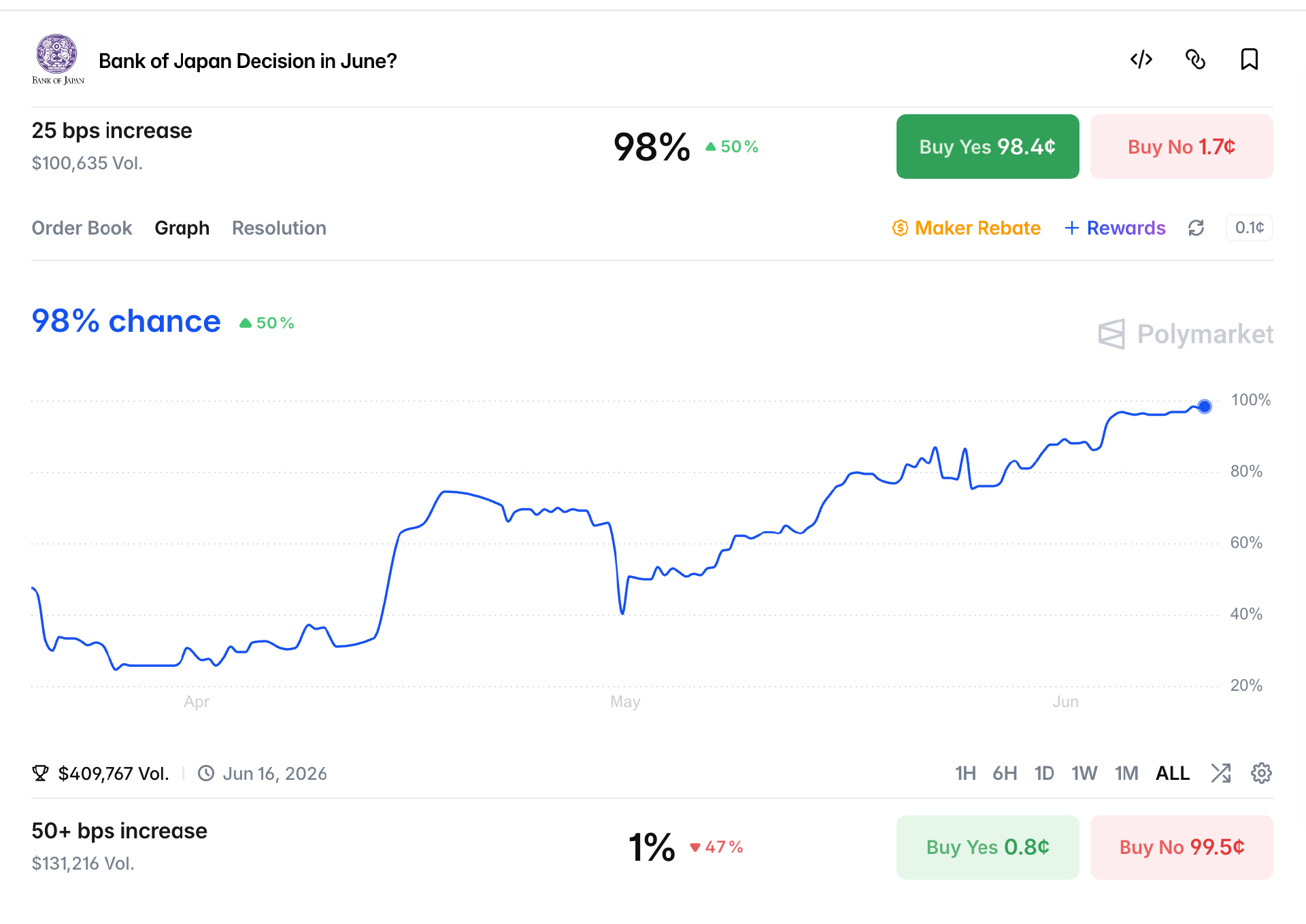
According to Nikkei News, the Bank of Japan (BoJ) is expected to raise the short-term policy rate from 0.75% to 1.0% at its monetary policy meeting on June 15-16, which would be the highest policy rate level since 1995. Currently, market pricing implies an extremely high probability of a rate hike, with the probability of "a 25bp (basis point) hike" on PolyMarket soaring from 25% in early April to 98%.
With the BOJ's rate hike imminent, a large number of investors engaging in yen carry trades may be forced to sell overseas assets, exchange funds back into yen, and repay loans, triggering a chain reaction that amplifies volatility in global risk assets—the flash crash in August 2024 is a classic case. Back then, a sharp yen appreciation led to a short-term plunge in global stock markets, with Bitcoin plummeting nearly $20,000 in a single day, a maximum drop of 15%.

Odaily Planet Daily will analyze the macro background and transmission mechanism of the BOJ's rate hike, and focus on assessing its risk impact on AI tech stocks and cryptocurrencies, for readers' reference.

1. Inflation Risks Driving BOJ Rate Hike

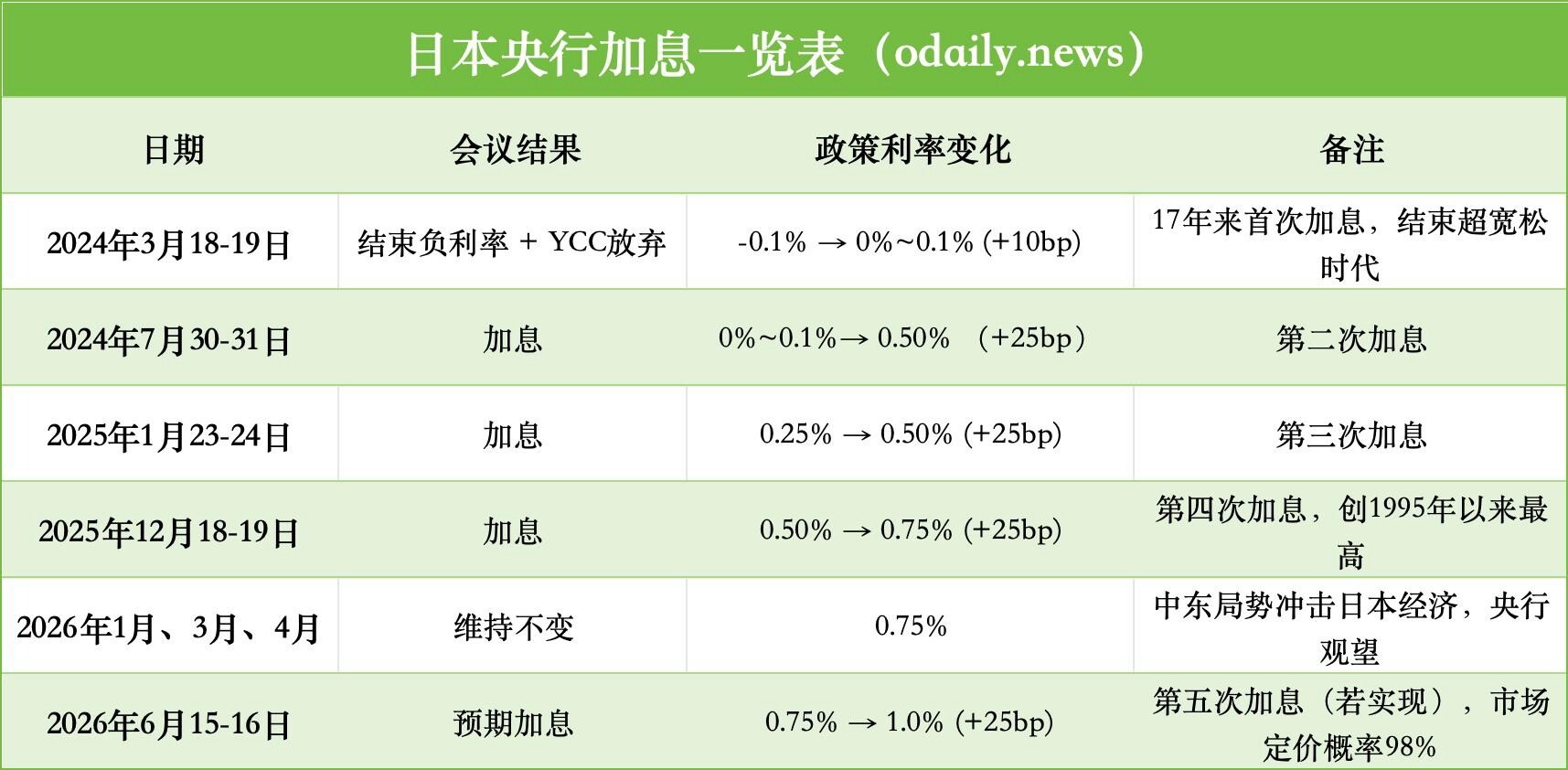
Over the past two years, hawkish voices within the BOJ have grown stronger, culminating in March 2024 with the end of its 17-year negative interest rate policy, raising the policy rate from -0.1% to a range of 0% ~ 0.1%, marking the first hike in this cycle. In July 2024, the BOJ hiked rates again by 15bp to 0.25% and announced gradual balance sheet reduction; in January and December 2025, it raised rates by 25bp each, bringing the rate to 0.75%; it remained unchanged in the first three meetings of 2026. The following are the details of the BOJ's rate hikes from several meetings:
After keeping rates unchanged for half a year, why is the BOJ迫不及待 starting a new round of rate hikes? This hike is primarily driven by two factors.

First, energy shocks and imported inflation pressure. Fluctuating oil prices due to conflicts in the Middle East in the first half of the year have significantly increased import costs for Japan, a country highly dependent on imported energy. The Corporate Goods Price Index (CGPI) rose 6.3% year-on-year in May, the fastest pace since 2023, with petroleum products up 9.6% and utilities up 8.5%. The BOJ expects core CPI for fiscal year 2026 to rise to 2.5-3.0%, well above the 2% target.

Second, a weak yen exacerbates imported inflation. The current USD/JPY exchange rate continues to hover near the high range of 158-160, approaching historically extreme weakness levels. The significant depreciation of the yen directly undermines the import purchasing power of Japanese companies, leading to a substantial increase in import costs for energy, raw materials, and other commodities, further pushing up domestic price levels. Although Japan's Ministry of Finance has intervened in the foreign exchange market multiple times, the effects have been limited and difficult to sustain. This situation is forcing the BOJ to tighten monetary policy (i.e., raise rates) at its June meeting to avoid inflation expectations spiraling out of control.

In a speech on June 3, BOJ Governor Kazuo Ueda explicitly shifted towards an anti-inflation narrative, emphasizing that if upside risks to prices outweigh downside risks to the economy, the pros and cons of a rate hike must be discussed.

Reuters, citing three informed sources, reported that unless the Middle East conflict escalates sharply, the BOJ will hike rates in June and may slow the pace of bond tapering to maintain market stability. Bloomberg and institutions like ING hold similar judgments, expecting the BOJ to hike a total of 50bp in 2026.

This series of shifts marks Japan's transition from the "global lender of last resort" to a normalizing central bank, posing a direct challenge to global assets reliant on cheap yen financing.

2. Yen Carry Trade Unwinding, Liquidity Continues to Tighten

The Bank of Japan's long-term maintenance of ultra-loose monetary policy has made the yen carry trade a crucial component of global liquidity over the past decade. Investors borrow yen at near-zero interest rates to invest in high-yield assets like US stocks, tech stocks, emerging markets, and cryptocurrencies, earning interest differentials and capital gains.

The BOJ's upcoming rate hike will directly increase yen financing costs and could trigger yen appreciation (USD/JPY decline), forcing leveraged investors to unwind positions, creating a positive feedback loop: yen appreciation leads to expanding forex losses → rising financing costs → forced investor deleveraging → large-scale selling of risk assets → further decline in asset prices → triggering more stop-loss orders → increased unwinding pressure.

Historically, every BOJ policy tightening signal has triggered severe market volatility.

On July 31, 2024, the BOJ hiked rates by 15bp to 0.25% and announced gradual balance sheet reduction, coupled with weak US employment data, triggering severe global market turmoil. At that time, South Korea's two major stock indices (KOSPI and KOSDAQ) both plummeted, triggering circuit breakers; Japanese stocks crashed, with the Nikkei 225 plunging 12.4% in a single day and falling over 20% cumulatively in a week, its worst performance since 1987; global stock markets fell in tandem, with US stocks and tech stocks adjusting simultaneously, and the VIX fear index soaring. Crypto was also hit hard, with Bitcoin and ETH plummeting over 30% within a week, and leveraged liquidations surging.

According to Morgan Stanley estimates, although a significant amount of positions have been gradually unwound since 2024, there are still approximately $500 billion in outstanding yen-financed positions in the market. Although the market has partially priced in some risks ahead of time, these positions still pose a significant隐患. Morgan Stanley warns that if the yen appreciates rapidly, it could trigger chain unwinding during periods of thin liquidity, particularly severely impacting highly leveraged assets.

J.P. Morgan Global Market Strategist Dubravko Lakos-Bujas and Forex Strategist Meera Chandan both noted that the policy divergence between the BOJ and the Fed will exacerbate the instability of carry trade unwinding, potentially leading to a revaluation of global risk assets.

3. Global Risk Assets to Suffer, US Stocks and Crypto Not Spared

The AI-driven tech boom was the main theme of US stocks in the first half of 2026, with chip stocks like Nvidia and Broadcom and hyperscale cloud service providers leading the Nasdaq to repeatedly hit new highs.

However, entering June, significant market rotation and pullbacks emerged, especially on June 5th, when US stocks experienced their most severe single-day pullback of 2026 so far. The Nasdaq plunged 4.18%, marking its largest single-day drop since April 2025; the S&P 500 fell 2.64%, ending a nine-week winning streak; the Dow fell 1.35%, the Philadelphia Semiconductor Index plummeted over 10%, with AI core stocks like Nvidia, Broadcom, Micron, and Marvell leading the decline. (Recommended reading: "Nasdaq's 4.2% Single-Day Drop, Did 'Black Friday' Burst the US Stock Bubble?")

The US stock pullback is due to macro factors like geopolitical tensions and Fed policy uncertainty, but the potential impact from the BOJ's rate hike cannot be ignored.

First, tightening liquidity will directly hit high-valuation growth stocks. AI companies have massive capital expenditure scales and are highly dependent on cheap financing. Unwinding yen carry trades will reduce the inflow of global risk-preference funds, with high-beta tech stocks being the first to be hit. Semiconductor leaders like Nvidia and Broadcom, as well as hyperscalers like Meta and Microsoft, have极高的 valuation sensitivity and are极易 susceptible to selling. Investing.com analysis points out that high-valuation growth sectors are most sensitive to changes in global liquidity; once carry trade unwinding begins, rapid deleveraging often occurs.

Second, rising energy costs will significantly compress AI profit margins. Middle East conflicts pushing up oil prices lead to大幅攀升 in data center power and cooling costs, combining with the BOJ rate hike to create a "stagflationary" macro environment, severely testing the sustainability of the AI business model.

BitMEX founder Arthur Hayes explicitly warned in his latest article "Reality Test": "The energy reality is testing the current market's 'dreaming' state." High oil prices not only raise operational costs but may also slow the growth in corporate token usage, further打击 AI-related revenue expectations.

Finally, there's the supply shock from mega IPOs and political/regulatory risks. Giants like SpaceX, Anthropic, and OpenAI plan密集 IPOs in the second half of 2026, with valuations often in the hundreds of times sales; lock-up period expirations will bring massive supply pressure. Simultaneously, Trump may shift to being anti-AI for the midterm elections, increasing regulatory uncertainty.

Cryptocurrencies, as the highest-beta global risk assets, face an even bleaker outlook. On one side, the BOJ's rate hike increases global financing costs, directly raising the cost of leveraged crypto trades and forcing large-scale unwinding of crypto leveraged positions. On the other side, in competing with AI for liquidity, AI capital expenditure has already absorbed大量 market funds, and crypto is already lagging; BOJ action will further tighten marginal liquidity.

Yahoo Finance analyst Lockridge Okoth stated that a 98% probability of a rate hike could trigger the next liquidity shock for Bitcoin. Investing.com analysis指出 that yen appreciation and BTC weakness are often高度同步, a typical signal of rising global risk aversion.

Arthur Hayes has also emphasized in multiple analyses that the dynamics of yen carry trades remain a key variable affecting Bitcoin's liquidity,提醒 investors to watch for short-term liquidity shocks triggered by policy signals. In recent articles, Arthur Hayes emphasized the need to警惕 the叠加 impact of short-term energy costs and monetary policy risks; BTC/ETH may adjust in the short term along with risk assets, with the long term depending on liquidity restarting.

Conclusion:

Renewed concerns about a BOJ rate hike are not an isolated event but a signal of边际收紧 in global liquidity. Especially with multiple factors叠加—current Middle East geopolitical conflicts pushing up oil prices, AI capital expenditure consuming liquidity, and Federal Reserve policy uncertainty—the缓冲空间 is further compressed.

For investors, in the short term, global risk assets, particularly highly leveraged and high-valuation sectors (AI tech stocks and cryptocurrencies), may face significant pullback pressure, with volatility明显抬升. It is necessary to maintain high vigilance and be mindful of leverage risks.

Domande pertinenti

QWhat is the Bank of Japan (BoJ) expected to do at its June 15-16 policy meeting, and what is the historical significance of this move?

AThe Bank of Japan is expected to raise its short-term policy interest rate by 25 basis points (bp) from 0.75% to 1.0% at its June 15-16 monetary policy meeting. If executed, this would mark the highest policy rate level in Japan since 1995.

QWhat are the two main reasons driving the Bank of Japan's decision to potentially raise interest rates again in June 2026?

AThe primary reasons are: 1) Energy shocks and imported inflation pressure, with rising oil prices increasing import costs and pushing up corporate goods prices; and 2) A weak Japanese Yen (JPY), which exacerbates imported inflation by making energy and raw material imports more expensive, forcing the BoJ to consider tightening monetary policy to prevent inflation expectations from becoming unanchored.

QHow did the market react to the Bank of Japan's policy changes in July 2024, as cited in the article?

AIn July 2024, the BoJ raised rates by 15bp and announced a gradual reduction of its bond holdings. This move, combined with weak US employment data, triggered severe market turbulence. Key Asian stock indices, including Japan's Nikkei 225, crashed, with the Nikkei falling 12.4% in a single day. Global stock markets declined in tandem, and the cryptocurrency market also suffered heavy losses, with Bitcoin and Ethereum plummeting over 30% within a week.

QAccording to the article, what is the estimated size of the remaining yen carry trade positions that could pose a risk, and what is the potential trigger for unwinding these positions?

AAccording to Morgan Stanley estimates cited in the article, there are still approximately $500 billion in outstanding yen-funded carry trade positions in the market. The potential trigger for a rapid unwinding of these positions would be a sharp appreciation of the Japanese Yen (USD/JPY falling), which could force leveraged investors to liquidate their holdings in risk assets to cover losses and repay loans.

QWhy are high-valuation AI technology stocks considered particularly vulnerable in the context of a potential Bank of Japan rate hike, according to the analysis?

AHigh-valuation AI technology stocks are considered vulnerable for several reasons: 1) They are heavily dependent on cheap financing for massive capital expenditures, and a global liquidity tightening from yen carry trade unwinding would reduce risk appetite, making them prime targets for sell-offs. 2) Rising energy costs (from Middle East conflicts) significantly increase data center power and cooling expenses, squeezing profit margins. 3) The combination of these factors creates a 'stagflationary' macro environment that challenges the sustainability of AI business models.

Letture associate

2029 Finale Prediction: When Cryptocurrency Completely "Vanishes", Who Can Remain in This Financial Upheaval?

By 2029, the crypto industry will have transformed into a largely invisible but foundational layer for traditional finance. This timeline outlines the key shifts from now until then. By mid-2026, the most sought-after assets on-chain will not be traditional tokens, but synthetic perpetual contracts for private, high-growth companies (like SpaceX, OpenAI). These become primary price discovery tools, highlighting the market's craving for real-world asset value. Most altcoins enter a sustained bear market as their fundamental lack of asset-backed value is exposed. In late 2026, the "AI + Crypto" narrative largely fades as AI giants prove they don't need crypto infrastructure, except for prediction markets betting on model performance. Simultaneously, a quiet but significant wave of tokenization for institutional assets (money market funds, private credit) begins. The industry splits into a noisy speculative economy and a silent institutional one. Throughout 2027, major public blockchain foundations pivot decisively to serve institutional clients, building compliance toolkits and sales teams. However, key sectors hit growth ceilings: private perpetual contracts are legally restricted from public promotion, stable币 growth is capped by looming political uncertainty, and tokenization projects remain cautious. In 2028, following a U.S. election assumed to maintain a regulatory (not prohibitive) stance, a pivotal change occurs. After a major liquidation crisis exposes the flaws of synthetic contracts lacking a real-asset anchor, new regulations allow the *public solicitation* of private security sales (secondary market shares) to accredited investors. This creates a legitimate, direct on-ramp for retail capital into previously illiquid private equity. By 2029, the resulting bull market is driven by trading in real, innovative company shares (biotech, robotics, AI labs), not speculative tokens. "Crypto" as a distinct asset class recedes; it becomes the mundane, unseen plumbing for this new global private markets infrastructure. Tokens that survive are those capturing real cash flows from this infrastructure. Speculation persists but is marginalized. The core questions posed at the start are answered: token value is tied to legally enforceable claims on real assets, frontier tech adoption happens via private market channels, and crypto's absorption into traditional finance is marked by its becoming boring and invisible. The key validation for this entire thesis is whether, by late 2028, a legal pathway exists for ordinary accredited investors to access private assets directly.

marsbit29 min fa

2029 Finale Prediction: When Cryptocurrency Completely "Vanishes", Who Can Remain in This Financial Upheaval?

marsbit29 min fa

After the U.S. Banned Fable 5, Zhipu's Stock Soared 47%

On June 15, Chinese AI company Zhipu's stock surged up to 47.6% in Hong Kong, closing with a 32.82% gain. This sharp rise followed two key industry events. On June 12, Anthropic was compelled by a U.S. government export control order to suspend global access to its latest flagship models, Claude Fable 5 and Claude Mythos 5, impacting developers and businesses reliant on them. The next day, Zhipu announced it was opening access to its new open-source flagship model, GLM-5.2, for all Coding Plan users, with API and model weights (under the MIT license) to follow. The Anthropic incident highlighted a critical shift in the AI industry: beyond raw capability, the stability, continuous accessibility, and control over AI models are becoming equally vital, especially as AI integrates deeper into business workflows. Zhipu's move, emphasizing that "frontier intelligence should not belong to a few nor be subject to arbitrary revocation," positioned its open, accessible model as an alternative. GLM-5.2 focuses on "Long Horizon Tasks" with a 1M context window, aiming for consistency in complex, extended projects. Market analysts suggest this event exposes the risk of dependency on closed-source models subject to single jurisdiction policies, potentially accelerating a shift toward domestic base models and localized deployments. The investment response indicates a new valuation metric is emerging—prioritizing which companies can provide AI capabilities that are not only advanced but also reliably and sustainably accessible.

marsbit30 min fa

After the U.S. Banned Fable 5, Zhipu's Stock Soared 47%

marsbit30 min fa

PANews Column Registration and Article Submission Guide

"PANews Column Registration and Submission Guide" provides instructions for users to register as columnists and publish articles on the PANews platform. Key application requirements are emphasized: content should focus on in-depth analysis within Crypto, Web3, blockchain, data, and viewpoints. Content primarily for brand/product introductions will not be approved, and heavily AI-generated content will be rejected. Promotional (PR/soft) content is directed to the business channel. **Registration Process:** * **Web:** Go to the official website footer, click "Apply for Column," and register with a phone number or email (login via verification code, no password). Fill in the column name, description, upload an avatar, and submit links to previously published work. * **Mobile:** Navigate to "My" -> "Contribute & Create" and complete the form. **Article Submission Tutorial:** 1. Log in to the PANews website. 2. Access the "Creator Center" from your personal homepage. 3. Use the editor to create and publish articles. **Video Upload:** The platform supports embedding videos from third-party sites (e.g., Bilibili). Copy the embed code from the source video, use the editor's "Insert/Edit media" button, paste the code under the "Embed" tab, and adjust the display size (recommended: width 100%, height 560px). **PANews Skills (AI Agent Tool):** PANews offers an official AI Agent skill set called PANews Skills, enabling AI tools to query platform content, track trends, and publish column articles directly. It includes three main skills: 1. `panews`: For tracking daily must-read lists, popular articles, and funding news. 2. `panews-creator`: For managing columns, publishing articles, and uploading images. 3. `panews-web-viewer`: For parsing PANews webpages into Markdown. These skills are compatible with various AI Agent tools (OpenClaw, Cursor, Claude Code, ChatGPT, Gemini, etc.). To use the `panews-creator` skill, users must obtain a specific authentication value from the PANews website after logging into their columnist account.

marsbit41 min fa

PANews Column Registration and Article Submission Guide

marsbit41 min fa

I Built Myself an Investment Workbench Using AI

For the past two weeks, I've been immersed in Vibe Coding—using AI to write code from natural language descriptions. This process has enabled me to quickly build functional tools that address long-standing personal ideas. Previously, I had many concepts but found execution too cumbersome. Key ideas included a unified dashboard for assets across US stocks, Crypto, HK stocks, and A-shares; a real-time alert system for price movements; an investment map visualizing sector relationships; and a tool to correlate prediction market bets with news and market data. Traditional development hurdles meant these often remained unrealized. Using AI (Codex, Claude Code, and DeepSeek API), I built four initial tools: 1. A **Cross-Market Asset Dashboard** showing total assets, daily P&L, and holdings by market, with added features for alerts and sector mapping. It's deployed locally for privacy. 2. A **Prediction Market (PM) Monitor** tracking bets on events (e.g., company valuations) and correlating probability shifts with news and market movements. I categorize bets by conviction to filter noise. 3. A **Simple Operations Backend** for managing my writing workflow (topics, progress, publishing). It's cloud-deployed for mobile access. 4. A **One-Click Formatting Tool** that automates converting drafts into various platform-specific formats, saving manual effort. While these tools are basic, they represent a significant shift: AI lowers the barrier to creating personalized systems. I believe individual investors can now feasibly build core systems for: * **Asset Observation** (tracking holdings and changes) * **Signal Monitoring** (watching for key market shifts) * **Sector Mapping** (understanding network relationships within a sector) * **Performance Review** (documenting rationale and outcomes) The power of Vibe Coding is its fast feedback loop. Ideas can be implemented, tested, and iterated on rapidly, turning "want-to-do" into "done." This marks the start of my new phase, where I'll share investment thoughts, tool tests, on-chain operations, and educational Web3 content.

marsbit57 min fa

I Built Myself an Investment Workbench Using AI

marsbit57 min fa

Trading

Spot
Futures
活动图片