Airdrops Won't Make You Rich, edgeX Doesn't Need a Community

marsbitPubblicato 2026-03-31Pubblicato ultima volta 2026-03-31

Introduzione

The decentralized perpetual contract protocol edgeX, incubated by Amber Group and backed by Circle Ventures, faced massive community backlash following its token airdrop distribution. Despite earlier promises not to screen out Sybil accounts and to distribute tokens based on points earned through trading, users discovered significant inconsistencies in token allocation. Many users reported receiving vastly different token amounts for the same number of points—some obtained 11 tokens per point, while others received as few as 0.5. Further allegations emerged, including insider trading, with reports that low-point affiliated addresses received a quarter of the total airdrop. The project worsened the situation by disabling comments on its social media channels to suppress criticism. Influential figures like Bingwa accused edgeX of being a "setup" rather than a legitimate project, designed to manipulate and exploit users. The incident has eroded trust in airdrop mechanisms, highlighting the risks of "rule changes after the fact" and the lack of transparency. As a result, user activity on edgeX plummeted, with daily new deposits dropping from over 2,000 to under 50 shortly after the airdrop snapshot. The event raises broader concerns about the sustainability of airdrop-driven engagement in DeFi, suggesting that the era of "airdrop致富" (getting rich from airdrops) may be over.

Author: Gu Yu, ChainCatcher

Last week, the severe backlash from BackPack was still vivid in everyone's minds, and today, another decentralized perpetual contract trading protocol, edgeX, is facing a tidal wave of criticism.

This morning, edgeX officially announced the website to check and claim the token airdrop, with plans to list on exchanges tonight. As a project incubated by Amber Group and strategically invested in by Circle Ventures this year, edgeX was once highly anticipated by airdrop hunters.

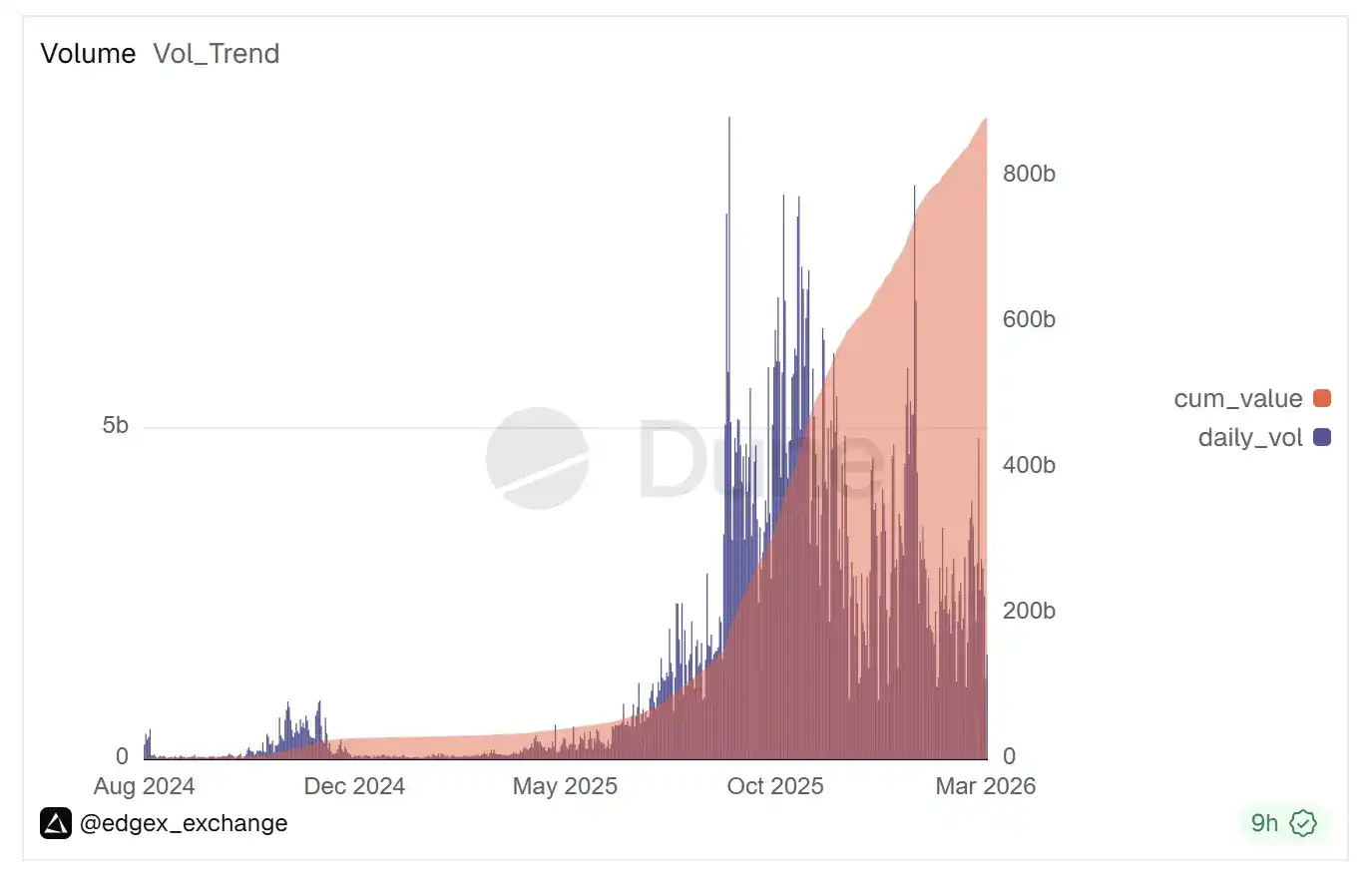
Since August 2025, edgeX's trading volume has entered a period of rapid growth. To date, it has accumulated over 470,000 user addresses, a total trading volume exceeding $87.7 billion, and a current Total Value Locked (TVL) of over $360 million. Furthermore, edgeX has generated over $180 million in fee revenue from these trades.
The edgeX team had previously promised the community that they would absolutely not screen for Sybil attacks—'if you have points, you get tokens'—which was a source of confidence for many edgeX users. However, what no one anticipated was that while edgeX indeed did not remove Sybil accounts this time, they manipulated the "points weighting" instead.

Based on community feedback, many users earned the same number of points through trading but received different amounts of airdropped tokens. Some users received 4 tokens per point on average, some only received 0.5 tokens per point, while others received 11 tokens per point. In response, the project team merely stated that points from different sources indeed had different weights.

Even calculating at the rate of 11 tokens per point, their current value is only about $5.5. In contrast, the secondary market price for edgeX points last year was $30-40, resulting in significant losses for secondary market buyers of these points.

What's worse, several KOLs, including He Bi, exposed that the edgeX project team engaged in a 'rat warehouse' situation (insider trading/preferential allocation), where multiple linked addresses with low points collectively received a quarter of the total airdropped tokens.

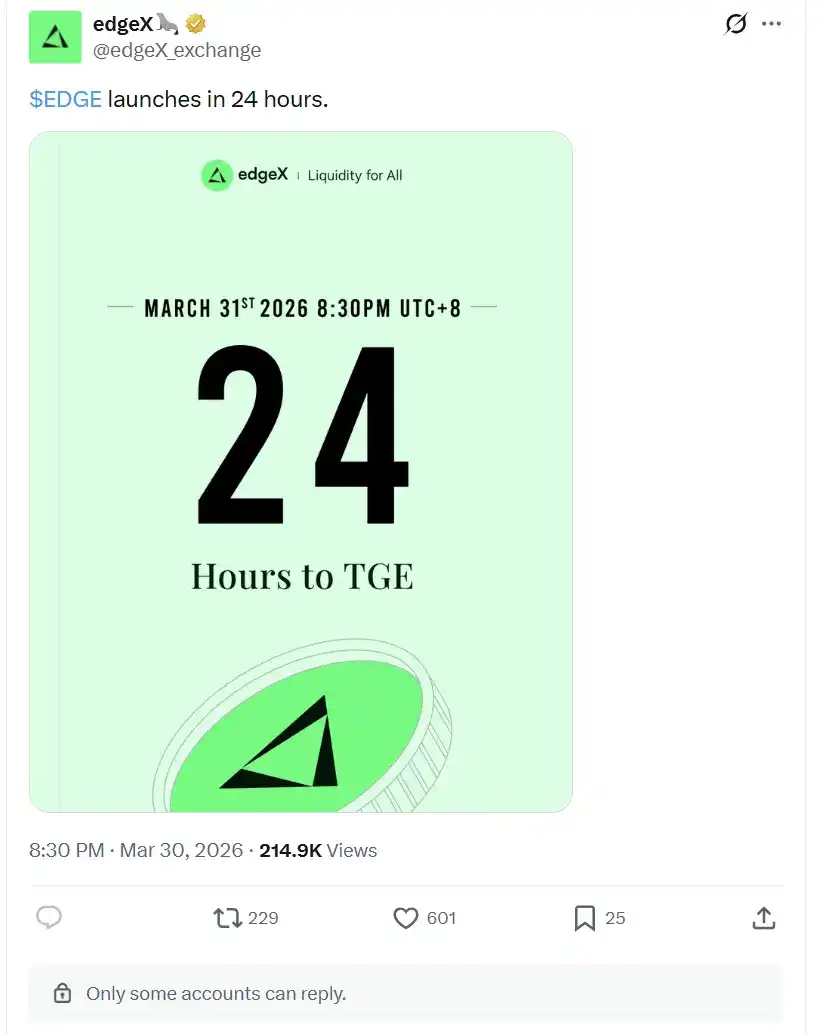
As community质疑声四起质疑 (questioning) grew louder, edgeX directly disabled comments on its X (formerly Twitter) account, attempting to suppress the spread of negative comments, but it was already too late.
"Why did they change rules arbitrarily, resulting in different rights for the same points? Why delete posts, kick people out, and suppress discussion? Because a project that from the very start intended to rely on wash trading to inflate data, hype valuations with stories, and coordinate with market maker groups for利益输送 (benefit transfer/insider profiteering) fundamentally cannot respect users, nor can it respect the community," said well-known KOL Ice Frog in an X post.

Ice Frog also stated that the most egregious aspect of edgeX is that it wasn't aimed at building a project from the beginning, but rather at setting up a scheme (a scam/plot), attempting to use manipulation and收割 (harvesting/exploitation) to destroy this industry.

Undoubtedly, this "post-rules" handling directly shatters the core premise of user trust in airdrop mechanisms—predictability. Once users cannot evaluate returns based on公开规则 (public rules), the so-called "points farming strategy" loses its博弈基础 (gaming foundation). One after another, large-scale "反向撸毛" (reverse airdrop/being rugged) and "作恶" (malicious acts) events continue to impact user confidence.

In fact, a significant portion of the trading volume and user activity on many yet-to-launch-token DeFi protocols comes from airdrop expectations. The seemingly massive community size and trading volume are built on this foundation. Once such projects complete their token launches and lose the appeal of potential收益 (returns/yields) for users, the false prosperity will quickly crumble. Once the expected returns from trading for airdrops are no longer certain or even become negative, the overall activity of the entire DeFi market could significantly decline.

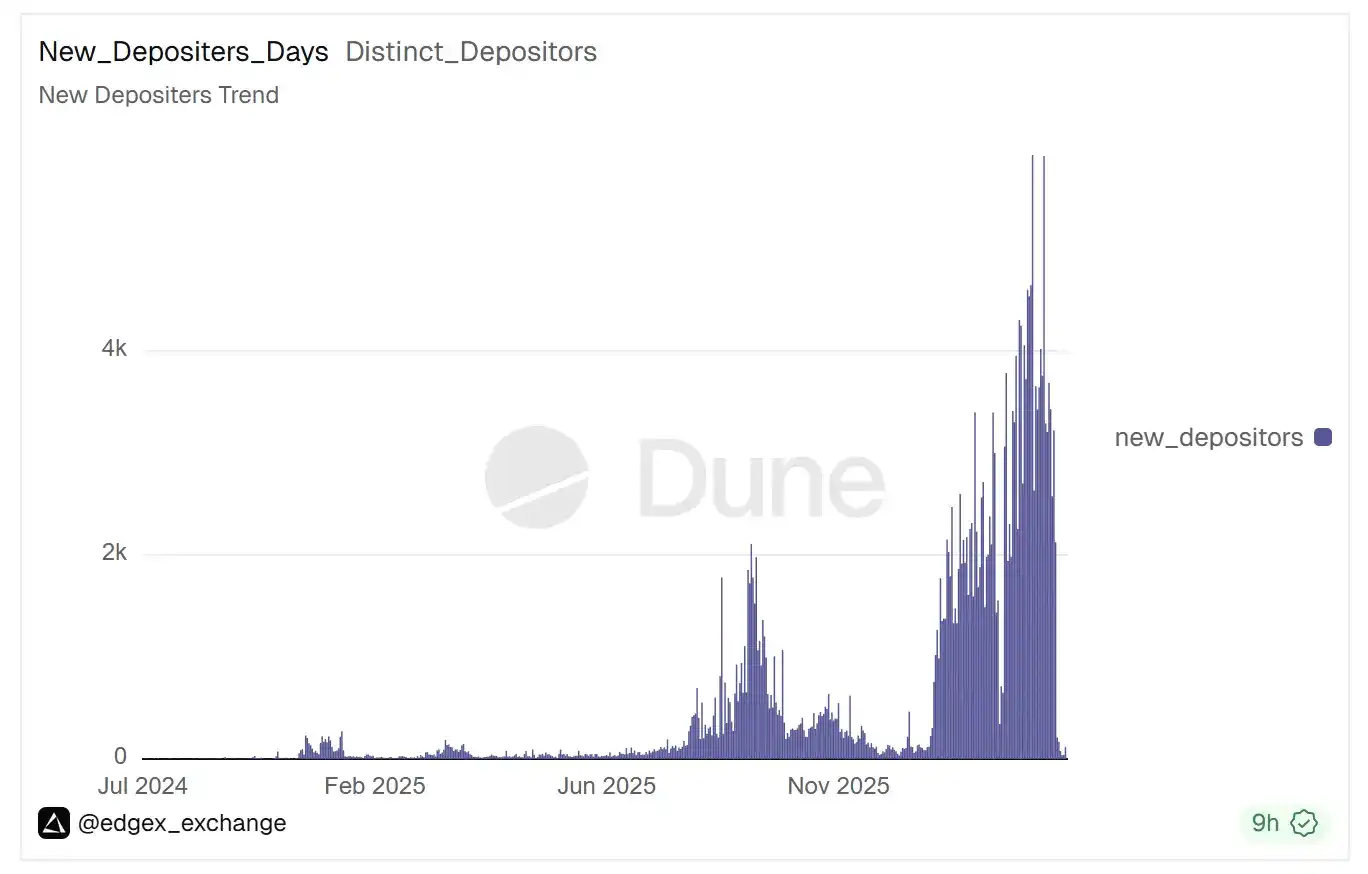
Taking edgeX as an example, in the days following the conclusion of the airdrop snapshot for this project, the number of new depositing users per day plummeted from over 2,000 to fewer than 50.
After the edgeX反向撸毛 (rug pull), what remains for the market is a series of question marks: How many people will continue to believe in "getting rich through airdrops"? As反向撸毛 (getting rugged) becomes the new normal and large numbers of airdrop hunters leave, will DeFi's trading activity and user stickiness continue to decrease?

When "反向撸毛" (reverse airdrops/rug pulls) evolve from isolated incidents into an industry consensus, the myth of getting rich through airdrops may have come to an end. For participants in the post-airdrop era, protecting the cash flow in hand might be more important than chasing those hard-to-verify "airdrop expectations."


Domande pertinenti

QWhat is the main controversy surrounding the edgeX airdrop distribution?

AThe main controversy is that edgeX applied different weights to user points without clear prior disclosure, resulting in unequal token distributions for users with the same number of points. Some users received 11 tokens per point while others received as low as 0.5, breaching expectations of fairness and transparency.

QHow did edgeX respond to the community's criticism regarding the airdrop?

AedgeX closed the comments section on its X (Twitter) account to suppress negative feedback and did not provide a transparent explanation for the unequal point weighting, only acknowledging that points from different sources had different weights.

QWhat allegations did KOLs like He Bi and Bing Wa make against edgeX?

AKOLs alleged that edgeX engaged in 'rat trading' (insider manipulation), where low-point affiliated addresses received a quarter of the total airdropped tokens, suggesting the project was designed to benefit insiders rather than the community.

QWhat impact did the airdrop snapshot have on edgeX's user activity?

AAfter the airdrop snapshot was completed, daily new depositing users on edgeX plummeted from over 2,000 to fewer than 50, indicating a collapse in user engagement once the airdrop incentive was removed.

QWhy does the article suggest that the edgeX incident could harm the broader DeFi ecosystem?

AThe incident undermines trust in airdrop predictability, which drives much of DeFi's trading volume and user activity. If users can no longer rely on fair rewards, engagement may decline, and the 'airdrop farming' economy could collapse.

Letture associate

Saylor's Purchase of 1550 Bitcoin Is a Bad Trade

**Title: Saylor's Purchase of 1,550 Bitcoins Was a Bad Trade** The article critically analyzes Strategy's recent move of selling 32 bitcoins followed by a much larger purchase of 1,550 bitcoins. While appearing bullish, the author argues this trade is detrimental to MSTR shareholders. The core argument revolves around the concept of "breakeven modified Net Asset Value (mNAV)," a key metric for Strategy. To increase Bitcoin per share (BPS) for MSTR holders, Strategy must issue new shares at a premium high enough that the funds raised can buy more bitcoin than the bitcoin backing each existing share. Currently, this breakeven mNAV is estimated at 1.30. The recent trade failed on two counts: 1. The shares for the $181 million raise were issued at an mNAV *below* the 1.30 breakeven point. Selling "cheap" shares to buy bitcoin actually *reduces* BPS. 2. Only $101.3 million of the raised funds were used to buy bitcoin; the rest went to boost the company's dollar reserves. The breakeven mNAV calculation assumes *100%* of proceeds are used for bitcoin purchases. Diverting funds, even if mNAV were high, dilutes BPS. The result is an estimated 0.19% decrease in Bitcoin per share for MSTR holders. In exchange, Strategy merely extended its operational runway for its dollar reserves from ~6.3 months to 7 months. The author interprets this as Strategy prioritizing the survival and development of its STRC business over its stated core goal of increasing MSTR's BPS. This constitutes a gamble: if sacrificing MSTR value leads to improved market sentiment and a recovery in STRC's price (and thus mNAV), the whole system could work. If not, Strategy may be forced into a cycle of further diluting MSTR to stay afloat, potentially leading to deferred STRC dividends or corporate decline. The article concludes with a hope for price recovery for Bitcoin, MSTR, and STRC.

Foresight News13 min fa

Saylor's Purchase of 1550 Bitcoin Is a Bad Trade

Foresight News13 min fa

The AI Bear Market Lasting Two Days Is Over; Why Did Funds Buy Back Storage Stocks First?

After a severe two-day selloff in early June that erased over $1 trillion from U.S. chip stock market value, capital is flowing back first to the memory sector. The correction was not driven by a collapse in AI demand but rather a market reassessment of high expectations. Stocks like Broadcom faced selling pressure despite strong AI revenue guidance, signaling a shift in focus from who has an "AI story" to who can most rapidly translate AI demand into verifiable profits and earnings per share (EPS). Memory companies, such as Micron and SK Hynix, are leading the recovery because their EPS growth is more immediately verifiable. The AI server boom directly increases demand for high-bandwidth memory (HBM) and high-capacity server DRAM, tightening supply and driving up contract prices for conventional DRAM and NAND Flash. This price increase, coupled with a shift to higher-margin products, flows directly into near-term revenue and profitability, as evidenced in recent earnings reports. In contrast, other AI semiconductor segments like GPUs, ASICs, and optical modules, while central to the long-term AI infrastructure story, face longer and less certain paths to EPS validation. Their growth depends more on future product cycles, customer adoption timelines, and capital expenditure plans. The rebound in memory stocks highlights a market preference for assets with shorter, more transparent EPS conversion cycles following the recent de-risking phase. However, this does not negate the potential of other AI hardware segments should they provide clearer near-term order visibility. The episode has raised the validation bar for all AI-related investments.

marsbit13 min fa

The AI Bear Market Lasting Two Days Is Over; Why Did Funds Buy Back Storage Stocks First?

marsbit13 min fa

Monera Digital|Crypto Market May Report: Four Major Reasons Behind the Accelerated Decline

Monera Digital Crypto Market May Report: Four Key Reasons Behind the Accelerated Decline The crypto market experienced a significant downturn in May, driven by an internal liquidity crisis rather than external macro factors. Bitcoin fell from around $82,850 to $73,674, even as traditional markets rallied in the final week, highlighting a clear "liquidity transmission failure" specific to crypto. Four primary internal factors caused the accelerated sell-off: 1. **Major ETF Outflows:** U.S. spot Bitcoin ETFs saw a net outflow of $2.425 billion for the month, the third-largest monthly withdrawal since their launch. Ethereum ETFs also reversed to net outflows. This turned a key pillar of the bull run into a source of selling pressure. 2. **Holder Capitulation:** On-chain data showed textbook "surrender" patterns. The Short-Term Holder MVRV ratio fell below 1.0, indicating this cohort is now in aggregate loss. The Net Unrealized Profit/Loss (NUPL) metric also deteriorated significantly. 3. **Contagious Negative Sentiment:** The Coinbase Premium Index, which shows U.S. institutional buying/selling pressure, turned deeply negative for most of the month. This confirmed the ETF outflows and reflected a strategic shift away from crypto toward assets like U.S. Treasuries. 4. **Leverage Unwinding and Psychological Breaks:** Despite the downturn, futures open interest initially grew, signaling leveraged positioning. This culminated in a sharp deleveraging event with $307 million in long liquidations. Furthermore, the price broke below the critical $75K-$76K support zone, which is both a key gamma option level and the approximate average cost basis for major public companies holding Bitcoin, turning them from potential buyers into potential sellers. The report concludes that the market's pricing power has shifted from macro narratives to internal liquidation. While Bitcoin's 200-week moving average quantile has entered a historical "value zone" at 10.2%, this indicates a deep bear market reset is underway, not an immediate reversal. A sustainable recovery will require both a genuine improvement in the macro liquidity environment and clear signs of renewed on-chain demand, such as ETF inflows resuming and the Coinbase Premium turning positive. Until then, discipline and capital preservation are paramount.

marsbit24 min fa

Monera Digital|Crypto Market May Report: Four Major Reasons Behind the Accelerated Decline

marsbit24 min fa

Trading

Spot
Futures
活动图片