AI Sweeps Everything, Why Are Crypto Builders the Most Secure?

marsbitPubblicato 2026-03-20Pubblicato ultima volta 2026-03-20

Introduzione

In an era where AI is disrupting industries and causing widespread job displacement, crypto builders are uniquely positioned to thrive. While AI threatens to automate many white-collar and coding jobs, the crypto sector has forged individuals with exceptional adaptability, cross-domain expertise, and rapid learning capabilities. The real issue isn’t that crypto is dying—it’s that AI is commoditizing knowledge-based work globally. True value in AI is captured by infrastructure players like NVIDIA and OpenAI, not by those simply wrapping AI models. In contrast, crypto offers structural advantages: its community operates at high information density, tracks multiple innovation frontiers, and builds non-commoditizable tech like zero-knowledge proofs and quantum-resistant cryptography. Major players like Stripe, BlackRock, and Cloudflare are investing heavily in crypto infrastructure, signaling real-world demand. The future remains uncertain, but those who build through uncertainty—as seen in past technological revolutions—will define the next era. Crypto builders, equipped with a unique skill set and mindset, are among the best prepared to navigate and lead in the age of AI.

Written by: YQ

Compiled by: Chopper, Foresight News

A current point of debate on Crypto Twitter is: 'Should I stay, or should I go?' The question itself is wrong; it assumes there is a safe place to go, but in reality, there is none.

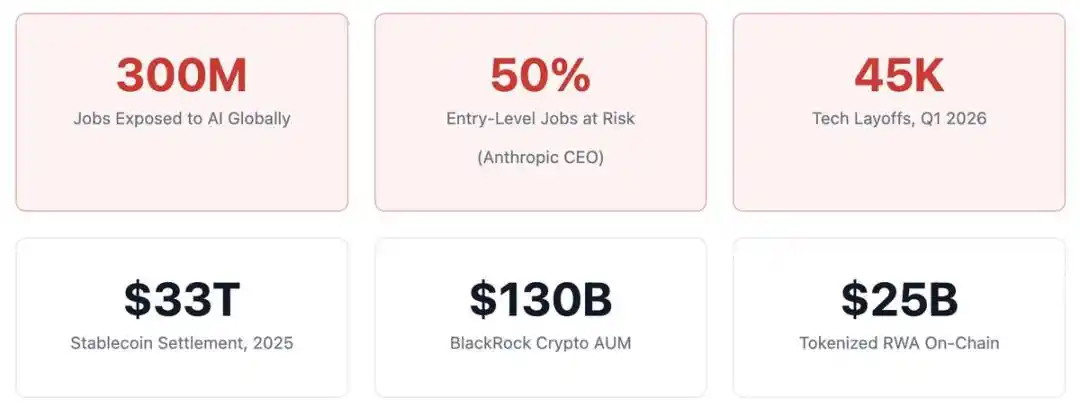
Goldman Sachs states that 300 million jobs globally will be impacted by AI. The CEO of Anthropic claims that 50% of junior white-collar jobs will disappear within five years. Just in Q1 2026, 45,000 tech workers were laid off.

This is not a problem unique to the crypto industry; it is the Fourth Industrial Revolution arriving at everyone's doorstep.

The panic you feel is real and widespread. And those who find the next direction to build will define the next thirty years.

What I see is this: the crypto industry hasn't made you fragile; it has forged you into the fastest-learning, most cross-domain capable, and most adaptable builders on the planet. The real question is: will you use this ability, or will you discard it to chase a sense of security that simply doesn't exist.
Confronting the Real Problem

The statement 'Crypto is dead for builders' had some merit in 2022. It described a market that no longer exists today.

Behind the same anxiety lies a more brutal, yet more universal truth: AI is commoditizing all work based on existing knowledge and pattern matching.

This is the real fear, not 'crypto has no use cases.' What is truly unsettling is that Claude Code, Codex, Gemini Code Assist are already so powerful that most junior software development roles are being replaced.

Stanford University research confirms: since the launch of ChatGPT, the employment rate for developers aged 22-25 has fallen by 20%. 60% of companies plan to replace employees with AI in 2026. The marginal cost of a competent code agent is approaching zero.

This is not a cryptocurrency problem. This is a problem facing all of human civilization, and it is impacting every industry simultaneously.
Three Types of People Make Money, The Rest Panic

Stripping away the hype, who is *really* making money from AI right now?

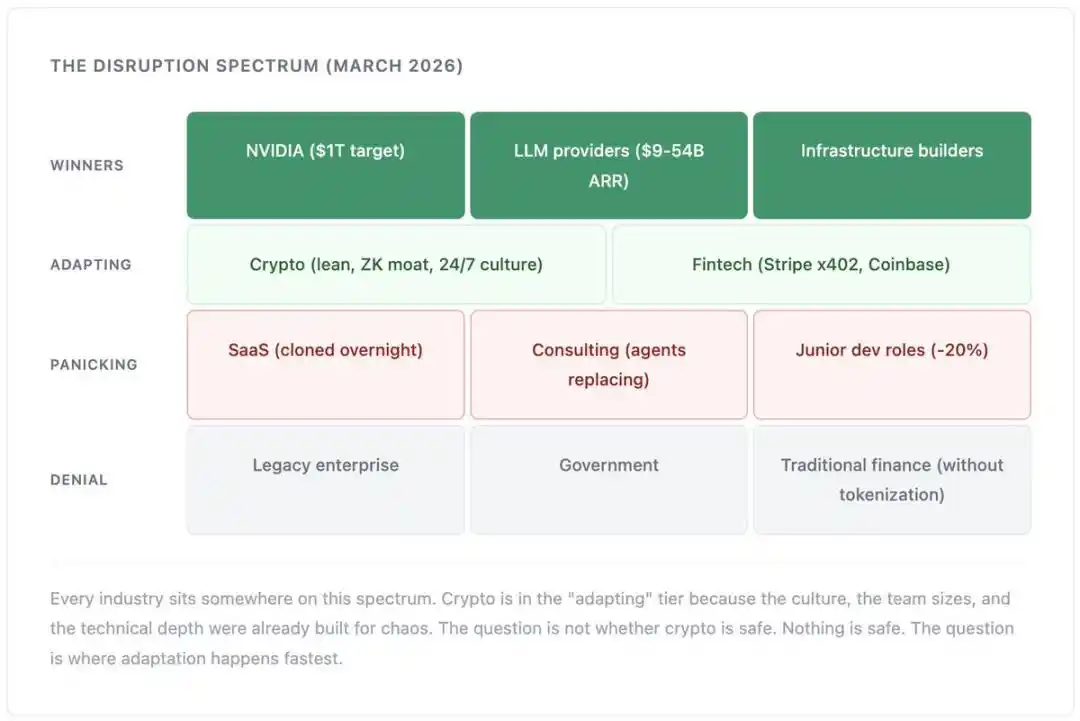
First Layer: NVIDIA. NVIDIA's annual revenue is $216 billion; Jensen Huang aims for $1 trillion in annual AI chip revenue by 2027. This is the classic 'selling shovels' logic, proven effective time and again in every transformation.

Second Layer: Major model vendors. OpenAI's annualized revenue is $12.7 billion, targeting $54 billion by 2027. Anthropic's annual recurring revenue is approaching $9 billion, targeting $20-26 billion in 2026. They sell API calls, have recurring revenue, and real profits.

Third Layer: Fearmongers. Short video creators, course sellers, make money by telling you 'AI will replace you.' The content is fear, the product is a $99 course, with extremely high profit margins.

Everyone else is searching for a moat, but finding none. A good idea gets copied by hundreds of companies within days of launch. If the profits are attractive enough, OpenAI, Anthropic, or Google will step in and launch their own version.

Manus was the first general AI agent, then Claude launched Cowork, followed by OpenClaw open-sourcing the entire concept, garnering 219k stars on GitHub. The window from 'innovation' to 'commoditization' is now measured in weeks.

A dangerous signal: if your moat is just 'a nice interface wrapped around a large model,' then you have no moat. The marginal cost of wrapping models is approaching zero. The real barrier in the AI field lies in controlling the infrastructure that large models rely on, not piling features on top of them.

Why Crypto Builders Actually Have a Unique Advantage

Set aside shallow narratives like 'crypto is dead' and ask: how much better off is any other field?

Compared to SaaS? All features will be copied by AI overnight. Compared to consulting? Agents are replacing analysts. Compared to junior dev roles? Employment has fallen 20% in two years.

Crypto builders possess structural advantages that other tech fields lack.
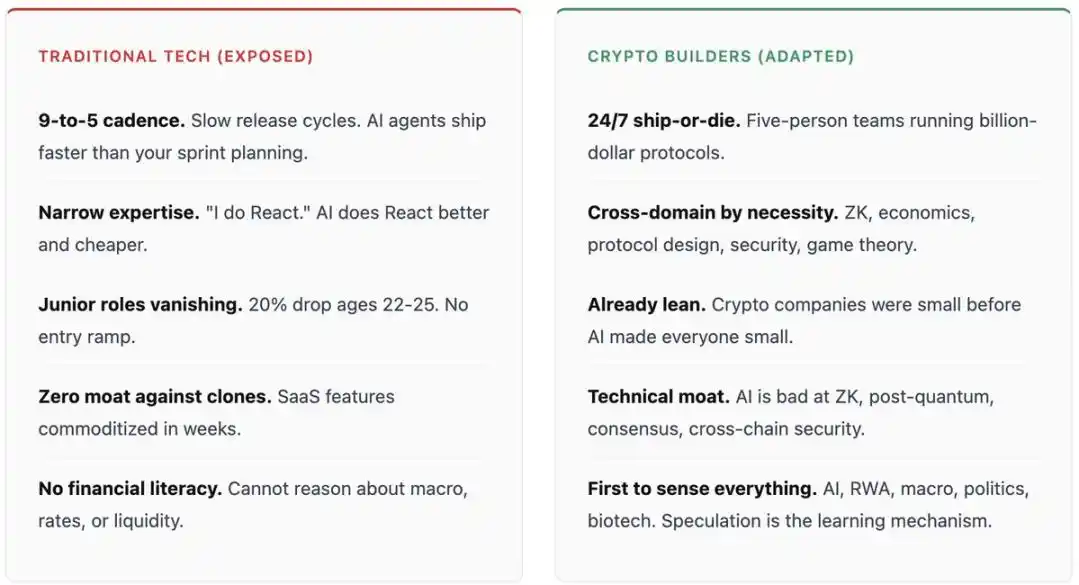
One point is particularly important: the crypto crowd has the highest information density in the tech circle. They track cryptography, distributed systems, macroeconomics, geopolitics, oil, gold, AI, biotech, longevity tech, SpaceX, and all cultural hotspots.

Why? Because they are betting on it. Meme coins, prediction markets, new token offerings... Speculation is not a flaw; it is the fastest learning mechanism humans have invented. By the time traditional industries catch on to a trend, crypto builders have already built the infrastructure for it and moved on to the next big thing.

And technical barriers aren't just talk; they are measurable. The Ethereum Foundation has elevated post-quantum cryptographic security to its highest strategic priority. Vitalik's 'Ethereum Simplification' roadmap places 'full quantum resistance' at its core. Zero-knowledge proof systems, Poseidon hash functions, lattice-based cryptography...

Claude Code can easily crush CRUD apps, but it's far less effective when writing recursive SNARK circuits or designing validator penalty mechanisms with game-theoretic guarantees.

The Fact Everyone is Ignoring

Watch actions, not sentiment. Those actually doing things are giving an answer completely opposite to the doomsayers on Crypto Twitter with their actions.
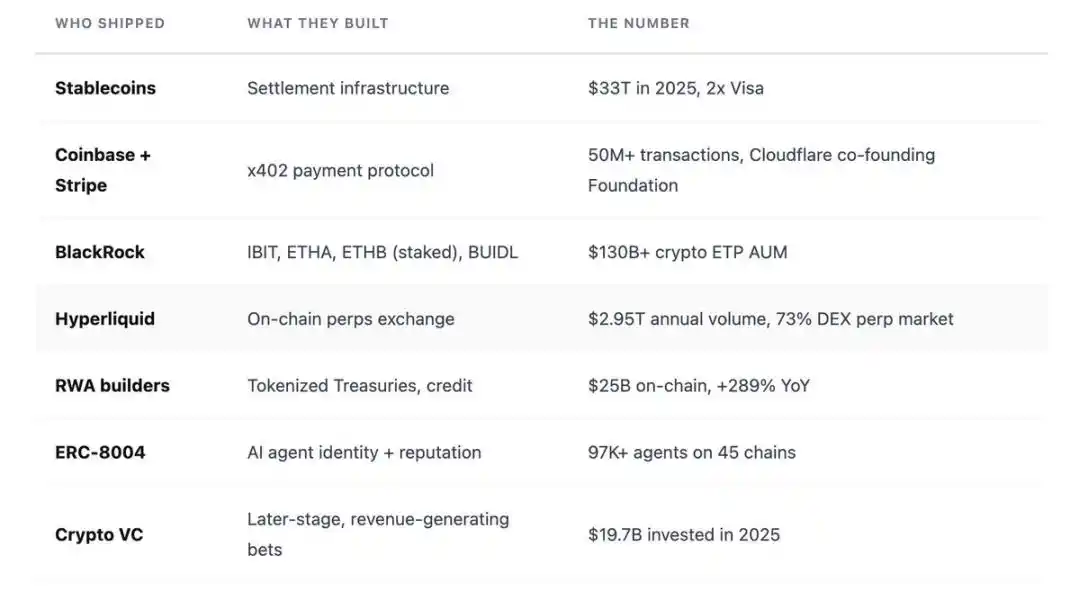
Stripe won't integrate a dying protocol. BlackRock won't issue a staked ETH ETF in a dead market. Cloudflare won't co-found a payments foundation for an industry with no future.

Hype is not demand; adoption is demand. These giants are voting with their feet.

Pandora's Box is Open

Sam Altman cannot predict what GPT-6 will bring. Dario Amodei built a lab focused on safety yet still admits half of junior jobs will disappear. Sundar Pichai reorganized all of Google to pivot entirely to AI.

The people building these technologies don't know what the future holds. No one knows.

Only three things are certain:

  • The box won't close. AI will get stronger, code agents will get better, white-collar automation will accelerate. We are not going back to an era of all hand-written code. The question is not how to escape, but how you position yourself.
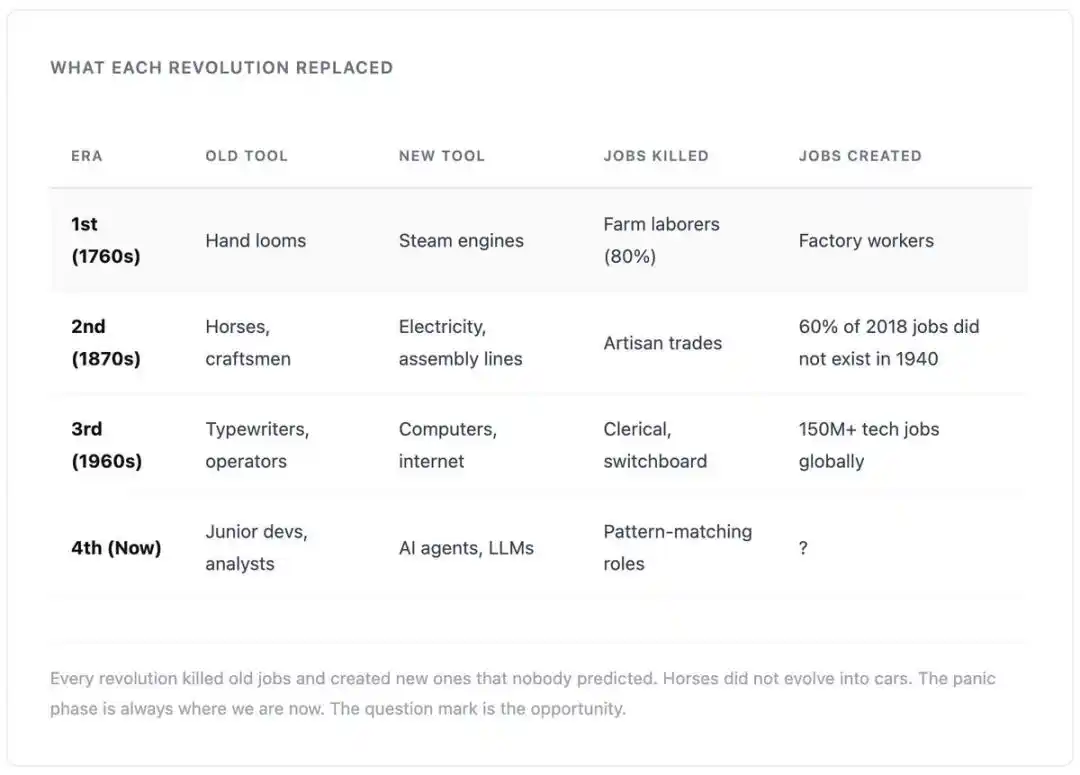
  • New tools create new professions. In 1995, no one foresaw 'social media manager.' In 2005, no one foresaw 'cloud architect.' Today, no one can predict the AI-native professions of 2030. But every industrial revolution has created more jobs than it destroyed, without exception.
  • Builders during the panic will dominate the next era. Amazon was born amidst the skepticism of the dot-com bubble; Stripe was founded when payments were 'already solved'; Coinbase started when Bitcoin was a joke.

When everyone feels 'now is not the time to build,' it is precisely the signal that it is the best time to build.
Your Choice

For doing old things, this is the worst of times. For trying new things, this is the best of times.

Don't leave the industry just because Crypto Twitter is full of anxiety. *Everyone* is anxious. Financial analysts are anxious. SaaS founders are anxious. Junior engineers at Google are anxious.

The difference is: the crypto industry has endowed you with a set of capabilities most builders don't have: all-weather cross-domain pattern recognition, a permissionless innovation sandbox, lean teams that can launch quickly without approval, and the community that absorbs new technologies the fastest globally.

Follow your genuine interest. Not because it's a comforting platitude, but because in a world where no one knows the future, the only reliable signal is whether you genuinely care about this thing, whether you are willing to persevere through difficult times.

And difficult times will come for everyone, for every industry.

Pandora's box is open; it cannot be closed. Pick up the new tools and move to the frontier. Those who persist in building amidst the panic will ultimately define the next era.


Domande pertinenti

QWhy does the article argue that crypto builders are uniquely positioned during the AI revolution?

AThe article argues that crypto builders possess structural advantages such as high information density, cross-domain adaptability, and experience in fast-paced, permissionless innovation. They are skilled in complex areas like cryptography and distributed systems, which are less easily automated by AI compared to routine coding tasks.

QAccording to the article, what are the three groups currently profiting from AI?

AThe three groups profiting from AI are: 1) Nvidia (selling AI chips), 2) Major model manufacturers like OpenAI and Anthropic (selling API calls with recurring revenue), and 3) Those selling fear, such as influencers and course sellers capitalizing on AI anxiety.

QWhat is the core fear that the article identifies, beyond the crypto-specific concerns?

AThe core fear identified is that AI is commoditizing all work based on existing knowledge and pattern matching, threatening to replace a vast number of white-collar and junior developer positions across all industries, not just crypto.

QWhat evidence does the article provide to counter the narrative that 'crypto is dead' for builders?

AThe article points to actions from major institutions like Stripe integrating crypto protocols, Blackrock issuing a staking ETH ETF, and Cloudflare co-founding a payment foundation as evidence of real-world demand and long-term confidence, contradicting the superficial narrative.

QWhat is the article's final advice to builders feeling anxiety about the future?

AThe article advises builders to leverage the unique skills they've developed in crypto, such as rapid learning and adaptation, and to continue building new things based on genuine interest, as periods of widespread panic are historically the best times for innovation and defining the next era.

Letture associate

Unitree Passes the Hearing, Hangzhou Reaps the Rewards

Unitree Technology, a leading company in Hangzhou's tech scene known as one of the "Hangzhou Six Dragons," has officially passed the review for listing on the Shanghai Stock Exchange's STAR Market (科创板). It plans to raise 4.202 billion yuan for the research and development of intelligent robot models and robot hardware. This milestone will make Unitree the "first humanoid robotics stock." Founded in 2016 by Wang Xingxing, the company started humbly in a small office in Hangzhou's Binjiang district. Initially, the robotics sector was not viewed favorably by the market, with Unitree's products often labeled as "toys" and struggling to secure funding. At its most critical point, with only around 100,000 yuan left, Wang stopped his own salary to keep the company afloat. A crucial turning point came in 2018 when Hangzhou's state-owned capital system provided timely support. A financial platform under the city's state-owned assets completed due diligence in three days and granted a 20-million-yuan loan within a week. This "patient capital" infusion stabilized Unitree, enabling its transition from prototype development to mass production and commercial viability. Subsequently, Hangzhou Capital, through its two major 100-billion-yuan mother funds—the Hangzhou Science and Technology Innovation Fund and the Hangzhou Innovation Fund—participated in four of Unitree's financing rounds (B2, B3, C, and C+). This continuous backing helped the company grow, attract top-tier industrial investors like China Mobile, Tencent, Alibaba, and Geely, and solidify its position as a global leader in legged robotics. By 2025, Unitree achieved significant scale, with revenue reaching 16.99 billion yuan, net profit of 5.91 billion yuan, global leadership in humanoid robot shipments, and over 33,000 quadruped robots sold worldwide. Unitree's journey exemplifies Hangzhou's strategy of nurturing hard-tech startups from "seedlings" to industry leaders. Beyond Unitree, Hangzhou's capital ecosystem has supported other "Six Dragons" like Cloudwalk, BrainCo, and DeepSeek. The city has established a 500-billion-yuan "3+N" industrial fund cluster and specialized early-stage funds like the "Runmiao Fund" with a 20-year term to fill funding gaps for very early-stage projects. This robust "capital + talent" model, coupled with an influx of over 430,000 young professionals in 2025 alone, has fostered a vibrant innovation ecosystem. Hangzhou is now home to 48 unicorns and 413 potential unicorns, building comprehensive industrial chains in AI, robotics, brain-computer interfaces, and more. As Hangzhou experiences a wave of IPOs, it is solidifying its reputation as an ideal city for entrepreneurs.

marsbit17 min fa

Unitree Passes the Hearing, Hangzhou Reaps the Rewards

marsbit17 min fa

Are Rising U.S. Stocks Getting More Dangerous? Goldman Sachs: Downside Protection Mechanisms Have Almost Failed

The US stock market rally is showing signs of becoming increasingly precarious as key downside protection mechanisms fail, according to Goldman Sachs. Derivatives strategist Brian Garrett notes that the S&P 500 options volatility skew has plunged to an 18-month low, indicating the market now prices an 8% probability for both a 10% drop and a 10% rise—a sign of "skew failure." Concurrently, Goldman's Panic Index hit a two-year low, reflecting minimal demand for tail-risk hedging. This complacency emerges amid a relentless market surge, with the S&P 500 setting new records frequently in 2024. Garrett highlights three major concerns: extreme concentration in the top ten stocks (40% of index weight), heavy reliance on AI-themed performance, and a price pattern eerily similar to the 1998-1999 period. Despite pervasive media pessimism, this fear is absent in options pricing. Downside hedge costs are historically low. Goldman suggests tactical trades: buying RSP outperformance options versus the SPX for a broadening rally, purchasing VIX calls for protection, and going long on Bitcoin ETF volatility. Hedge funds have been net buyers for two weeks, with sector rotation into financials and out of industrials. Notably, the global single-stock leveraged/ inverse ETF AUM has doubled to over $60 billion in two months, underscoring growing speculative activity.

marsbit43 min fa

Are Rising U.S. Stocks Getting More Dangerous? Goldman Sachs: Downside Protection Mechanisms Have Almost Failed

marsbit43 min fa

DAT Failure? Listed Companies Betting on HYPE Floating Profit of $12.5 Billion

Several public companies that adopted a "HYPE Treasury" strategy—holding significant reserves of the HYPE token from the Hyperliquid ecosystem—have achieved substantial paper gains, collectively exceeding $1.25 billion. This contrasts with the reported struggles of MicroStrategy's flagship BTC treasury strategy. The article profiles three such HYPE-focused treasury companies: 1. **Hyperliquid Strategies Inc. (PURR):** The largest holder, with approximately 22.3 million HYPE tokens valued at ~$1.636 billion, resulting in an unrealized gain of ~$1.22 billion. It has fully transitioned from a biotech firm to a dedicated crypto treasury, adding staking and validator operations to enhance returns. 2. **Hyperion DeFi (HYPD):** Holds around 2 million HYPE tokens (~$147 million value) with a gain of ~$49.4 million. It is deeply integrated into the Hyperliquid ecosystem, running a major validator node and building DeFi products for additional yield. 3. **Lion Group Holding (LGHL):** A smaller holder with ~194,000 HYPE tokens (~$14.14 million value), maintaining a long-term commitment to the token. The success of these HYPE treasuries is attributed not only to the token's significant price appreciation but also to active on-chain participation through staking, validation, and ecosystem integrations, creating a compounding "flywheel" effect. The article posits that while MicroStrategy's BTC strategy faces challenges, HYPE treasuries may offer a more sustainable model through deeper protocol engagement, with potential for further growth if HYPE's price rises as predicted by some analysts.

marsbit1 h fa

DAT Failure? Listed Companies Betting on HYPE Floating Profit of $12.5 Billion

marsbit1 h fa

Trading

Spot
Futures
活动图片




