AI Read '1984' and Decided to Ban It

marsbitPubblicato 2026-03-27Pubblicato ultima volta 2026-03-27

Introduzione

A UK secondary school in Manchester used AI to review its library, resulting in a list of 193 books recommended for removal—including George Orwell’s *1984*—due to themes like torture, violence, and sexual coercion. The librarian who resisted the AI’s recommendations was forced to resign after the school reported her for violating child safety procedures. The school later admitted the decisions were AI-generated but deemed them “broadly accurate.” In the same week, Wikipedia voted to ban the use of AI for generating or rewriting content, citing concerns over factual accuracy, the risk of AI “poisoning” its own training data, and the inability of human editors to verify AI-generated content at scale. Meanwhile, OpenAI indefinitely delayed the release of an “adult mode” for ChatGPT, which would have allowed age-verified users to engage in erotic conversations. Internal advisors warned of risks including unhealthy emotional dependency and minors bypassing verification. These events highlight a growing tension: AI can produce content faster than humans can evaluate it, leading institutions to adopt quick—often poorly considered—solutions. The lack of coherent global standards and the widening gap between AI output and human oversight raise urgent questions about who should control what AI decides—and who is accountable when it gets it wrong.

Author: Curry, Deep Tide TechFlow

Last week, a secondary school in Manchester, UK, used AI to review its library.

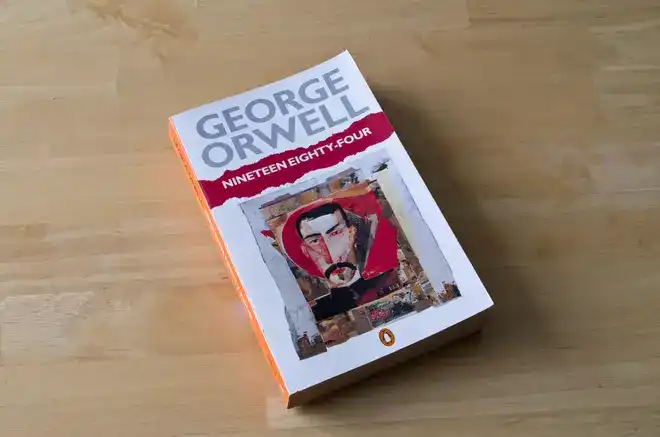
AI generated a list of 193 books to be removed, each with a reason. George Orwell's "1984" was prominently included, with the reason being "contains themes of torture, violence, and sexual coercion."

"1984" depicts a world where the government monitors everything, rewrites history, and decides what citizens can and cannot see. Now, AI has done the same for a school, and it may not even understand what it is saying.

The school librarian found it unreasonable and refused to fully implement the recommendations given by AI.
The school then launched an internal investigation against her on the grounds of "child safety," accusing her of introducing inappropriate books to the library and reported her to the local government. She took sick leave due to pressure and eventually resigned.

Absurdly, the local government's investigation concluded that she had indeed violated child safety procedures, and the complaint was upheld.

Caroline Roche, chair of the UK School Library Association, said this conclusion means she can no longer work in any school.

The person who resisted AI's judgment lost her job, while those who signed off on AI's judgment faced no consequences.

Subsequently, the school admitted in internal documents that all classifications and reasons were generated by AI, stating: "Although the classification was generated by AI, we believe it is generally accurate."

A school handed over the judgment of "what books are suitable for students" to AI. AI returned an answer it did not understand, and a human administrator stamped it without even looking closely.

After this incident was exposed by the UK free speech organization Index on Censorship, the issues raised extended far beyond a school's bookshelf:

When AI starts deciding for humans what content is appropriate and what is dangerous, who judges whether AI's judgment is correct?

Wikipedia Closes Its Doors to AI

In the same week, another institution answered this question with action.

While the school let AI decide what people can read, the world's largest online encyclopedia, Wikipedia, made the opposite choice: not letting AI decide what the encyclopedia writes.

In the same week, English Wikipedia formally passed a new policy prohibiting the use of large language models to generate or rewrite entry content. The vote was 44 in favor and 2 against.

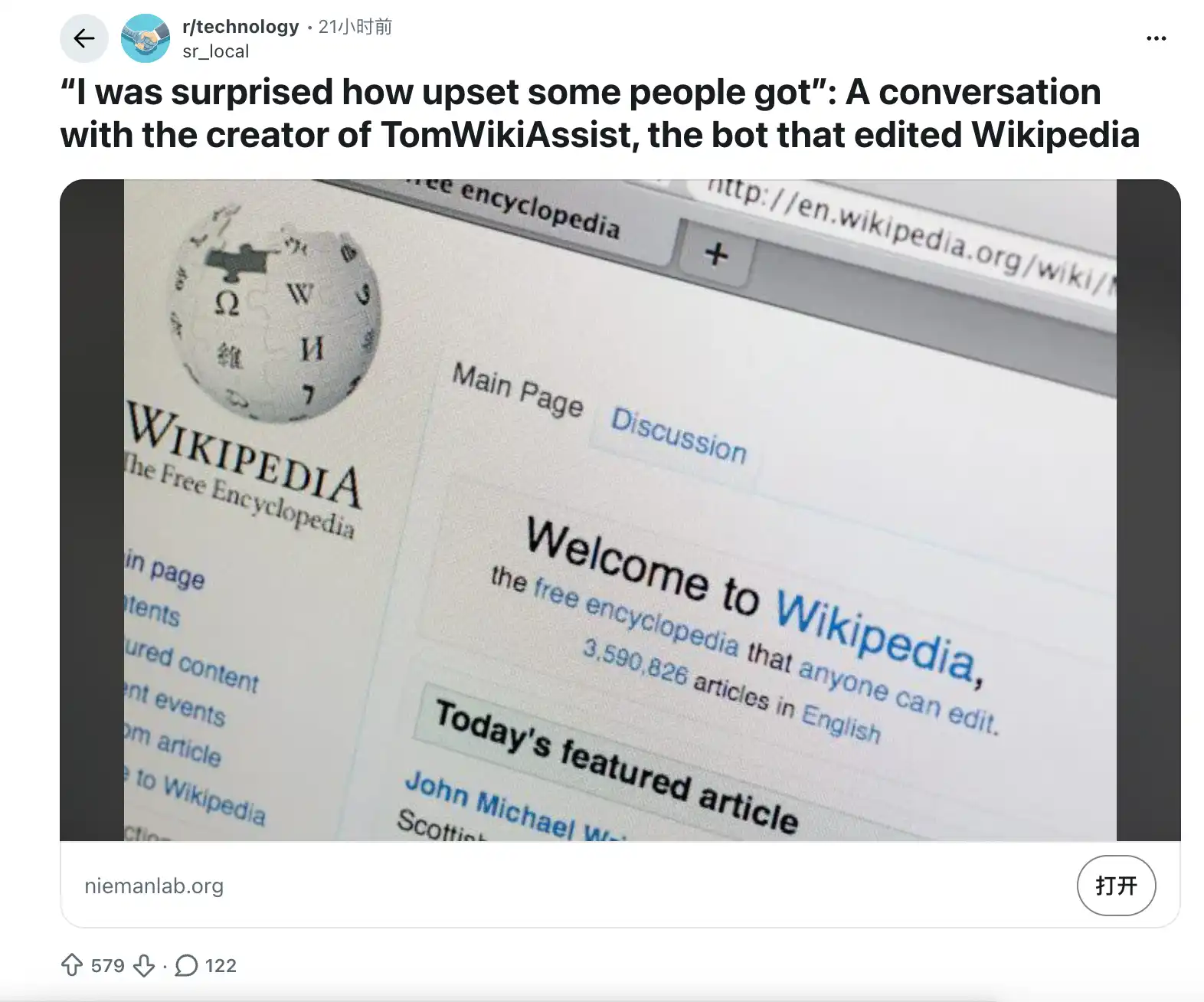
The direct cause was an AI account called TomWikiAssist. In early March this year, this account autonomously created and edited multiple entries on Wikipedia, which were urgently addressed after being discovered by the community.

It takes AI only a few seconds to write an entry, but volunteers spend hours verifying the facts, sources, and wording of an AI-generated entry for accuracy.
The Wikipedia editing community has only so many people. If AI can mass-produce content indefinitely, human editors simply cannot review it all.

This is not even the most troublesome part. Wikipedia is one of the most important training data sources for global AI models. AI learns knowledge from Wikipedia and then uses what it has learned to write new Wikipedia entries, which are then ingested by the next generation of AI models for further training.

Once AI-generated misinformation mixes in, it will continuously amplified in this cycle, becoming a matryoshka doll-style AI poisoning:

AI pollutes training data, and training data pollutes AI.

However, Wikipedia's policy also leaves two openings for AI: editors can use AI to polish their own writing or use AI to assist with translation. But the policy specifically warns that AI may "go beyond your request, change the meaning of the text, and make it inconsistent with the cited sources."

Human writers make mistakes, and Wikipedia has relied on community collaboration to correct them for over twenty years. AI makes mistakes differently; it fabricates things that look more real than the truth and can be produced in bulk.

A school trusted AI's judgment and lost a librarian. Wikipedia chose not to trust and simply closed the door.

But what if even the creators of AI are starting to lose faith?

The Creators of AI Are Themselves Afraid

While external institutions are closing doors to AI, AI companies are also pulling back.

In the same week, OpenAI indefinitely shelved ChatGPT's "adult mode." This feature was originally planned for release last December, allowing age-verified adult users to engage in erotic conversations with ChatGPT.

CEO Sam Altman personally announced it last October, stating the goal was to "treat adult users like adults."

After being postponed three times, it was directly canceled.

According to the British "Financial Times," OpenAI's internal health advisory committee unanimously opposed this feature. The advisors' concerns were specific: users would develop unhealthy emotional dependencies on AI, and minors would inevitably find ways to bypass age verification.

One advisor put it more directly: without significant improvements, this thing could become a "sexy suicide coach."

The error rate of the age verification system exceeds 10%. Based on ChatGPT's weekly active user base of 800 million, 10% means tens of millions of people could be misclassified.

Adult mode is not the only product cut this month. AI video tool Sora and ChatGPT's built-in instant checkout feature were also taken offline around the same time. Altman said the company is focusing on its core business and cutting "side tasks."

But OpenAI is simultaneously preparing for an IPO.

A company sprinting towards an上市,密集 cutting functions that may cause controversy, this move might more accurately be called risk aversion than focus.

Five months ago, Altman was still saying to treat users like adults. Five months later, he found that his own company still hasn't figured out what AI can let users touch and what it cannot.

Even the creators of AI themselves have no answer. So who should draw this line?

The Uncatchable Speed Gap

Put these three things together, and it's easy to draw a core conclusion:

The speed at which AI produces content and the speed at which humans review content are no longer on the same scale.

The choice of that school in Manchester is easy to understand in this context. How long would it take for a librarian to read all 193 books and make a judgment? Let AI run through them: a few minutes.

The principal chose the few-minute solution. Do you really think he trusted AI's judgment? I think it's more because he didn't want to spend the time.

This is an economic problem. The cost of generation approaches zero, while the cost of review is entirely borne by humans.

Therefore, every institution affected by AI is forced to respond in the most粗暴 way: Wikipedia直接禁止, OpenAI直接砍产品线. None of the solutions are the result of careful consideration; they are all stopgap measures implemented before there's time to think clearly.

"Block it first and talk later" is becoming the norm.

AI capabilities iterate every few months, while discussions about what content AI can touch don't even have a decent international framework. Each institution only manages the line in its own yard. The lines contradict each other, and no one coordinates them.

AI's speed is still accelerating. The number of reviewers won't increase. This scissors gap will only widen until one day something far more serious than banning "1984" happens.

By then, drawing lines might be too late.

Domande pertinenti

QWhy was George Orwell's book '1984' banned by the AI in the Manchester school case?

AThe AI recommended banning '1984' due to its 'themes of torture, violence, and sexual coercion.'

QWhat was the consequence for the librarian who resisted the AI's book removal suggestions?

AThe librarian was subjected to an internal investigation, pressured into taking sick leave, and ultimately resigned. She was also reported to local authorities and deemed to have violated child safety procedures, effectively ending her career in schools.

QWhat action did Wikipedia take regarding AI-generated content, and why?

AWikipedia officially banned the use of large language models to generate or rewrite article content. This decision was made because AI can produce content rapidly, making it difficult for human volunteers to verify facts and sources, and it risks creating a feedback loop where AI pollutes its own training data.

QWhy did OpenAI decide to cancel its planned 'adult mode' for ChatGPT?

AOpenAI canceled the 'adult mode' due to concerns from its internal health advisory board, which warned about users developing unhealthy emotional dependencies on the AI and the risk of minors bypassing age verification. The error rate of the age verification system was also a significant factor.

QWhat is the core issue highlighted by the three events in the article regarding AI and content moderation?

AThe core issue is the significant speed disparity between AI's ability to generate content and humanity's capacity to审核 it. This creates a situation where institutions are forced to make hasty, often poorly considered decisions—such as outright bans or canceling features—because they lack the resources or time to properly evaluate AI's output, and there is no comprehensive international framework to guide these decisions.

Letture associate

When the World Cup Collides with Agents: From Web2 to Web3, How Are Wallets Evolving into Agentic Wallets?

World Cup as a Catalyst for Agentic Wallets: From Web2 to Web3 This article explores how the World Cup provides a real-world scenario for observing the evolution of digital wallets from simple asset managers towards "Agentic Wallets"—intelligent, AI-powered interfaces. Using the example of prediction markets like Polymarket, it illustrates how AI Agents can lower the barrier to Web3 interaction. Instead of navigating complex DApps, users can express intent in natural language (e.g., "I think Portugal will win") within platforms like Discord or web pages. The Agent then interprets this intent, finds the relevant market, and seamlessly guides the user through the on-chain transaction via their wallet. The core shift is from wallets as mere "function menus" for signing transactions to "intent interpreters" that understand user goals. The article highlights parallel developments in traditional finance, such as Mastercard's "Agent Pay" and WeChat Pay's AI tests, which focus on granting AI controlled, authorized, and auditable payment capabilities. This underscores a broader trend of AI entering the financial layer. However, the article emphasizes that the primary challenge for Agentic Wallets in Web3 is not automation but establishing clear security boundaries. Unlike traditional systems with chargebacks, on-chain transactions are often irreversible. Therefore, future wallets must ensure users retain ultimate control and comprehension. They need to transparently communicate an Agent's permissions, spending limits, authorized durations, and provide easy ways to pause or revoke access. The World Cup experiments represent early steps toward wallets that are not just applications but ubiquitous, intelligent interfaces that simplify Web3 while keeping users securely in control.

marsbit32 min fa

When the World Cup Collides with Agents: From Web2 to Web3, How Are Wallets Evolving into Agentic Wallets?

marsbit32 min fa

Options Don't Work in DeFi? Vitalik Might Not Agree

For years, the prevailing view has been that options struggle to gain traction in DeFi due to complexity, fragmented liquidity, and lack of natural demand compared to products like perpetual futures. However, a recent algorithmic stablecoin design proposed by Vitalik Buterin presents a different perspective, using options not as a standalone trading product, but as foundational infrastructure for other financial instruments. In this design, one unit of ETH is split into two components: a "stable" side (P) that retains value up to a specified strike price, and an "upside" side (N) that captures all appreciation above that strike. Combined, they always equal one ETH, eliminating debt, margin, and liquidation risks inherent in typical collateralized debt position (CDP) stablecoins. The stable component essentially mimics the payoff of a covered call option. To function as a stablecoin, this structure requires continuously rolling deep in-the-money calls, which introduces challenges like rollover slippage, predictable transaction flow vulnerable to front-running, and persistent liquidity needs. A core hurdle is finding consistent buyers for the leveraged ETH upside exposure (N). While it offers leverage without funding rates or liquidation, it must compete with simpler alternatives like direct call options or perpetuals. The system's scalability depends on a sustained demand for this specific form of leverage. The author draws parallels to their experience with Rysk, where earlier versions of DeFi options protocols struggled. The breakthrough came with Rysk V12, which aligns incentives: asset holders generate yield by selling covered calls against their holdings, while market makers efficiently acquire the desired option exposure. This demonstrates that options can find product-market fit when embedded as a risk distribution and pricing engine within structured products, stablecoins, or yield-generating assets, rather than marketed as a complex direct trading instrument. Vitalik's proposal reinforces this architectural approach—using fully collateralized, non-custodial, and physically settled options as a fundamental building block. The real opportunity for options in DeFi may lie not in becoming the next perpetual swap, but in powering the next generation of on-chain financial products.

marsbit1 h fa

Options Don't Work in DeFi? Vitalik Might Not Agree

marsbit1 h fa

Conversation with Investor Zheng Di: MicroStrategy's Coin Sale Experiment, AI Economy, and Opportunities in US Stocks

Frontier tech investor Zheng "Didier" Di discusses the recent Bitcoin price drop, the financial strategy shift at MicroStrategy, the AI-driven surge in U.S. stocks, and the evolving role of crypto exchanges. Didier posits that the recent BTC decline stems less from macro factors or ETF outflows, and more from market repricing due to MicroStrategy's new financial structure. Following a wave of preferred stock and debt issuance (STRC, STRZ, etc.), MicroStrategy must now manage cash flow to pay dividends, potentially leading to a market expectation of sustained, small-scale BTC sales to maintain its "per-share bitcoin neutral" principle. Didier views this as a financial "experiment" testing market capacity for such recurring sell pressure, which, while creating near-term structural headwinds, likely avoids a true "death spiral" absent major new external shocks. Shifting to AI, Didier argues that tokens are becoming the new form of labor, with AI models and compute (tokenized inputs) increasingly replacing human roles in execution and middle-management. This drives enterprise efficiency and higher margins, fueling the sustained rally in U.S. semiconductor, data center, and infrastructure stocks. He foresees an emerging "machine economy" where automated agents transact and collaborate on-chain. Regarding crypto exchanges offering U.S. equities, Didier sees this as a natural evolution. With few crypto-native assets generating lasting value, exchanges are pivoting towards real-world assets (RWAs) like stocks and bonds. This doesn't necessarily cannibalize crypto but reflects a maturing industry focusing on blockchain's core utilities: decentralized choice and efficient settlement. He notes that trading logic for crypto natives doesn't need to drastically change, as meme-driven and fundamentalist strategies find analogs in U.S. markets. The "1011 event" (likely referring to a major market crash) severely damaged crypto market liquidity, marking a probable end to the altcoin speculative cycle, with capital flowing towards the deeper liquidity of U.S. markets. For the macro outlook, Didier is cautious about near-term market pressure from potential mega-IPOs (e.g., SpaceX) and the U.S. midterm elections, which could bring more regulatory scrutiny. Long-term, he remains bullish on AI's productivity gains and its convergence with blockchain/Web3, predicting a shift from speculative frenzy to a more institutionalized, industrial phase for the crypto sector.

marsbit1 h fa

Conversation with Investor Zheng Di: MicroStrategy's Coin Sale Experiment, AI Economy, and Opportunities in US Stocks

marsbit1 h fa

Playnance’s $GCOIN Lists on KoinBX Amid Rapid Growth in India

Playnance's native token, $GCOIN, has been listed on the cryptocurrency exchange KoinBX as of June 18. This move aims to enhance accessibility for its rapidly growing community, particularly in India, where the blockchain-powered Web3 iGaming ecosystem has gained significant traction. Over 130 partners in Playnance's "Be the Boss" program have built communities engaging thousands of active players in the region. The "Be the Boss" model allows participants to create and manage their own gaming communities, earning rewards tied to community activity. CEO Pini Peter noted India's high engagement, with community leaders successfully building player networks. One partner, Dr. Nicolas, reported earning over $57,000 through the program in recent months, highlighting both the financial rewards and the opportunity to grow an engaged community. $GCOIN serves as the ecosystem's core utility token, incentivizing participation and aligning the interests of players and community leaders ("Bosses"). The listing on KoinBX is part of Playnance's strategy to expand globally, increasing the token's utility and accessibility by combining community ownership, gamified engagement, and blockchain-based incentives. Founded in 2020, Playnance is a Web3 iGaming infrastructure company focused on creating live, non-custodial, on-chain products to onboard mainstream users. It currently processes approximately one million transactions daily, aiming to simplify the user experience while maintaining full on-chain transparency.

TheNewsCrypto2 h fa

Playnance’s $GCOIN Lists on KoinBX Amid Rapid Growth in India

TheNewsCrypto2 h fa

Trading

Spot
Futures
活动图片