AI Kills India's Most Profitable Business: 2 Trillion

marsbitPubblicato 2026-06-09Pubblicato ultima volta 2026-06-09

Introduzione

The article discusses the significant impact of AI on India's IT outsourcing industry, a sector that has been the backbone of the country's economic growth for three decades. On June 3, India's IT stock index plunged 5.8%, with major firms like TCS, Infosys, and Wipro seeing sharp declines. The panic stems from the realization that AI tools capable of coding, testing, documentation, and customer service directly threaten India's core business model of selling programmer hours. The industry, which generated approximately $282 billion in revenue in the 2025 fiscal year with nearly 80% from exports, faces an existential challenge. The traditional growth logic—more projects requiring more engineers—is being dismantled. Estimates suggest AI could reduce development teams from 100 people to just 2-3 for certain tasks, slashing project costs and company profit margins. Consequently, leading firms have begun reducing headcounts, a reversal of a decades-long trend, and entry-level job openings have plummeted. The risk is profound as IT services account for over 7% of India's GDP and support millions of jobs. With high youth unemployment, the AI-driven reduction in low-to-mid-level engineering roles poses a severe socio-economic threat. However, India also shows potential to adapt and lead in the AI era. Reports indicate it has the world's highest rates of AI tool adoption among employees and managers. Major IT firms are rapidly deploying enterprise AI solutions like Microsoft Copil...

On June 3rd, India's IT sector crashed.

TCS plummeted 9%, Infosys fell 4.3%, and Wipro dropped 3.7%. India's IT index fell 5.8% in a single day, setting a four-month record for the largest decline.

It wasn't a bad earnings report or a sudden policy change. The only two words that sent the market into a panic: AI.

Over the past year, the world's attention has been focused on the US and China — with OpenAI, Anthropic, and DeepSeek taking turns in the spotlight. But AI's first major blow has landed on India.

If AI can really write code, perform testing, create documentation, and handle customer service, what will happen to the country most dependent on 'selling programmers' to the world?

India is the answer.

Multiple industry insiders told Pencil News: this dramatic change suddenly accelerated in the second half of 2025, marked by the emergence of Agentic AI. AI can help complete 70% to 80% of the work for a SaaS software.

Kouting Intelligence, an AI programming company that has raised three rounds of funding, told Pencil News: "The impact of AI programming on the IT outsourcing economy is not an 'influence', but potentially a 'killer blow'.

01

30 Years of National Fortune, Hinged on a Line of Code

A single industry has sustained India for 30 years.

Many don't know that India's most profitable industry is not manufacturing, nor is it the internet. It's IT outsourcing.

According to data from the National Association of Software and Service Companies (NASSCOM), in the 2025 fiscal year, India's technology industry's total revenue reached approximately $282.6 billion (about ¥2 trillion), of which IT service revenue was about $137 billion, accounting for nearly half of the entire industry.

More importantly, exports. In FY 2025, India's technology industry's export revenue reached $224 billion, representing nearly 80% of total revenue.

What does this mean? Simply put, one of India's most lucrative businesses is working for American and European companies.

Kedi Chuhai CEO Luan Tianyi cut to the essence: "Software outsourcing is essentially 'selling people'. Charging by headcount and man-hours, very similar to the construction industry."

Over the past 30 years, India has almost rewritten its national fortune with this single industry. American companies need software development, European banks need system maintenance, Global 500 companies need digital transformation. What to do? Send the work to India, which then organizes thousands upon thousands of engineers to take the orders.

Thus, a classic model formed: more clients, more projects, more engineers, higher revenue.

Today, India's major leading IT service companies are representatives of this model.

In FY 2025, TCS's annual revenue exceeded $30 billion, with a workforce approaching 600,000; Infosys's annual revenue was about $19.3 billion, with over 320,000 employees; Wipro's annual revenue was about $10.5 billion, with over 230,000 employees.

Just these three companies alone have over 1.15 million employees.
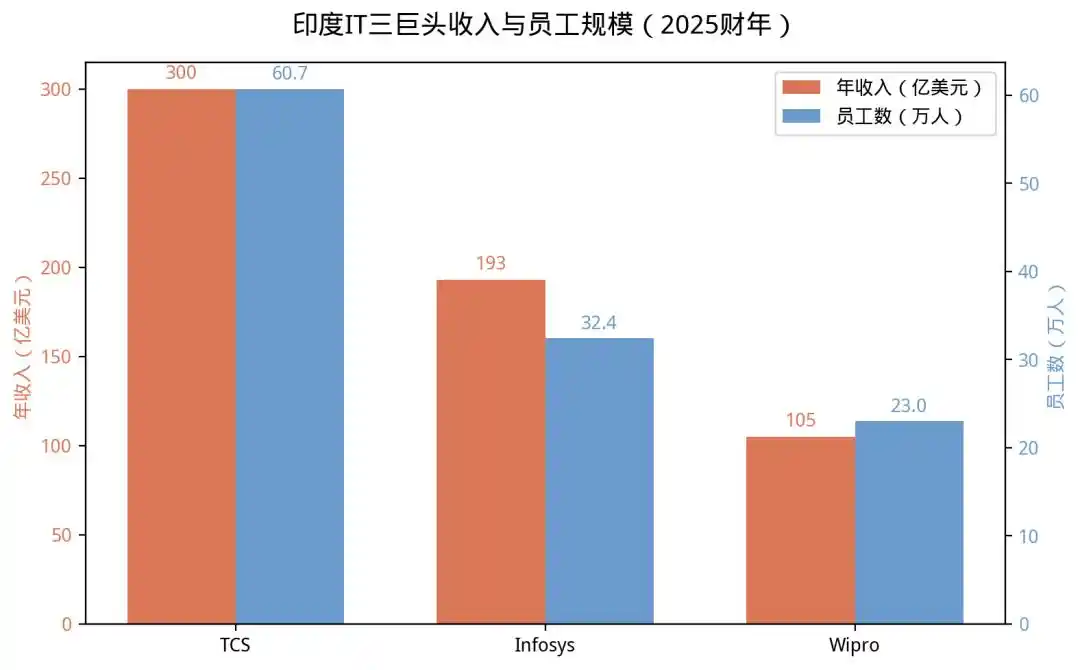
Revenue and Employee Scale of India's IT Big Three (FY 2025) Source: NASSCOM

More importantly, the growth logic of these companies has long been highly consistent: hire more engineers, take on more projects, earn more revenue. For decades, an important metric for capital markets evaluating Indian IT companies was not AI capability, but employee headcount.

According to Reuters data, the scale of India's IT industry has reached approximately $283 billion. Many international investors even call India: "The World's Back Office".

But this logic is changing. A key factor, related to AI: the IT outsourcing business is being dismantled by AI programming.

Su Wen said: "New technologies rarely kill directly in existing markets. A more common way is: in emerging markets, making you completely unqualified to participate. Like the person specialized in catching the ball under the basketball hoop, does that position still exist? No matter how good you are at catching, it's meaningless now."

02

Single-Day 5.8% Plunge: Capital is Voting with its Feet

Therefore, the capital market is starting to worry about one thing.

This past February, India's IT sector evaporated $22.5 billion (about ¥160 billion) in market value in one week. The market at the time thought it was an overreaction. But by June, panic reappeared.

On June 3, India's IT index plunged 5.8% in a single day, the biggest drop in 4 months; India's largest software exporter TCS plummeted 9%, Infosys fell 4.3%, Wipro dropped 3.7%.

TCS Headquarters Building Source: Forbes India

More notably, this is no longer an isolated incident. As of early June, India's IT index has fallen 22% cumulatively so far in 2026; while it fell 26% for the entirety of 2025. In other words, this star sector that once supported India's economic growth has been one of the worst-performing industries in the market for two consecutive years.
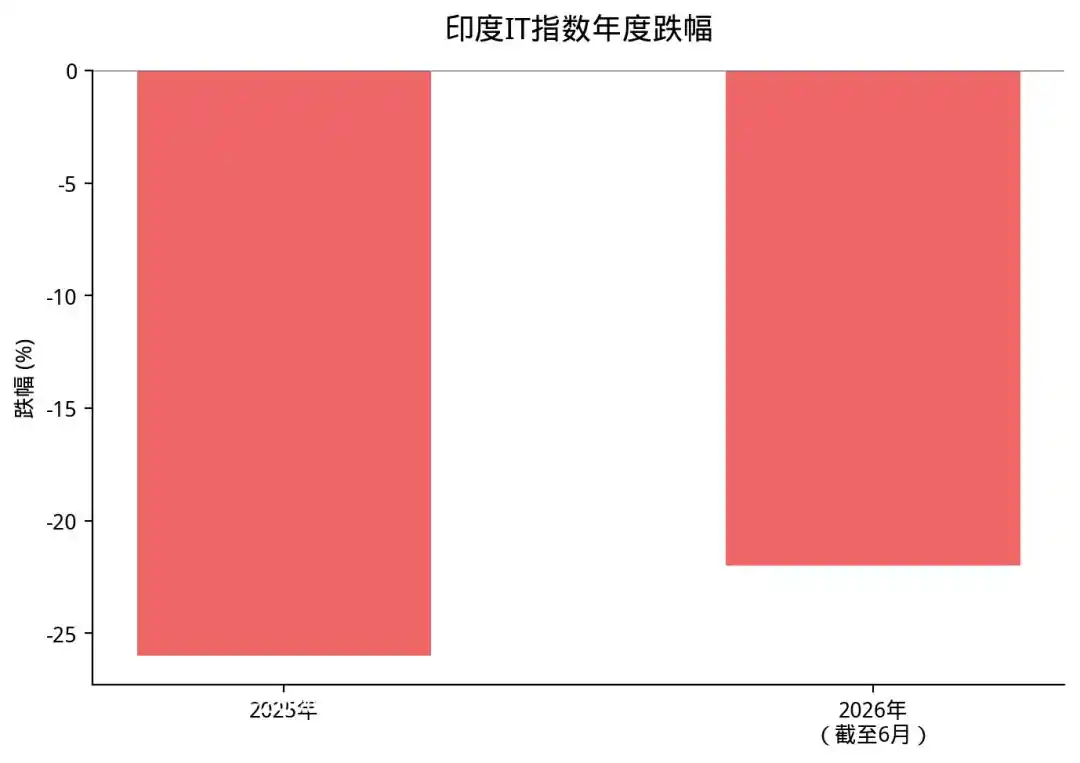
India's IT Index Plunges for Two Consecutive Years Source: Economic Times

The reason is simple. More and more investment institutions are realizing: what AI is replacing is precisely India's core business. Such as writing code, testing software, operations support, documentation, customer service support. These tasks used to require a large number of engineers, but now more and more companies are starting to try letting AI handle them.

What's more terrifying is that the capital market is not worried about "all programmers becoming unemployed." Rather, it's that: India's most profitable business model will become obsolete.

The past logic was: a client has a project, an Indian company sends 100 people, earns money for 100 people. The future may become: a client has a project, AI completes 80% of the work, only 20 people are needed.

Kouting Intelligence, an AI programming company that has raised three rounds of funding, provided Pencil News with a set of data: a development team that needed 100 people in the past can now be completed by 2-3 people; an e-commerce website that might have cost hundreds of thousands or even millions to develop can now have its cost compressed to $6-8.

Even more frightening is the average order value. "The average order value for software development companies may face a 70%-90% decline," Su Wen told Pencil News.

Brokerage research reports show that the overall net profit margin of the software outsourcing industry has dropped from nearly 10% to about 0.1% (not specifically referring to India). This means the profit margins of Indian IT companies are being squeezed out by AI.

The global perspective is even more staggering.

Mordor Intelligence data shows that the global IT outsourcing market size in 2025 was about $618 billion. Of this, about 40%-60% relies on labor-intensive delivery, roughly $250 billion to $450 billion — about ¥3 trillion — facing the risk of being directly replaced or having prices slashed by AI.
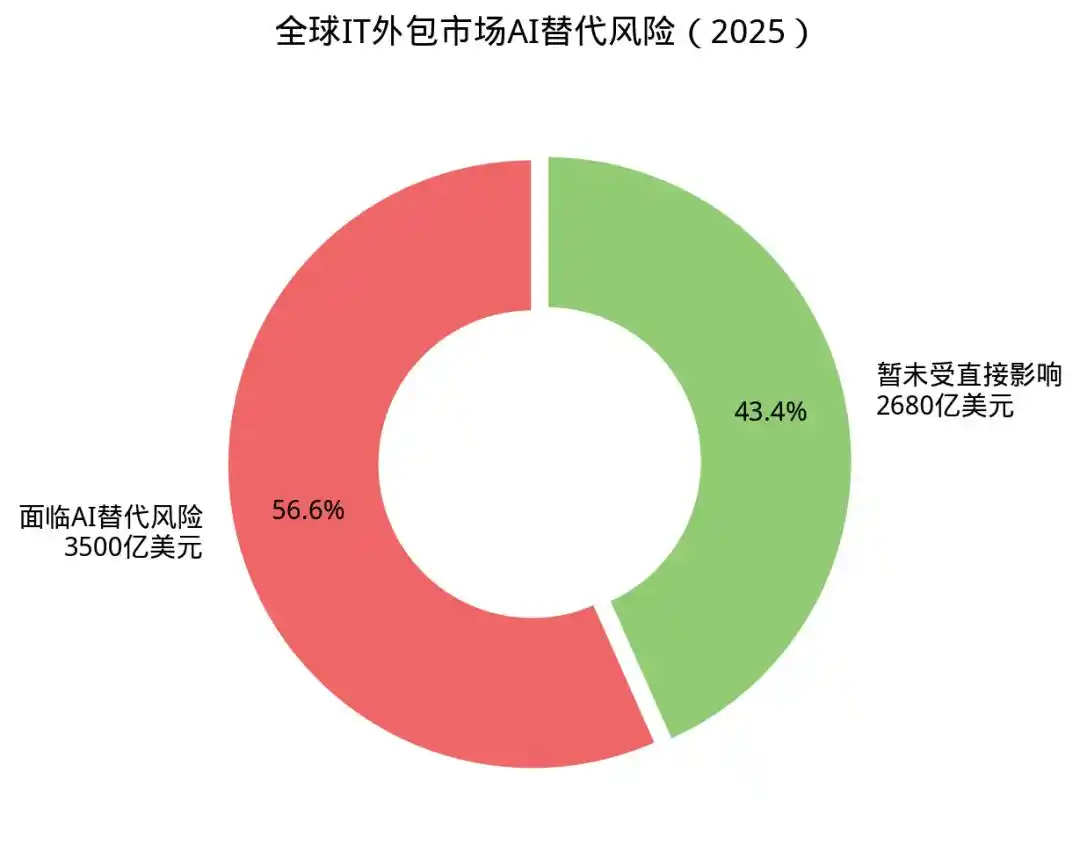
Global IT Outsourcing Market AI Substitution Risk (2025) Source: Mordor Intelligence

For a $280 billion industry, this is a nuclear-level alarm.

03

Leading Companies are Laying Off

More dangerous signals are emerging.

If it were just stock prices falling, it wouldn't be a big deal. What is truly noteworthy is hiring. More direct changes are already appearing in the headcounts of leading companies.

Su Wen's judgment is more radical: "A 20x reduction in engineering personnel is the bare minimum."

The judgment of veteran programmer Meisi, with over ten years of experience at large companies, is similar: "The future trend is a 10:1 compression. An engineering team of two to three thousand people might ultimately need only two to three hundred."

India's largest IT service company, TCS, had a total employee count of about 607,000 in FY 2025, a decrease of about 13,000 compared to the previous fiscal year. Infosys's total employee count was about 324,000, a year-on-year decrease of about 15,000.

This is a rare phenomenon in India's IT industry over many past years. For 30 years, the headcounts of these companies have almost only increased. Growth was the norm, contraction the exception. And today, this 30-year growth curve is turning downward.

ANSR Founder & CEO Lalit Ahuja stated plainly: "There is an air of caution in the market, companies are reducing their hiring numbers."

The entire Indian tech sector's hiring market is shrinking sharply. In June 2026, active tech job openings in India had fallen to 93,000, the lowest point in 28 months. Job openings for technical positions with less than 2 years of experience plummeted 44% year-on-year — nearly half of the entry-level positions vanished.

Su Wen explained the logic behind it: "Development with a complexity score of 4 or below can be completely replaced. A team that needed 100 people before now only needs 2-3."

In past growth cycles, increased projects often meant increased hiring; now, revenue growth and employee growth are gradually decoupling.

The biggest worry for Indian tech companies used to be: not enough people. Today, they are starting to wonder: are there too many people?

When leaders like TCS and Infosys simultaneously start "downsizing," the direction of an era has already changed.

04

India Hit in the Heart by AI

Why is India in more danger than others?

Because what AI has hit in India is not a peripheral industry, but a core industry.

Take a simple example. If AI impacts an e-commerce company, the effect is limited. If AI impacts the advertising industry, the effect is limited. But India is different; IT services are one of India's most important export industries. India's IT industry's total revenue has surpassed $315 billion, accounting for over 7% of India's GDP, employing over 6 million people. Behind these 6 million people are 6 million families, the livelihoods of tens of millions.

More importantly, this is not an isolated industry. IT outsourcing supports India's training industry, real estate industry (office buildings and residences in Bangalore, Hyderabad), service industry, and education industry. One IT job supports at least 3-5 related jobs. This means the impact of AI on the IT industry could ultimately affect the employment ecosystem of 20 to 30 million people in India.

And India itself faces an even harsher reality. Reuters data shows: India's urban youth unemployment rate remains high at 13.6%.

Huge numbers of young people are already looking for jobs. The unemployment rate for Indian university graduates has soared to 29.1%, with 40% of young graduates under 25 unable to find work. Over 1.5 million computer science graduates flood the job market every year, but only 42.6% meet the employable standards of companies.

Now AI is starting to squeeze employment further. Employment pressure + skill mismatch + AI substitution — these are not three separate problems, but a mutually reinforcing death spiral.

Su Wen put it bluntly: "The new market is already bypassing you. You're not losing to peers; this segment is being erased by technology."

An Everest Group analyst stated plainly: "AI will no longer require L1 and L2 level engineers." And these L1 and L2 engineers are precisely the foundation of India's IT industry, the first stop for the 1.5 million annual computer graduates, the entry point for millions of families to change their fortunes.

05

India's Opportunity: 80% of Employees Use AI, Ranked First Globally

Of course, India could also become the biggest winner.

The story isn't over. Because India has another set of data.

According to Boston Consulting Group's (BCG) latest "AI at Work 2026" report, India has become one of the most proactive countries globally in AI application, ranking first worldwide in employee and manager AI adoption rates.

Another survey by ADP, covering 34 countries, "People at Work 2026," shows: 80% of Indian employees use AI tools multiple times a week; 41% of Indian employees use AI daily; the global averages are only 50% and 20% respectively.

That means: globally, on average, about 1 in 5 people use AI daily; but in India, about 2 in 5 people use AI daily.
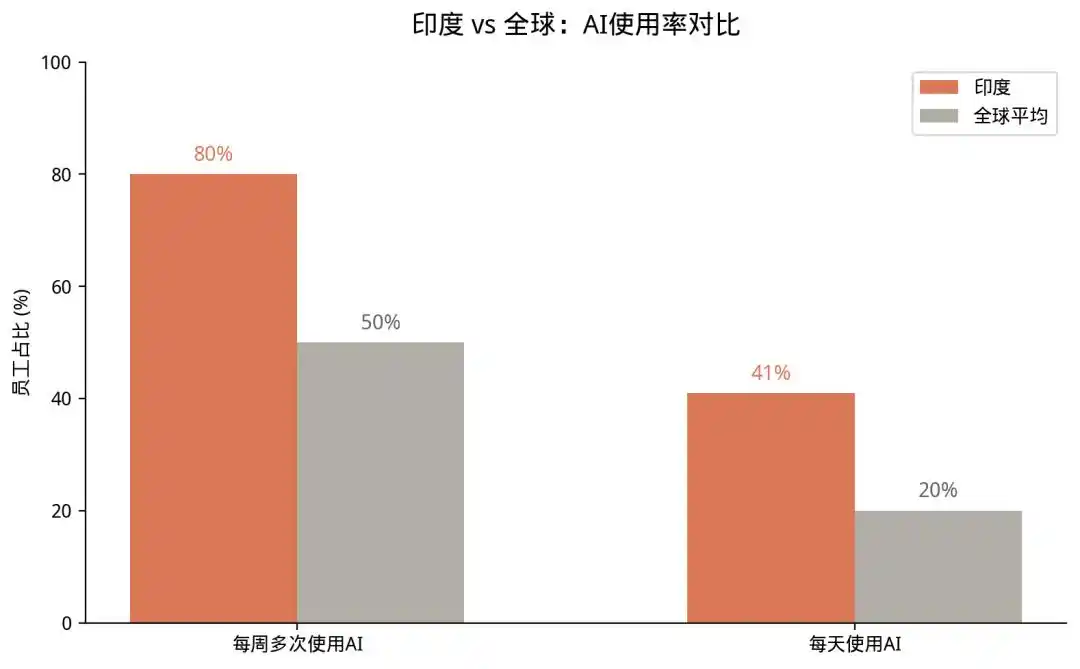
India vs Global AI Usage Comparison Source: BCG/ADP 2026

Not only are employees using it, but companies are also deploying it on a large scale. At the end of May, Microsoft disclosed a set of data: TCS, Infosys, and Wipro have each deployed over 100,000 Microsoft 365 Copilot licenses; the combined deployment scale of the three companies exceeds 300,000 seats, referred to by Microsoft as one of the world's largest enterprise-grade AI deployment cases.

In other words, two things are happening simultaneously in India: on one side, AI is impacting traditional outsourcing jobs; on the other side, AI is penetrating enterprises at an unprecedented rate.

This is also why Microsoft's India head recently stated publicly: India has become one of the fastest-growing AI markets globally.

06

The New Paradigm

What might the new paradigm for IT outsourcing in India be?

In fact, while the capital market is still worried about India's IT outsourcing model being dismantled by AI, India's largest tech companies have already started looking for new ways to make money: no longer selling engineers, but selling AI productivity.

The most typical is TCS. In Q1 2026, TCS disclosed that its annualized order book for AI-related business has reached $2.3 billion, up from $1.8 billion the previous quarter — a growth of about 28% in one quarter.

At the same time, TCS's new order wins for the quarter reached $12 billion, still maintaining a historical high. This indicates an interesting phenomenon: clients have not stopped spending money, only the way they spend it has changed.

In the past, clients bought 100 programmers. Today, clients buy AI solutions, Agent systems, and automation capabilities.

Many people think India's biggest future opportunity is to emulate the US and create something like Cursor. But a mainstream view is: India's real opportunity lies in becoming the world's largest AI implementation center.

In foundational models, the US already has a batch of monopolistic-level companies: OpenAI, Anthropic, Google, Meta, etc. But models are just the beginning; the real complexity lies in implementation.

As of 2026, India already has over 2,100 Global Capability Centers (GCCs), serving multinationals like Microsoft, JPMorgan Chase, Goldman Sachs, Walmart, Pfizer, generating about $100 billion in revenue and directly employing over 2.36 million people.

These Global Capability Centers essentially undertake: software development, system integration, enterprise digitization, data management, IT operations, etc. These tasks require massive engineering implementation capabilities, which is precisely the area where India has accumulated its deepest expertise over the past 30 years.

According to IDC predictions, by 2028, global enterprise AI spending will exceed $630 billion. And India's biggest opportunity may not be to compete in the model market, but to compete in the deployment market.

If for the past 30 years, India exported engineers to the world. Then for the next 10 years, India might export to the world: Agent deployment capabilities, AI operations capabilities, and AI productivity.

Perhaps, this is India's true new paradigm.

This article is from WeChat public account "Pencil News" (ID: pencilnews), author: Aiyu, editor: Wang Fang


Domande pertinenti

QWhat was the main reason for the sudden drop in India's IT stock index on June 3rd?

AThe main reason was the growing panic over the impact of Artificial Intelligence (AI). The market is concerned that AI's ability to write code, perform testing, handle customer service, and other tasks will significantly disrupt India's core IT outsourcing business model, which relies heavily on selling programmer hours.

QAccording to the article, why is the Indian IT services industry particularly vulnerable to AI disruption?

AThe Indian IT services industry is particularly vulnerable because AI directly targets its core business model. This industry, which generates over $2 trillion in revenue and accounts for a large portion of India's exports and GDP, primarily makes money by providing human-intensive services like coding and software maintenance. AI threatens to drastically reduce the number of engineers needed for projects, thereby undermining the traditional 'sell people by the hour' revenue model.

QWhat data does the article present to show that traditional IT outsourcing jobs in India are already declining?

AThe article presents several data points: 1) Headcount reductions at major firms like TCS (down ~13,000 employees) and Infosys (down ~15,000 employees) in the 2025 fiscal year. 2) A sharp drop in active tech job openings in India to 93,000, a 28-month low, with entry-level job postings for workers with less than 2 years of experience plummeting by 44%. This indicates a reversal of the decades-long trend of constant hiring growth in the sector.

QDespite the challenges, what potential opportunity does AI present for India according to the article?

AThe article suggests that India's opportunity lies in becoming the world's largest AI implementation and deployment center. Instead of competing to build foundational AI models (like the US), India can leverage its decades of experience in IT services and its vast network of Global Capability Centers (GCCs) to specialize in deploying AI solutions, managing Agent systems, and providing AI-powered productivity services for global enterprises.

QWhat evidence does the article provide to show that India is aggressively adopting AI within its workforce?

AThe article cites surveys showing India leads globally in AI adoption rates among employees. According to the 'People at Work 2026' survey, 80% of Indian employees use AI tools multiple times a week, and 41% use them daily—far above the global averages of 50% and 20%, respectively. Furthermore, major Indian IT firms like TCS, Infosys, and Wipro have collectively deployed over 300,000 licenses for Microsoft 365 Copilot, representing one of the world's largest enterprise AI rollouts.

Letture associate

Wang Chuan: After Investing in Storage Stocks and Seeing a Thirty-Fold Return, How to Remain Unanxious (Part 7) - A Quarter-Century Cycle

Wang Chuan: Reflections on Investment Anxiety and Market Cycles After Observing a 30x Gain in a Storage Stock (Part 7) – A Quarter-Century Cycle This article examines the cyclical nature and inherent risks in technology hardware investments, using the storage and semiconductor sectors as examples. It criticizes the misleading practice of "annualized" Net Dollar Retention (NDR) rates, where short-term growth is extrapolated unrealistically. A key concept explored is "reflexivity" – demand driven by panic, exploration, and liquidity during market booms, which can vanish just as quickly when conditions reverse. This reflexivity exists both in product demand and among speculative stock buyers, creating powerful feedback loops that inflate prices during upturns and exacerbate crashes during downturns. The author highlights a major risk for hardware sectors: unlike assets with defined cycles (e.g., Bitcoin's halving), there's no guarantee of a swift recovery post-crash. Companies like Micron, Intel, and Cisco took roughly a quarter-century to surpass their 2000 highs, enduring drawdowns exceeding 80%. This is attributed to the "bullwhip effect" in supply chains, where demand collapses instantly but过剩产能 persists, and a migration of narrative-driven capital. High-valuation stories吸引 speculative funds during growth phases, but these funds quickly depart for the next hot narrative once growth slows, leaving behind stronger companies with much lower valuations. The piece warns of dangerous mental models formed during bull markets: 1) equating current strong demand with perpetual high growth, and 2) believing that making fast, large profits is easy. Citing巴菲特, the author notes that easy money undermines rationality, likening speculators to Cinderella at a ball with a clock that has no hands. The current phase presents an asymmetric risk-reward scenario: potential for further gains exists, but the downside risk is an 80%+ drawdown and a multi-decade wait for breakeven, which reflexive speculators cannot tolerate. The hypothetical investor "老王" (Lao Wang), who achieved a 30x return, is used to illustrate potential pitfalls. Leverage could lead to a wipeout during a sharp correction. Even without leverage, ingrained beliefs in easy money would likely lead him to double down after losses, expecting a quick rebound. Instead, he might face a protracted decline, depleting his resources through frantic trading as the high-growth narrative fades. The conclusion references Schopenhauer, comparing those who have seen multiple market cycles to an audience seeing the same magic trick repeatedly—once the illusion is understood, its power is gone.

marsbit6 min fa

Wang Chuan: After Investing in Storage Stocks and Seeing a Thirty-Fold Return, How to Remain Unanxious (Part 7) - A Quarter-Century Cycle

marsbit6 min fa

US Stocks Too Expensive? This Top CIO Scoured the Globe and Found 5 Stocks More Attractive Than NVIDIA

Summary: Main Street Research CIO James Demmert maintains his bullish 8,100 target for the S&P 500 but argues that greater opportunities now lie overseas. He identifies five international stocks with superior valuations poised to benefit from the AI revolution, suggesting international markets will outperform the US for years. Key Recommendations: 1. **ASML (Netherlands):** A foundational chip manufacturing technology provider, offering crucial AI exposure and geographic diversification. Demmert's top long-term pick. 2. **HSBC (UK/Asia):** A global bank with a 9x P/E ratio, better growth prospects than US peers like JPMorgan, and strong Asian presence. 3. **Siemens Energy (Germany):** A direct play on global power grid expansion driven by AI, crypto, and EV electricity demand. 4. **BHP Group (Australia):** A "hidden AI play" and "second derivative" of the trend due to massive copper demand for data centers. Trades at a 16x P/E. 5. **AstraZeneca (UK):** An undervalued healthcare stock with a strong pipeline (18x P/E, >20% growth), expected to benefit from AI's impact on medicine. Core Thesis: International outperformance is driven by both attractive valuations and a major policy shift. While the US tightens fiscal policy, Europe and Japan are launching unprecedented stimulus, reigniting growth. Demmert recommends allocating 45% of a portfolio internationally, citing excessive US investor conservatism as a key mistake.

marsbit11 min fa

US Stocks Too Expensive? This Top CIO Scoured the Globe and Found 5 Stocks More Attractive Than NVIDIA

marsbit11 min fa

a16z Partner: Three Paths for Crypto Projects to Find PMF

Author: Jason Rosenthal. Compiler: Shenchao TechFlow. Finding Product-Market Fit (PMF) is the most critical variable for a company's survival. In the crypto space, misaligned growth hacking and airdrops often mask the absence of true PMF. However, leading teams are now finding PMF faster. Here are three proven paths for crypto projects to achieve PMF: 1. **Co-build with Anchor Clients:** Partner with the most sophisticated potential clients in your field and develop the product based on their specific needs. Their adoption serves as the strongest validation, more valuable than media coverage or TVL metrics. This approach is shaping current product roadmaps, as seen in collaborations between crypto startups and traditional finance. 2. **Position Ahead of an Exponential Curve:** Identify and position yourself ahead of a major emerging trend before the market fully realizes it. The most evident current curve is the rise of AI Agents as autonomous economic actors. Projects like AgentCash by Merit Systems, which enables AI Agents to pay for API access with crypto, are building foundational payment rails for the impending Agent economy. 3. **Be Your Own First and Best Customer:** The most enduring infrastructure companies don't wait for external validation. They first build and prove their technology by using it to power their own applications at scale before offering it to others. Matter Labs exemplifies this by anchoring its ZKsync technology in a concrete application, Cari Network, which enables U.S. regional banks to conduct real-time, on-chain interbank transfers of tokenized deposits. The underlying logic is consistent: the fastest path to PMF involves choosing the right battlefield and executing with conviction—by co-building with clients whose validation compounds, positioning ahead of the curve before consensus forms, or becoming your own best case study.

marsbit12 min fa

a16z Partner: Three Paths for Crypto Projects to Find PMF

marsbit12 min fa

Wang Chuan: How to Avoid Anxiety When the Neighbor, Lao Wang, Made Thirty Times His Investment in Storage Stocks (7) - A Quarter-Century Cycle

Wang Chuan: Reflections on a Quarter-Century Cycle – How to Stay Calm After a 30x Gain on Storage Stocks (Part 7) This article continues the discussion on investment pitfalls. It highlights the deceptive use of metrics like the "Annualized Net Dollar Retention Rate" by some companies to inflate growth projections. The core analysis focuses on the "reflexivity" present in both product demand and financial markets during boom periods. In a bubble, speculative and fear-driven demand in the real economy interacts with speculative, leveraged buying in financial markets, creating a powerful upward feedback loop. This dynamic reverses sharply when faced with physical or liquidity constraints, leading to a cascading downturn. The hardware and semiconductor sectors face unique risks. Unlike assets with defined cycles, there's no guarantee of a swift recovery post-crash. Historical examples like Micron, Intel, and Cisco show it can take decades to surpass previous peaks after severe drawdowns (80-95%). This is due to the "bullwhip effect" in supply chains—demand vanishes quickly while过剩产能 persists—and the migration of speculative capital and growth narratives to new sectors once momentum slows. Companies may have stronger fundamentals years later, but the speculative "soul" of extreme valuations is long gone. The author warns of psychological traps for new investors: mistaking temporary, intense demand for permanent growth, and believing that making quick, large profits is easy. Citing Buffett, the piece cautions that easy money erodes rationality. The current phase presents an asymmetric risk-reward scenario: potential for further gains versus the risk of an 80%+ drawdown and a multi-decade recovery wait—an outcome reflexive speculators cannot endure. The hypothetical "Lao Wang" who made 30x may be wiped out by leverage or, driven by the "get-rich-quick" mindset, may repeatedly try to recover losses until exhausted, failing to recognize that the high-growth narrative has ended. The piece concludes with Schopenhauer's analogy: those who've seen multiple cycles are like an audience watching the same magic trick repeatedly—the illusion no longer works.

链捕手20 min fa

Wang Chuan: How to Avoid Anxiety When the Neighbor, Lao Wang, Made Thirty Times His Investment in Storage Stocks (7) - A Quarter-Century Cycle

链捕手20 min fa

Trading

Spot
Futures

Articoli Popolari

Cosa è $S$

Comprendere SPERO: Una Panoramica Completa Introduzione a SPERO Mentre il panorama dell'innovazione continua a evolversi, l'emergere delle tecnologie web3 e dei progetti di criptovaluta gioca un ruolo fondamentale nel plasmare il futuro digitale. Un progetto che ha attirato l'attenzione in questo campo dinamico è SPERO, denotato come SPERO,$$s$. Questo articolo mira a raccogliere e presentare informazioni dettagliate su SPERO, per aiutare gli appassionati e gli investitori a comprendere le sue basi, obiettivi e innovazioni nei domini web3 e crypto. Che cos'è SPERO,$$s$? SPERO,$$s$ è un progetto unico all'interno dello spazio crypto che cerca di sfruttare i principi della decentralizzazione e della tecnologia blockchain per creare un ecosistema che promuove l'impegno, l'utilità e l'inclusione finanziaria. Il progetto è progettato per facilitare interazioni peer-to-peer in modi nuovi, fornendo agli utenti soluzioni e servizi finanziari innovativi. Al suo interno, SPERO,$$s$ mira a responsabilizzare gli individui fornendo strumenti e piattaforme che migliorano l'esperienza dell'utente nello spazio delle criptovalute. Questo include la possibilità di metodi di transazione più flessibili, la promozione di iniziative guidate dalla comunità e la creazione di percorsi per opportunità finanziarie attraverso applicazioni decentralizzate (dApps). La visione sottostante di SPERO,$$s$ ruota attorno all'inclusività, cercando di colmare le lacune all'interno della finanza tradizionale mentre sfrutta i vantaggi della tecnologia blockchain. Chi è il Creatore di SPERO,$$s$? L'identità del creatore di SPERO,$$s$ rimane piuttosto oscura, poiché ci sono risorse pubblicamente disponibili limitate che forniscono informazioni dettagliate sul suo fondatore o fondatori. Questa mancanza di trasparenza può derivare dall'impegno del progetto per la decentralizzazione—un ethos che molti progetti web3 condividono, dando priorità ai contributi collettivi rispetto al riconoscimento individuale. Centrando le discussioni attorno alla comunità e ai suoi obiettivi collettivi, SPERO,$$s$ incarna l'essenza dell'empowerment senza mettere in evidenza individui specifici. Pertanto, comprendere l'etica e la missione di SPERO rimane più importante che identificare un creatore singolo. Chi sono gli Investitori di SPERO,$$s$? SPERO,$$s$ è supportato da una varietà di investitori che vanno dai capitalisti di rischio agli investitori angelici dedicati a promuovere l'innovazione nel settore crypto. Il focus di questi investitori generalmente si allinea con la missione di SPERO—dando priorità a progetti che promettono avanzamenti tecnologici sociali, inclusività finanziaria e governance decentralizzata. Queste fondazioni di investitori sono tipicamente interessate a progetti che non solo offrono prodotti innovativi, ma contribuiscono anche positivamente alla comunità blockchain e ai suoi ecosistemi. Il supporto di questi investitori rafforza SPERO,$$s$ come un concorrente degno di nota nel dominio in rapida evoluzione dei progetti crypto. Come Funziona SPERO,$$s$? SPERO,$$s$ impiega un framework multifunzionale che lo distingue dai progetti di criptovaluta convenzionali. Ecco alcune delle caratteristiche chiave che sottolineano la sua unicità e innovazione: Governance Decentralizzata: SPERO,$$s$ integra modelli di governance decentralizzati, responsabilizzando gli utenti a partecipare attivamente ai processi decisionali riguardanti il futuro del progetto. Questo approccio favorisce un senso di proprietà e responsabilità tra i membri della comunità. Utilità del Token: SPERO,$$s$ utilizza il proprio token di criptovaluta, progettato per servire varie funzioni all'interno dell'ecosistema. Questi token abilitano transazioni, premi e la facilitazione dei servizi offerti sulla piattaforma, migliorando l'impegno e l'utilità complessivi. Architettura Stratificata: L'architettura tecnica di SPERO,$$s$ supporta la modularità e la scalabilità, consentendo un'integrazione fluida di funzionalità e applicazioni aggiuntive man mano che il progetto evolve. Questa adattabilità è fondamentale per mantenere la rilevanza nel panorama crypto in continua evoluzione. Coinvolgimento della Comunità: Il progetto enfatizza iniziative guidate dalla comunità, impiegando meccanismi che incentivano la collaborazione e il feedback. Nutrendo una comunità forte, SPERO,$$s$ può affrontare meglio le esigenze degli utenti e adattarsi alle tendenze di mercato. Focus sull'Inclusione: Offrendo basse commissioni di transazione e interfacce user-friendly, SPERO,$$s$ mira ad attrarre una base utenti diversificata, inclusi individui che potrebbero non aver precedentemente interagito nello spazio crypto. Questo impegno per l'inclusione si allinea con la sua missione generale di empowerment attraverso l'accessibilità. Cronologia di SPERO,$$s$ Comprendere la storia di un progetto fornisce preziose intuizioni sulla sua traiettoria di sviluppo e sui traguardi. Di seguito è riportata una cronologia suggerita che mappa eventi significativi nell'evoluzione di SPERO,$$s$: Fase di Concettualizzazione e Ideazione: Le idee iniziali che formano la base di SPERO,$$s$ sono state concepite, allineandosi strettamente con i principi di decentralizzazione e focus sulla comunità all'interno dell'industria blockchain. Lancio del Whitepaper del Progetto: Dopo la fase concettuale, è stato rilasciato un whitepaper completo che dettaglia la visione, gli obiettivi e l'infrastruttura tecnologica di SPERO,$$s$ per suscitare interesse e feedback dalla comunità. Costruzione della Comunità e Prime Interazioni: Sono stati effettuati sforzi attivi di outreach per costruire una comunità di early adopters e potenziali investitori, facilitando discussioni attorno agli obiettivi del progetto e ottenendo supporto. Evento di Generazione del Token: SPERO,$$s$ ha condotto un evento di generazione del token (TGE) per distribuire i propri token nativi ai primi sostenitori e stabilire una liquidità iniziale all'interno dell'ecosistema. Lancio della Prima dApp: La prima applicazione decentralizzata (dApp) associata a SPERO,$$s$ è stata attivata, consentendo agli utenti di interagire con le funzionalità principali della piattaforma. Sviluppo Continuo e Partnership: Aggiornamenti e miglioramenti continui alle offerte del progetto, inclusi partnership strategiche con altri attori nello spazio blockchain, hanno plasmato SPERO,$$s$ in un concorrente competitivo e in evoluzione nel mercato crypto. Conclusione SPERO,$$s$ rappresenta una testimonianza del potenziale del web3 e delle criptovalute di rivoluzionare i sistemi finanziari e responsabilizzare gli individui. Con un impegno per la governance decentralizzata, il coinvolgimento della comunità e funzionalità progettate in modo innovativo, apre la strada verso un panorama finanziario più inclusivo. Come per qualsiasi investimento nello spazio crypto in rapida evoluzione, si incoraggiano potenziali investitori e utenti a ricercare approfonditamente e a impegnarsi in modo riflessivo con gli sviluppi in corso all'interno di SPERO,$$s$. Il progetto mostra lo spirito innovativo dell'industria crypto, invitando a ulteriori esplorazioni delle sue innumerevoli possibilità. Mentre il percorso di SPERO,$$s$ è ancora in fase di sviluppo, i suoi principi fondamentali potrebbero effettivamente influenzare il futuro di come interagiamo con la tecnologia, la finanza e tra di noi in ecosistemi digitali interconnessi.

75 Totale visualizzazioniPubblicato il 2024.12.17Aggiornato il 2024.12.17

Cosa è $S$

Cosa è AGENT S

Agent S: Il Futuro dell'Interazione Autonoma in Web3 Introduzione Nel panorama in continua evoluzione di Web3 e criptovalute, le innovazioni stanno costantemente ridefinendo il modo in cui gli individui interagiscono con le piattaforme digitali. Uno di questi progetti pionieristici, Agent S, promette di rivoluzionare l'interazione uomo-computer attraverso il suo framework agentico aperto. Aprendo la strada a interazioni autonome, Agent S mira a semplificare compiti complessi, offrendo applicazioni trasformative nell'intelligenza artificiale (AI). Questa esplorazione dettagliata approfondirà le complessità del progetto, le sue caratteristiche uniche e le implicazioni per il dominio delle criptovalute. Cos'è Agent S? Agent S si presenta come un innovativo framework agentico aperto, progettato specificamente per affrontare tre sfide fondamentali nell'automazione dei compiti informatici: Acquisizione di Conoscenze Specifiche del Dominio: Il framework apprende in modo intelligente da varie fonti di conoscenza esterne ed esperienze interne. Questo approccio duale gli consente di costruire un ricco repository di conoscenze specifiche del dominio, migliorando le sue prestazioni nell'esecuzione dei compiti. Pianificazione su Lungo Orizzonte di Compiti: Agent S impiega una pianificazione gerarchica potenziata dall'esperienza, un approccio strategico che facilita la suddivisione e l'esecuzione efficiente di compiti complessi. Questa caratteristica migliora significativamente la sua capacità di gestire più sottocompiti in modo efficiente ed efficace. Gestione di Interfacce Dinamiche e Non Uniformi: Il progetto introduce l'Interfaccia Agente-Computer (ACI), una soluzione innovativa che migliora l'interazione tra agenti e utenti. Utilizzando Modelli Linguistici Multimodali di Grandi Dimensioni (MLLM), Agent S può navigare e manipolare senza sforzo diverse interfacce grafiche utente. Attraverso queste caratteristiche pionieristiche, Agent S fornisce un framework robusto che affronta le complessità coinvolte nell'automazione dell'interazione umana con le macchine, preparando il terreno per innumerevoli applicazioni nell'AI e oltre. Chi è il Creatore di Agent S? Sebbene il concetto di Agent S sia fondamentalmente innovativo, informazioni specifiche sul suo creatore rimangono elusive. Il creatore è attualmente sconosciuto, il che evidenzia sia la fase embrionale del progetto sia la scelta strategica di mantenere i membri fondatori sotto anonimato. Indipendentemente dall'anonimato, l'attenzione rimane sulle capacità e sul potenziale del framework. Chi sono gli Investitori di Agent S? Poiché Agent S è relativamente nuovo nell'ecosistema crittografico, informazioni dettagliate riguardanti i suoi investitori e sostenitori finanziari non sono documentate esplicitamente. La mancanza di approfondimenti pubblicamente disponibili sulle fondazioni di investimento o sulle organizzazioni che supportano il progetto solleva interrogativi sulla sua struttura di finanziamento e sulla roadmap di sviluppo. Comprendere il supporto è cruciale per valutare la sostenibilità del progetto e il suo potenziale impatto sul mercato. Come Funziona Agent S? Al centro di Agent S si trova una tecnologia all'avanguardia che gli consente di funzionare efficacemente in contesti diversi. Il suo modello operativo è costruito attorno a diverse caratteristiche chiave: Interazione Uomo-Computer Simile a Quella Umana: Il framework offre una pianificazione AI avanzata, cercando di rendere le interazioni con i computer più intuitive. Mimando il comportamento umano nell'esecuzione dei compiti, promette di elevare le esperienze degli utenti. Memoria Narrativa: Utilizzata per sfruttare esperienze di alto livello, Agent S utilizza la memoria narrativa per tenere traccia delle storie dei compiti, migliorando così i suoi processi decisionali. Memoria Episodica: Questa caratteristica fornisce agli utenti una guida passo-passo, consentendo al framework di offrire supporto contestuale mentre i compiti si sviluppano. Supporto per OpenACI: Con la capacità di funzionare localmente, Agent S consente agli utenti di mantenere il controllo sulle proprie interazioni e flussi di lavoro, allineandosi con l'etica decentralizzata di Web3. Facile Integrazione con API Esterne: La sua versatilità e compatibilità con varie piattaforme AI garantiscono che Agent S possa adattarsi senza problemi agli ecosistemi tecnologici esistenti, rendendolo una scelta attraente per sviluppatori e organizzazioni. Queste funzionalità contribuiscono collettivamente alla posizione unica di Agent S all'interno dello spazio crittografico, poiché automatizza compiti complessi e multi-fase con un intervento umano minimo. Man mano che il progetto evolve, le sue potenziali applicazioni in Web3 potrebbero ridefinire il modo in cui si svolgono le interazioni digitali. Cronologia di Agent S Lo sviluppo e le tappe di Agent S possono essere riassunti in una cronologia che evidenzia i suoi eventi significativi: 27 Settembre 2024: Il concetto di Agent S è stato lanciato in un documento di ricerca completo intitolato “Un Framework Agentico Aperto che Usa i Computer Come un Umano”, mostrando le basi per il progetto. 10 Ottobre 2024: Il documento di ricerca è stato reso pubblicamente disponibile su arXiv, offrendo un'esplorazione approfondita del framework e della sua valutazione delle prestazioni basata sul benchmark OSWorld. 12 Ottobre 2024: È stata rilasciata una presentazione video, fornendo un'idea visiva delle capacità e delle caratteristiche di Agent S, coinvolgendo ulteriormente potenziali utenti e investitori. Questi indicatori nella cronologia non solo illustrano i progressi di Agent S, ma indicano anche il suo impegno per la trasparenza e il coinvolgimento della comunità. Punti Chiave su Agent S Man mano che il framework Agent S continua a evolversi, diversi attributi chiave si distinguono, sottolineando la sua natura innovativa e il potenziale: Framework Innovativo: Progettato per fornire un uso intuitivo dei computer simile all'interazione umana, Agent S porta un approccio nuovo all'automazione dei compiti. Interazione Autonoma: La capacità di interagire autonomamente con i computer attraverso GUI segna un passo avanti verso soluzioni informatiche più intelligenti ed efficienti. Automazione di Compiti Complessi: Con la sua metodologia robusta, può automatizzare compiti complessi e multi-fase, rendendo i processi più veloci e meno soggetti a errori. Miglioramento Continuo: I meccanismi di apprendimento consentono ad Agent S di migliorare dalle esperienze passate, migliorando continuamente le sue prestazioni e la sua efficacia. Versatilità: La sua adattabilità attraverso diversi ambienti operativi come OSWorld e WindowsAgentArena garantisce che possa servire un'ampia gamma di applicazioni. Man mano che Agent S si posiziona nel panorama di Web3 e delle criptovalute, il suo potenziale per migliorare le capacità di interazione e automatizzare i processi segna un significativo avanzamento nelle tecnologie AI. Attraverso il suo framework innovativo, Agent S esemplifica il futuro delle interazioni digitali, promettendo un'esperienza più fluida ed efficiente per gli utenti in vari settori. Conclusione Agent S rappresenta un audace passo avanti nell'unione tra AI e Web3, con la capacità di ridefinire il modo in cui interagiamo con la tecnologia. Sebbene sia ancora nelle sue fasi iniziali, le possibilità per la sua applicazione sono vaste e coinvolgenti. Attraverso il suo framework completo che affronta sfide critiche, Agent S mira a portare le interazioni autonome al centro dell'esperienza digitale. Man mano che ci addentriamo nei regni delle criptovalute e della decentralizzazione, progetti come Agent S giocheranno senza dubbio un ruolo cruciale nel plasmare il futuro della tecnologia e della collaborazione uomo-computer.

537 Totale visualizzazioniPubblicato il 2025.01.14Aggiornato il 2025.01.14

Cosa è AGENT S

Come comprare S

Benvenuto in HTX.com! Abbiamo reso l'acquisto di Sonic (S) semplice e conveniente. Segui la nostra guida passo passo per intraprendere il tuo viaggio nel mondo delle criptovalute.Step 1: Crea il tuo Account HTXUsa la tua email o numero di telefono per registrarti il tuo account gratuito su HTX. Vivi un'esperienza facile e sblocca tutte le funzionalità,Crea il mio accountStep 2: Vai in Acquista crypto e seleziona il tuo metodo di pagamentoCarta di credito/debito: utilizza la tua Visa o Mastercard per acquistare immediatamente SonicS.Bilancio: Usa i fondi dal bilancio del tuo account HTX per fare trading senza problemi.Terze parti: abbiamo aggiunto metodi di pagamento molto utilizzati come Google Pay e Apple Pay per maggiore comodità.P2P: Fai trading direttamente con altri utenti HTX.Over-the-Counter (OTC): Offriamo servizi su misura e tassi di cambio competitivi per i trader.Step 3: Conserva Sonic (S)Dopo aver acquistato Sonic (S), conserva nel tuo account HTX. In alternativa, puoi inviare tramite trasferimento blockchain o scambiare per altre criptovalute.Step 4: Scambia Sonic (S)Scambia facilmente Sonic (S) nel mercato spot di HTX. Accedi al tuo account, seleziona la tua coppia di trading, esegui le tue operazioni e monitora in tempo reale. Offriamo un'esperienza user-friendly sia per chi ha appena iniziato che per i trader più esperti.

1.1k Totale visualizzazioniPubblicato il 2025.01.15Aggiornato il 2026.06.02

Come comprare S

Discussioni

Benvenuto nella Community HTX. Qui puoi rimanere informato sugli ultimi sviluppi della piattaforma e accedere ad approfondimenti esperti sul mercato. Le opinioni degli utenti sul prezzo di S S sono presentate come di seguito.

活动图片