AI Benefits Senior Staff? 40% of CEOs Plan to Cut Junior Positions, Young People's Jobs Are More at Risk

marsbitPubblicato 2026-05-18Pubblicato ultima volta 2026-05-18

Introduzione

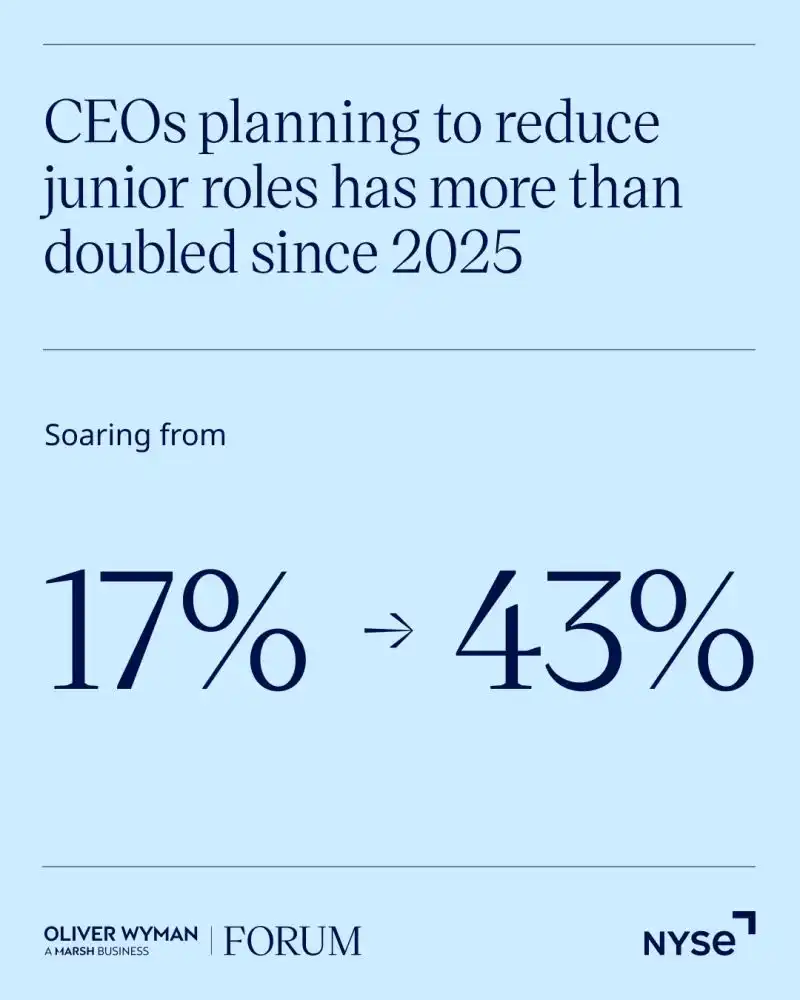
The traditional assumption that senior employees are first in line during layoffs is being inverted in the AI era. A survey of 415 CEOs by Oliver Wyman and the NYSE reveals 43% plan to cut entry-level positions in the next 1-2 years to shift towards a mid-to-senior talent structure, a sharp rise from 17% last year. The logic is that AI excels at automating routine, cognitive tasks typically handled by junior staff (e.g., coding, data review), while the experience and judgment of senior employees remain harder to replicate. Research indicates this shift primarily manifests as a hiring freeze for junior roles rather than mass layoffs. Goldman Sachs estimates AI currently nets a loss of about 16,000 US jobs monthly, disproportionately impacting Generation Z concentrated in highly automatable white-collar roles. This raises long-term concerns about a broken talent pipeline, as companies risk having no future senior managers trained internally. Despite the dominant trend, a minority of successful AI adopters, like IBM and Salesforce, are expanding junior hiring, arguing these employees are adept at using and building AI tools. However, most companies are still in early AI deployment phases, with 67% in planning/pilot stages and many reporting returns below expectations. The overarching reality is a weakening of job security across all levels, as organizations reshape for an AI-augmented, leaner future.

Author: Claude, Shenchao TechFlow

Shenchao's Insight: A recent survey of 415 global CEOs by Oliver Wyman in partnership with the New York Stock Exchange shows that 43% of CEOs plan to reduce junior positions in the next one to two years, shifting their workforce composition towards mid- to senior-level talent. This figure has more than doubled from 17% last year. AI is systematically replacing routine tasks typically handled by junior employees, while experienced employees become more valuable due to their judgment and expertise. Goldman Sachs previously estimated that AI is eliminating a net of approximately 16,000 US jobs per month, with Generation Z being the most affected.

In past waves of layoffs, older, higher-paid employees were often the first targets. But the logic of the AI era is reversing this trend.

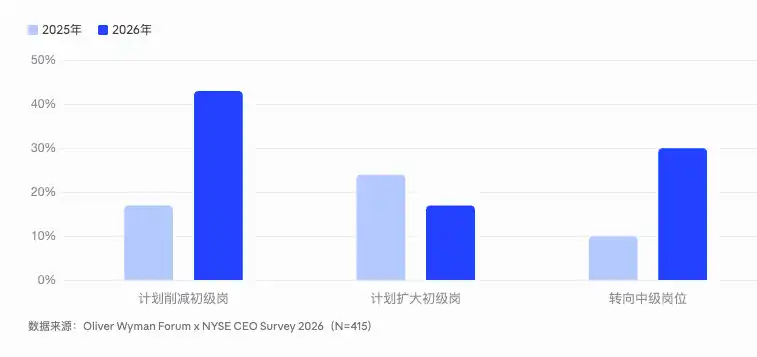
According to a Bloomberg report on May 16th, the 2026 CEO Agenda survey released by management consultancy Oliver Wyman and the New York Stock Exchange reveals that over 40% of CEOs plan to reduce junior positions in the next one to two years, tilting their workforce structure towards more mid- to senior-level employees; only 17% of CEOs indicated they would increase the proportion of junior roles. A year ago, these numbers were almost the opposite.

The survey covered 415 CEOs (266 from public companies, 149 from private companies), with the public company sample representing about 10% of global market capitalization, including 65 Fortune 500 CEOs.

John Romeo, Head of the Oliver Wyman Forum, told Bloomberg in an interview, "The difficulty for junior employees to enter the workforce is indeed increasing. CEOs now place greater emphasis on mid- to senior-level employees to drive productivity."
43% of CEOs Plan to Cut Junior Positions, AI's 'Experience Bias' Effect Emerges

The logic behind this shift is not hard to understand: the tasks that AI agents are currently capable of performing are highly concentrated in the typical scope of work for junior employees. Writing code, evaluating sales leads, reviewing documents, compiling data reports—these routine cognitive tasks previously handled by junior staff are being rapidly replaced by AI systems.

However, what AI currently cannot replicate is the judgment formed through years of industry experience. Future of work advisor Ravin Jesuthasan told Bloomberg that the corporate attitude is shifting to "I need someone who has actually done this, because her experience, judgment, and problem-solving ability make her more valuable than the AI."

This phenomenon has data support in academia. A paper by Harvard University researchers Seyed M. Hosseini and Guy Lichtinger analyzed resume and hiring data covering 62 million employees and 285,000 US companies. The results show that since early 2023, among companies actively adopting generative AI, the number of junior employees decreased by 7.7% over six quarters compared to non-adopting firms, while the number of senior employees was largely unaffected. A key finding is that this decline primarily stems from a hiring slowdown, not large-scale layoffs. In other words, they are not firing people, but simply not hiring them.
The Oliver Wyman report states the implication of this trend more bluntly: "CEOs with the longest planning horizons are the most likely to plan for headcount reductions. This suggests they anticipate that organizations will become leaner, enhanced by AI, not as a cost-cutting measure, but as an end-state."

Goldman Sachs Estimates: AI Net Eliminates 16,000 US Jobs Monthly, Generation Z Bears the Brunt

Goldman Sachs economist Elsie Peng estimated in an April research report that the AI substitution effect eliminated about 25,000 jobs per month over the past year, while the AI augmentation effect created about 9,000 jobs per month in the same period, resulting in a net elimination of about 16,000 jobs. Frontierbeat

The impact is highly unevenly distributed. In occupations with the highest exposure to AI substitution, the unemployment rate gap between entry-level workers under 30 and experienced workers aged 31 to 50 has widened significantly compared to pre-pandemic levels. The wage gap has also worsened concurrently; Goldman's regression analysis estimates that for every one standard deviation increase in AI substitution exposure, the wage gap between entry-level and experienced workers widens by approximately 3.3 percentage points. Fortune

Generation Z is disproportionately concentrated in routine white-collar roles such as data entry, customer service, legal support, and billing processing—precisely the areas AI is most adept at automating. They lack the experiential buffer that senior employees possess. Fortune

A Stanford University study from last November further confirms this: in fields with the highest AI exposure, young employees are 16% more likely to be unemployed than other groups. Fortune

Long-Term Risks of a Broken Talent Pipeline

While cutting junior positions can lower costs and improve efficiency in the short term, the hidden costs are raising alarms.

Helen Leis, Global Head of Leadership and Change at Oliver Wyman, pointed out to Bloomberg that if companies want to have mid- to senior-level talent to manage AI-driven workflows in the future, "these people need to first learn the job within the company." Not hiring junior employees is akin to cutting off one's own talent pipeline.

Andrew McAfee, co-director of MIT's Initiative on the Digital Economy, previously expressed similar concerns to the Harvard Business Review: "Other than on-the-job learning and apprenticeship training, how are people supposed to learn how to do a job?"

Monster survey data shows that nearly 90% of the class of 2026 are worried that AI or automation will replace entry-level positions, a sharp rise from 64% in 2025. Fortune

These concerns are not unfounded. According to a SignalFire report, from 2023 to 2024, the hiring volume for junior positions at the 15 largest US tech companies fell by 25%. The situation in the UK is more severe, with graduate roles in the tech sector decreasing by 46% in 2024, projected to drop another 53% by 2026. IEEE SpectrumRezi

A Few Companies Go Against the Grain: AI 'Winners' Actually Value Junior Employees More

Interestingly, companies most successful in AI deployment are adopting a different talent strategy.

The Oliver Wyman report points out that "a cohort of contrarian, advanced AI adopters believe this technology is increasing the value of junior talent, not displacing them." Among companies with higher ROI from AI investments, the proportion leaning towards increasing junior positions is higher than among those not yet seeing returns.

IBM announced in February this year its plan to triple its hiring of US junior positions and rewrite job descriptions for the AI era. Salesforce CEO Marc Benioff announced this week the hiring of 1,000 recent graduates and interns to build its AI systems, writing on platform X: "They say AI will kill junior jobs. But these grads & interns are BUILDING AI." Amazon Web Services CEO Matt Garman publicly stated that replacing junior employees with AI is "one of the dumbest decisions a company can make," reasoning that junior employees are often the most proficient users of AI tools.

However, these cases remain the minority in the overall trend. The Oliver Wyman survey shows that 74% of CEOs are freezing or reducing headcount, up from 67% last year. The most aggressive cuts are happening in the technology, media, and telecom industries.

AI's ROI Dilemma: Most Companies Still in the 'Money-Burning Experimentation' Stage

There is a significant gap between CEOs' confidence in AI's ability to change workforce structures and the actual returns AI is delivering.

The Oliver Wyman survey reveals that 67% of corporate AI deployments remain in the planning and pilot stages. 53% of CEOs say it is too early to assess AI investment returns, a figure that has increased from 41% last year. Only 27% of CEOs report that AI investment returns meet or exceed expectations, down from 38% last year. Nearly a quarter say AI has had no impact on revenue whatsoever.

The report describes this as "not a crisis of confidence, but a recognition that redesigning work at scale is slower and more difficult than initial enthusiasm anticipated."

However, the report also notes that companies deploying AI across more than two application areas report cost savings and revenue growth roughly double that of companies with single-scenario deployments. The value curve for AI is non-linear, with real returns concentrated after scaled deployment.

A statement by economist Teresa Ghilarducci of The New School to Bloomberg perhaps sums up the current situation: Even if AI tilts the workplace balance in favor of experienced employees, it does not mean they have gained job security. "Companies are increasingly less committed to their employees."


Domande pertinenti

QAccording to the Oliver Wyman survey, what is the key change in CEO hiring plans for junior positions?

AOver 40% of CEOs plan to reduce junior positions over the next one to two years, shifting their workforce structure towards more mid- to senior-level talent. This figure has more than doubled from 17% the previous year, representing a significant reversal in hiring strategy.

QWhat is the 'seniority bias' effect of AI on the workforce mentioned in the article?

AThe 'seniority bias' effect refers to the trend where AI is systematically automating routine, cognitive tasks typically performed by junior employees (e.g., coding, document review, data reporting). Meanwhile, senior employees, whose value lies in experience, judgment, and complex problem-solving abilities that AI cannot yet replicate, are becoming more valuable and less likely to be replaced.

QWhat does the Goldman Sachs research cited in the article say about AI's net impact on US jobs?

AGoldman Sachs economists estimate that AI is currently displacing about 25,000 US jobs per month while simultaneously creating around 9,000 new ones. This results in a net loss of approximately 16,000 jobs per month, with Generation Z workers being disproportionately affected.

QWhat long-term risk does cutting junior positions pose to companies, according to experts in the article?

ACutting junior positions risks severing a company's talent pipeline. Experts warn that future mid- and senior-level leaders, who will need to manage AI-driven workflows, must first learn the business from within the company. By not hiring and training junior employees, companies are undermining their own long-term succession planning and leadership development.

QHow do the most successful AI-adopting companies differ in their approach to hiring junior staff, according to the article?

AA minority of successful, advanced AI adopters are taking a counter-trend approach. Companies like IBM, Salesforce, and Amazon Web Services are expanding hiring for junior roles. They view AI as a tool that enhances the value of junior talent (who often become skilled AI users) rather than simply replacing them, and they are actively recruiting graduates to help build and work with AI systems.

Letture associate

Jensen Huang: Vera Rubin Full Mass Production, AI Agent a Key Focus, Challenging Intel to Target the Next-Generation AI PC Gateway

NVIDIA CEO Jensen Huang delivered the keynote speech at GTC Taipei 2026, announcing several major product launches and strategic directions. The company's Vera Rubin architecture is now in full-scale production, with OpenAI, Anthropic, and SpaceX among the first customers. NVIDIA highlighted AI Agent as a key future focus, introducing the Vera CPU designed for AI agents and the Vera BlueField-4 STX for secure, chip-level AI storage processing. A significant move involves challenging Intel in the PC market. NVIDIA, in collaboration with MediaTek, is developing the RTX SPARK PC chip (manufactured by TSMC) for Windows systems, set to launch this fall for laptops and desktops. This signals NVIDIA's push into the next-generation AI PC arena, aiming to provide a vertically integrated core computing platform for the entire Windows ecosystem, similar to Apple's approach. Other announcements include the new Nemotron 3 Ultra AI model and the NVIDIA DSX platform, described as a complete "playbook" for building AI factories, allowing performance simulation and validation before physical deployment. In automotive, the DRIVE Hyperion platform was positioned as a global robotaxi platform, with major Chinese automakers like BYD, Geely, Zeekr, Xiaomi, and Pony.ai already adopting or developing autonomous driving solutions based on it. The Alpamayo 2 super open inference model for robotaxis was also introduced. For robotics, NVIDIA unveiled the Isaac GR00T humanoid robot reference platform for academic research and a large open-source agent tools and skills suite for Physical AI. The company plans to collaborate with global humanoid robot manufacturers, including China's Unitree, whose H2 Plus robot served as the reference hardware for the GR00T platform demonstration.

marsbit24 min fa

Jensen Huang: Vera Rubin Full Mass Production, AI Agent a Key Focus, Challenging Intel to Target the Next-Generation AI PC Gateway

marsbit24 min fa

Running MoE on Mobile Phones? Meta Proposes MobileMoE, Speeding Up iPhone 16 Pro by 3.8x

Meta's MobileMoE, a mobile-optimized Mixture-of-Experts (MoE) language model architecture, enables efficient on-device large language model (LLM) inference for the first time on commercial smartphones. Designed for decoder-only Transformers, it replaces dense feed-forward layers with MoE layers. Key design choices include 8 experts with granularity g=8, top-4 routing, and a shared expert. The model undergoes a four-stage training process: pre-training, intermediate training, supervised fine-tuning, and quantization-aware training. Results show MobileMoE models, with similar memory footprint, achieve equal or higher average accuracy across 14 foundational benchmarks while using only 1/2 to 1/4 of the FLOPs compared to dense baselines. After INT4 quantization, they remain competitive. Notably, on an iPhone 16 Pro, MobileMoE-S demonstrates significant speedups: up to 3.8x faster in the prompt phase and 2.2-3.4x faster in per-token generation compared to a dense counterpart, with lower peak memory usage. While MobileMoE establishes a new Pareto frontier for on-device LLMs in accuracy-compute trade-offs, particularly excelling in code and math tasks, it currently lags behind models like Qwen3.5 2B in advanced instruction following and knowledge reasoning. Future work includes improving post-training techniques, exploring NPU deployment, and managing the runtime memory sensitivity of MoE models to varying inputs.

marsbit29 min fa

Running MoE on Mobile Phones? Meta Proposes MobileMoE, Speeding Up iPhone 16 Pro by 3.8x

marsbit29 min fa

Bitcoin's Weak Rebound Fails to Mask Adjustment Trend, HYPE's Top Signal Warns of Short-Term Risks | Invited Analysis

**Title:** Bitcoin's Weak Rebound Fails to Mask Downtrend; HYPE Top Signal Alerts of Short-Term Risks | Exclusive Analysis **Abstract:** This weekly market analysis examines the current technical structures of Bitcoin and HYPE, outlining key trading strategies. Bitcoin's daily chart shows it has broken below the median line of its primary ascending channel, indicating structural weakness. It is currently experiencing a weak rebound within a short-term descending channel, targeting resistance at $75,000-$76,000. Failure to break above this zone could lead to a resumption of the downtrend, testing support at $69,500-$70,500. Trading strategies include positioning for a rebound rejection (Plan A) or a breakdown below key support (Plan B) with controlled short positions. For HYPE, the 4-hour chart reveals a potential seven-wave advance from the May 14 low, now showing signs of exhaustion. A bearish divergence (momentum weakening) has been observed, coupled with a top signal from the proprietary "Spread Trading Model" at potential endpoint 47. The key this week is to monitor if a confirmed top forms here, especially upon a breach of the $62.5-$64.57 support area. If broken, a larger corrective move towards $54-$56.30 is anticipated. The short-term strategy for HYPE focuses on cautious long entries only upon confirmed stabilization within the support zone. The report also details a successful short BTC trade from the previous week, yielding a ~5.07% profit, executed based on model signals and price action. Strict risk management rules, including dynamic stop-loss adjustments, are emphasized.

marsbit45 min fa

Bitcoin's Weak Rebound Fails to Mask Adjustment Trend, HYPE's Top Signal Warns of Short-Term Risks | Invited Analysis

marsbit45 min fa

Trading

Spot
Futures

Articoli Popolari

Come comprare PEOPLE

Benvenuto in HTX.com! Abbiamo reso l'acquisto di ConstitutionDAO (PEOPLE) semplice e conveniente. Segui la nostra guida passo passo per intraprendere il tuo viaggio nel mondo delle criptovalute.Step 1: Crea il tuo Account HTXUsa la tua email o numero di telefono per registrarti il tuo account gratuito su HTX. Vivi un'esperienza facile e sblocca tutte le funzionalità,Crea il mio accountStep 2: Vai in Acquista crypto e seleziona il tuo metodo di pagamentoCarta di credito/debito: utilizza la tua Visa o Mastercard per acquistare immediatamente ConstitutionDAOPEOPLE.Bilancio: Usa i fondi dal bilancio del tuo account HTX per fare trading senza problemi.Terze parti: abbiamo aggiunto metodi di pagamento molto utilizzati come Google Pay e Apple Pay per maggiore comodità.P2P: Fai trading direttamente con altri utenti HTX.Over-the-Counter (OTC): Offriamo servizi su misura e tassi di cambio competitivi per i trader.Step 3: Conserva ConstitutionDAO (PEOPLE)Dopo aver acquistato ConstitutionDAO (PEOPLE), conserva nel tuo account HTX. In alternativa, puoi inviare tramite trasferimento blockchain o scambiare per altre criptovalute.Step 4: Scambia ConstitutionDAO (PEOPLE)Scambia facilmente ConstitutionDAO (PEOPLE) nel mercato spot di HTX. Accedi al tuo account, seleziona la tua coppia di trading, esegui le tue operazioni e monitora in tempo reale. Offriamo un'esperienza user-friendly sia per chi ha appena iniziato che per i trader più esperti.

438 Totale visualizzazioniPubblicato il 2024.12.12Aggiornato il 2025.03.21

Come comprare PEOPLE

Discussioni

Benvenuto nella Community HTX. Qui puoi rimanere informato sugli ultimi sviluppi della piattaforma e accedere ad approfondimenti esperti sul mercato. Le opinioni degli utenti sul prezzo di PEOPLE PEOPLE sono presentate come di seguito.

活动图片