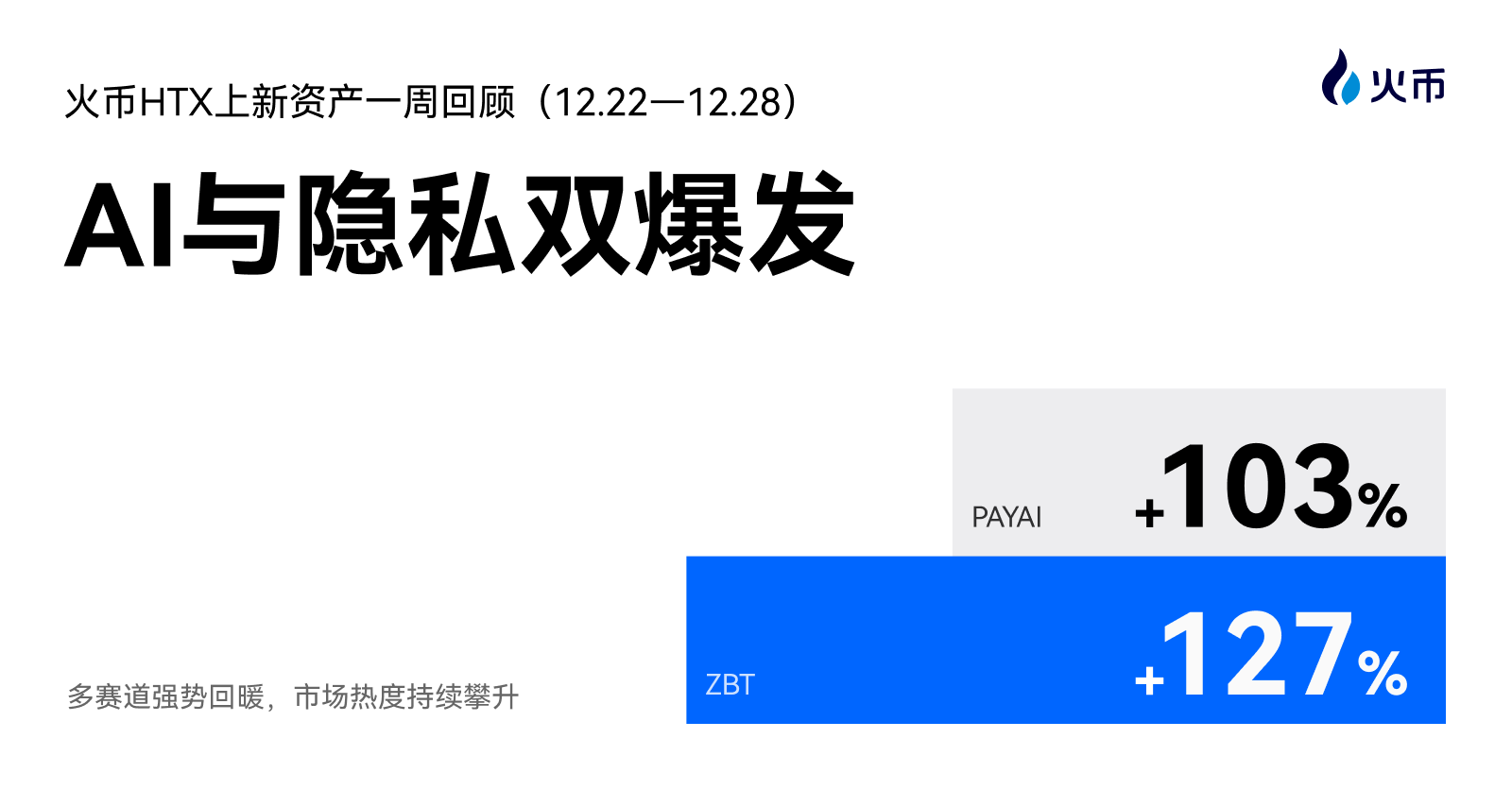
AI and Privacy Double Breakout! Huobi HTX New Assets Weekly Review (12.22—12.28): ZBT +127%, PAYAI +103%, Multiple Sectors Show Strong Rebound

marsbitPubblicato 2025-12-31Pubblicato ultima volta 2025-12-31

Introduzione

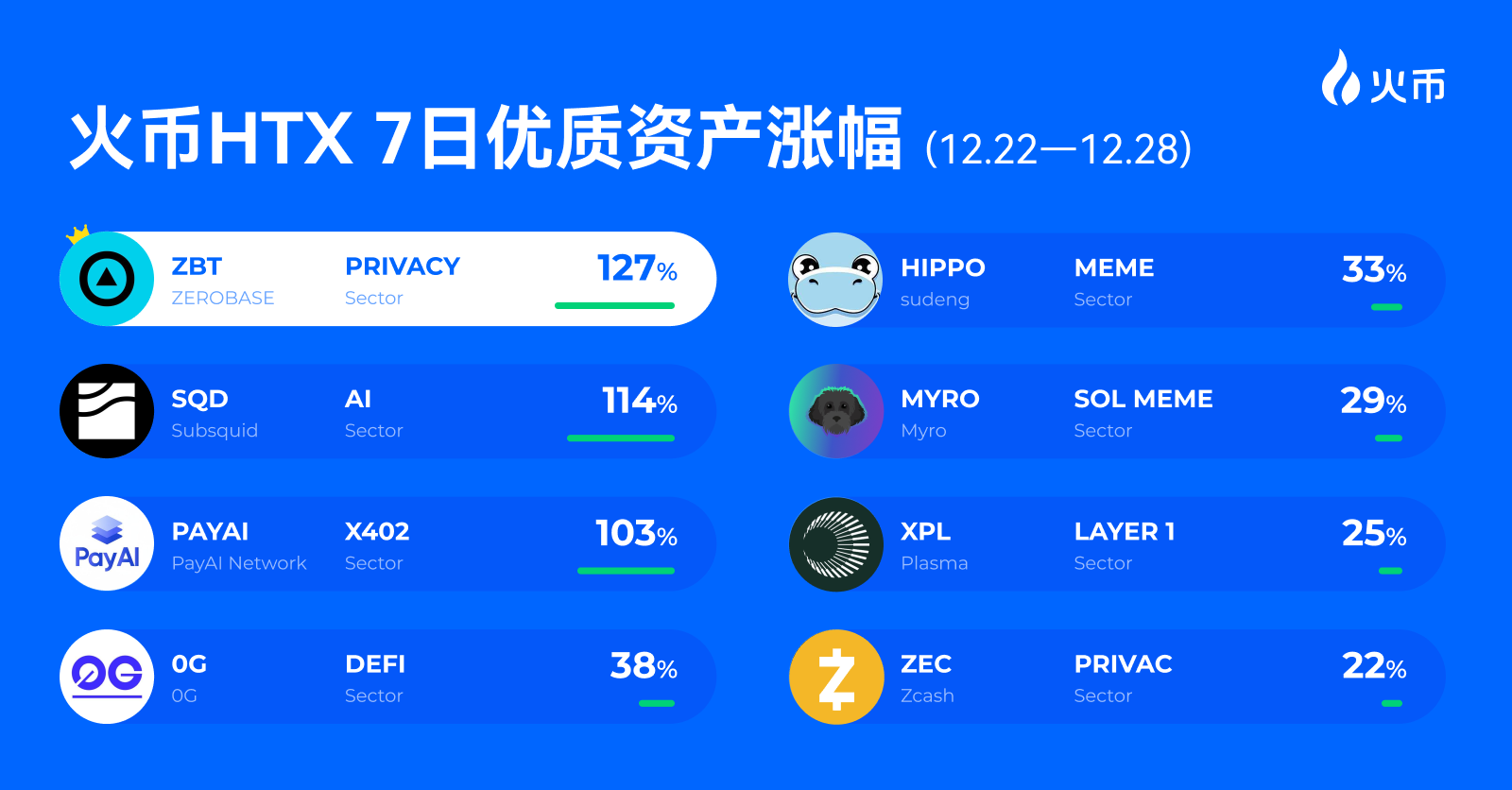
In the final week of 2025, the cryptocurrency market saw a broad recovery across multiple sectors, including AI, privacy, and meme tokens, driven by positive macro sentiment and holiday trading activity. On Huobi HTX, several assets recorded significant gains from December 22 to 28. ZBT (Zerobase), a privacy-focused infrastructure project, led with a 127% increase. The AI narrative regained momentum with PAYAI (PayAI Network) rising 103% and SQD (Subsquid) up 114%, partly due to the launch of Coinbase’s x402 V2 payment protocol supporting multi-chain transactions. ZEC (Zcash), a established privacy coin, also climbed 22%. Meme tokens showed seasonal strength, with DONKEY (BSC-based, +21%), MYRO (Solana-based, +29%), and HIPPO (Sui-based, +33%) all posting gains. Other notable performers included DeFi and L1 assets: 0G (Zero Gravity, +38%), SPK (Spark, +17%), and XPL (Plasma, +25%). Huobi HTX highlighted its early support for these trending assets, enabling users to capture opportunities as the crypto market continues its structured recovery.

As we approach the end of 2025, the sentiment in the crypto market continues to recover, with trading activity heating up again alongside the festive season行情. Macro tailwinds and hot narratives are driving sector strength, with multiple sectors like AI, Privacy, and Meme showing a comprehensive rebound. Capital flows are clearly directed towards high-growth narratives and value targets in细分 themes. Several popular assets on Huobi HTX saw outstanding gains over the past week (December 22nd - December 28th), with ZBT leading the pack with a 127% increase, as market sentiment continues to聚集 around leading sectors.

AI Narrative Returns to the Mainstream: PAYAI, SQD Lead the Charge

The AI narrative remains the absolute main theme of 2025, with accelerating technological adoption driving a revaluation of application-layer assets. A key driver behind this week's strong rebound in the AI sector was the official launch of the V2 version of the x402 protocol by the Coinbase developer team. x402 is an open-source payment protocol built specifically for AI agents. The new version offers default multi-chain support, covering native token payments on ecosystems like Base and Solana, and is directly compatible with traditional channels like ACH and bank card networks, providing greater scalability for the commercialization of AI services.

Driven by this positive development, assets within the x402 ecosystem saw significant strength. This performance further validates the mid-2025 sector trend judgment—AI business models are moving from concept to a scalable stage. Huobi HTX's early布局 of related core assets provides users with ample opportunity to capture the行情.

  • PAYAI (PayAI Network): Rose 103% this week, belongs to the AI sector within the x402 ecosystem. PayAI is an open-source, decentralized AI agent marketplace built on ElizaOS, libp2p, IPFS, and Solana. Market focus is on model capability upgrades and ecosystem expansion plans, making it a key tool for capital seeking exposure to the AI sector.

  • SQD (Subsquid): Rose 114%, AI computing power infrastructure. SQD Network is a decentralized data lake and query engine designed to provide developers with high-performance, permissionless data access. Rising expectations for computing power demand are driving valuation repairs, with trading volume significantly increasing, creating resonance between narrative and capital.

Privacy Protocols Regain Favor: ZBT, ZEC Both Rise

On-chain privacy capabilities are seen as a fundamental infrastructure proposition for the next cycle. The privacy sector continues to heat up, driven by policy trends and industry structural adjustments, showing a "resonance between old and new" structural行情. Huobi HTX's rich asset coverage provides users with multi-dimensional布局 options.

  • ZBT (Zerobase): Topped the list this week with a 127% gain, a breakout project in the privacy narrative. Zerobase is a decentralized cryptographic infrastructure network supporting products like zkStaking, zkLogin, and ProofYield, connecting institutional DeFi, user privacy protection, and real-world asset (RWA) strategies, ensuring system verifiability and trustworthiness while safeguarding private data security.
  • ZEC (Zcash): Rose 22%, a classic privacy asset representative. Zcash is a decentralized, open-source crypto internet currency, developed based on the Zerocash Protocol paper presented at the 2014 IEEE conference, utilizing zero-knowledge proofs and multiple account mechanisms to ensure transaction anonymity.
Seasonal Meme行情 Emerges: DONKEY, MYRO, HIPPO Rotate and Strengthen

Approaching the year-end, Meme sentiment is warming up. Light narratives and strong liquidity remain the advantageous characteristics of Meme-type assets. Several Meme assets on Huobi HTX achieved good gains. Their volatility advantage is matched with higher trading efficiency on the Huobi HTX platform, helping users flexibly grasp structural行情.

  • DONKEY: Rose 21% this week, a BSC ecosystem Meme with some community heat. Its origin is a post by Binance founder CZ saying "I am a donkey." The donkey is seen as a symbol of hard work in Chinese culture, representing those who work diligently.
  • MYRO (Myro): Rose 29%, a SOL ecosystem Meme. Myro is named after Solana founder Raj Gokal's beloved dog, Myro. This project pays homage to him and his dog and responds to the crypto space's普遍 demand for dog-themed narratives.
  • HIPPO (sudeng): Rose 33%, a SUI ecosystem Meme. $HIPPO is a meme coin created by fans on SUI to celebrate the world's cutest hippo, Sudeng. Under new community-driven management, the project donates part of its profits to global wildlife causes.

Multiple Sectors Resonate Upward: DeFi, L1 Ecosystems Synchronously Recover

Beyond the hot narrative areas, multi-sector asset轮动上涨 indicates stronger signs of incremental capital回流, suggesting the year-end structural行情 may continue.

  • 0G (Zero Gravity): Rose 38%, belongs to the DeFi+AI sector. Zero Gravity is a decentralized AI operating system, serving as the foundational layer for decentralized AI applications and blockchains. It efficiently coordinates the utilization of hardware resources like storage and computing, as well as software assets like data and models, to handle the scale and complexity of AI workloads.
  • SPK (Spark): Rose 17%, benefiting from capital回流 and improved protocol expectations. Spark is an on-chain capital allocator, currently deploying $3.86 billion in capital across DeFi, CeFi, and RWA fields. It dynamically adjusts asset allocation based on market conditions automatically, significantly improving capital efficiency while maintaining a prudent risk appetite.
  • XPL (Plasma): Rose 25%, belongs to the L1 ecosystem. Plasma is an EVM-compatible Layer 1 blockchain specifically built for high-capacity, low-cost global stablecoin payments. Prices continue to fluctuate upwards with expectations of traffic growth from underlying network ecosystem expansion.

Wealth Effect Highlights: Hot Assets Available on Huobi HTX

As the 2025行情 gradually recovers, sector differentiation remains significant. Choosing the right trading venue and a platform with forward-looking asset reserves will be key for users to gain an advantage in the new cycle. For most projects on this week's gainers list, Huobi HTX had already enabled trading support during their early布局 stages, allowing users more participation opportunities at the起点 of the行情.

Leveraging its敏锐 asset listing strategy and trading ecosystem advantages, Huobi HTX helps users achieve more efficient opportunity capture in complex market conditions. In the future, Huobi HTX will continue to iterate its platform strategies around market trends, user needs, and行情 cycle changes, expanding high-quality assets and trading depth to create a higher-certainty wealth appreciation path for users. More行情 and asset opportunities are available on Huobi HTX.

About Huobi HTX

Huobi HTX was founded in 2013. After 12 years of development, it has evolved from a cryptocurrency exchange into a comprehensive blockchain business ecosystem encompassing digital asset trading, financial derivatives, research, investment, incubation, and other businesses.

As a leading global Web3 portal, Huobi HTX adheres to a development strategy focused on global expansion, ecological prosperity, wealth effect, and security & compliance, providing comprehensive, secure, and reliable value and services to virtual currency enthusiasts worldwide.

To learn more about Huobi HTX, please visithttps://www.htx.com/ or HTX Square, and follow us on X, Telegram, and Discord. For further inquiries, please contact [email protected].


Domande pertinenti

QWhich asset had the highest percentage gain on Huobi HTX from December 22 to December 28, 2025, and what was its percentage increase?

AZBT (Zerobase) had the highest percentage gain, increasing by 127%.

QWhat was the main driver behind the strong rebound of the AI sector mentioned in the article?

AThe main driver was the launch of the V2 version of the open-source payment protocol x402 by the Coinbase developer team, which supports multi-chain and traditional payment channels for AI services.

QName two assets from the privacy protocol sector that performed well and their respective gains.

AZBT (Zerobase) gained 127% and ZEC (Zcash) gained 22%.

QWhich meme asset on the Solana ecosystem saw a 29% increase, and what is its namesake?

AMYRO (Myro) saw a 29% increase, and it is named after Solana co-founder Raj Gokal's dog, Myro.

QWhat is the primary function of the SQD Network as described in the article?

ASQD Network is a decentralized data lake and query engine designed to provide developers with high-performance, permissionless data access.

Letture associate

OpenAI Post-Training Engineer Weng Jiayi Proposes a New Paradigm Hypothesis for Agentic AI

OpenAI engineer Weng Jiayi's "Heuristic Learning" experiments propose a new paradigm for Agentic AI, suggesting that intelligent agents can improve not just by training neural networks, but also by autonomously writing and refining code based on environmental feedback. In the experiment, a coding agent (powered by Codex) was tasked with developing and maintaining a programmatic strategy for the Atari game Breakout. Starting from a basic prompt, the agent iteratively wrote code, ran the game, analyzed logs and video replays to identify failures, and then modified the code. Through this engineering loop of "code-run-debug-update," it evolved a pure Python heuristic strategy that achieved a perfect score of 864 in Breakout and performed competitively with deep reinforcement learning (RL) algorithms in MuJoCo control tasks like Ant and HalfCheetah. This approach, termed Heuristic Learning (HL), contrasts with Deep RL. In HL, experience is captured in readable, modifiable code, tests, logs, and configurations—a software system—rather than being encoded solely into opaque neural network weights. This offers potential advantages in explainability, auditability for safety-critical applications, easier integration of regression tests to combat catastrophic forgetting, and more efficient sample use in early learning stages, as demonstrated in broader tests on 57 Atari games. However, the blog acknowledges clear limitations. Programmatic strategies struggle with tasks requiring long-horizon planning or complex perception (e.g., Montezuma's Revenge), areas where neural networks excel. The future vision is a hybrid architecture: specialized neural networks for fast perception (System 1), HL systems for rules, safety, and local recovery (also System 1), and LLM agents providing high-level feedback and learning from the HL system's data (System 2). The core proposition is that in the era of capable coding agents, a significant portion of an AI's learned experience could be maintained as an auditable, evolving software system.

marsbit19 min fa

OpenAI Post-Training Engineer Weng Jiayi Proposes a New Paradigm Hypothesis for Agentic AI

marsbit19 min fa

Your Claude Will Dream Tonight, Don't Disturb It

This article explores the recent phenomenon of AI companies increasingly using anthropomorphic language—like "thinking," "memory," "hallucination," and now "dreaming"—to describe machine learning processes. Focusing on Anthropic's newly announced "Dreaming" feature for its Claude Agent platform, the piece explains that this function is essentially an automated, offline batch processing of an agent's operational logs. It analyzes past task sessions to identify patterns, optimize future actions, and consolidate learnings into a persistent memory system, akin to a form of reinforcement learning and self-correction. The article draws parallels to similar features in other AI agent systems like Hermes Agent and OpenClaw, which also implement mechanisms for reviewing historical data, extracting reusable "skills," and strengthening long-term memory. It notes a key difference from human dreaming: these AI "dreams" still consume computational resources and user tokens. Further context is provided by discussing the technical challenges of managing AI "memory" or context, highlighting the computational expense of large context windows and innovations like Subquadratic's new model claiming drastically longer contexts. The core critique argues that this strategic use of human-centric vocabulary does more than market products; it subtly reshapes user perception. By framing algorithms with terms associated with consciousness, companies blur the line between tool and autonomous entity. This linguistic shift can influence user expectations, tolerance for errors, and even perceptions of responsibility when systems fail, potentially diverting scrutiny from the companies and engineers behind the technology. The article concludes by speculating that terms like "daydreaming" for predictive task simulation might be next, continuing this trend of embedding the idea of an "inner life" into computational processes.

marsbit21 min fa

Your Claude Will Dream Tonight, Don't Disturb It

marsbit21 min fa

Trading

Spot
Futures

Articoli Popolari

Come comprare ZBT

Benvenuto in HTX.com! Abbiamo reso l'acquisto di Zerobase (ZBT) semplice e conveniente. Segui la nostra guida passo passo per intraprendere il tuo viaggio nel mondo delle criptovalute.Step 1: Crea il tuo Account HTXUsa la tua email o numero di telefono per registrarti il tuo account gratuito su HTX. Vivi un'esperienza facile e sblocca tutte le funzionalità,Crea il mio accountStep 2: Vai in Acquista crypto e seleziona il tuo metodo di pagamentoCarta di credito/debito: utilizza la tua Visa o Mastercard per acquistare immediatamente ZerobaseZBT.Bilancio: Usa i fondi dal bilancio del tuo account HTX per fare trading senza problemi.Terze parti: abbiamo aggiunto metodi di pagamento molto utilizzati come Google Pay e Apple Pay per maggiore comodità.P2P: Fai trading direttamente con altri utenti HTX.Over-the-Counter (OTC): Offriamo servizi su misura e tassi di cambio competitivi per i trader.Step 3: Conserva Zerobase (ZBT)Dopo aver acquistato Zerobase (ZBT), conserva nel tuo account HTX. In alternativa, puoi inviare tramite trasferimento blockchain o scambiare per altre criptovalute.Step 4: Scambia Zerobase (ZBT)Scambia facilmente Zerobase (ZBT) nel mercato spot di HTX. Accedi al tuo account, seleziona la tua coppia di trading, esegui le tue operazioni e monitora in tempo reale. Offriamo un'esperienza user-friendly sia per chi ha appena iniziato che per i trader più esperti.

180 Totale visualizzazioniPubblicato il 2025.10.16Aggiornato il 2025.10.16

Come comprare ZBT

Discussioni

Benvenuto nella Community HTX. Qui puoi rimanere informato sugli ultimi sviluppi della piattaforma e accedere ad approfondimenti esperti sul mercato. Le opinioni degli utenti sul prezzo di ZBT ZBT sono presentate come di seguito.

活动图片












