AI Accelerates Everything: Mathematics's Line of Defense Has Fallen, Physics is Already in AI's Crosshairs

marsbitPubblicato 2026-08-28Pubblicato ultima volta 2026-08-28

Introduzione

This summer, the mathematics community was shaken as OpenAI's Astra model reportedly solved 10 long-standing open problems, and Claude Fable 5 found a potential counterexample to the Jacobian conjecture. This was followed by a major shift in physics: renowned physicist Gavin E. Crooks presented an open problem in stochastic thermodynamics to Claude, which the AI solved completely in days—a task that might take a skilled graduate student months. The problem concerned constraints on entropy production statistics under the Detailed Fluctuation Theorem (DFT), a core concept in non-equilibrium physics. Claude provided a unifying geometric answer: all possible DFT-compatible distributions correspond to a convex "moment body." Its key insight was that for a fixed "gap," the distribution is uniquely determined, making any general DFT distribution a mixture of these basic two-outcome distributions. This structure implies that for given lower-order moments, the nth moment only has a sharp lower bound, with no upper bound. Claude demonstrated that numerous previously published bounds on entropy production are merely low-dimensional projections or "shadows" of this single, unified convex body. The AI-authored paper offers a complete hierarchical characterization of the moment constraints. This case signifies a potential paradigm shift: AI is progressing from solving known problems to aiding in the exploration of fundamental, unsolved scientific questions, heralding an AI-accelerated er...

This summer, the mathematics world was shaken by continuous shocks—

OpenAI's Astra model solved 10 long-standing unresolved mathematical problems at once (including the existence of non-sofic groups, new results on high-dimensional sphere packing, etc.); Claude Fable 5 found a counterexample to the nearly century-old Jacobian conjecture and later significantly advanced the Riemann Hypothesis!

This left Sidharth Hariharan, a mathematics graduate student at Carnegie Mellon University, even more confused.

Previously, after receiving an email from 2022 Fields Medalist Maryna Viazovska, he learned that his research had been preemptively published by the AI agent 'Gauss', and he wept.
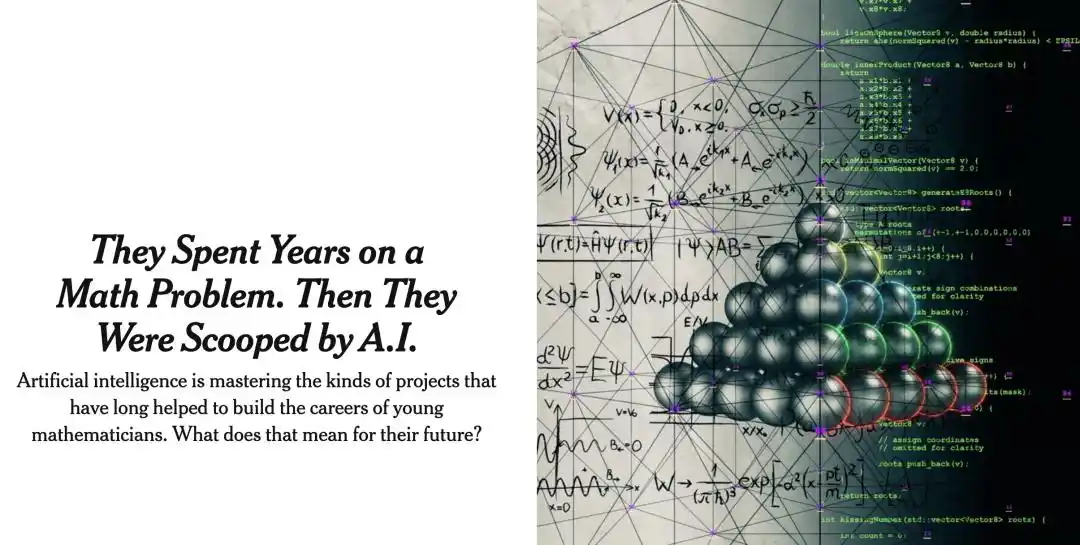
A year ago, you could still dismiss such progress as 'curiosity or hype, not very useful,' but the situation has changed. Even Fields Medalist Terence Tao admitted: Now, that argument no longer holds water.

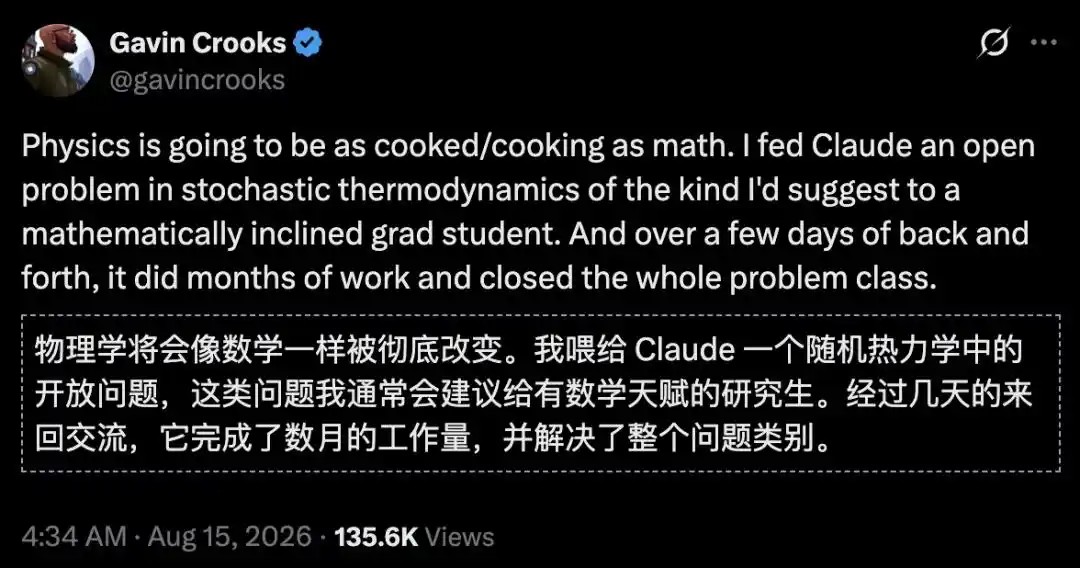
Just as the ripples in the mathematics community hadn't subsided, physicist Gavin E. Crooks tossed an open problem to Claude, and within days the entire problem was completely solved. Even a physics graduate student with solid mathematical skills might have taken months on this problem.

In physics, humans are also being dimensionally reduced by AI!

Against this backdrop, he, one of the founders of non-equilibrium statistical mechanics, asserted:

Physics will follow in mathematics's footsteps.
He acknowledged that academia is about to undergo a major transformation.

Academia has two roles: advancing knowledge and teaching/training/mentoring the next generation.

Science may soon develop at a pace humans cannot keep up with. And the other role also faces impact:

So, when any question I pose might be answered faster by Claude, how do we teach and train students?

What Exactly Was the Problem?

To understand the weight of this matter, one must return to Crooks himself. Gavin E. Crooks is highly esteemed in non-equilibrium thermodynamics and statistical mechanics.

In 1998–1999, while still a graduate student at Berkeley, he proposed the famous Crooks fluctuation theorem, which precisely relates non-equilibrium work to equilibrium free energy differences, becoming one of the cornerstones of stochastic thermodynamics.

A single 1999 paper alone has garnered thousands of citations.
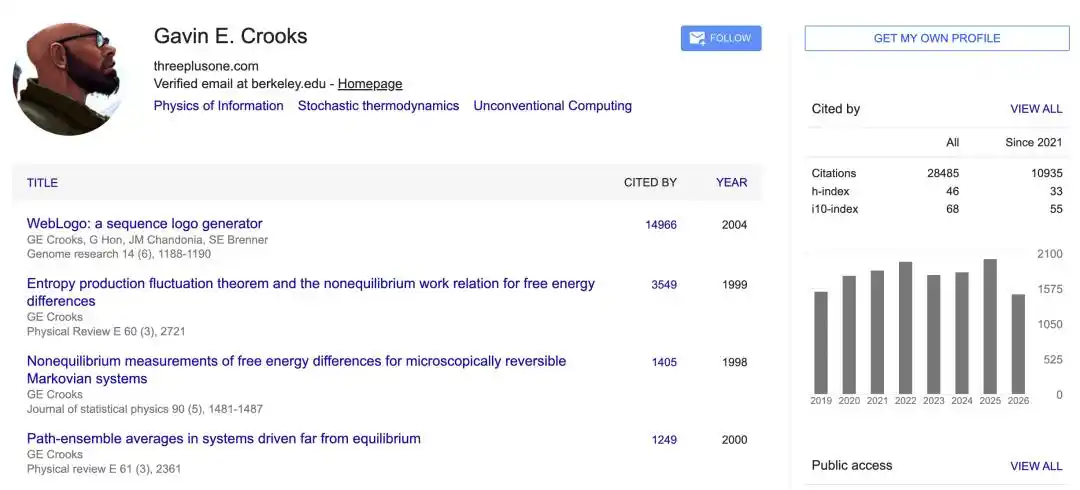
His long-term research traverses the intersection of thermodynamics, information theory, and computational science, profoundly influencing nanoscale thermodynamics, free energy estimation methods, and even the later formation of thermodynamic computing paradigms.

He received the Presidential Early Career Award for Scientists and Engineers (PECASE, one of the highest honors bestowed by the U.S. government on early-career researchers) and was elected a Fellow of the American Physical Society (APS Fellow) in 2019, enjoying high prestige in relevant academic circles.

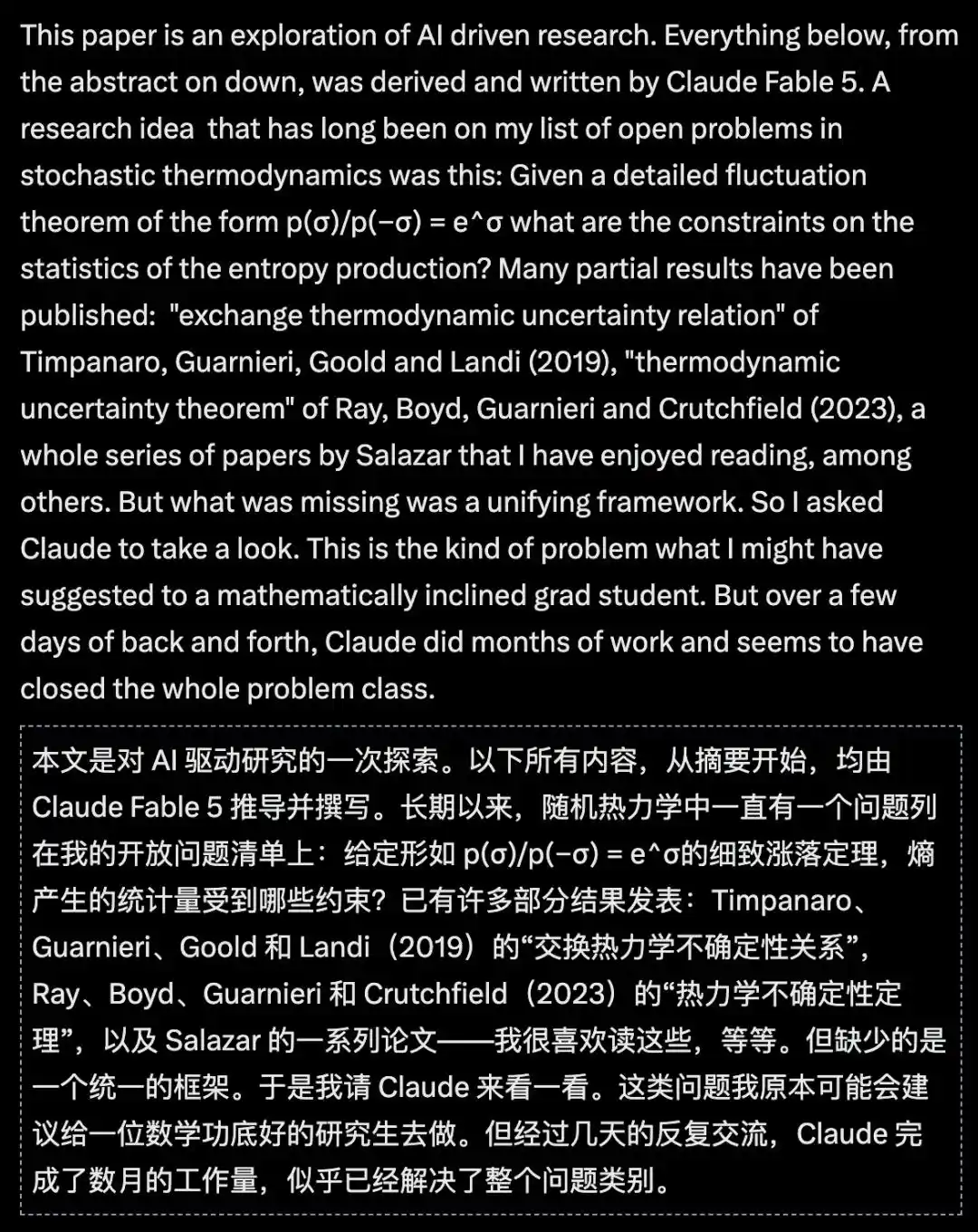
This time, Claude solved a stochastic thermodynamics problem given by Crooks.

In the microscopic world, a system can occasionally briefly 'go against the second law of thermodynamics,' but the probability ratio of逆行事件 to normal events is not arbitrary; it is precisely controlled by entropy production and decreases exponentially rapidly.

This is described by the beautiful, symmetric Detailed Fluctuation Theorem (DFT)—
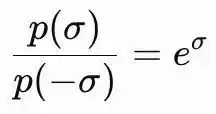
The problem: Under this functional constraint, what constraints exist for the statistics of entropy production?

This had already spawned a series of results.

Timpanaro et al.'s 2019 exchange TUR (exchange thermodynamic uncertainty relation) started from the exchange fluctuation theorem, giving a saturable bound in matrix form. Salazar's work continued to excavate tight bounds on skewness, tail probabilities, and information content from the DFT.

The 2023 TUT upgraded TUR from an inequality to a 'theorem,' clarifying the precise current achieving minimal scaled variance, and emphasized the influence of higher moments of entropy production.

They were unearthed one after another, yet a unified geometric picture was always missing.

Claude, however, identified all these local results as different projections of the same convex body and provided a complete hierarchical moment characterization.

The entire paper, from the abstract onward, was written by Claude.
Claude's Unified Answer: A Convex Region, Only a Lower Bound

Claude's core insight is remarkably clean:

Every distribution satisfying the DFT uniquely corresponds to a 'gap distribution' ν (i.e., the distribution of |σ|).

For each fixed gap 'a', the distribution P_a has only two outcomes ±a, with weights strictly fixed by e^σ.

Therefore, any DFT distribution is a unique mixture of these two basic outcome distributions.

The joint reachable region of statistics is thus a convex body (moment body). More crucially, this convex body has an exact characterization at each order:

Given the first n−1 moments, the n-th moment can only take values in [some sharp lower bound, +∞), with no upper bound. The lower bound is achieved by a unique distribution with a finite number of symmetric outcome levels.

Every previously published DFT bound can be recovered as a low-dimensional projection of this unified convex region.

This also explains why the same distribution can nearly saturate all these bounds simultaneously.

This theory can also be generalized to the general two-distribution Crooks fluctuation theorem.

The mechanism stems from an overlooked structural fact: the mean function of DFT, a·tanh(a/2), can be written as a sum of simple relaxation terms with positive weights, with poles at odd squares.
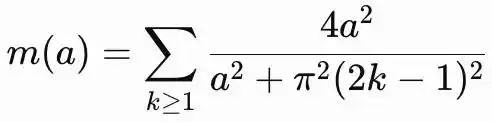
This directly maps the entire problem to the classical moment problem. Using precise identities involving Wronskian and Hankel determinants, all optimization falls onto a few atomic distributions.

The result: Nearly all published DFT bounds become low-dimensional projections (shadows) of this unified convex body. The same two-outcome distribution often saturates multiple different bounds simultaneously—because at a fixed mean, it is a vertex of the convex body.

For the general two-distribution Crooks fluctuation theorem, the symmetric channel (sum of forward and reverse moments) completely inherits the same hierarchy, while the asymmetric channel is almost unconstrained. This precisely explains why one-sided free energy estimators can be arbitrarily poor, while two-sided estimation is inherently necessary.

New Physics

The Thermodynamic Uncertainty Theorem itself was not a completely new discovery by Claude. The foundational version of this theorem was published in 2023 by Kyle J. Ray, Alexander B. Boyd, Giacomo Guarnieri, and James P. Crutchfield.
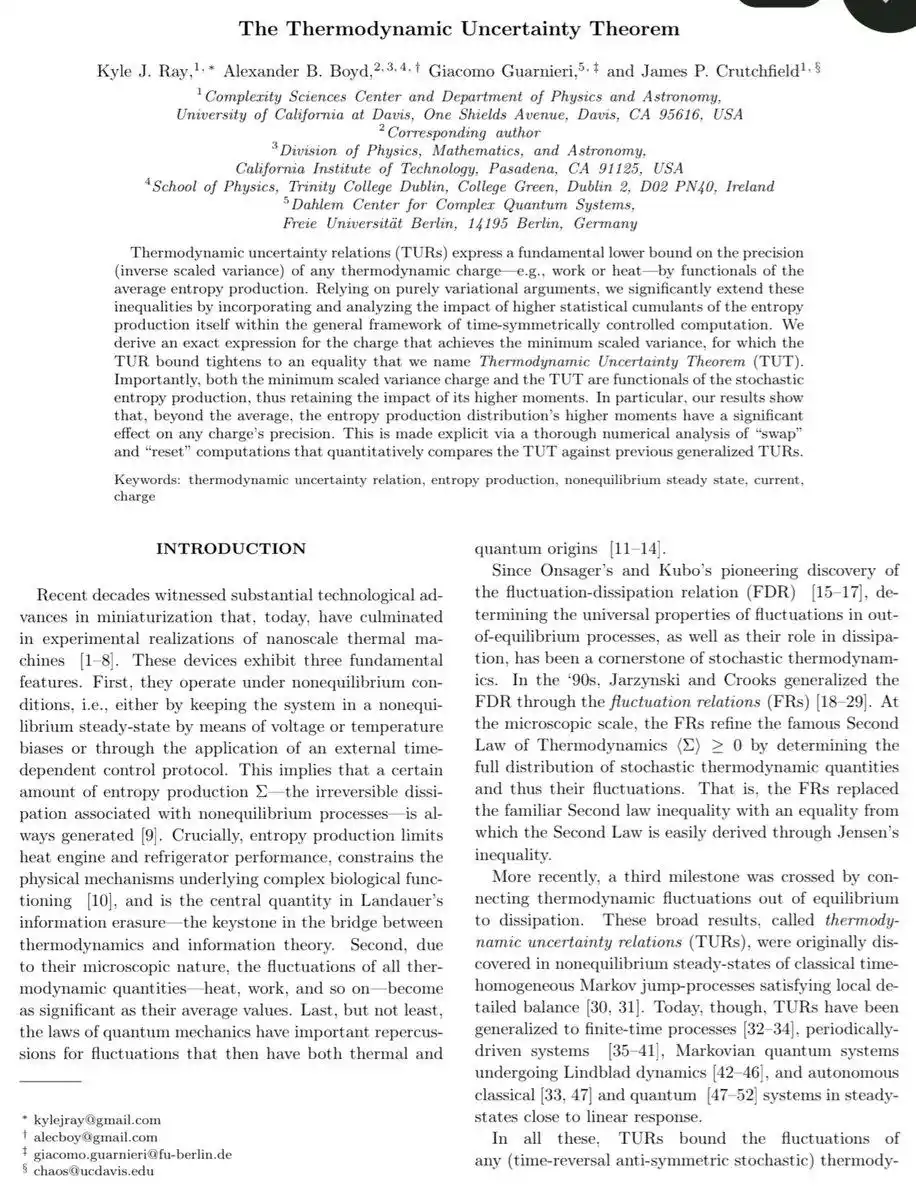
Claude placed all these 'projections' back into the same geometric object and proved that this object can be completely described.

The novel and fascinating aspect lies in the AI-driven research process.

Claude was not merely asked to explain an existing physics concept.

It was used to explore a difficult theoretical problem, connect existing ideas, and search for new mathematical structures.

This may become a story more significant than a single thermodynamic result:

AI is shifting from solving problems humans already know how to solve, to helping scientists explore problems we don't yet know how to solve.

Physics is entering its own AI-accelerated era.

References:

https://www.nytimes.com/2026/06/08/science/ai-scoop-young-mathematicians.html

https://x.com/SciTechera/status/2088872862254084449https://x.com/gavincrooks/status/2088643200038883830

https://x.com/gavincrooks/status/2088643200038883830

https://x.com/gavincrooks/status/2088590113463013582?s=20

This article is from the WeChat public account "新智元" (New Wisdom), author: ASI Revelation, editor: David


Domande pertinenti

QAccording to the article, what significant impact did AI have on mathematics before its breakthrough in physics?

AAI models like OpenAI's Astra solved 10 long-standing open math problems, and Claude Fable 5 found a counterexample to the nearly century-old Jacobian conjecture and significantly advanced work on the Riemann hypothesis.

QWho is Gavin E. Crooks, and why is his perspective on AI significant in the article?

AGavin E. Crooks is a leading figure in non-equilibrium statistical mechanics, famous for the Crooks fluctuation theorem. His perspective is significant because he prompted the AI (Claude) to solve a complex problem in stochastic thermodynamics, leading to a breakthrough and his assertion that physics will follow mathematics into an AI-accelerated era.

QWhat was the core insight provided by Claude regarding the Detailed Fluctuation Theorem (DFT)?

AClaude's core insight was that every distribution satisfying the DFT uniquely corresponds to a 'gap distribution.' The joint reachable region for statistical moments forms a convex body where, for any given order, only a sharp lower bound exists, with no upper bound, unifying all previously known DFT bounds as low-dimensional projections of this convex body.

QHow does the article differentiate the new role of AI in scientific research from its previous role?

AThe article states that AI is shifting from solving problems humans already know how to solve to helping scientists explore problems we do not yet know how to solve, representing a move from a tool for execution to a partner in fundamental discovery.

QWhat are the two key roles of academia mentioned in the article, and how is AI challenging them?

AThe two roles are advancing knowledge and teaching/training/mentoring the next generation. AI challenges the first by potentially advancing science at a pace humans cannot follow and challenges the second by raising the question of how to teach students when AI can answer their questions faster than a human instructor.

Letture associate

Bill Gates' Latest Long-Form Article: The Real Trouble with AI is That We Aren't Ready

Bill Gates' latest essay, "The turbulent AI era is here. The choices we make now are critical," warns that society is unprepared for the profound social and economic transition AI will bring. While optimistic about AI's long-term potential in healthcare, education, and other fields, Gates focuses on the "transition period" over the next 10-20 years. He argues this transition differs from past technological shifts like the Industrial Revolution because AI automates cognitive labor itself, potentially reducing the total number of future jobs. Risks like enhanced cyber-attacks and social disruption are already emerging, not distant future threats. A key concern is "low-cost intelligence substitution," where AI performs defined tasks cheaper than humans, gradually thinning workforces. Gates introduces the concept of "Human Reserved" jobs—roles like nursing or delivering serious medical news—where human judgment and empathy should remain central, even if AI is technically capable. To manage the transition, he calls for new governance, stronger social safety nets, retraining, and international cooperation, especially between the US and China. Crucially, he proposes taxing AI usage and robots to slow displacement and fund social programs. The core dilemma Gates presents is that AI could become humanity's "greatest equalizer" or its "worst source of injustice," depending on whether its immense productivity gains are broadly shared or concentrate wealth and power. The fundamental challenge is not just advancing the technology, but adapting our social and economic systems to it.

marsbit13 min fa

Bill Gates' Latest Long-Form Article: The Real Trouble with AI is That We Aren't Ready

marsbit13 min fa

Just Now, Anthropic Unveils Physical MCP: Claude Begins Controlling the Real World

Anthropic has announced the Model Hardware Standard (MHS), a new standard enabling AI agents like Claude to safely control physical devices. Building on the Model Context Protocol (MCP), MHS standardizes communication between AI agents and hardware such as microscopes, robotic arms, and lasers, marking a significant step for AI from the digital into the physical world. Developed in collaboration with HHMI Janelia Research Campus, MHS uses standardized drivers to translate basic commands (e.g., read, write) into a format any programmable device can understand. This drastically reduces integration time from weeks to hours or minutes and allows agents to discover and operate new devices using natural language tags that describe machine properties and safety limits. Agents can control devices via MCP, command-line interfaces, or APIs. They can sequence operations, monitor results, adjust parameters in real-time, and generate deterministic scripts for long-running tasks. Early tests show Claude interacting with hardware exploratively, like a scientist, learning to calibrate a laser and scripting the process. Early adopters and partners include AWS, Automata, Danaher, Doosan Robotics, and Tecan, who are integrating MHS support into their platforms. While promising, challenges remain: Claude's physical reasoning is limited, requiring expert oversight, and MHS currently only works with programmable hardware. Anthropic plans further refinements and broader device support before open-sourcing the standard.

marsbit46 min fa

Just Now, Anthropic Unveils Physical MCP: Claude Begins Controlling the Real World

marsbit46 min fa

History's Only Asset with a 100% Win Rate After 4 Years of Holding

**Title: The Only Asset with a 100% Win Rate Over Any 4-Year Holding Period** This article analyzes which major, freely-tradable assets have historically never produced a nominal loss over any rolling 4-year holding window. It concludes that only two distinct categories achieve this: ultra-low-risk contractual assets and Bitcoin. Among traditional risk assets, none maintain a perfect 4-year record. The S&P 500 had negative 4-year periods (e.g., 1929-1932: -64.8%). The Nasdaq 100 fell roughly 60% from 2000-2003. Gold saw a ~47.7% loss from 1981-1984. US real estate declined about 23.3% from 2007-2010. Even long-term US Treasury bonds (e.g., 2021-2024: -19.8%) and corporate bonds can produce 4-year losses due to interest rate and market price risks. In contrast, the first category achieving 100% nominal success includes assets like rolling 3-month US Treasury Bills, 4-year certificates of deposit (CDs), and US Treasuries held to maturity within 4 years. Their "guarantee" stems from contractual obligations and credit backing (e.g., FDIC insurance, US sovereign promise), not price appreciation. The sole exception in the high-risk category is Bitcoin. Analysis of daily data from 2010-2026 across 4,419 rolling 4-year windows shows a 100% positive return rate. The worst 4-year period (April 2021 to April 2025) still yielded a +32.6% total return (~7.3% CAGR). This record is unique because Bitcoin has no issuer, promises no cash flows, and has endured severe drawdowns (70-90%), yet its market price has always recovered within a 4-year span. The key distinction is the source of the "100%": contractual assets offer known, low nominal returns, while Bitcoin's record stems purely from historical price appreciation despite extreme volatility. The article suggests that for Bitcoin, the ability to hold for 4+ years is more critical than active trading strategies.

marsbit53 min fa

History's Only Asset with a 100% Win Rate After 4 Years of Holding

marsbit53 min fa

How One Article Moved 45 Billion: The Collapse of a 25-Year-Old 'AI Stock Guru'

This article details the dramatic rise and near-collapse of a hedge fund built by Leopold Aschenbrenner, a 24-year-old former OpenAI researcher. The fund, named Situational Awareness, amassed $45 billion in assets within two years. Its explosive growth stemmed from Aschenbrenner's influential 165-page manifesto predicting AGI's arrival by 2027 and his high-profile Silicon Valley connections. The fund employed an extremely aggressive strategy: high concentration and 400% leverage to bet long on AI infrastructure stocks while shorting legacy software firms. In July, this structure backfired when both sides of the trade reversed simultaneously—AI stocks plunged while shorted stocks rallied—triggering massive losses that nearly wiped out all equity. Major player Jane Street reportedly lost billions. The fund's leveraged public portfolio was ultimately sold at a discount to Citadel. The SEC is now investigating banks like Goldman Sachs for their role in facilitating the fund's high-leverage trades. The article compares this to past blow-ups like Archegos, highlighting systemic failures in risk management where the pursuit of short-term profits overrode due diligence. It questions whether such risky leverage concentrated in the AI sector, currently at record highs, poses a broader systemic threat. Ironically, Aschenbrenner, who studied AI safety at OpenAI, designed a fund structure prone to uncontrolled failure. Days after the crisis, he reportedly raised another $400 million for new investments.

marsbit1 h fa

How One Article Moved 45 Billion: The Collapse of a 25-Year-Old 'AI Stock Guru'

marsbit1 h fa

Trading

Spot
活动图片