After Three Years of Continuous Stock Selling, Buffett Finally Makes a Move

marsbitPubblicato 2026-08-10Pubblicato ultima volta 2026-08-10

Introduzione

Warren Buffett’s Berkshire Hathaway has ended its three-year streak of net stock sales and turned to net buying in Q2 2026, investing nearly $19.8 billion overall. The most notable move was a $10 billion private investment in Alphabet, making Google a top-five holding alongside Apple, American Express, Bank of America, and Coca-Cola. This decision, led by new CEO Greg Abel, signals Berkshire's increasing openness to tech investments. Additionally, Berkshire resumed share buybacks with $4.5 billion in Q2. These moves have reduced its massive cash and Treasury holdings from nearly $400 billion to about $364.7 billion. During the recent AI-driven semiconductor boom, Berkshire was criticized for holding back and missing out. However, the company stayed true to its value-investing discipline, waiting for prices to become reasonable. Now, with the market cooling, Berkshire is deploying its cash reserves to buy selectively, embodying Buffett’s long-term approach of being patient and acting when opportunities arise.

Author|Azuma(@azuma_eth)
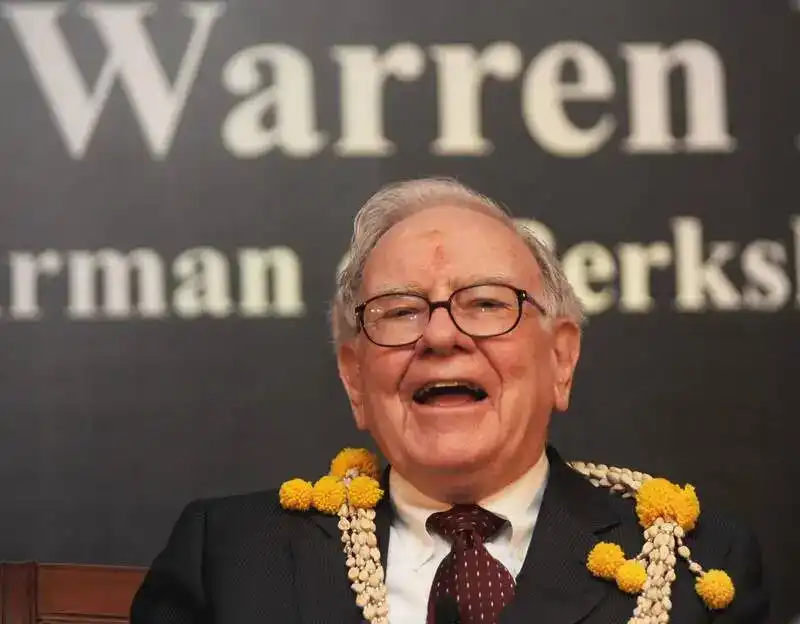
On August 9th Beijing Time, after the US stock market closed, Berkshire Hathaway released its Q2 2026 financial report.

The report data shows that Berkshire Hathaway's total revenue for Q2 2026 reached $101.808 billion, a year-over-year increase of approximately 10%. Net profit attributable to shareholders was $25.667 billion, doubling (a roughly 107% increase) compared to the same period last year, with both operating profit and net profit significantly exceeding market expectations.

However, a more significant signal in the report is that Berkshire Hathaway finally ended over three years (14 quarters) of net stock selling and shifted to net buying.

With $400 Billion in Cash, Berkshire Finally Acts

The report data shows that in the second quarter, Berkshire Hathaway purchased approximately $23.47 billion worth of stocks and sold only $3.69 billion, resulting in net purchases close to $19.8 billion, ending the prolonged net selling state that began in 2023.

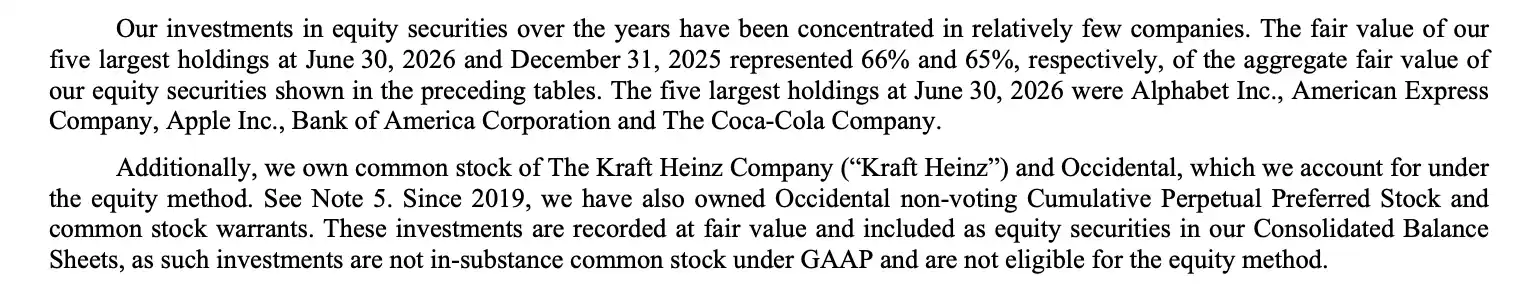
More noteworthy for investors is the direction of the funds. The report disclosed that Berkshire Hathaway's largest move last quarter was an additional approximately $10 billion investment in Alphabet (Google's parent company) through a private placement. This move officially places Google among Berkshire Hathaway's top five largest stock holdings by market value—alongside American Express, Apple, Bank of America, and Coca-Cola. As of the end of June, these five holdings collectively accounted for 66% of the stock investment portfolio, indicating that concentration remains extremely high.
Although Warren Buffett himself has long maintained a cautious attitude towards tech stocks, he previously revealed when first investing in Google that the decision was made jointly after discussions with Greg Abel (Berkshire Hathaway's current CEO, who officially succeeded Buffett on January 1st this year). Buffett also admitted that missing out on Google earlier was a "historical mistake," and this late investment was based on value investment logic, focusing on its search monopoly moat and stable cash flow.

This recent billion-dollar increase, however, represents an investment decision made under the leadership of the new CEO, Abel—perhaps indicating that with Buffett stepping back and Abel taking the helm, Berkshire Hathaway's tolerance and participation in technological frontiers are increasing.

In addition to resuming net buying in the market, Berkshire Hathaway also conducted its first stock buyback in two years during the second quarter. The report disclosed that last quarter, Berkshire Hathaway spent approximately $4.527 billion on buybacks, the highest quarterly amount since 2021; in July, it added over $3.3 billion more for buybacks.

In March of this year, Berkshire Hathaway announced the restart of its stock buyback plan. Abel stated at the time that the buybacks were because management believed the "intrinsic value" of their own stock was higher than its market price.

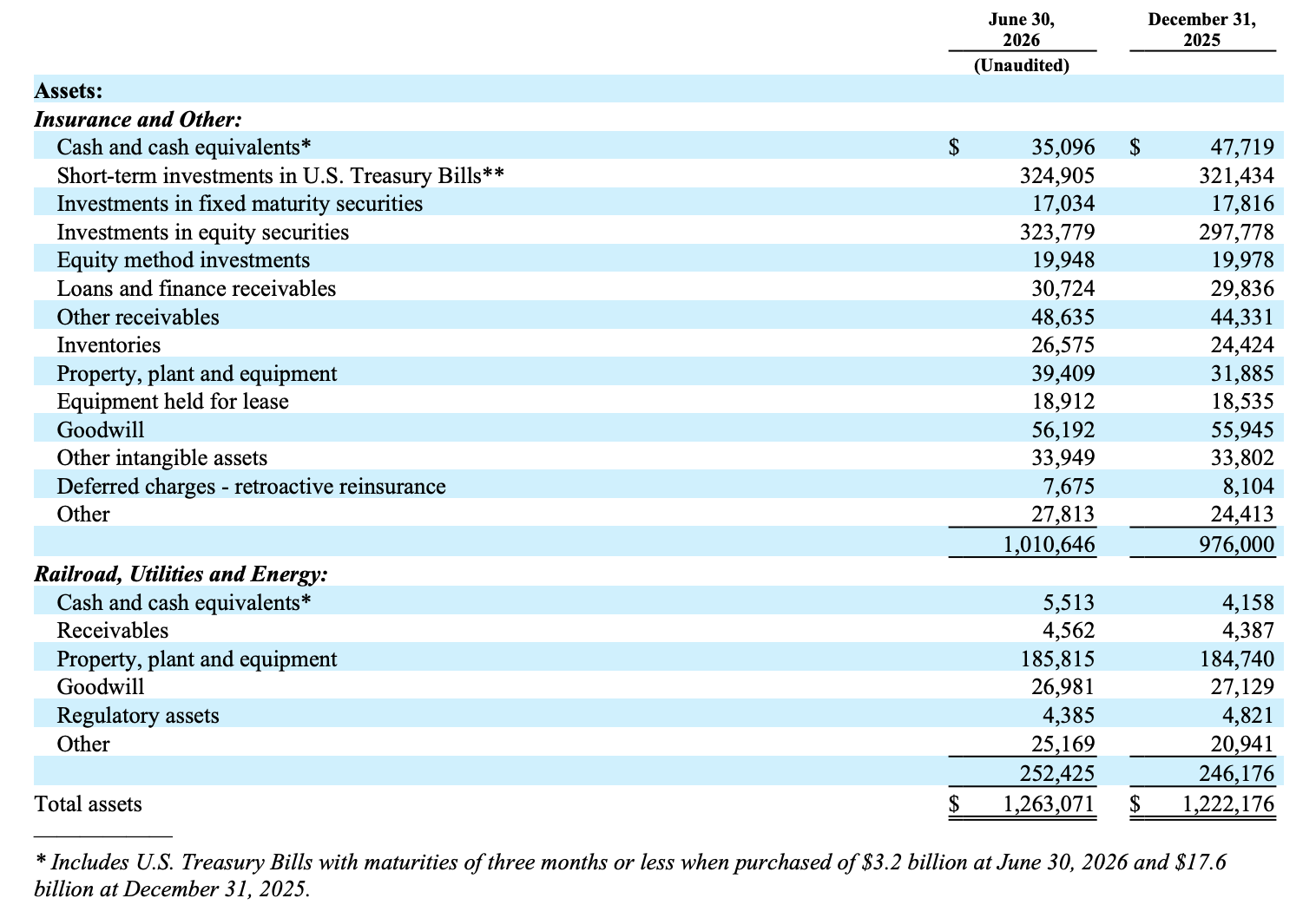
With the shift in investment and buyback pace, the massive cash reserves Berkshire Hathaway has long accumulated are also beginning to change. Over the past few years, one of the company's biggest labels has been a "cash machine." Due to a lack of large-scale opportunities meeting Buffett's investment criteria, the company's cash and short-term US Treasury holdings continued to climb, reaching a historical high of nearly $400 billion by the end of Q1 this year.

However, as stock acquisitions, stock buybacks, and industrial mergers and acquisitions (primarily for acquiring the petrochemical company OxyChem and homebuilder Taylor Morrison) unfolded, Berkshire Hathaway's cash reserves began to decline. As of June 30th, Berkshire held approximately $35.1 billion in cash and cash equivalents, and short-term US Treasury holdings were about $324.9 billion, totaling roughly $364.7 billion, a noticeable decrease from $397.38 billion at the end of Q1.
Once Mocked for "Not Keeping Up with the Times," Actually Watching Quietly "From the Banks of the Era's Turbulence"

Rewind to 2023 through early 2026.

Over these past few years, the wave of AI technology completely ignited the global capital markets. The chip and semiconductor industry chain, represented by Nvidia, SK Hynix, Samsung, and Micron, became the most crowded trading sector.

The market was filled with an "All in AI" frenzy. Any fund manager not heavily invested in semiconductors was seen as outdated. Meanwhile, Buffett and his Berkshire Hathaway, sitting on hundreds of billions in cash, chose an almost indifferent stance of observation.

Mockery followed. "Buffett can't keep up with the times," "Value investing is dead," "In the face of the AI revolution, the moat theory is outdated," "The old man isn't even as good as me"... Similar doubts were endless. People delighted in discussing the semiconductor stocks' gains of several-fold or even dozens-fold, comparing them to Berkshire Hathaway's seemingly sluggish stock performance, and eagerly concluded—this 90-plus-year-old investment maestro and his designated successor, Abel, had lost their judgment regarding the tech revolution.

But Berkshire Hathaway's choices clearly had their own logic. In its Q2 2026 report, Berkshire Hathaway reiterated its signature warning: "The amount of investment gains/losses in any given quarter is usually meaningless and provides virtually no analytical or predictive value."
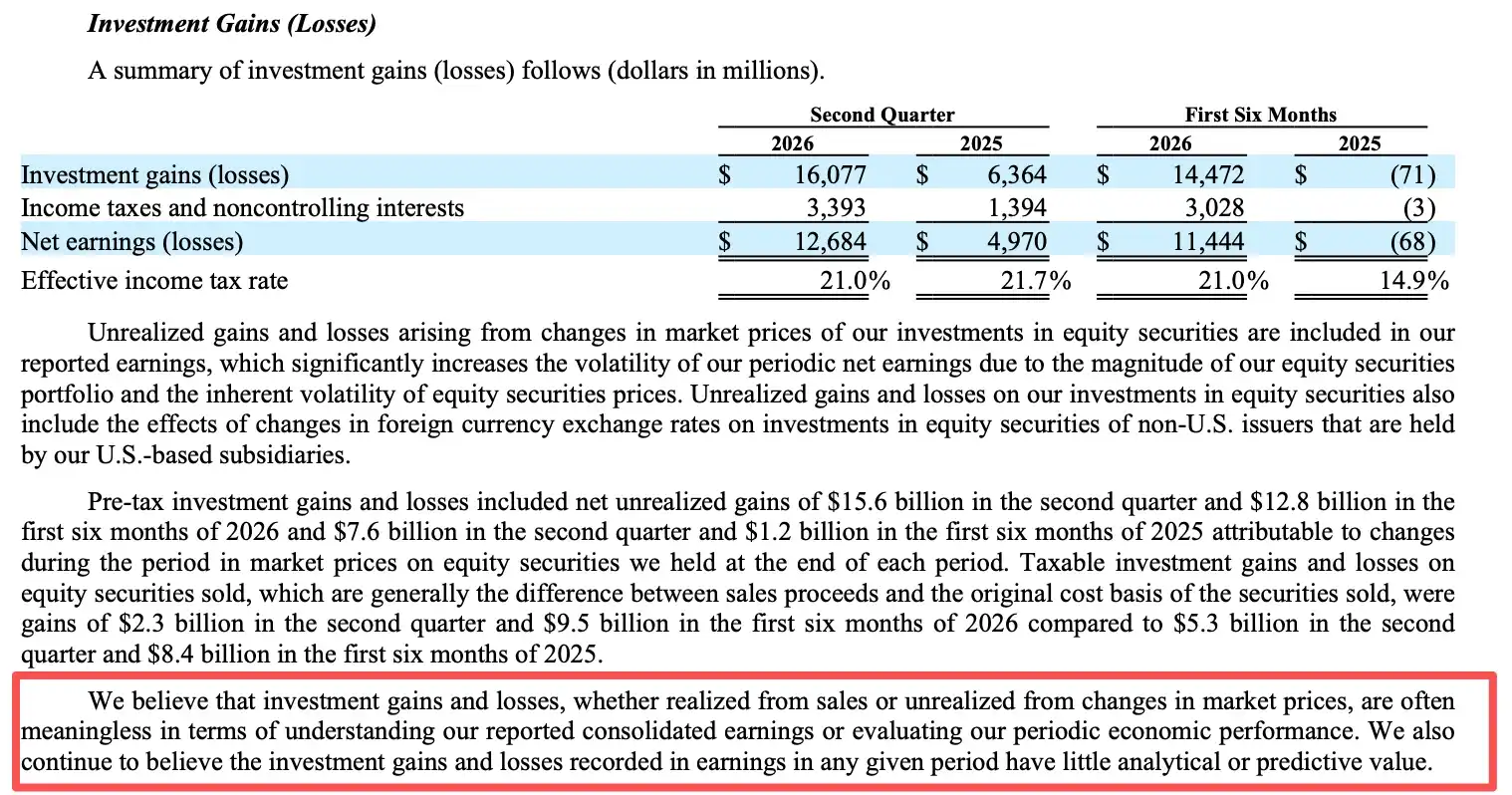
While this statement seems directed at GAAP accounting standards, it is actually a consistent attitude towards short-term market speculation. In the eyes of Buffett and Abel, doubts may still persist about whether the semiconductor industry can escape its cyclical nature, and uncertainty exists about when the explosive demand for AI hardware will translate into sustainable cash flow.

When the market entered its狂欢 stage and semiconductor companies' stock prices soared, the market environment at that time no longer conformed to Berkshire Hathaway's discipline of "buying great companies at fair prices." Thus, while the market was immersed in FOMO sentiment, Berkshire Hathaway chose the most boring but also most DNA-aligned strategy—waiting.

Until recent months, as the semiconductor frenzy suddenly subsided, previously overhyped targets experienced significant corrections. Those investors who once mocked Buffett for "missing the boat" suddenly realized that the paper profits from chasing semiconductor highs rapidly evaporated in the correction. Meanwhile, the hundreds of billions in cash on Berkshire Hathaway's books not only provided unparalleled safety but also gave it the courage to be greedy when others are fearful.

The $19.8 billion in net purchases in the second quarter is precisely the validation of this discipline. It's worth noting that Berkshire Hathaway did not chase the market at its peak but rather made large-scale moves after market fluctuations and the return of quality asset prices to reasonable ranges.

This is the truth Buffett has practiced for decades—investing is not about who runs the fastest, but about who lives the longest and laughs last.


Crypto di tendenza

Domande pertinenti

QWhat significant change did Berkshire Hathaway make in its investment strategy in Q2 2026, after a period of consistent net stock selling?

AIn Q2 2026, Berkshire Hathaway shifted from a prolonged period of net stock selling to net buying, ending over three years (14 consecutive quarters) of net sales. The company made approximately $198 billion in net stock purchases.

QWhat was Berkshire Hathaway's largest single investment disclosed in the Q2 2026 report, and what does it signify for the company's portfolio?

ABerkshire Hathaway's largest single investment in Q2 2026 was a $10 billion private purchase of additional shares in Alphabet (Google's parent company). This investment moved Alphabet into Berkshire's top five equity holdings, indicating a potential shift towards greater tolerance and participation in technology under new CEO Greg Abel.

QHow did Berkshire Hathaway's massive cash and short-term Treasury holdings change in Q2 2026, and what were the primary reasons for this change?

ABerkshire Hathaway's combined cash and short-term U.S. Treasury holdings decreased from a record high of nearly $400 billion at the end of Q1 to approximately $364.7 billion by June 30, 2026. The reduction was primarily due to significant stock purchases, stock buybacks (the first in two years), and acquisitions in the industrial sector.

QAccording to the article, how did public and market perception of Buffett and Berkshire Hathaway's strategy contrast with their recent actions during the AI/semiconductor boom?

ADuring the AI/semiconductor market boom, Buffett and Berkshire were often criticized as being 'out of touch' or having an outdated 'value investing' philosophy for not heavily investing in high-flying tech stocks. However, their recent net purchases demonstrate their disciplined strategy of waiting for market volatility to subside and asset prices to return to reasonable levels before deploying their massive cash reserves, validating their focus on long-term stability over short-term trends.

QWhat core investment philosophy or warning from Berkshire Hathaway's Q2 2026 report does the article highlight as key to understanding their approach to market fluctuations?

AThe article highlights Berkshire's reiterated warning in its Q2 2026 report that 'investment gains/losses in any given quarter are usually meaningless and provide almost no analytical or predictive value.' This underscores their philosophy of ignoring short-term market noise and speculation, focusing instead on long-term value and disciplined capital allocation.

Letture associate

Attention: Major Token Unlocks in 20 Altcoins This Week! Here is the Daily and Hourly List

**Attention: Major Token Unlocks This Week Across 20 Altcoins! Here's the Daily & Hourly Schedule** The cryptocurrency market declined this week due to heightened expectations of a Fed rate hike following higher-than-anticipated US inflation data. Bitcoin fell roughly 3%, with most altcoins following suit, although Ethereum is an exception, set to close the week up 0.77%. However, a significant wave of token unlocks is scheduled for the upcoming week across many altcoins. The following is a detailed schedule (times in UTC+3): * **Sep 14, 03:00:** Chainbase (C) - $1.34M (5.65% of market cap). * **Sep 15, 03:00:** ZKBase (ZKC) - $9.83M (63.72%). * **Sep 15, 15:00:** StarkNet (STRK) - $3.68M (1.79%). * **Sep 16, 03:00:** Major unlocks for Arbitrum (ARB, $13.05M), Alaya AI (AGT), GoPlus (GPS), Magma Finance (MAGMA), Valve (VALVES), STABL (STABL - $14.22M, 77.80%), and RollX (ROLL). * **Sep 17, 03:00:** Pudgy Penguins (PENGU, $5.13M) and Caldera (ERA, 16.03%). * **Sep 17, 13:00:** ZKsync (ZK) - $1.67M. * **Sep 18, 03:00:** Lombard (BARD) - $3.81M. * **Sep 19, 03:00:** RateX (RTX) - $3.42M (29.19%). * **Sep 20, 03:00:** Kaito (KAITO, $5.36M) and Sapien (SAPIEN, 10.55%). * **Sep 20, 15:00:** Lista DAO (LISTA) - $2.86M. * **Sep 20, 17:00:** Bedrock (BR) - $12.05M. * **Sep 20, 18:00:** LayerZero (ZRO) - $24.88M. Notably, the unlocks for ZKBase (ZKC) and STABL (STABL) represent a very high percentage of their respective circulating market caps at 63.72% and 77.80%. *This is not investment advice.

cryptonews.ru31 min fa

Attention: Major Token Unlocks in 20 Altcoins This Week! Here is the Daily and Hourly List

cryptonews.ru31 min fa

How Cryptocurrency Owners Lose Fortunes Due to a Single Blockchain Mistake

Crypto investors can lose fortunes not only due to hacks, but also from simple user errors in blockchain operations. This article details how mistakes like incorrect swap routes, address poisoning, wrong network selection, or granting excessive smart contract permissions can lead to irreversible losses worth millions of dollars from a single signed transaction. Key failure scenarios include: major swaps executed through pools with insufficient liquidity, causing extreme price slippage and massive losses (examples on Solana, Aave, and Cardano); sending funds to incorrect or poisoned addresses, turning transfers into non-recoverable losses (e.g., a $71M WBTC loss); and granting long-lasting smart contract approvals that can later be exploited (e.g., a $13.4M loss via SwapNet). The core issue is that blockchain networks execute transactions exactly as signed, without evaluating user intent. Unlike traditional finance, where intermediaries can intervene, crypto transfers are final once confirmed. Therefore, full control over assets also means full responsibility. The article concludes with critical safety practices: fully verifying addresses, checking networks, assessing swap liquidity and output, revoking unused approvals, using hardware wallets, and understanding common phishing tactics. Ultimately, the power of self-custody carries the risk of losing everything with one erroneous signature.

cryptonews.ru1 h fa

How Cryptocurrency Owners Lose Fortunes Due to a Single Blockchain Mistake

cryptonews.ru1 h fa

Trading

Spot

Articoli Popolari

Come comprare MOVE

Benvenuto in HTX.com! Abbiamo reso l'acquisto di Movement (MOVE) semplice e conveniente. Segui la nostra guida passo passo per intraprendere il tuo viaggio nel mondo delle criptovalute.Step 1: Crea il tuo Account HTXUsa la tua email o numero di telefono per registrarti il tuo account gratuito su HTX. Vivi un'esperienza facile e sblocca tutte le funzionalità,Crea il mio accountStep 2: Vai in Acquista crypto e seleziona il tuo metodo di pagamentoCarta di credito/debito: utilizza la tua Visa o Mastercard per acquistare immediatamente MovementMOVE.Bilancio: Usa i fondi dal bilancio del tuo account HTX per fare trading senza problemi.Terze parti: abbiamo aggiunto metodi di pagamento molto utilizzati come Google Pay e Apple Pay per maggiore comodità.P2P: Fai trading direttamente con altri utenti HTX.Over-the-Counter (OTC): Offriamo servizi su misura e tassi di cambio competitivi per i trader.Step 3: Conserva Movement (MOVE)Dopo aver acquistato Movement (MOVE), conserva nel tuo account HTX. In alternativa, puoi inviare tramite trasferimento blockchain o scambiare per altre criptovalute.Step 4: Scambia Movement (MOVE)Scambia facilmente Movement (MOVE) nel mercato spot di HTX. Accedi al tuo account, seleziona la tua coppia di trading, esegui le tue operazioni e monitora in tempo reale. Offriamo un'esperienza user-friendly sia per chi ha appena iniziato che per i trader più esperti.

593 Totale visualizzazioniPubblicato il 2024.12.13Aggiornato il 2026.08.21

Come comprare MOVE

Discussioni

Benvenuto nella Community HTX. Qui puoi rimanere informato sugli ultimi sviluppi della piattaforma e accedere ad approfondimenti esperti sul mercato. Le opinioni degli utenti sul prezzo di MOVE MOVE sono presentate come di seguito.

活动图片