After the Great NFT Collapse: Speculation is Dead, Utility Reigns?

marsbitPubblicato 2026-01-06Pubblicato ultima volta 2026-01-06

Introduzione

The NFT market has experienced a dramatic collapse, marked by the cancellation of NFT Paris 2025 due to severe financial strain. Over five years, NFTs transitioned from a speculative frenzy—epitomized by Beeple’s $69.3 million sale—to a period of severe contraction. Data reveals a 35% increase in supply in 2025, while sales plummeted by 37%, and the total market capitalization fell 86% from its 2022 peak. Average sale prices dropped to $96, down 75% from the bull market highs. Even blue-chip projects like CryptoPunks and Bored Ape Yacht Club saw floor prices crash by over 78%. Major platforms struggled: OpenSea’s monthly revenue fell from up to $120 million to under $1 million, prompting a pivot to a broader “Trade Everything” model. Blur and Magic Eden saw token prices drop over 98%, while older platforms like X2Y2 shut down entirely. Amid the downturn, Pudgy Penguins emerged as a success story by leveraging its IP into physical consumer goods, generating an estimated $50 million annually through retail partnerships and brand campaigns—avoiding crypto terminology to appeal to mainstream audiences. Similarly, Yuga Labs transferred CryptoPunks to a non-profit to focus on cultural preservation rather than speculation. NFTs are increasingly functioning as utility tools: Courtyard.io tokenizes physical Pokémon cards, facilitating over $12.7 million in sales in a month, while FIFA uses NFTs for World Cup ticket verification to combat scalping. The speculative NFT era i...

Original Author: Sanqing, Foresight News

On January 5th, the NFT Paris developer conference, originally scheduled for February, was abruptly canceled. The banks of the Seine, once home to all-night parties, are now left with only a cold official announcement tweet: "The market crash has hit us hard. Even with aggressive cost-cutting measures, we are still unable to sustain it."

Five years ago, digital artist Beeple's work "Everydays: The First 5000 Days" sold for a staggering $69.3 million at Christie's auction house. Subsequently, from CryptoPunks selling for tens of millions to countless digital collectibles backed by mainstream institutions, that was the golden age of NFTs.

From a record-breaking, historic auction sale to a forced industry conference cancellation, NFTs have completed a full cycle from frenzy to清算 (liquidation/reckoning) in just five years.

Image - Everydays: The First 5000 Days NFT

NFT Market Supply and Demand Imbalance

Supply Explosion. According to CryptoSlam data, the supply in 2025 increased by 35% compared to 1 billion in 2024. Over the past four years, the total number of NFTs has skyrocketed from 38 million to 1.34 billion, an increase of approximately 3,400%.

Sales Shrinkage. According to CryptoSlam data, the total NFT sales in 2025 were approximately $5.63 billion, a 37% decrease from $8.9 billion in 2024. According to CoinGecko data, the total NFT market capitalization fell from a peak of about $17 billion in April 2022 to about $2.4 billion by the end of 2025, a drop of about 86%. In 2025 alone, the total NFT market capitalization shrank from about $9.2 billion in January to its year-end size, a staggering annual decline of 68%.

Liquidity Dilution. As the minting threshold lowered, the market entered a "high-frequency, low-price" mode. According to CryptoSlam data, the average transaction price has fallen from $124 in 2024 to $96 by the end of 2025. Compared to the average transaction price of over $400 during the peak of the 2021-2022 bubble, it has fallen by three-quarters.
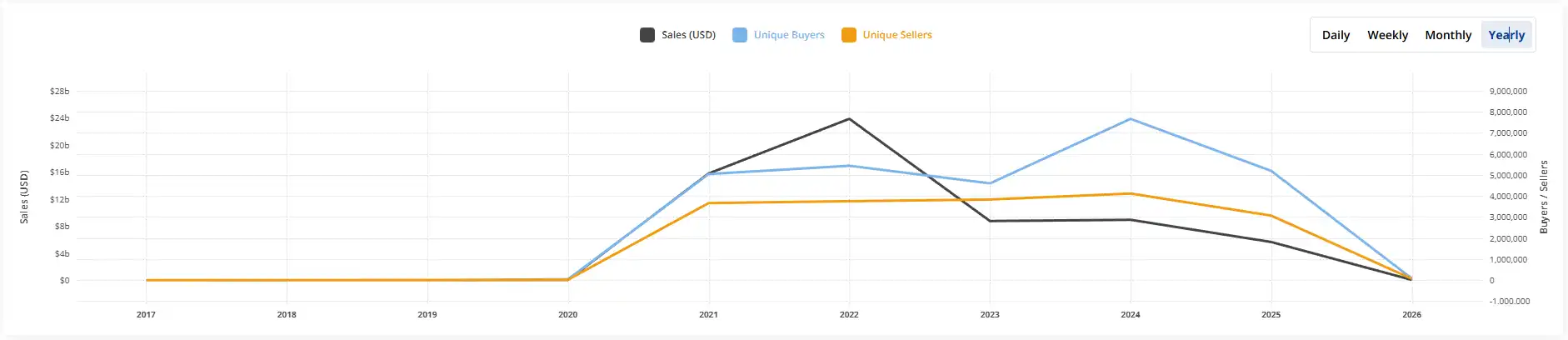
Image Source: CryptoSlam

Even former top-tier NFT projects and blue-chip NFTs could not escape the fate. Taking CryptoPunks as an example, the floor price has fallen to about 30 ETH, down 78% from its peak of 125 ETH in 2021; Bored Ape Yacht Club (BAYC) fell about 83% from around 30 ETH to about 5 ETH; Azuki fell about 93% from around 12 ETH to 0.8 ETH.

Collective "Flight" and Evolution of Platforms

The movements of industry leaders mark the end of this cycle.

OpenSea, which once firmly held the top spot in the NFT market, saw its platform revenue drop from $50 million to $120 million per month during the NFT golden age to less than one million.

Therefore, OpenSea announced a transformation. The platform will shift from a单纯的 "NFT marketplace" to a universal on-chain trading center for "Trade Everything", covering physical collectibles and digital assets like tokens, and confirmed it will issue a token.

Blur, which had a meteoric rise, saw its TVL continuously hit new lows, and its token price also fell 99% from its high.

Then there's Magic Eden, which started on Solana. After a year of operation, it issued a token. Affected by the NFT market conditions and the落地 (materialization) of short-selling expectations, the platform's trading volume began to shrink, and its token price also fell over 98% from its high.

Even projects that couldn't keep up with the changing times, like the older NFT marketplace X2Y2, have been淘汰 (eliminated), completely shutting down, with the team having pivoted to the AI field.

From "Token" to "Brand"

Amid the widespread despair, Pudgy Penguins successfully broke through against the trend, becoming an industry outlier. Its success does not rely on complex innovation in token technology or short-term speculative hype, but rather on transforming digital IP into physical consumer goods, gradually building a sustainable brand ecosystem that spans Web3 and traditional retail.

Through the dual revenue model推行 (implemented) by CEO Luca Netz, Pudgy Penguins deeply integrates IP licensing with physical goods. Its physical toys have entered over 10,000 retail channels globally, including Walmart, Target, and Walgreens. According to an AInvest report, this transformation has brought the project approximately $50 million in annual revenue, effectively offsetting the impact of the overall crypto market contraction.
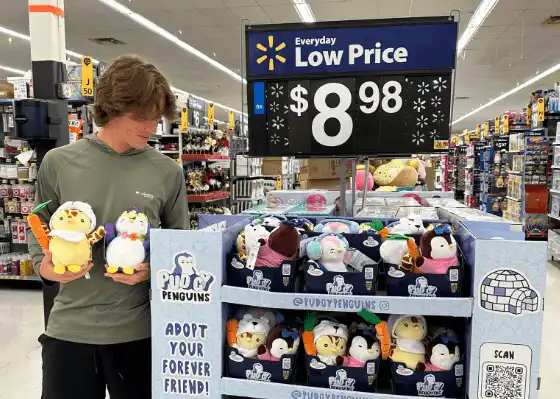
Image - Pudgy Penguins toy shelf in a US Walmart

During the 2025 Christmas period, Pudgy Penguins spent approximately $500,000 to project a giant animation on the Las Vegas landmark Sphere.

Image - Pudgy Penguins image on the Sphere

This advertisement, aimed at millions of tourists, avoided crypto jargon and the term NFT, presenting only a family-friendly IP image. It stimulated secondary market liquidity through brand exposure. In the past 14 days, the floor price of this NFT rose 25%, and trading volume increased by about 33%.

This shift in thinking from speculation to cultural operation seems to be becoming a consensus among industry survivors. Last May, Bored Ape Yacht Club (BAYC) issuer Yuga Labs transferred the IP rights of the top NFT project CryptoPunks to the non-profit organization Infinite Node Foundation, aiming to剥离 (strip) it from its speculative nature of price fluctuations and seek longer-term art preservation and cultural operation.

Physical Backing and Functional Return

Beyond IP branding, NFTs are becoming the underlying tool for connecting real-world assets (RWA).

Physical Card Trading. The platform Courtyard.io is changing the game. They deposit real Pokémon cards into certified vaults and tokenize them as NFTs. In the 30 days leading up to the end of 2025, the platform processed over 230,000 transactions, generating approximately $12.7 million in sales, proving strong market demand for this type of highly liquid, physically-backed asset.

Functional Tickets. FIFA (Fédération Internationale de Football Association) has also joined this camp, introducing "priority purchase right" NFTs in the ticket sales for the 2026 World Cup. These NFTs are not for speculation but serve as a verification tool to prevent scalper premiums and price fraud in the secondary market.

What Died in NFTs, and What Remains

NFTs have not "completely died out," but they have indeed died once.

What died is the fantasy of viewing NFTs as a financial asset that could脱离 (detach from) real-world value and be continuously minted and traded based solely on narrative. In the face of the reality of infinite supply and limited demand, this path was destined to be unsustainable.

What remains is the role of NFTs as a "credential layer." They are no longer required to create value alone but are embedded within IP brands, physical assets, and functional scenarios,承担 (undertaking) the basic functions of rights confirmation, transfer, participation, and verification.

From Pudgy Penguins' toy shelves, to the on-chain circulation of physical cards, to the anti-scalping mechanism for World Cup tickets, NFTs are stepping down from the stage of speculation and returning to the toolbox.

For the NFT speculative market, this is undoubtedly a winter. But for NFTs themselves, this is more like a rebirth after disenchantment.


Letture associate

As Consensus Accelerates, What Are Young Investors Betting On?

Title: As Consensus Forms Faster, What Are Young Investors Betting On? In the rapid evolution of tech investment, a new generation of young investors is navigating a landscape where AI, robotics, commercial aerospace, and quantum computing are advancing simultaneously. Traditional investment logic based on financial models is giving way to a need for deep technical understanding and the ability to act before industry consensus forms. An analysis of trends from the "WAIC FUTURE TECH" list of young investment leaders reveals key shifts in focus. The first major trend is the movement of AI from the digital screen into the physical world. Investment is shifting from large language models and chatbots towards embodied AI, robotics, AI hardware, and edge computing. While demonstrations generate excitement, the real challenge lies in achieving scalable, reliable, and cost-effective delivery in complex real-world environments like factories and logistics. Success depends not just on algorithms but on the integration of sensors, actuators, and control systems. Second, the competitive focus for large models is moving beyond raw capability toward building an "intelligence flywheel." The goal is to create self-reinforcing systems where user interaction generates data, improving the model, which in turn enhances the user experience and attracts more engagement. Companies that successfully embed AI into workflows to create these closed-loop systems can build lasting value that isn't easily erased by the next model upgrade. Third, facing a potential bottleneck in high-quality human-generated data, investors are looking at new underlying technologies. Reinforcement learning and self-play, as demonstrated by AlphaGo Zero, offer paths for AI to generate its own experience. Scientific foundation models, which aim to build general AI capabilities for fields like life sciences and materials discovery, represent a non-consensus direction that could unlock new frontiers of knowledge and data. Finally, in deep-tech areas like quantum computing, commercial aerospace, and space-based infrastructure, patient capital is essential. These fields have long, uncertain development and validation cycles involving complex engineering, supply chains, and regulations. Investment here requires a long-term view, focusing on foundational team capabilities and the eventual emergence of market demand, even if commercial returns are distant. Collectively, these trends illustrate how young investors are adapting to a new era. They are learning to make earlier, technically-informed judgments, balance hype with real-world viability, and provide the patient capital needed to build the deep-tech foundations of the future.

marsbit3 min fa

As Consensus Accelerates, What Are Young Investors Betting On?

marsbit3 min fa

Can Japan Buy Growth with AI? Will the Bond Market Believe It?

Japan's cabinet has introduced the 2026 Basic Policy on Economic and Fiscal Management and Reform, shifting its primary fiscal target. The new framework moves away from the traditional annual primary balance goal and instead prioritizes a stable reduction of the debt-to-GDP ratio. This change is tied to a strategy of increased "responsible proactive fiscal" spending, aiming to boost long-term growth through investments in strategic sectors like AI, semiconductors, energy, and robotics. The government estimates total public and private investment in 62 key technologies could exceed 370 trillion yen by 2040. The market reaction has been mixed and cautious. While equity markets may respond to policy signals, bond markets are focused on fiscal credibility. Concerns center on whether the weakening of the clear primary balance anchor could lead to looser fiscal discipline. If investors doubt that these strategic investments will generate sufficient productivity gains, tax revenue, and nominal growth to outpace rising interest costs, they may demand higher yields on Japanese Government Bonds (JGBs). Recent volatility in the yen and JGB yields, with the 10-year yield briefly reaching 2.9%, reflects this skepticism. The success of this new framework hinges on two factors: whether Japan can achieve a nominal growth rate consistently higher than its long-term interest rates, and whether future budgets demonstrate disciplined control over bond issuance. The government's narrative is that strategic investment is essential to break Japan's cycle of low growth, aging, and labor shortages. However, the bond market will continuously assess the credibility of this plan, pricing the risk that it may represent fiscal expansion rather than a viable growth strategy.

marsbit40 min fa

Can Japan Buy Growth with AI? Will the Bond Market Believe It?

marsbit40 min fa

Misjudged A-Shares: Resilience, Expectations, and Confidence

China's A-share market recently faced selling pressure, especially in tech sectors, initially triggered by a global tech sell-off that began in South Korea. However, the article argues this is a case of "mistaken injury" and highlights the market's underlying resilience. This resilience stems from three main pillars: **1) Tech Sector Fundamentals:** Unlike Korea's market dominated by a few memory chip stocks, China's tech sector is diversified across computing, communications, electronics, and semiconductors, supported by dual narratives of global AI supply chains and domestic substitution. Core areas like optical modules and fiber optics continue to show strong earnings growth. **2) "National Team" Support:** State-backed institutions and large corporations have made significant market purchases and announced buybacks, providing liquidity and signaling confidence. This is seen as a stabilizing policy signal, often associated with market bottoms. **3) Broader Market Pillars:** Other major sectors are showing endogenous recovery momentum. Consumer stocks benefit from stabilizing CPI and signs of sector recovery (e.g., liquor price hikes). Cyclical sectors like aluminum have high earnings, potential price increases due to tight supply, and low valuations. The financial sector offers stable dividends and low valuations. The conclusion is that the sell-off was driven by external contagion, not a collapse in fundamentals. With strong policy support and recovering momentum across key sectors, the A-share market possesses the toughness to regain stability.

marsbit1 h fa

Misjudged A-Shares: Resilience, Expectations, and Confidence

marsbit1 h fa

Trading

Spot
活动图片



