Original Author: Sanqing, Foresight News
On January 5th, the NFT Paris developer conference, originally scheduled for February, was abruptly canceled. The banks of the Seine, once home to all-night parties, are now left with only a cold official announcement tweet: "The market crash has hit us hard. Even with aggressive cost-cutting measures, we are still unable to sustain it."
Five years ago, digital artist Beeple's work "Everydays: The First 5000 Days" sold for a staggering $69.3 million at Christie's auction house. Subsequently, from CryptoPunks selling for tens of millions to countless digital collectibles backed by mainstream institutions, that was the golden age of NFTs.
From a record-breaking, historic auction sale to a forced industry conference cancellation, NFTs have completed a full cycle from frenzy to清算 (liquidation/reckoning) in just five years.

Image - Everydays: The First 5000 Days NFT
NFT Market Supply and Demand Imbalance
Supply Explosion. According to CryptoSlam data, the supply in 2025 increased by 35% compared to 1 billion in 2024. Over the past four years, the total number of NFTs has skyrocketed from 38 million to 1.34 billion, an increase of approximately 3,400%.
Sales Shrinkage. According to CryptoSlam data, the total NFT sales in 2025 were approximately $5.63 billion, a 37% decrease from $8.9 billion in 2024. According to CoinGecko data, the total NFT market capitalization fell from a peak of about $17 billion in April 2022 to about $2.4 billion by the end of 2025, a drop of about 86%. In 2025 alone, the total NFT market capitalization shrank from about $9.2 billion in January to its year-end size, a staggering annual decline of 68%.
Liquidity Dilution. As the minting threshold lowered, the market entered a "high-frequency, low-price" mode. According to CryptoSlam data, the average transaction price has fallen from $124 in 2024 to $96 by the end of 2025. Compared to the average transaction price of over $400 during the peak of the 2021-2022 bubble, it has fallen by three-quarters.
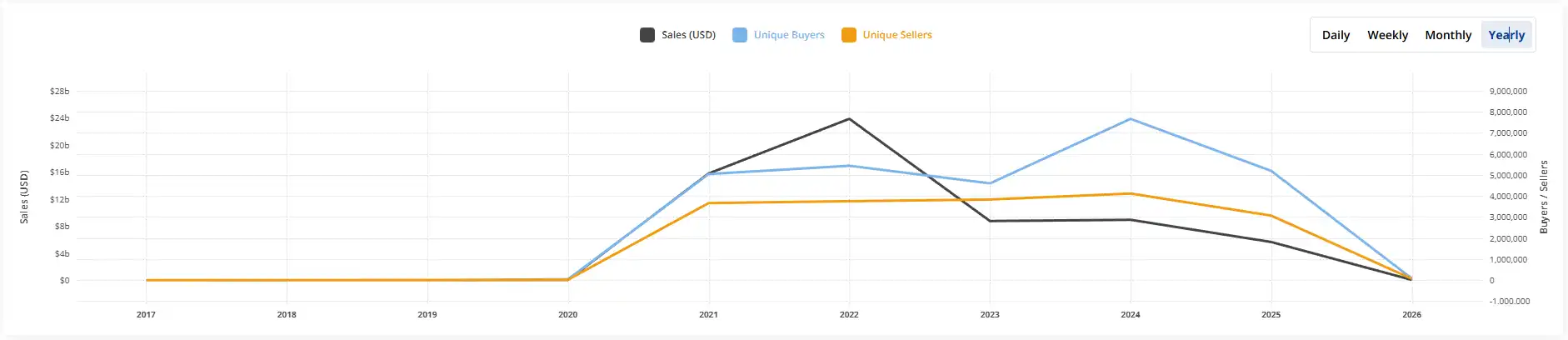
Image Source: CryptoSlam
Even former top-tier NFT projects and blue-chip NFTs could not escape the fate. Taking CryptoPunks as an example, the floor price has fallen to about 30 ETH, down 78% from its peak of 125 ETH in 2021; Bored Ape Yacht Club (BAYC) fell about 83% from around 30 ETH to about 5 ETH; Azuki fell about 93% from around 12 ETH to 0.8 ETH.
Collective "Flight" and Evolution of Platforms
The movements of industry leaders mark the end of this cycle.
OpenSea, which once firmly held the top spot in the NFT market, saw its platform revenue drop from $50 million to $120 million per month during the NFT golden age to less than one million.
Therefore, OpenSea announced a transformation. The platform will shift from a单纯的 "NFT marketplace" to a universal on-chain trading center for "Trade Everything", covering physical collectibles and digital assets like tokens, and confirmed it will issue a token.
Blur, which had a meteoric rise, saw its TVL continuously hit new lows, and its token price also fell 99% from its high.
Then there's Magic Eden, which started on Solana. After a year of operation, it issued a token. Affected by the NFT market conditions and the落地 (materialization) of short-selling expectations, the platform's trading volume began to shrink, and its token price also fell over 98% from its high.
Even projects that couldn't keep up with the changing times, like the older NFT marketplace X2Y2, have been淘汰 (eliminated), completely shutting down, with the team having pivoted to the AI field.
From "Token" to "Brand"
Amid the widespread despair, Pudgy Penguins successfully broke through against the trend, becoming an industry outlier. Its success does not rely on complex innovation in token technology or short-term speculative hype, but rather on transforming digital IP into physical consumer goods, gradually building a sustainable brand ecosystem that spans Web3 and traditional retail.
Through the dual revenue model推行 (implemented) by CEO Luca Netz, Pudgy Penguins deeply integrates IP licensing with physical goods. Its physical toys have entered over 10,000 retail channels globally, including Walmart, Target, and Walgreens. According to an AInvest report, this transformation has brought the project approximately $50 million in annual revenue, effectively offsetting the impact of the overall crypto market contraction.
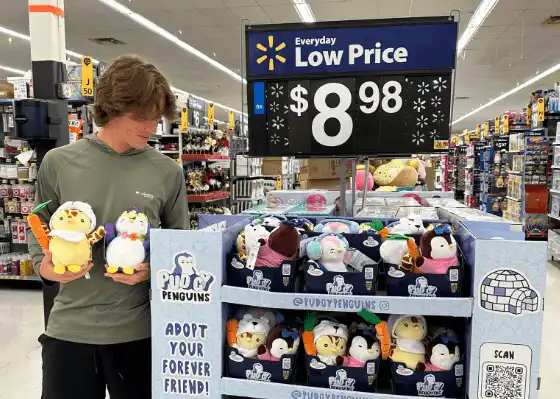
Image - Pudgy Penguins toy shelf in a US Walmart
During the 2025 Christmas period, Pudgy Penguins spent approximately $500,000 to project a giant animation on the Las Vegas landmark Sphere.
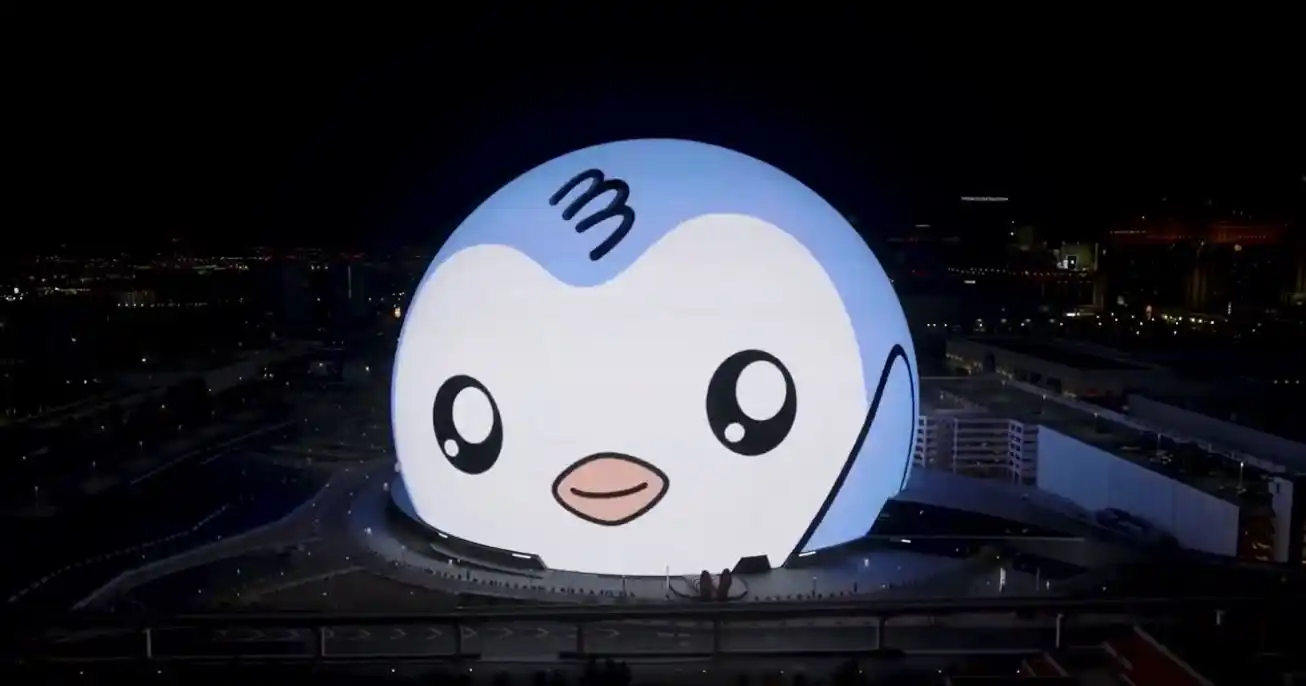
Image - Pudgy Penguins image on the Sphere
This advertisement, aimed at millions of tourists, avoided crypto jargon and the term NFT, presenting only a family-friendly IP image. It stimulated secondary market liquidity through brand exposure. In the past 14 days, the floor price of this NFT rose 25%, and trading volume increased by about 33%.
This shift in thinking from speculation to cultural operation seems to be becoming a consensus among industry survivors. Last May, Bored Ape Yacht Club (BAYC) issuer Yuga Labs transferred the IP rights of the top NFT project CryptoPunks to the non-profit organization Infinite Node Foundation, aiming to剥离 (strip) it from its speculative nature of price fluctuations and seek longer-term art preservation and cultural operation.
Physical Backing and Functional Return
Beyond IP branding, NFTs are becoming the underlying tool for connecting real-world assets (RWA).
Physical Card Trading. The platform Courtyard.io is changing the game. They deposit real Pokémon cards into certified vaults and tokenize them as NFTs. In the 30 days leading up to the end of 2025, the platform processed over 230,000 transactions, generating approximately $12.7 million in sales, proving strong market demand for this type of highly liquid, physically-backed asset.
Functional Tickets. FIFA (Fédération Internationale de Football Association) has also joined this camp, introducing "priority purchase right" NFTs in the ticket sales for the 2026 World Cup. These NFTs are not for speculation but serve as a verification tool to prevent scalper premiums and price fraud in the secondary market.
What Died in NFTs, and What Remains
NFTs have not "completely died out," but they have indeed died once.
What died is the fantasy of viewing NFTs as a financial asset that could脱离 (detach from) real-world value and be continuously minted and traded based solely on narrative. In the face of the reality of infinite supply and limited demand, this path was destined to be unsustainable.
What remains is the role of NFTs as a "credential layer." They are no longer required to create value alone but are embedded within IP brands, physical assets, and functional scenarios,承担 (undertaking) the basic functions of rights confirmation, transfer, participation, and verification.
From Pudgy Penguins' toy shelves, to the on-chain circulation of physical cards, to the anti-scalping mechanism for World Cup tickets, NFTs are stepping down from the stage of speculation and returning to the toolbox.
For the NFT speculative market, this is undoubtedly a winter. But for NFTs themselves, this is more like a rebirth after disenchantment.