After three consecutive interest rate cuts, the Federal Reserve finally pressed the "pause button" at its first policy meeting of 2026.
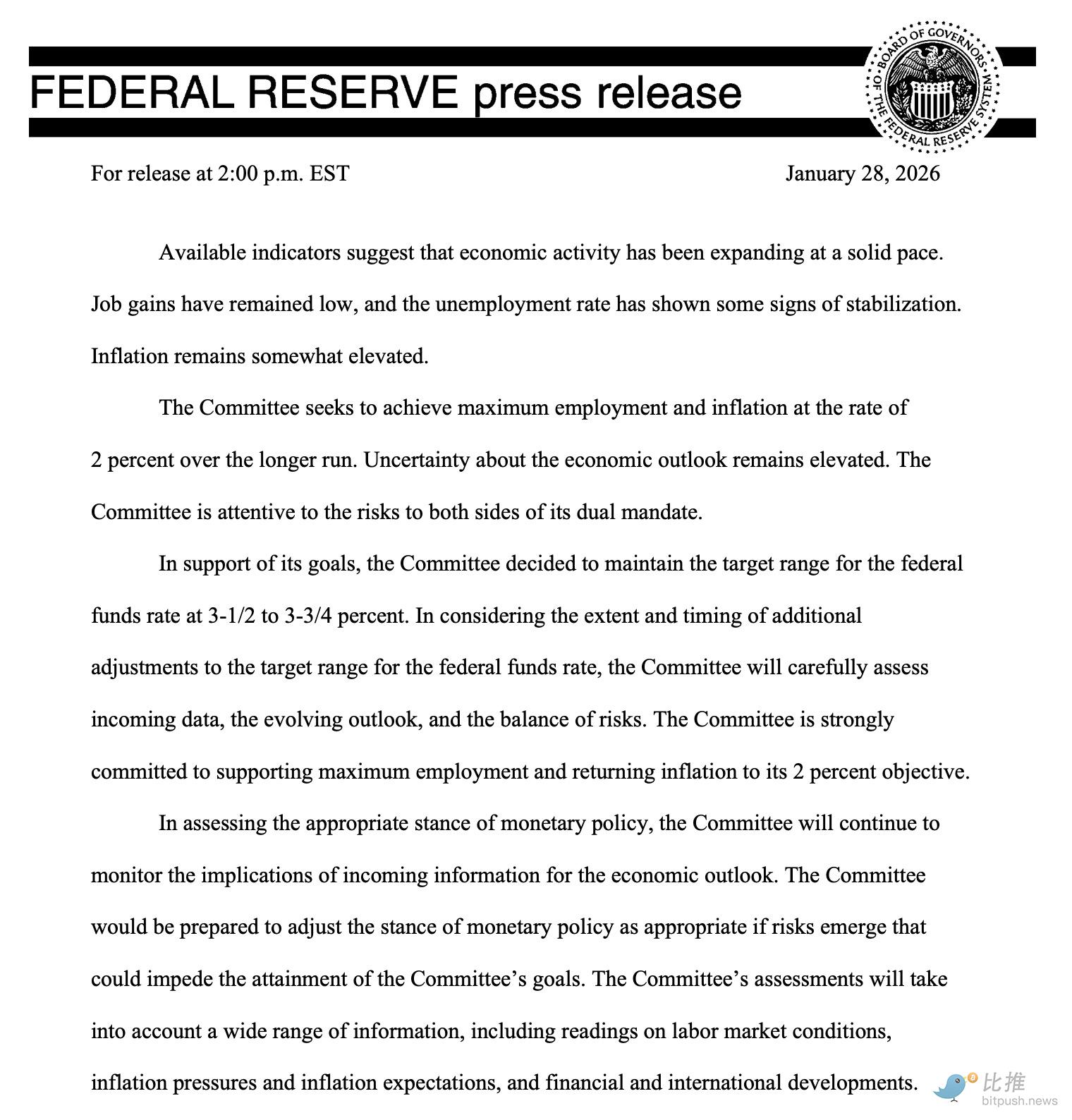
In the early hours of Thursday Beijing time, the Federal Reserve announced it would keep the benchmark interest rate unchanged in the range of 3.5% to 3.75%. This somewhat "uneventful" decision was in line with market expectations of over 97%, but it also revealed subtle internal policy cracks: two Fed governors voted against the decision, supporting a further 25 basis point rate cut.
The Shoe Has Dropped, But the Direction Remains Unclear
In its policy statement, the Fed maintained a relatively cautious tone: the economy is still "expanding robustly," inflation has "eased somewhat but remains above target," the labor market shows signs of cooling but does not yet constitute a systemic risk. The core message is very clear—monetary policy has transitioned from the "active adjustment" phase to the "observation and verification" phase.
It is worth noting that the Federal Open Market Committee (FOMC) is not monolithic. Two members voted in favor of continuing rate cuts, showing that policy preferences still diverge between falling inflation and a slowing economy. Overall, however, the Fed is unwilling to make new policy commitments in the current environment, instead choosing to hand the decision-making power back to subsequent data.
This stance sets the tone for the market: there will be no clear directional guidance in the short term, and asset pricing will revolve more around "changes in expectations" rather than "changes in policy."
Current federal funds rate market pricing shows that investors generally expect rates to remain unchanged this quarter, with the first rate cut now re-pointed to June of this year, and the market further expects a possible pause in the rate-cutting cycle by 2027.
However, regarding the interest rate path beyond this quarter, there are still significant differences among institutions: Morgan Stanley, Citigroup, and Goldman Sachs predict successive rate cuts in June and September; Barclays believes cuts are possible in June and December; while JPMorgan maintains its expectation for unchanged rates throughout the year.
Macro Markets: Gold Steals the Spotlight, Other Assets Remain Unfazed
If the Fed's decision itself did not cause waves, then the divergence in asset performance is the signal truly worth watching.
After the interest rate decision was announced, the spot gold price soared, breaking through the $5,500 per ounce mark for the first time. In just four trading days, the gold price rose from just below $5,000, breaking through multiple hundred-dollar thresholds, accumulating a gain of over $500, with a weekly increase of 10%. This speed and magnitude have made gold the undisputed protagonist of the current global market.
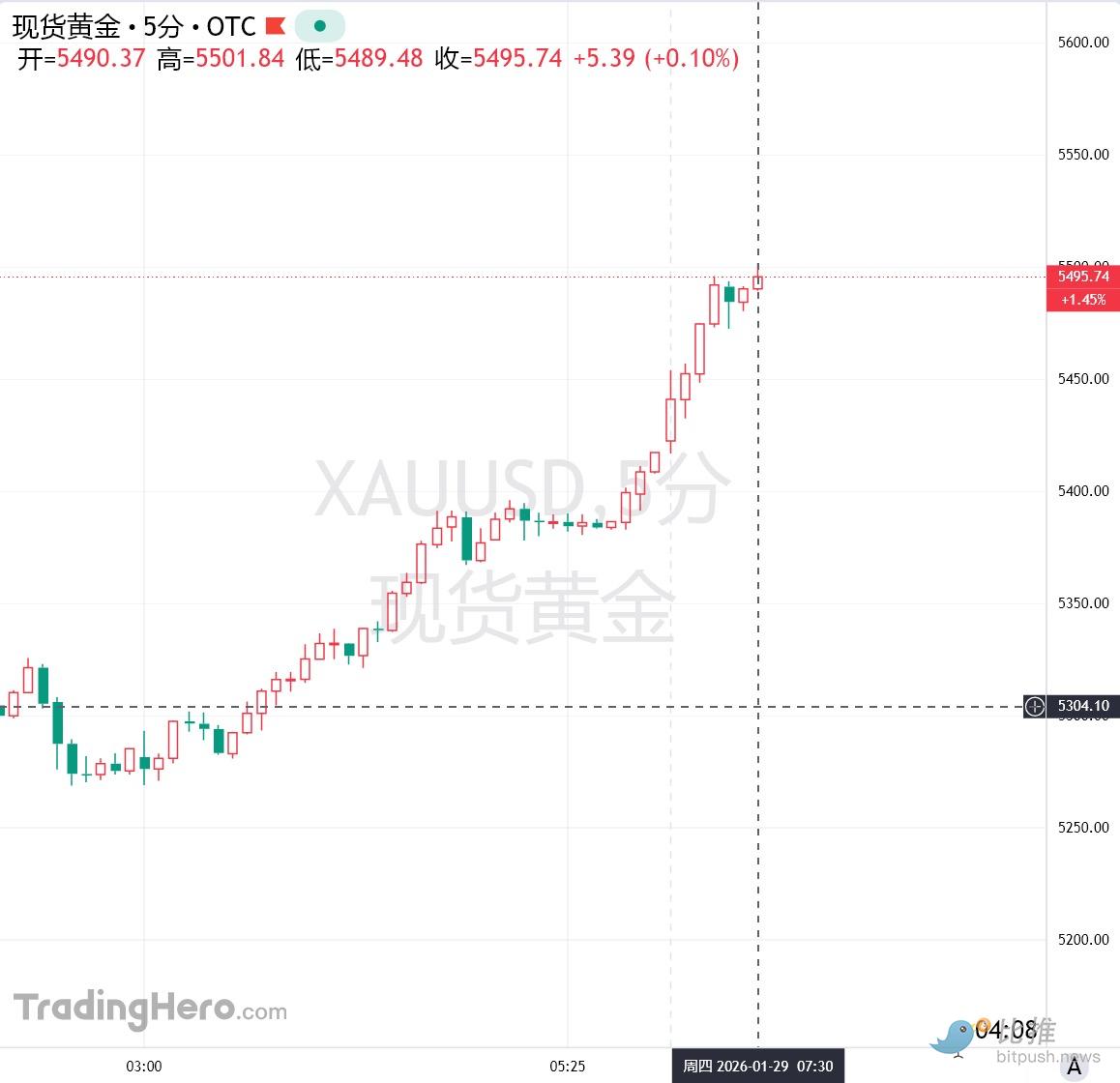
Gold's strength is not simply a matter of interest rate trading logic. Although the Fed has paused rate cuts, after successive rounds of easing, policy is nearing the neutral range, and the marginal constraint of real interest rates has eased somewhat; at the same time, resilient inflation, trade frictions, political uncertainty, and global policy games are intertwining, continuously amplifying safe-haven demand. Under the overlay of multiple uncertainties, capital has chosen the most traditional and consensus safe-haven asset.
In stark contrast to gold, other major assets overall reacted with restraint. US stocks maintained narrow fluctuations after the decision, showing no trend breakthrough; the US dollar index had limited volatility; US Treasury yields adjusted slightly but did not evolve into a systemic risk-off rally.
The same goes for crypto assets. After the news was announced, the Bitcoin price briefly dipped from $89,600 to the $89,000 level, then quickly pulling back to around $89,300. The fluctuation was less than 1%. Ethereum (ETH) hovered around the $3,000 mark, and mainstream altcoins like Solana and XRP also remained within their previous consolidation ranges.
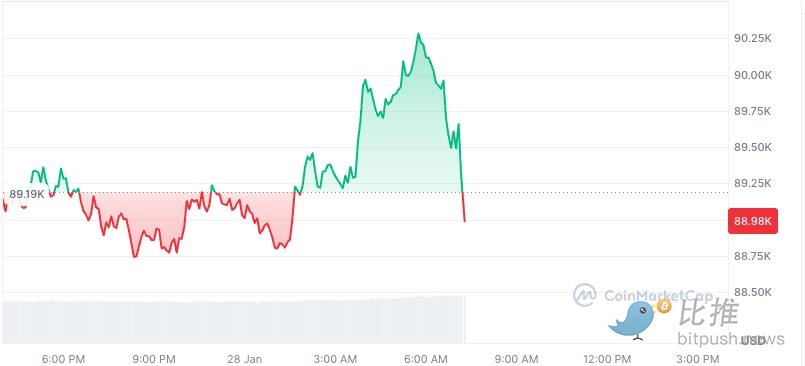
The market gave the most intuitive answer: when the direction is unclear, gold is pushed back to the center of the stage, while other assets enter a waiting state.
A Question More Important Than Rate Cuts: Who Will Shape the Next Phase of the Fed?
After the interest rate decision landed, the market's focus quickly shifted. Compared to "whether there will be another rate cut," investors began to discuss another question more frequently: who will lead the next phase of the Federal Reserve?
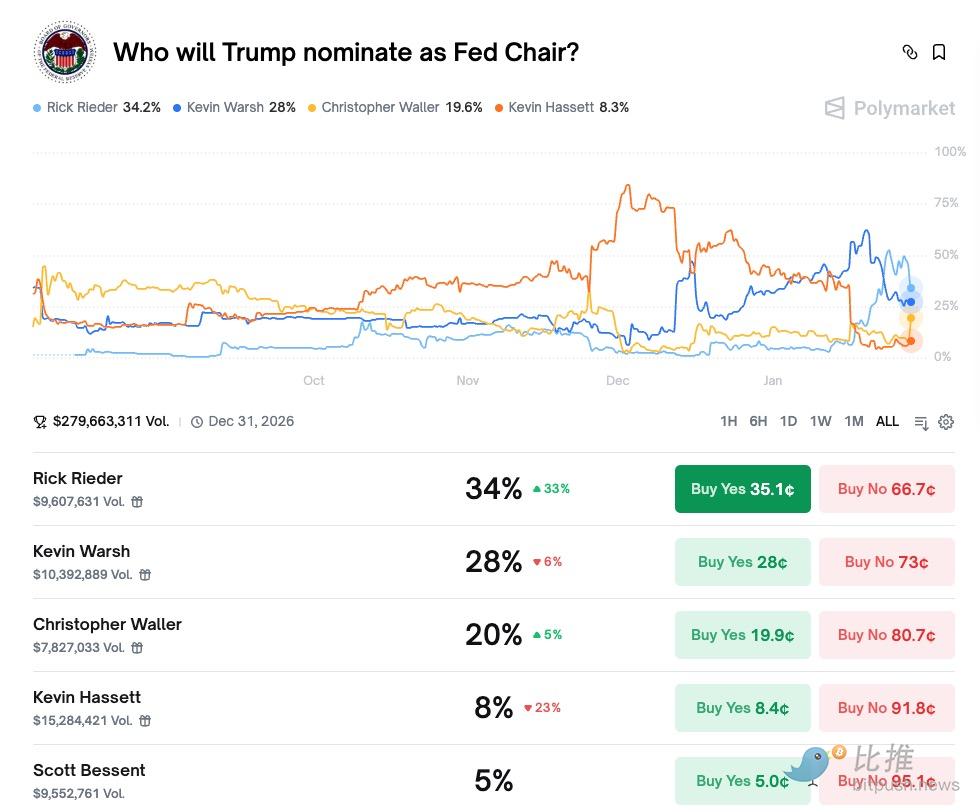
After the dust settled on the interest rate decision, the market's focus quickly shifted from "whether there will be another rate cut" to a question with longer-term implications—who will become the next Federal Reserve Chair.
This change is not accidental. As monetary policy gradually enters a sensitive range "close to neutral," the policy style for the next few years will largely depend on the leadership's understanding of inflation tolerance, financial stability, and market volatility. Against this backdrop, prediction markets provide a valuable window of reference.
According to the latest data from Polymarket, in the betting on "Who will Trump nominate as Fed Chair," the winning probabilities of several candidates have already formed a hierarchy:
Rick Rieder: The Market's Favorite "Pragmatist" (~34%)
Currently, the highest betting probability is for Rick Rieder, with a support rate of about 34%, which has risen significantly recently.
Rieder is currently BlackRock's Chief Investment Officer of Global Fixed Income, deeply involved in long-term bond market and macro asset allocation decisions, and is seen as one of the very few figures who truly straddles "policy-market-capital structure." His public views often emphasize financial market stability, policy transmission efficiency, and avoiding unnecessary systemic shocks.
From the market's perspective, if Rieder becomes Fed Chair, it would mean that central bank decisions would place greater importance on financial conditions and asset price signals, maintaining policy flexibility within the allowable range of inflation. This expectation explains why he is gaining increasing financial support in prediction markets—it is a bet on "predictability" and "market friendliness."
Kevin Warsh: Representative of Discipline and Credibility (~28%)
Ranked second is former Fed Governor Kevin Warsh, with a current betting probability of about 28%.
Warsh has always been known for his clear stance and tough style, emphasizing central bank credibility and long-term discipline on inflation issues. He has repeatedly expressed concerns about excessively loose policies and is also seen as an important representative of the traditional hawkish camp.
If Warsh ultimately wins, the market generally expects the Fed to be more cautious in its rate-cutting pace, tolerance for asset prices, and policy communication. This style typically helps suppress inflation expectations but also means risk assets need to adapt to a stricter financial environment.
Christopher Waller: The Academic Fed Governor (~20%)
The betting probability for current Fed Governor Christopher Waller is about 20%, placing him third.
Waller has a strong academic background and clear policy logic, and has long been regarded as the most influential "hawk" within the Fed (advocating high interest rates to suppress inflation). However, in this FOMC meeting, he cast a dissenting vote, supporting a continued rate cut, which means he either believes inflation is no longer the main threat or is feeling significant political/economic pressure.
If Waller takes over, the Fed may give more weight to employment and growth targets, with a relatively flexible policy pace, but whether he can maintain central bank independence in a highly politicized environment remains a focus of market attention.
Will Bitcoin Continue Its Bearish Trend?
While macro uncertainties intensify, on-chain data is beginning to release signals worth警惕 (being cautious about).
The latest analysis from CryptoQuant shows that the 365-day moving average of Bitcoin's "Supply in Loss" is starting to rise again. This metric measures the percentage of Bitcoin whose current price is below the price of its last on-chain transfer and is an important tool for observing changes in market structure.
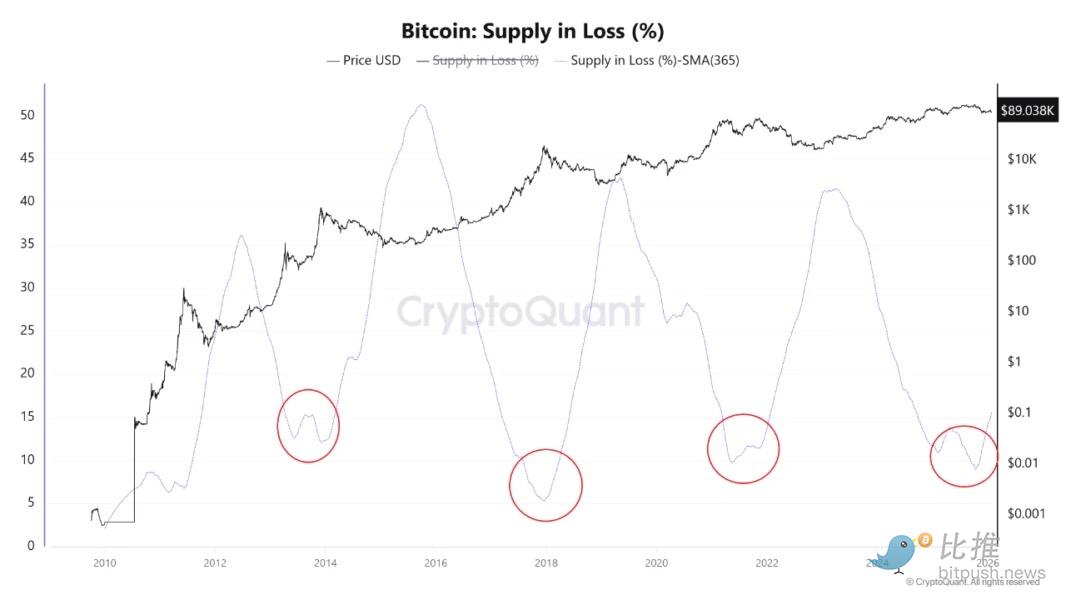
When Bitcoin hit its historical high of $126,000 last October, this indicator once fell to its lowest point this cycle, reflecting a market in a state of high profitability. But as the price fell, Supply in Loss began to rise continuously, showing that losses are gradually spreading from short-term traders to longer-term holders.
Historical experience shows that this directional change often appears in the early stages of bull-to-bear transitions. However, it is important to emphasize that this indicator has not yet reached the typical "capitulation zone"; it is more like a risk signal than a trend confirmation.
This means that Bitcoin's current state is closer to high-level digestion and structural reorganization rather than having already entered a clear main bear market decline phase. Whether it evolves into a deeper adjustment still highly depends on macro liquidity and subsequent capital flows. Gabe Selby, Research Head at CF Benchmarks, said: "Short-term bullish catalysts for Bitcoin still exist, but they are increasingly偏向 (leaning towards) political factors rather than monetary factors."
Summary: Macro Uncertainty, Structural Changes, the Market is Waiting for Answers
Overall, this round of market changes is not driven by a single event but is the result of multiple factors acting together. The Fed's choice to pause sends a signal of "caution rather than a pivot"; capital embraces gold amidst uncertainty, pushing risk aversion to the forefront; Bitcoin, while fluctuating at high levels, gradually reveals structural characteristics of the latter half of the cycle.
Before the direction becomes clear, the market seems more like it is conducting a patience test. Gold has already made its choice, while Bitcoin's next step still needs to wait for further convergence of macro and cyclical signals.
Author: seed.eth
Twitter:https://twitter.com/BitpushNewsCN
Bitpush TG Discussion Group:https://t.me/BitPushCommunity
Bitpush TG Subscription: https://t.me/bitpush






