After Riemann Hypothesis, Claude Shatters Another Century-Old Conjecture

marsbitPubblicato 2026-08-20Pubblicato ultima volta 2026-08-20

Introduzione

After decades of steadfast belief in classical geometric conjectures, a significant breakthrough has arrived via artificial intelligence. In a collaborative effort, mathematician Levent Alpöge and Anthropic's Claude have constructed a counterexample that falsifies the century-old Carathéodory conjecture in differential geometry, while simultaneously disproving the related Loewner index conjecture. The Carathéodory conjecture, first formulated in 1924, posited that any sufficiently smooth, closed, and convex surface in three-dimensional Euclidean space must possess at least two umbilical points—points where the surface's curvature is the same in all directions, making it locally spherical. This assertion, intuitively supported by examples like spheres (with infinitely many) and ellipsoids (with two), had remained unproven and unchallenged for over 100 years. The parallel Loewner conjecture imposed a theoretical limit of 1 on the index of any isolated umbilical point. The pivotal counterexample is an explicit, mathematically rigorous construction of a convex body that is infinitely smooth (C∞) yet contains only a single umbilical point, directly contradicting Carathéodory's requirement of at least two. Furthermore, this solitary umbilical point possesses an index of 2, violating the Loewner conjecture's stipulated upper bound of 1. This achievement follows Alpöge's earlier use of Claude to propose a counterexample for the three-dimensional Jacobian conjecture, signaling a pa...

A century-old conjecture has fallen yet again.

Anthropic/Harvard mathematician Levent Alpöge, in collaboration with Claude, has directly disproven the Carathéodory conjecture, which had perplexed the mathematical world for over 100 years, and in doing so, also shattered the Loewner index conjecture.

A PDF circulated within mathematical circles for a full week. Now, it has been officially made public.

This is not the first time Alpöge has teamed up with Claude to shake things up. During the World Cup this year, he proposed a counterexample to the 3-dimensional Jacobian conjecture, sending shockwaves through the mathematical community.

What Exactly is This Century-Old Conjecture About?

First, let's talk about the Carathéodory conjecture itself.

In 1924, German mathematician Hans Ludwig Hamburger proposed the Carathéodory conjecture in differential geometry, naming it after his doctoral advisor, the Greek mathematician Constantin Carathéodory.

The conjecture states that any convex, closed, and sufficiently smooth surface in three-dimensional Euclidean space must have at least two umbilic points.
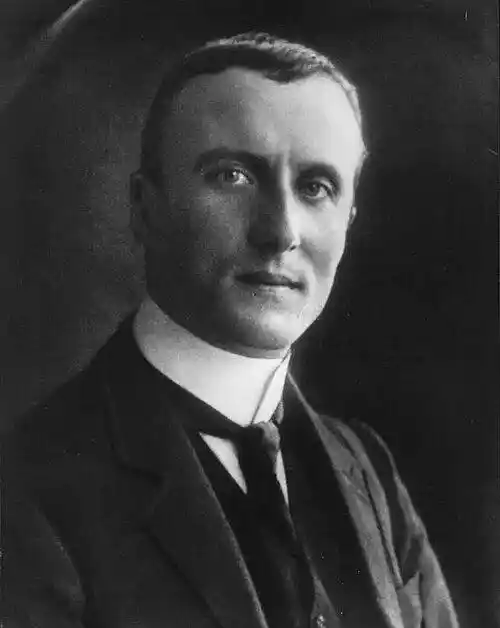
Constantin Carathéodory

The conjecture is extremely concise but notoriously difficult to prove: any sufficiently smooth closed convex surface must have at least two 'umbilic points'.

Umbilic points can be understood, in simple terms, as points on a surface where the 'curvature is exactly the same in all directions'.

In the differential geometry of surfaces in three-dimensional space, an umbilic point is a point on a surface where it locally resembles a sphere; all normal curvatures are equal at that point, meaning the two principal curvatures are equal, and every tangent vector is a principal direction.

Every point on a sphere is an umbilic point—no matter which direction you move, the curvature feels the same.

Carathéodory asserted: no matter how you shape or deform it, as long as this convex surface is sufficiently smooth, you cannot reduce the umbilic points to just one. At least two must remain.

This conjecture seems intuitively 'correct'.

A sphere has infinitely many umbilic points, an ellipsoid has two.
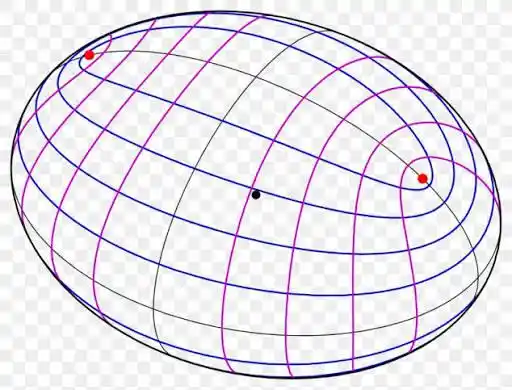
For a hundred years, countless mathematicians tried, but no one could construct a smooth convex body with only one umbilic point.

Parallel to this was the Loewner conjecture—that the index of an isolated umbilic point does not exceed 1. The two conjectures supported each other, for a century locking away an entire domain of differential geometry like a pair of iron locks.

Now, the lock has been pried open. This discovery shows that if a convex surface is too smooth (mathematically called C∞, infinitely differentiable), Levent Alpöge found a convex surface with only one umbilic point.

One Counterexample, Two Conjectures Fall Simultaneously

Alpöge and John-Paul Smith provided an extremely specific construction.

They defined a family of functions g_k, where for k=2, the function g2 serves as the support function for a sphere-like surface, producing a convex body with an umbilic point of index 2 at the origin.
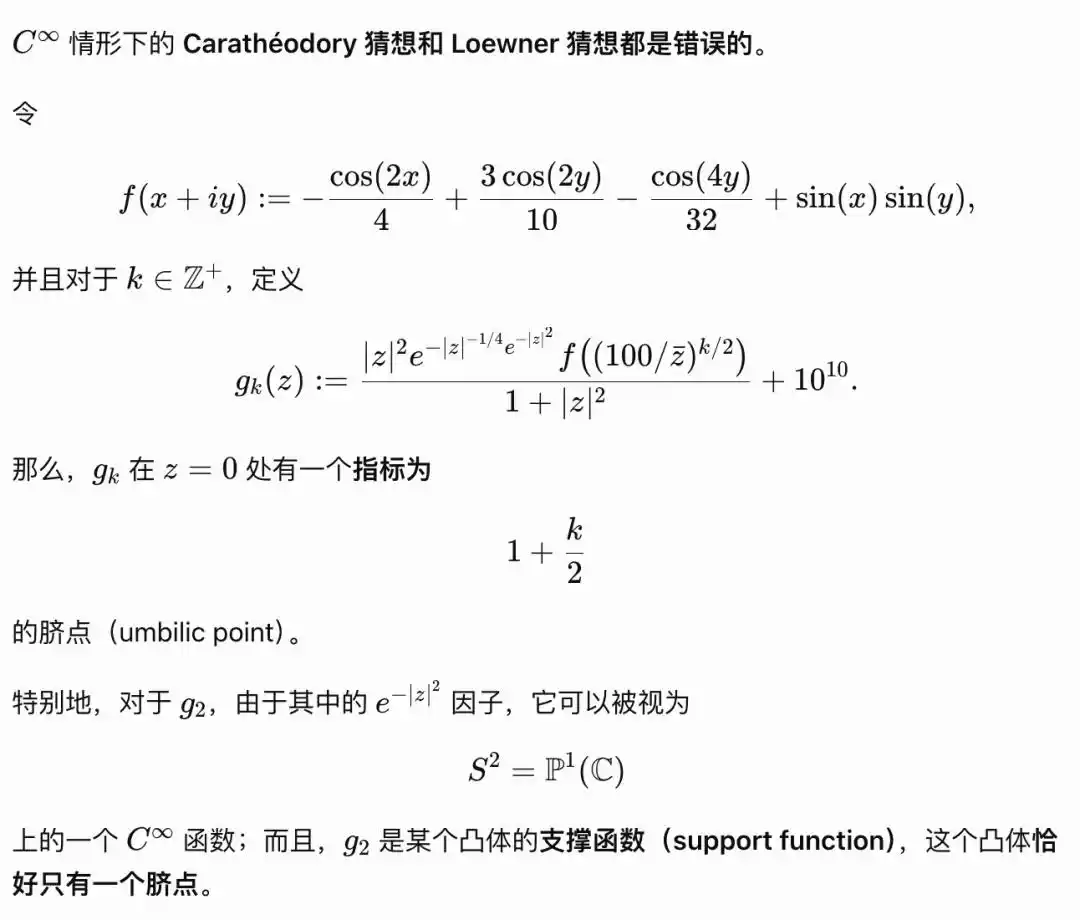
Note that an index of 2 already directly violates the Loewner conjecture's upper bound of 1.
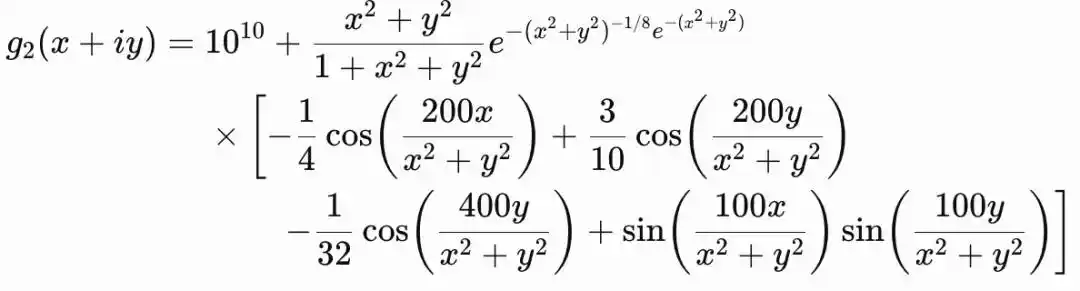
More crucially, due to the presence of an exponential decay term, g2 is mathematically guaranteed to be C∞ smooth—meaning this convex body satisfies all the smoothness conditions required by the Carathéodory conjecture.

But it has only one umbilic point.
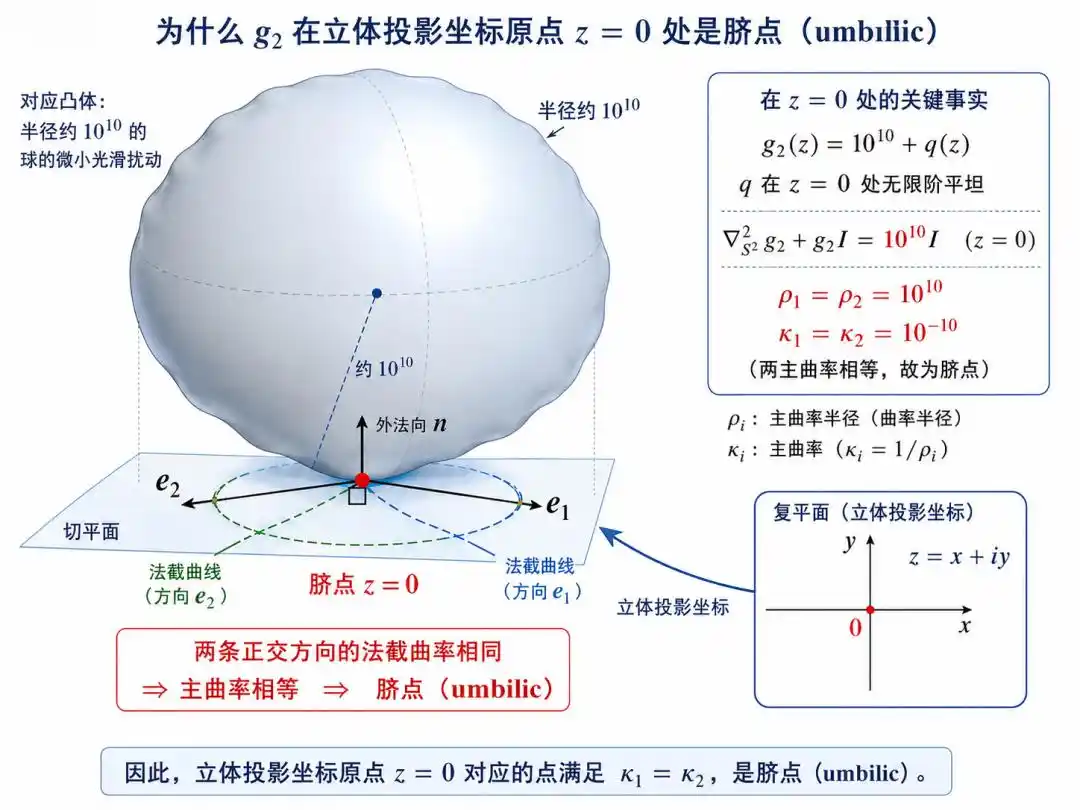
The Carathéodory conjecture requires at least two umbilic points, but the counterexample has one, thus disproving the conjecture.
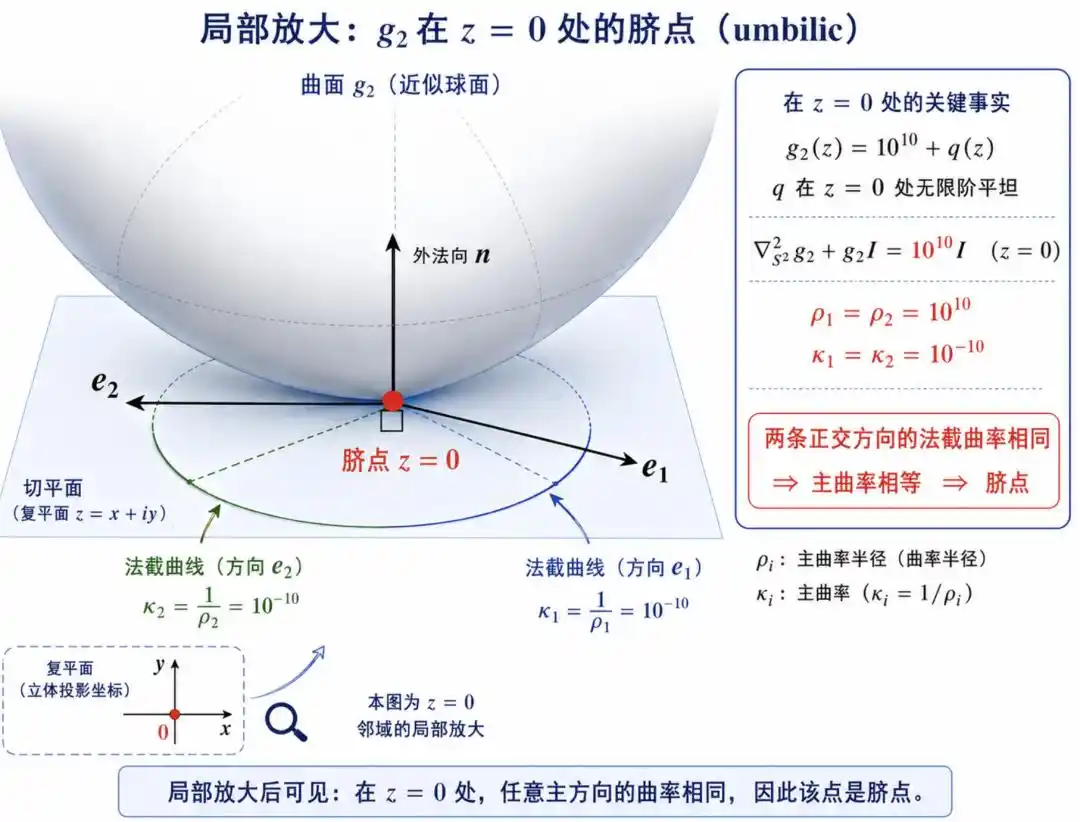
The Loewner index conjecture requires the index of an umbilic point to be 1, but this one is 2, disproving it as well.

An explicit, verifiable counterexample has taken down two conjectures that survived for over a century.

In mathematics, disproving a conjecture requires only one counterexample. But finding that counterexample can be harder than proving the conjecture itself.

The New Normal in Mathematics

Looking back over the past few months:

Claude's new record on the Riemann Hypothesis—raising the lower bound for the proportion of zeros from 41.6% to 67.2%, whereas humans had only advanced it by 0.8% in 37 years.

OpenAI's concentrated release of 10 advancements in mathematics and theoretical computer science.

Alpöge continuously using Claude to disprove several classic conjectures.

A newly crowned Fields Medalist announcing they are joining OpenAI.

A new trend is emerging.

AI is no longer just a mathematician's calculator. It is becoming a mathematician's 'intuition amplifier'—opening new pathways with its exhaustive search and construction capabilities in areas where human intuition fails.

A century-old conjecture was not shattered by superior human intellect. It was shattered by a brand new paradigm of human-machine collaboration.

This paradigm will continue to shatter more conjectures. The only question is: which one will fall next?

References:

https://x.com/haider1/status/2090034966717677902

https://x.com/alpoge/status/2089971359921156203

https://en.wikipedia.org/wiki/Carath%C3%A9odory_conjecture

This article is from the WeChat public account "New Zhiyuan", author: ASI Revelation

Domande pertinenti

QWhat was the main mathematical discovery announced in the article?

AThe main discovery is the explicit construction, by Levent Alpöge and John-Paul Smith with assistance from Claude, of a counterexample that disproves two long-standing mathematical conjectures: the Carathéodory conjecture and the Loewner index conjecture.

QWhat does the Carathéodory conjecture state about umbilical points on convex surfaces?

AThe Carathéodory conjecture, proposed in 1924, states that any smooth, closed, convex surface in three-dimensional Euclidean space must have at least two umbilical points. An umbilical point is a point where the surface is locally spherical, meaning all directional curvatures are equal.

QHow does the constructed counterexample specifically contradict the Carathéodory and Loewner conjectures?

AThe constructed counterexample is a convex body defined by the function g₂. It is C∞ smooth (infinitely differentiable), satisfying the conditions of Carathéodory's conjecture, yet it has only one umbilical point instead of the required two. Furthermore, this single umbilical point has an index of 2, which directly violates the Loewner conjecture's claim that the index of an isolated umbilical point cannot exceed 1.

QWhat role did Claude (the AI) play in this mathematical breakthrough according to the article?

AAccording to the article, Claude acted as an 'intuition supplementer' for mathematician Levent Alpöge. It helped by providing brute-force search and construction capabilities, opening new paths in areas where human intuition had previously failed, which was instrumental in finding the counterexample.

QBeyond this recent discovery, what other significant mathematical achievement involving AI does the article mention?

AThe article mentions that Claude was also involved in a new record for the Riemann Hypothesis, improving the lower bound for the proportion of zeros on the critical line from 41.6% to 67.2%. It also notes a series of recent advances, including OpenAI releasing 10 developments in mathematics and theoretical computer science, and a newly crowned Fields Medalist announcing they would join OpenAI.

Letture associate

Gold Diggers in Prediction Markets: From Competing for Trading Entrances to Competing for Outcome Definition Rights

The report identifies a shift in prediction market competition from front-end user acquisition to back-end infrastructure, specifically the "outcome layer." This layer encompasses the standardized services for rule comparison, evidence verification, outcome confirmation, and payment triggering. Analysis shows that while a tiny fraction (0.487%) of markets face disputes, they account for a significant share (8.64%) of traded volume. This highlights the financial impact of rule uncertainty, which creates trading alpha but limits strategy capacity due to shallow order books. The larger opportunity lies in productizing these backend functions. Services like automated settlement (e.g., HIP-4), AI-assisted evidence processing, and external data oracles (e.g., Pyth, Chainlink) are becoming reusable, cross-platform infrastructure. This is creating a "second profit pool" separate from trading fees. Current observable revenue for this outcome layer is estimated at $15-37 million annually. If applied to the entire existing market, this could expand to $64-161 million. In a mature state, modeled after existing commercial models like Azuro's, annual revenue potential could reach approximately $456 million. While the industry logic is forming, pure-play investment assets are still early. Platform equities (e.g., Kalshi, Polymarket) price in broad growth, not just the outcome layer. Tokens like HYPE have minimal fee contribution from related products, and ICE's exposure is too small relative to its total business. The key is to track early projects that achieve cross-platform adoption and convert usage into attributable, recurring revenue. The most significant alpha may emerge before the ideal investment target is fully established.

marsbit6 min fa

Gold Diggers in Prediction Markets: From Competing for Trading Entrances to Competing for Outcome Definition Rights

marsbit6 min fa

Bitcoin Surpasses $72k. What Happens Next?

Bitcoin exceeded $72,000, reaching its highest level since early summer after a $8,000 surge. The broader crypto market followed, with total market capitalization rising 10%. Analysts attribute the rally to a combination of factors: the U.S. Treasury's decision to increase purchases of long-term government bonds, which lowers yields and makes riskier assets like crypto more attractive, and positive remarks about cryptocurrency from former President Donald Trump. Experts note that while Trump's comments provided an emotional boost, the Treasury's action was a more fundamental driver. However, they caution that significant sustained growth is not assured. High U.S. inflation limits the Federal Reserve's ability to ease policy, and network activity within crypto ecosystems remains low. Competition for capital from sectors like semiconductors and AI also persists. Analysts present mixed short-term forecasts. Some see resistance around $72,000; a breakout could target $76,000-$80,000, but a moderate, localized rise within a longer-term downward trend is deemed more likely. Others identify $69,000-$70,000 as a key support zone. A sustained move above $72,000 could open a path toward $75,000-$78,000, or even $80,000-$82,000 under a strong bullish scenario, with support expected around $66,000-$67,000 on any pullback. The overall outlook is cautiously optimistic, with the recent surge signaling improved sentiment, but a confirmed upward trend requires prices to solidify above current levels.

cryptonews.ru9 min fa

Bitcoin Surpasses $72k. What Happens Next?

cryptonews.ru9 min fa

Optimism Developers' Vote Deprives Users of $49 Million Airdrop

On August 19th, the Optimism community approved a proposal to reallocate 546.9 million OP tokens (worth ~$49.7 million) from a reserve for future user airdrops into a new Strategic Ecosystem Fund for development. The vote passed with 17.97 million OP for and 10.93 million against, with a decisive last-minute vote from developer group Test in Prod securing the majority. The funds will now be managed by the Optimism Foundation to foster ecosystem growth, targeting partnerships with blockchains, protocols, and financial firms, and attracting major brands. This marks a strategic shift from broad user acquisition via airdrops to focusing on corporate clients and enterprise solutions (OP Enterprise). The decision does not affect past airdrops, which distributed 269.1 million OP over five rounds. The proposal faced criticism. L2BEAT and delegate cp0x argued the Foundation gains overly broad discretion without sufficient detail on fund use, results measurement, or benefit to OP holders. Critics also noted these tokens were publicly reserved for future user distributions, and their reallocation removes the need for separate community votes on individual Foundation deals. Test in Prod defended its support, stating the reserve is needed for competitive corporate deals where premature disclosure could be detrimental, while urging the Foundation to later disclose aggregate spending and outcomes.

cryptonews.ru9 min fa

Optimism Developers' Vote Deprives Users of $49 Million Airdrop

cryptonews.ru9 min fa

Trading

Spot
活动图片