After National Intervention: The Reshaping of the 2025 Cryptocurrency Crime Landscape

比推Pubblicato 2026-01-12Pubblicato ultima volta 2026-01-12

Introduzione

State-level actors significantly increased cryptocurrency-related activities in 2025, marking a new phase of maturity for illegal on-chain ecosystems. Illicit addresses received at least $154 billion, a 162% year-over-year increase, largely driven by a 694% surge in transactions involving sanctioned entities. Stablecoins dominated illegal transactions, accounting for 84% of the total. North Korean hackers stole a record $2 billion, including a historic $1.5 billion attack on Bybit. Russia launched the rubleksandrovich (A7A5) token to evade sanctions, processing over $93.3 billion in transactions within a year. Iranian proxy networks and China-based money laundering groups also expanded operations, offering specialized criminal services like fraud, terror financing, and sanctions evasion. Illegal infrastructure providers now offer full-stack services—domain registration, hosting, and technical support—enabling both cybercriminals and state actors to scale malicious activities. Cryptocurrency is increasingly linked to real-world violence, including human trafficking and coerced asset transfers. Despite illicit activity growing, it remains below 1% of all traceable cryptocurrency transactions. Collaboration among law enforcement, regulators, and crypto firms is critical to address these evolving threats.

Written by: Chainalysis

Compiled by: Chopper, Foresight News

Original Title: National-Level Players Enter the Scene, Deciphering the Loss of Control and Transformation of Cryptocurrency Crime in 2025


In 2025, we observed a significant increase in cryptocurrency-related activities at the national level, marking a new mature phase in the development of the illegal on-chain ecosystem. Over the past few years, the professionalization within the cryptocurrency crime sphere has deepened; illegal organizations have now established large-scale on-chain infrastructure to support transnational criminal networks in procuring goods and services and laundering proceeds from crypto crimes. Against this backdrop, national governments have also begun to venture into this domain. On one hand, they leverage these mature professional service providers, and on the other, they are building customized, exclusive infrastructure to evade sanctions on a large scale. As governments tap into this illicit cryptocurrency supply chain originally created for cybercriminals and organized crime groups, government agencies, compliance, and security teams now face severe challenges in terms of consumer rights protection and national security.
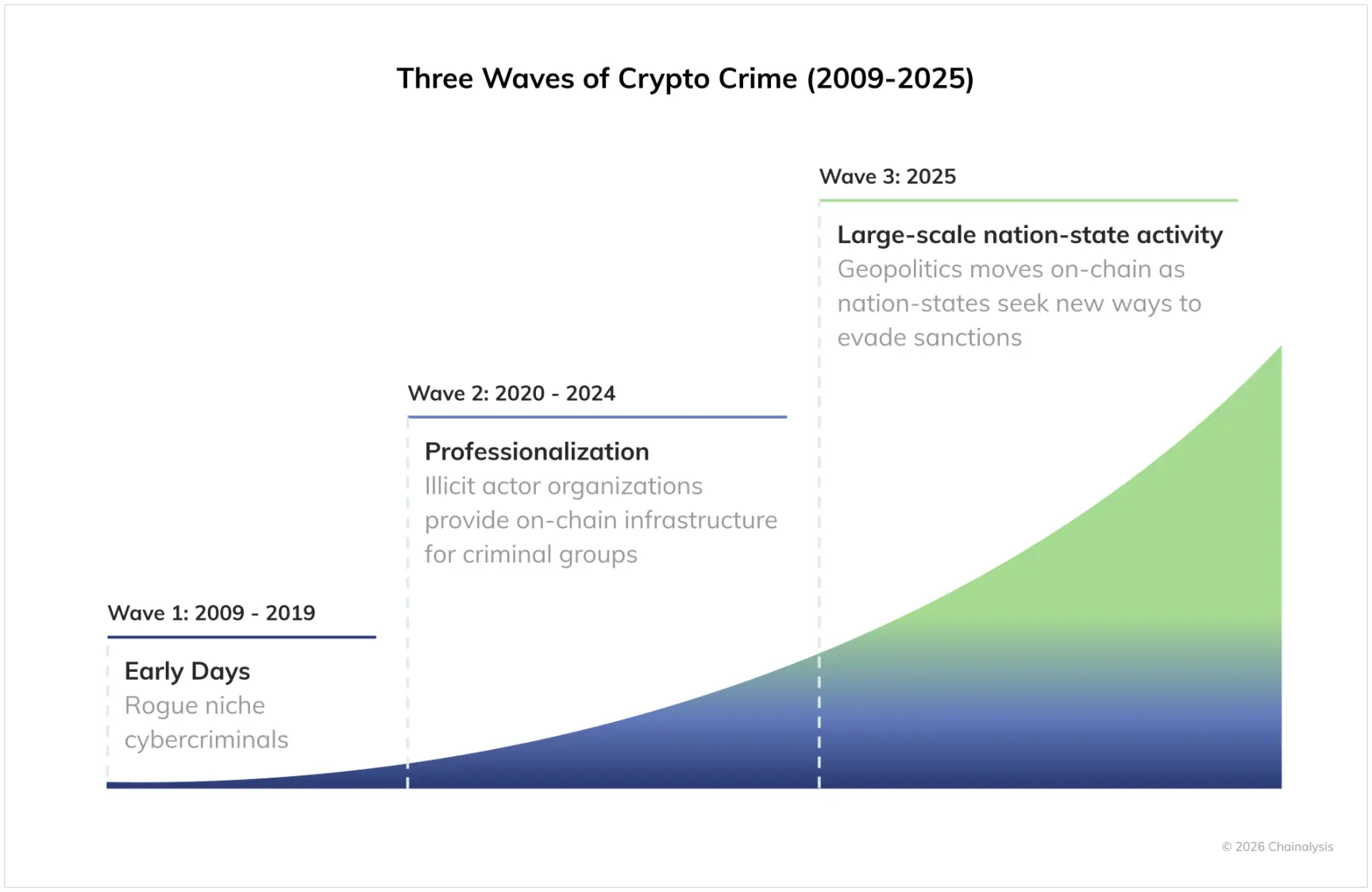
What are the specific on-chain manifestations of these developments and other industry changes? Next, we will analyze them by combining data with macro trends.
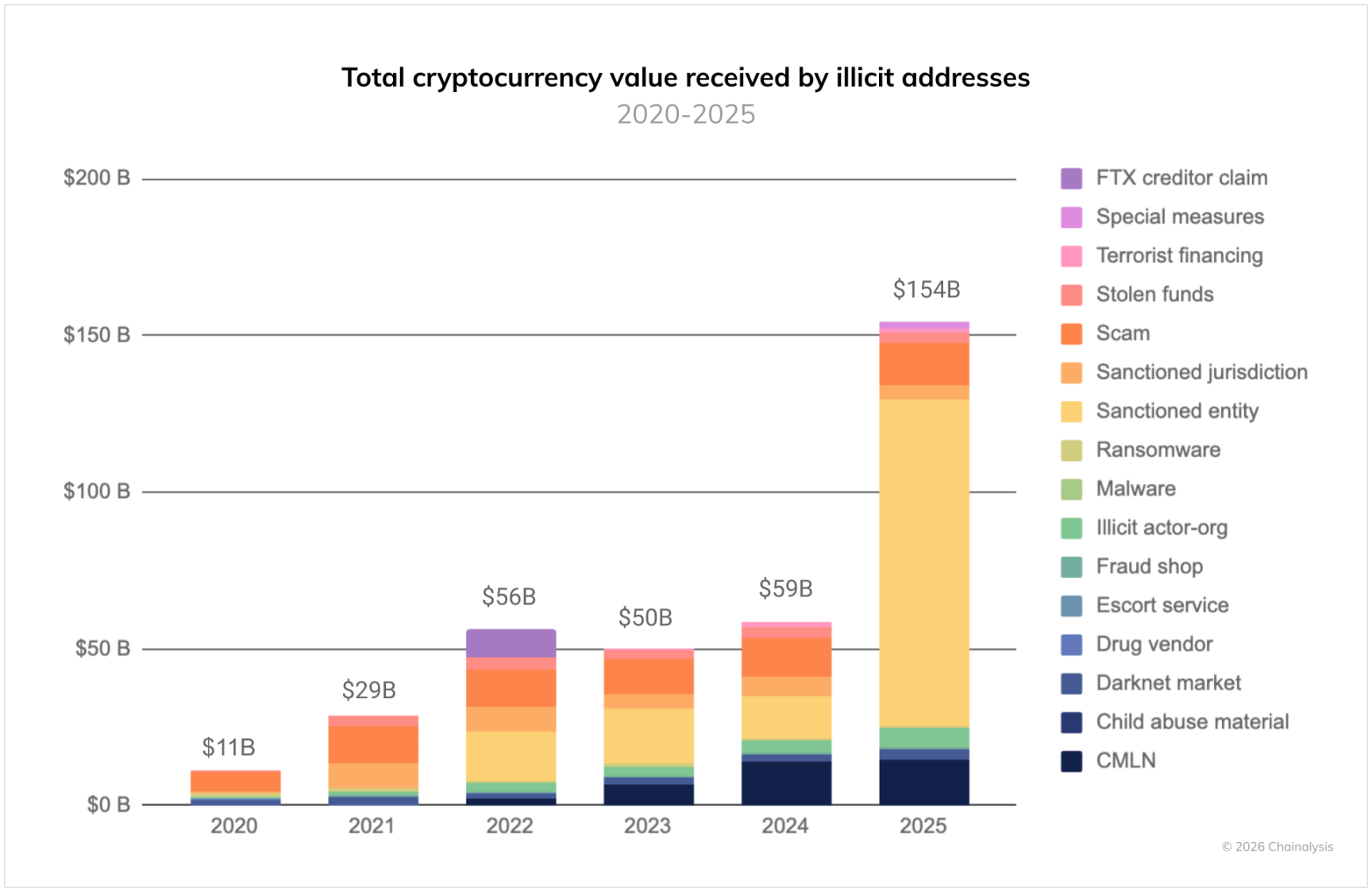
According to our monitoring data, the scale of funds flowing into illegal cryptocurrency addresses in 2025 reached at least $154 billion, a sharp increase of 162% year-on-year. This growth was primarily driven by a surge in fund inflows to sanctioned entities, which skyrocketed by 694% year-on-year. However, even after excluding the growth from sanctioned entities, 2025 still stands as a record year for cryptocurrency crime, as the scale of most illegal activity categories saw growth.

Nevertheless, the scale of these illegal transactions still pales in comparison to the overall cryptocurrency economy, where the main body of transactions remains legitimate. We estimate that although the proportion of illegal transactions in the total traceable cryptocurrency transaction volume in 2025 increased slightly compared to 2024, it remains below 1%.

As shown in the figure below, we also observed a continuous shift in the types of assets involved in cryptocurrency crimes.
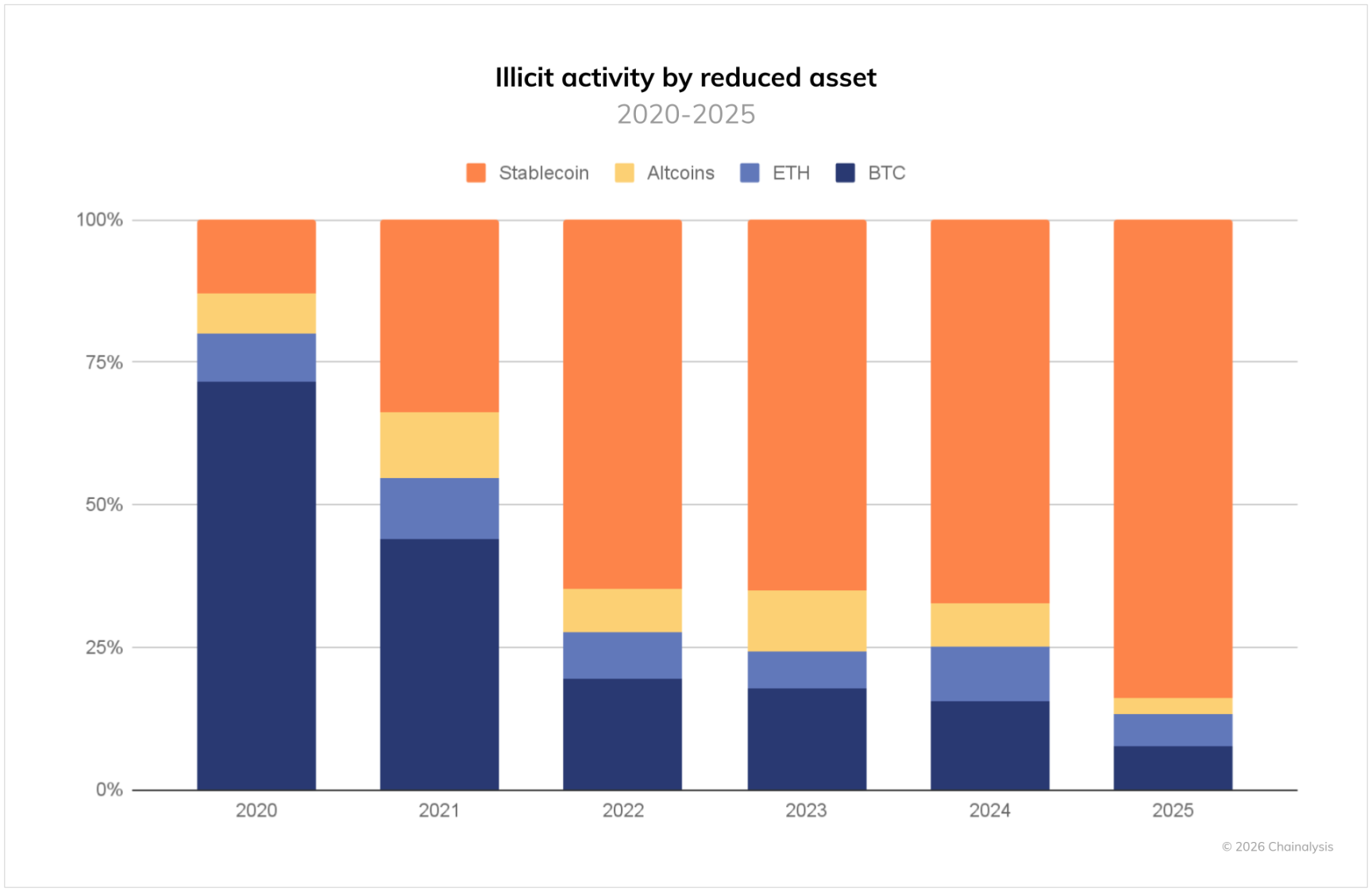
Over the past few years, stablecoins have gradually become the dominant asset in illegal transactions, currently accounting for 84% of the total illegal transaction volume. This trend aligns with the overall development characteristics of the cryptocurrency ecosystem: with advantages such as convenience for cross-border transfers, low volatility, and wide application scenarios, the share of stablecoins in the entire cryptocurrency transaction volume continues to expand.

The following sections will delve into the core trends that defined the 2025 cryptocurrency crime landscape, trends that will remain important to focus on in the future.

National-Level Threats Drive Transaction Volume: North Korean Thefts Hit Record High, Russia's A7A5 Token Facilitates Large-Scale Sanction Evasion

In 2025, stolen funds remained a major threat to the cryptocurrency ecosystem, with hacking groups linked to North Korea alone stealing $2 billion. This figure was primarily driven by several highly destructive large-scale hacking incidents, the most notable being the attack on the Bybit exchange in February. This incident involved nearly $1.5 billion, making it the largest digital asset theft in the history of cryptocurrency. Although North Korean hackers have long been a major force threatening the cryptocurrency ecosystem, the past year saw record highs both in the amount stolen and in the sophistication of their intrusion and money laundering methods.

Particularly noteworthy is that the scale of on-chain activities reached unprecedented levels in 2025. Russia introduced relevant legislation in 2024 to use cryptocurrency to evade sanctions, and this measure was formally implemented in February 2025. The country launched the ruble-backed token A7A5, which saw its transaction volume exceed $93.3 billion in less than a year since its launch.

Meanwhile, over the past few years, Iran's proxy networks have conducted money laundering, illegal oil trading, and bulk commodity procurement for weapons on-chain through verifiable wallet addresses that have been placed on sanctions lists, with a cumulative transaction volume exceeding $2 billion. Despite suffering multiple military strikes, terrorist groups supported by Iran, such as Hezbollah, Hamas, and the Houthis, continue to use cryptocurrency on an unprecedented scale.

In 2025, Chinese money laundering networks emerged as a dominant force in the illegal on-chain ecosystem. These organizations operate with sophisticated models, greatly promoting the diversification and professionalization of cryptocurrency crime, offering various specialized criminal services including "money laundering services." Building upon early illegal operation models like "Huiyin Guarantee," these networks have established full-service criminal enterprises, covering businesses in multiple areas such as fraud, scams, laundering proceeds from North Korean hacker thefts, sanction evasion, and terrorism financing.

Full-Stack Illegal Infrastructure Providers Fuel Malicious Cyber Activities

While governments increase their use of cryptocurrency, traditional cybercrime activities remain rampant: ransomware operators, child sexual abuse and cybercrime platforms, malware distributors, scammers, and illegal marketplaces still rely on vast support networks to maintain operations. Illicit actors and national governments are increasingly dependent on on-chain infrastructure providers that offer full-stack services, including domain registrars, secure and reliable hosting services, and other technical infrastructure that can be used to carry out malicious cyber activities.

These infrastructure providers have evolved into comprehensive infrastructure platforms capable of resisting platform takedowns, abuse complaints, and sanction enforcement. As the scale of these services continues to expand, they may become a key force driving economic crime and state-supported entities to expand the scope of malicious cyber activities.

Growing Correlation Between Cryptocurrency and Violent Crime

In the perception of many, cryptocurrency crime is still confined to the virtual world. The masterminds are merely anonymous figures hiding behind keyboards, not posing a threat in the real world. But in fact, the connection between on-chain activities and violent crime is deepening. Human trafficking gangs are using cryptocurrency for transactions more and more; at the same time, disturbingly, the number of violent coercion attack cases has risen significantly, where criminals use violent means to force victims to transfer crypto assets, and such assaults often occur during peak cryptocurrency price periods.

Looking ahead, collaboration between law enforcement agencies, regulatory bodies, and cryptocurrency companies will be key to addressing these complex, evolving, and interconnected threats. Although the proportion of illegal transactions in the legitimate cryptocurrency transaction volume remains limited, maintaining the integrity and security of the cryptocurrency ecosystem has never been more important.


Twitter:https://twitter.com/BitpushNewsCN

Bitpush TG Discussion Group:https://t.me/BitPushCommunity

Bitpush TG Subscription: https://t.me/bitpush

Original link:https://www.bitpush.news/articles/7601752

Domande pertinenti

QWhat was the total value of illicit cryptocurrency transactions in 2025, and what was the primary driver of this growth?

AThe total value of illicit cryptocurrency transactions in 2025 reached at least $154 billion, a 162% year-over-year increase. This growth was primarily driven by a 694% surge in inflows to sanctioned entities.

QWhich asset has become the dominant currency for illicit transactions, and what percentage of the total illicit volume does it represent?

AStablecoins have become the dominant asset for illicit transactions, representing 84% of the total illicit transaction volume.

QWhich country's state-sponsored groups set a new record for cryptocurrency theft in 2025, and what was the most notable attack?

ANorth Korean hacking groups set a new high for cryptocurrency theft in 2025, stealing $2 billion. The most notable attack was the February hack of the Bybit exchange, which resulted in a loss of nearly $1.5 billion, making it the largest digital asset theft in cryptocurrency history.

QWhat new token did Russia launch in 2025 to facilitate large-scale sanctions evasion, and what was its trading volume?

ARussia launched the ruble-backed token A7A5 in 2025 to facilitate large-scale sanctions evasion. Its trading volume surpassed $93.3 billion in less than a year.

QAccording to the article, what is an emerging and concerning trend regarding the link between cryptocurrency and real-world crime?

AAn emerging and concerning trend is the increasing link between on-chain activity and violent crime. This includes human trafficking networks using crypto for transactions and a significant rise in violent coercion attacks, where victims are forced under duress to transfer crypto assets, often during periods of peak cryptocurrency prices.

Letture associate

Analyzing the Impact of AI on Economic Growth and Productivity

**Title: Analyzing AI's Impact on Economic Growth and Productivity** This article examines three contrasting views on AI's influence on economic growth and productivity. **The Optimistic View** posits that AI, especially through automating R&D ("recursive self-improvement"), could dramatically accelerate growth, even triggering a technological "singularity" with explosive, potentially infinite, economic expansion. **The Moderate/Mainstream View** acknowledges AI's productivity benefits but emphasizes significant real-world constraints that could limit its impact. These include: limited cost savings per task, structural ceilings on which jobs and industries are "exposed" to AI, adoption bottlenecks (e.g., compute, energy, regulatory hurdles), and the "weak link" effect where non-automatable tasks cap overall gains. Consequently, the realized AI dividend may be far lower than optimistic projections, with estimates typically ranging from 0.1% to 1.3% annual productivity growth. **The Pessimistic View** stems from two strands. The first aligns with the moderate view but applies extremely conservative assumptions about task exposure and efficiency gains, yielding minimal projected impact. The second introduces a demand-side critique: if AI primarily replaces rather than augments labor, it could depress labor's share of income, weaken consumer demand, and create a "demand trap" that ultimately stifles growth, unless offset by redistribution policies. **The authors' assessment** is nuanced: * **Short-term (1-2 years):** AI will support growth primarily through investment spending, not significant productivity gains. * **Medium-term (3-5 years):** Three potential paths emerge based on AI demand and bottleneck severity: 1. **"Optimistic Path":** High demand, few bottlenecks. Rapid productivity gains but risk of major job displacement and social conflict without redistribution. 2. **"Moderate Path" (most likely):** High demand but significant, surmountable bottlenecks. Leads to moderate productivity gains, financial market volatility (K-shaped returns), and sectoral job losses. 3. **"Pessimistic Path":** Low demand or severe bottlenecks. Minimal productivity and growth impact, triggering financial market corrections but allowing a smoother societal transition with less labor disruption. * **Long-term:** AI holds potential for a major productivity revolution and prosperity. The conclusion stresses that no path is smooth. Technologically "optimistic" outcomes could be socially detrimental, while "pessimistic" technological diffusion might be more socially stable. Policymakers must monitor developments and prepare balanced responses to manage economic, financial, and social sustainability.

marsbit4 min fa

Analyzing the Impact of AI on Economic Growth and Productivity

marsbit4 min fa

The New Cold War is a Tech Stock War

The New Cold War is a Tech Stock War The article argues that the contemporary geopolitical and economic rivalry between the US and China represents a "New Cold War," but one fundamentally fought through technology and financial markets, not physical barriers or conventional trade. Historically, US dominance was secured through financial systems. The Soviet Union, reliant on the rigid "Transferable Ruble," was ultimately undermined by its dependency on the US dollar for oil trade. Later, Japan's semiconductor challenge was countered not just by tariffs (e.g., Plaza Accord, 301 investigations) but by binding it to US Treasury bonds. China presents a more complex, "embedded" challenger. While it holds vast dollar reserves and US debt like Japan, its industrial base is stronger and more diversified than the Soviet Union's. Surviving the initial 2018 trade war phase, the conflict has evolved into a "tech-financial war." The core battlefield is now the stock market. US tech stocks (AI, semiconductors) are treated as sovereign assets, buoyed by bipartisan national will. China is pushing to strengthen its own financial markets to convert industrial strength into financial power and fund its tech ambitions. Companies like ChangXin (semiconductors), Moonshot AI, and DJI compete not just for market share but as financial proxies for their respective systems. The new paradigm is moving from globally efficient monopolies (Apple, Google) towards companies that achieve monopolistic profits within their respective geopolitical spheres. This competition over "pricing power" and financial valuation in segmented markets defines the current era, making the stock market the primary arena for this tech-centric struggle.

marsbit13 min fa

The New Cold War is a Tech Stock War

marsbit13 min fa

RWA Weekly: Ten European Financial Institutions Establish Tokenized Asset Cooperative; Ondo Launches New Execution Network Ondo Network

RWA Weekly: European Banks Form Tokenized Asset Cooperative; Ondo Launches New Execution Network Ondo Network Covering July 24-31, 2026, the RWA sector saw a steady on-chain total value locked (TVL) of $36.8 billion, with holder count hitting a record high. However, stablecoin transfer volumes fell sharply (~30%), indicating low on-chain settlement demand. Key regulatory moves include South Korea advancing stablecoin legislation and a push to scrap crypto taxes, Kenya lowering capital requirements for stablecoin issuers, and Zimbabwe approving seven projects for its crypto sandbox. In project developments, BIS-led Project Agorá successfully tested cross-border payments with tokenized funds across six currencies. Ten major European financial institutions formed the RL1 blockchain cooperative to build tokenized asset infrastructure. Other notable updates: Aviva launched a tokenized dollar liquidity fund on XRPL, POSCO International tokenized commercial invoices on Injective, and a Brazilian farmer used tokenized cattle as collateral for a loan. Additional progress includes BNY Mellon migrating its core transfer agent operations to blockchain, Securitize gaining SEC investment advisor registration, and Tether’s compliant stablecoin USA₮ launching on Celo. Ondo Finance introduced Ondo Network, a new execution layer focused on speed and privacy, moving away from its initial chain plans. An analysis highlights that despite the growing scale of on-chain RWAs (~$32B), approximately 90% remain underutilized in DeFi, pointing to a critical challenge in unlocking liquidity and fostering real-world application beyond mere issuance.

marsbit14 min fa

RWA Weekly: Ten European Financial Institutions Establish Tokenized Asset Cooperative; Ondo Launches New Execution Network Ondo Network

marsbit14 min fa

South Korean Stock Market Sees Sharp Rebound After Forceful De-leveraging, SK Hynix Rises 30%

On July 31, South Korean stocks staged a historic rebound. The benchmark KOSPI index surged 18.27%, with chipmaker SK Hynix hitting a 30% gain limit. This followed a brutal, near-40% decline in the KOSPI over the previous month, driven largely by a deleveraging spiral involving leveraged ETFs. Analysts attributed the sharp sell-off to structural liquidity issues rather than deteriorating corporate fundamentals. The rally was triggered by a confluence of positive catalysts. Firstly, strong earnings from U.S. cloud giants Microsoft and Amazon alleviated fears of an "AI bubble burst," boosting global tech sentiment. Secondly, SK Group Chairman Chey Tae-won made a rare personal purchase of SK Hynix shares, seen as a strong vote of confidence. Thirdly, the South Korean government announced a 20 trillion won ($139 billion) AI investment fund. In response to the market turmoil, South Korean regulators are tightening controls on leveraged ETFs, admitting oversight shortcomings. Measures include raising minimum cash保证金 requirements for散户 investors and suspending new product launches. While the rebound signals eased liquidity pressure, analysts note deep structural issues remain. The market's future stability is seen as dependent on global tech capital expenditure trends and memory chip price cycles, with some viewing the surge as a technical correction rather than a definitive trend reversal.

marsbit34 min fa

South Korean Stock Market Sees Sharp Rebound After Forceful De-leveraging, SK Hynix Rises 30%

marsbit34 min fa

Trading

Spot
活动图片