After Marvell's 32% Surge, the Chinese Chip Family Behind It Emerges

marsbitPubblicato 2026-06-03Pubblicato ultima volta 2026-06-03

Introduzione

The stock price of Marvell Technology surged 32.5% on June 2nd, driven by NVIDIA CEO Jensen Huang highlighting its custom ASICs and optical interconnects as core to AI data center architecture. This event brought attention to the Chinese semiconductor family behind Marvell: the Dai siblings. The story centers on three siblings, all UC Berkeley graduates, whose three-decade entrepreneurial journey aligns with major semiconductor industry shifts. In 1995, youngest sister Dai Wei Li co-founded Marvell with her husband Sehat Sutardja and his brother, focusing on storage controllers. Eldest brother Dai Wei Min founded EDA company Ultima, later sold to Cadence, and later founded VeriSilicon (芯原) in China, becoming a leading semiconductor IP provider. Second brother Dai Wei Jin co-founded EDA firm Silicon Perspective (sold to Cadence) and GPU IP company Vivante, later acquired by VeriSilicon. The combined "Dai-Sutardja" family network extends beyond Marvell. Their ventures and investments form a comprehensive ecosystem for the post-Moore's Law, chiplet era. Key holdings include: Dream Big Semiconductor (AI SuperNICs, acquired by Arm), Alphawave (high-speed SerDes IP, acquired by Qualcomm), and Silicon Box (a chiplet advanced packaging foundry). VeriSilicon itself thrives on the AI ASIC and IP boom in China. Collectively, the family's AI infrastructure-related portfolio is estimated at over $22 billion. Their strategy represents a distinct path: building critical components for op...

Author: Ada, Deep Tide TechFlow

On June 2nd, Marvell's stock surged 32.5% in a single day, closing at $290.79, a record high. Over the past 12 months, it has risen 265%. The direct catalyst was Jensen Huang naming Marvell's custom ASICs and optical interconnect as "the core of AI data center architecture" at Computex.

A company being personally endorsed by NVIDIA's CEO at a major conference is rare enough. This company was founded in 1995 by Weili Dai and her husband, Sehat Sutardja, in their living room. Weili Dai is the youngest of the three Dai siblings from Shanghai and one of the driving forces behind this family's thirty-year footprint in the chip industry.

The eldest brother, Weimin Dai, is in Shanghai, serving as the Chairman of VeriSilicon, known as the "first semiconductor IP stock" on the A-share market. Around 2026, VeriSilicon's market cap was approximately 150 billion RMB, with AI ASIC orders hitting record highs for six consecutive quarters. The second brother, Weijin Dai, is currently a director and General Manager of the IP Business Division at VeriSilicon. Vivante, which he founded in 2007, was acquired by VeriSilicon for $57.53 million.

Looking back over the past thirty years, the three Dai siblings founded six companies, with two going public and four being acquired. But that's only half the story. What truly flows beneath is the network woven within the chip industry following the marriage alliance between the "Dai" and "Sutardja" families. From the US to China, from EDA tools to factories or production lines for chiplet advanced packaging, from IP licensing to AI SuperNIC.

Three Siblings Made Six Bets Over Thirty Years, Hitting the Right Timing Each Time

All three Dai siblings graduated with degrees in Electrical Engineering from UC Berkeley. Their entrepreneurial timelines perfectly align with three major paradigm shifts in the semiconductor industry.

1995: Weili Dai, along with her husband Sehat Sutardja and Sehat's brother Pantas Sutardja, founded Marvell in Silicon Valley, focusing on hard drive storage controllers, adopting a pure fabless model. The same year, the eldest brother, Weimin Dai, founded Ultima in Silicon Valley, developing EDA tools. This was the late stage of PC普及 (popularization), where fabless design and the move towards EDA tooling were core features of the semiconductor industry's first major restructuring. The Dai family bet on both trends simultaneously. Ultima was acquired by Cadence in 2000, and Marvell went public in 2000.

1996: Weijin Dai co-founded Silicon Perspective, developing digital implementation EDA, which was acquired by Cadence for approximately $500 million in 2002. Around the same period, the eldest brother, Weimin Dai, turned his attention to China. In 2001, he returned to Shanghai to found VeriSilicon, betting on the "IP licensing + one-stop chip customization" model, providing semi-finished products to nascent SoC design companies in China. That same year, China joined the WTO, and the number of local chip design companies exploded from over 100 to several thousand. VeriSilicon was the ammunition supplier for this wave.

2007: Weijin Dai founded Vivante, focusing on embedded GPU IP, targeting automotive and IoT applications. This was on the eve of the mobile internet boom, a time when all endpoints began requiring graphics capabilities. In 2016, Weimin Dai's VeriSilicon fully acquired Vivante for $57.53 million. Weijin Dai transitioned from CEO of Vivante to General Manager of VeriSilicon's IP Business Division. This internal family merger connected the "China IP leader" and "embedded GPU IP" lines.

2019: Weili Dai embarked on her third venture. After leaving Marvell, she, along with Sehat and former Marvell executive Sohail Syed, founded Dream Big Semiconductor in Silicon Valley, focusing on chip open platforms and AI SuperNICs. In 2021, Weili Dai, Sehat, and Korean semiconductor veteran Han Byung Joon co-founded Silicon Box in Singapore, a chiplet advanced packaging fab. Chiplets represent the only viable industry path to continue boosting single-chip performance as Moore's Law slows, betting on the post-Moore era.

August 2020: Weimin Dai's VeriSilicon went public on the STAR Market, raising 1.862 billion RMB, crowned by the market as the "first semiconductor IP stock." October 2025: Weili Dai's Dream Big was acquired by Arm for $265 million in cash.

Six companies over thirty years, two IPOs, four acquisitions by top-tier buyers. This is an impressive track record, but focusing solely on it misses the real other half of the story.
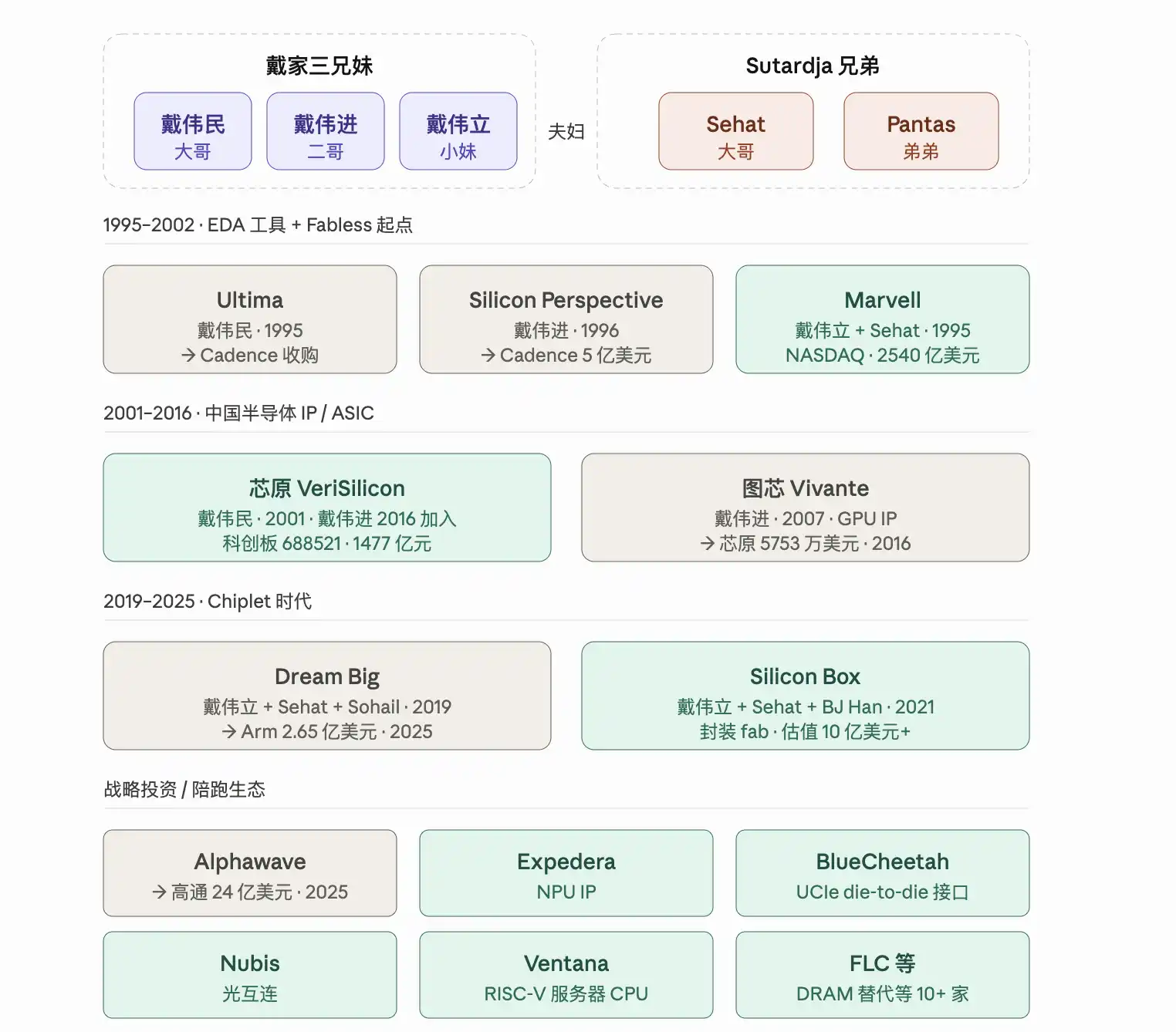
The Industrial Foundation Built by Two Families

The founding trio of Marvell in 1995 was Weili Dai, Sehat Sutardja, and Sehat's brother, Pantas Sutardja. Sehat was born in Jakarta, Indonesia, became a licensed radio technician at 13, and earned his Ph.D. in Electrical Engineering from Berkeley in 1988, where he met and married Weili Dai. Marvell was a product of the collaboration between the "Dai" and "Sutardja" families from day one, not just a husband-and-wife startup.

This advantage has amplified over the thirty years.

The Dai family has deep roots in China's semiconductor ecosystem. The eldest brother, Weimin Dai's VeriSilicon is a leading domestic IP provider. Its cooperation with SMIC and Huahong Grace can be traced back to the founding of SMIC. VeriSilicon's first 0.18-micron standard cell library for SMIC solved the IP export control issues SMIC faced at the time. The second brother, Weijin Dai, from Silicon Perspective to Vivante and back to VeriSilicon, layered networks in EDA, GPU IP, and IoT customers into China's local SoC ecosystem.

Looking at the Sutardja family, starting from the Marvell era, their engineering network extended to Southeast Asia and Europe. In 2021, when Weili Dai and Sehat co-founded Silicon Box in Singapore with Han Byung Joon, the company crossed the unicorn threshold by early 2024. It has a roughly $2 billion advanced semiconductor packaging factory in Tampines, Singapore, and is building a $3.6 billion new factory in Italy. Behind these factories lie industrial policy alignments with Singapore's Economic Development Board and the Italian government. This capacity-scheduling capability across East Asia and Europe is something the Dai family's connections in mainland China alone couldn't unlock.

More significant is the combined investment portfolio of the "Dai + Sutardja" families. Focusing on the chiplet ecosystem, there are at least 15 publicly traceable companies they have invested in or co-founded: Alphawave (high-speed SerDes interconnect IP, acquired by Qualcomm for $2.4 billion in December 2025); Expedera (NPU IP); BlueCheetah (UCIe die interface IP); Nubis (optical interconnect); Ventana (RISC-V server CPUs); FLC (DRAM alternative solutions). These companies, along with the previously mentioned VeriSilicon, Vivante, Dream Big, and Silicon Box, cover nearly every layer needed for the chiplet era: semiconductor IP, interconnect standards, packaging fabs, specialized compute chips. The two families have jointly built an entire industrial foundation for the post-Moore era.

Replicating Marvell's Rise Logic

What is the logic behind Marvell's current surge?

Over the past year, the bottlenecks in AI data centers have been quietly shifting. GPU compute shortages were the story of 2023-2024. By the second half of 2025, as hyper-scale training and inference ramped up, the real bottlenecks became three things: custom ASICs (allowing customers to not constantly buy NVIDIA's general-purpose GPUs), high-speed interconnect between chips, and the advanced packaging capability to pack these into the same package.

Marvell is positioned on the first two. Making custom ASICs like TPUs for Google and Amazon, and using optical communication chips for high-speed transmission. This is the real reason for its 265% rise over the year, and the real reason NVIDIA invested $2 billion in Marvell in March. Jensen Huang himself needs this interconnect thread.

Overlay the same map with the "Dai + Sutardja Family" marker, and the picture changes completely.

Dream Big bets on chiplet platforms and AI SuperNICs (800 Gbps bandwidth for lateral GPU interconnect). When Arm announced the $265 million cash acquisition in October 2025, Arm's intention was clear: to upgrade from selling CPU IP to becoming a "full-stack data center architect," mirroring NVIDIA's 2019 $6.9 billion acquisition of Mellanox.

Alphawave bets on high-speed SerDes interconnect IP, listed in London. On December 18, 2025, Qualcomm completed its $2.4 billion acquisition. The Dai+Sutardja family is Alphawave's second-largest shareholder, with Weili Dai cashing out approximately $237 million from the deal.

VeriSilicon in China operates on "IP + one-stop ASIC customization," similar to what Marvell does in the US, but with a customer structure of Chinese AI chip buyers like Alibaba, ByteDance, and Cambricon. AI compute accounted for 73% of new orders in 2025, and 91% of the 8.24 billion RMB new orders signed in the first four months of 2026. Its market cap is around 147.7 billion RMB ($20.5 billion), about 8% of Marvell's size, but with a steeper growth curve.

Silicon Box bets on chiplet advanced packaging fabs. Its valuation crossed the $1 billion threshold in early 2024. This company doesn't plan to IPO or sell, representing the heaviest piece on the board for the Dai+Sutardja families in the critical AI infrastructure capacity layer.

Additionally, there are over 10 invested/incubated companies like Expedera (NPU IP), BlueCheetah (UCIe die interface IP), Nubis (optical interconnect), Ventana (RISC-V server CPU), FLC (DRAM alternative). Each precisely occupies a position within the previously mentioned "three AI data center bottlenecks."

Adding these assets together, a conservative estimate places the scale of assets directly related to the two families in this AI wave at over $22 billion. This number won't appear on any list because it's dispersed across five jurisdictions, four company types, and over a dozen companies, but it exists.

From the perspective of a family industrial portfolio, the two families have placed at least six independent bets in this AI data center wave, each highly overlapping with the current logic driving Marvell's rise. Marvell is their loudest brand, but far from their only ticket in this round.

The Third Path: Key Components at Standard Transition Points

Currently, there are two mainstream narratives in the AI semiconductor industry.

One is platform-type giants reaping the benefits. NVIDIA sells GPUs + the CUDA ecosystem; Broadcom and Marvell sell custom ASICs + interconnect. This is the track for players with market caps above $150 billion.

The other is independent ASIC startups aiming for IPO. Companies like Tenstorrent, Cerebras, Groq, Etched bypass NVIDIA, focusing on acceleration for specific scenarios, betting on establishing a pole independent of GPUs.

The Dai+Sutardja families have taken a third path: creating key components for open standards, building their own packaging fabs, waiting for acquisition by giants, or becoming the domestic IP leader themselves. This path makes particular sense in the chiplet era because chiplets themselves are the antithesis of closed vertical integration. As long as standards are open, key IP + packaging capacity become scarce commodities, offering a much shorter path than independently building entire ASICs and aiming for IPO.

But the trade-off is clear. This path is destined not to produce the next NVIDIA. It allows founders multiple graceful exits and long-term retention of influence within the industrial ecosystem, but it won't place anyone on the final podium of AI infrastructure.

When Weili Dai and her husband founded Marvell in a Silicon Valley living room in 1995, the company was little-known. Today, Marvell is a $254 billion AI data center star. Although Weili Dai had exited most of her equity from thirty years ago at various points, simultaneously, she and her family still hold stakes in VeriSilicon, Silicon Box, cash from the Alphawave sale, cash from Dream Big's sale to Arm, and equity in over a dozen chiplet ecosystem companies.

Marvell was her most resounding victory, but not her only one, and likely not her last.

Crypto di tendenza

Domande pertinenti

QWhat was the direct catalyst for Marvell's single-day surge of 32.5% to a record high on June 2nd?

AThe direct catalyst was Nvidia CEO Jensen Huang's endorsement at Computex, where he highlighted Marvell's custom ASICs and optical interconnects as 'the core of AI data center architecture'.

QWhat is the core business model of the Chinese company VeriSilicon (芯原股份) founded by Dai Weimin?

AVeriSilicon's core business model is 'IP licensing + one-stop custom chip design'. It acts as an ammunition supplier by providing semi-finished products and IP to China's burgeoning SoC design companies.

QWhat are the three key bottlenecks in AI data centers that have emerged in the second half of 2025, according to the article?

AThe three key bottlenecks are: 1) Custom ASICs (to reduce reliance on Nvidia's general-purpose GPUs), 2) High-speed interconnects between chips, and 3) Advanced packaging capabilities to integrate these components.

QDescribe the third strategic path the Dai+Sutardja family has taken in the AI semiconductor industry, distinct from the two mainstream narratives.

AThe third path involves focusing on critical components for open standards (e.g., IP for interconnects, NPUs) and building key manufacturing capacity like advanced packaging fabs (Silicon Box). This strategy relies on acquisition by larger players or achieving leadership in a niche market (like IP in China), rather than building the next full-stack platform like Nvidia or an independent ASIC startup aiming for an IPO.

QWhat is the estimated total asset size related to the current AI wave that the Dai and Sutardja families hold across their portfolio, as per the article?

AThe article provides a conservative estimate that the two families' directly related asset portfolio in this AI wave exceeds $22 billion.

Letture associate

Podcast Notes | Conversation with GSR Asset Management Head: To Determine if This Crypto Rally is Real, Just Watch the Lending Rates on Aave

Podcast Summary: Dialogue with GSR's Head of Asset Management: To Determine if This Crypto Rally is Real, Just Check Lending Rates on Aave Andy Baehr, Managing Director of Asset Management at GSR, discusses the current crypto market, characterizing it as stuck in a state of "ambivalence" with short-lived, unsustainable rallies. He outlines a simple framework: the market moves between "ambivalence" and "conviction" (sustained upward momentum). Currently, every rally resembles a single-stage rocket booster that quickly fizzles out. Baehr identifies three key signals to watch: 1) DeFi lending rates, 2) the potential passage of the CLARITY Act, and 3) the market forming a consensus on the "Fed hawkish peak." He emphasizes that the most immediate indicator for the sustainability of the recent CPI-triggered rally is the USDC borrowing rate on Aave, currently around 3.75%—close to U.S. Treasury yields. The absence of a credit spread indicates low leverage demand and a lack of market energy. He explains that a healthy, sustained rally requires layered buying pressure. Last year's rally progressed from an ETH short squeeze to crypto-native trader influx and finally to ETF inflows. Currently, this structure is missing. Other potential structural buyers like Digital Asset Treasury (DAT) companies are absent, and ETF flows have proven transient. Baehr notes that while small-cap crypto tokens outperformed large caps in Q2—a potential sign of capitation in major assets—capital is also flowing to more exciting opportunities like AI stocks and tech IPOs, leaving crypto sidelined. Regarding DeFi, he highlights that platforms like Aave provide a clear, real-time signal of leverage demand through their supply/demand-driven interest rates. A significant, sustained rate increase would signal genuine market conviction. He also observes the quiet emergence of fixed-income-like products and vaults in DeFi. On regulation, the probability of the CLARITY Act passing before the August 7th deadline has dropped linearly from 75% to below 40% on Polymarket. Baehr suggests its passage would be treated as a bullish surprise, a potent driver for price movement. However, political hurdles, including ethical clause debates and disclosures about the First Family's crypto profits, remain significant obstacles. Ultimately, the market awaits clarity on the Fed's terminal rate under Chair Warsh. Until the "Fed Solstice"—the point where the market collectively understands the peak of hawkish policy—sustained conviction will be difficult to achieve.

marsbit8 min fa

Podcast Notes | Conversation with GSR Asset Management Head: To Determine if This Crypto Rally is Real, Just Watch the Lending Rates on Aave

marsbit8 min fa

7 Months After the Collapse of Huiwang, Southeast Asia's Escrow Platforms Undergo a Major Reshuffle

Following the collapse of Huione Pay—dubbed the "Alipay of Southeast Asia"—seven months ago, the region's underground financial guarantee platform sector is undergoing a significant reshuffle. This power vacuum has been swiftly filled by emerging platforms such as XinBi, Tiger/Navigator, JinBei (renamed JinBo), Dali/Tiancheng, and FullyLight. These platforms, operating largely via Telegram and offering services like escrow for illicit transactions, have absorbed the vast user base and markets left behind by Huione. While positioning themselves as "trust intermediaries," their primary clientele consists of networks involved in online scams, money laundering, illegal gambling, and even human trafficking. For instance, the Tiger/Navigator platform explicitly provides "escrow" services for kidnapping-for-ransom operations ("强押车交易"). Data underscores the immense scale: Huione alone processed over $103 billion in cryptocurrency payments and facilitated over $31 billion through its escrow market before its downfall, linking it to Cambodia's notorious Prince Group. Since its collapse, competitors have seen explosive growth. For example, the XinBi platform has accumulated over $1.6 billion in total USDT revenue, while platforms like NewPay, OkPay (under Dali), and FullyLight Wallet collectively processed over $4.8 billion in USDT in a single year. This ecosystem thrives in regions like Cambodia and Myanmar, where regulatory gaps allow these platforms to act as critical financial infrastructure for sprawling cybercrime industries, from scam compounds to online casinos. The article concludes that the moniker "Southeast Asian Alipay" is a misnomer, obscuring the platforms' fundamental role in enabling serious criminal enterprises rather than representing legitimate financial innovation.

Odaily星球日报1 h fa

7 Months After the Collapse of Huiwang, Southeast Asia's Escrow Platforms Undergo a Major Reshuffle

Odaily星球日报1 h fa

The Changing Landscape: What Are Crypto VCs Experiencing?

Title: The Shifting Landscape of Crypto Venture Capital The era of dedicated crypto venture capital funds is undergoing a significant transformation. Once essential for navigating the sector's complexity and high risk, these specialized funds are now facing an identity crisis as the market matures. This shift mirrors historical patterns in other specialized investment classes like cleantech and SPACs, where initial information advantages dissipate as technologies become mainstream and integrated into existing industry frameworks. The article argues that crypto is reaching a critical inflection point, transitioning from a "building phase" to an "integration phase." Major players like Stripe, BlackRock, and Visa now engage with crypto not for its novel mechanics but as a foundational financial infrastructure. Their needs—regulatory compliance, banking partnerships, distribution channels—align with traditional fintech, a domain easily understood by large, generalist funds like Sequoia and Founders Fund. This evolution creates a "barbell effect" within the VC landscape. On one end are massive, diversified platforms that can incorporate crypto as one vertical among many. On the other are small, nimble funds focused on niche, experimental projects. The middle ground—medium-sized dedicated crypto funds—is being squeezed out. Their typical fund size makes it impossible to generate sufficient returns solely from early-stage crypto bets, yet they cannot compete with giants for later-stage deals. Consequently, leading crypto-native firms like Paradigm and Framework Ventures are expanding into AI, robotics, and other sectors, driven partly by LP pressure for better returns amid a broader VC DPI crisis. Others, like Dragonfly and a16z, have narrowed their crypto focus predominantly to financial infrastructure like stablecoins, reframing the sector's core narrative. For crypto entrepreneurs, this consolidation presents challenges. While generalist funds offer larger checks and broader resources, crypto projects now compete fiercely with AI for attention and capital within these firms. Furthermore, the long-term, non-commercial foundational work that built the ecosystem—funded by dedicated crypto VCs—is less likely to attract generalist capital focused on direct returns. The conclusion is that "crypto investor" as a standalone category is becoming obsolete, akin to "internet investor." Crypto is becoming a baseline infrastructure layer. The future will see a barbell structure: large-scale growth financing handled by generalist funds, while pioneering, speculative projects are funded by small, specialized vehicles. The dedicated crypto funds of the 2017-2021 boom, which incubated core infrastructure, are giving way to this new, bifurcated reality.

Foresight News1 h fa

The Changing Landscape: What Are Crypto VCs Experiencing?

Foresight News1 h fa

Trading

Spot

Articoli Popolari

Come comprare CHIP

Benvenuto in HTX.com! Abbiamo reso l'acquisto di USD.AI (CHIP) semplice e conveniente. Segui la nostra guida passo passo per intraprendere il tuo viaggio nel mondo delle criptovalute.Step 1: Crea il tuo Account HTXUsa la tua email o numero di telefono per registrarti il tuo account gratuito su HTX. Vivi un'esperienza facile e sblocca tutte le funzionalità,Crea il mio accountStep 2: Vai in Acquista crypto e seleziona il tuo metodo di pagamentoCarta di credito/debito: utilizza la tua Visa o Mastercard per acquistare immediatamente USD.AICHIP.Bilancio: Usa i fondi dal bilancio del tuo account HTX per fare trading senza problemi.Terze parti: abbiamo aggiunto metodi di pagamento molto utilizzati come Google Pay e Apple Pay per maggiore comodità.P2P: Fai trading direttamente con altri utenti HTX.Over-the-Counter (OTC): Offriamo servizi su misura e tassi di cambio competitivi per i trader.Step 3: Conserva USD.AI (CHIP)Dopo aver acquistato USD.AI (CHIP), conserva nel tuo account HTX. In alternativa, puoi inviare tramite trasferimento blockchain o scambiare per altre criptovalute.Step 4: Scambia USD.AI (CHIP)Scambia facilmente USD.AI (CHIP) nel mercato spot di HTX. Accedi al tuo account, seleziona la tua coppia di trading, esegui le tue operazioni e monitora in tempo reale. Offriamo un'esperienza user-friendly sia per chi ha appena iniziato che per i trader più esperti.

328 Totale visualizzazioniPubblicato il 2026.04.21Aggiornato il 2026.06.02

Come comprare CHIP

Discussioni

Benvenuto nella Community HTX. Qui puoi rimanere informato sugli ultimi sviluppi della piattaforma e accedere ad approfondimenti esperti sul mercato. Le opinioni degli utenti sul prezzo di CHIP CHIP sono presentate come di seguito.

活动图片













